
Batteries power much of our daily life, from keeping a child’s toy running to ensuring a professional tool delivers consistent performance. The global alkaline battery market is valued at over $10 billion. Within that, C battery and D battery remain two of the most commonly used types in households and industries alike.
At first glance, the C battery and the D battery seem quite similar: both are cylindrical cells, and both typically provide a 1.5 V output in their alkaline form. However, when you look closer at C battery vs D battery, the differences in size, capacity, and usage become clear.
The C LR14 battery is designed for medium-drain devices such as radios, toys, and mid-size flashlights, while the D cell is built for heavy-duty, long-runtime applications like lanterns, boomboxes, and industrial tools.
Modern users also have the option of rechargeable C batteries and rechargeable D batteries, which provide around 1.2 V nominal voltage and can be recharged hundreds of times, making them a sustainable and cost-effective alternative.
Whether you’re focused on portability with a C battery or maximum endurance with a D battery, understanding these differences ensures you get the most out of your devices.
In this guide, we’ll explore the C Battery vs D Battery. We will talk about their specifications, chemistry options, and real-world use cases.
By the end, you’ll know exactly when to choose a C LR14 battery and when to opt for a D battery, whether alkaline or rechargeable, and how factors like D battery voltage and capacity affect performance.
What is a C Battery?
A C battery, often labeled as the C LR14 battery, is a medium-sized cylindrical cell commonly found in toys, radios, handheld instruments, and mid-size flashlights. It’s designed for situations where AA batteries don’t provide enough stamina, but a bulkier D cell would be overkill.

Physically, a C battery measures about 26.2 mm in diameter and 50.0 mm in height, making it compact enough for portable devices while still packing significantly more energy than AA cells.
In terms of output, a C battery delivers 1.5 V in its alkaline form—the same as AA or D batteries—but because of its smaller volume, it stores less energy than a D cell.
For reliable C batteries that deliver consistent performance across temperature ranges, Flywing-Tech’s FDK LR14 F series offers Japanese manufacturing quality with competitive pricing for both single units and volume applications.
Types of C Battery
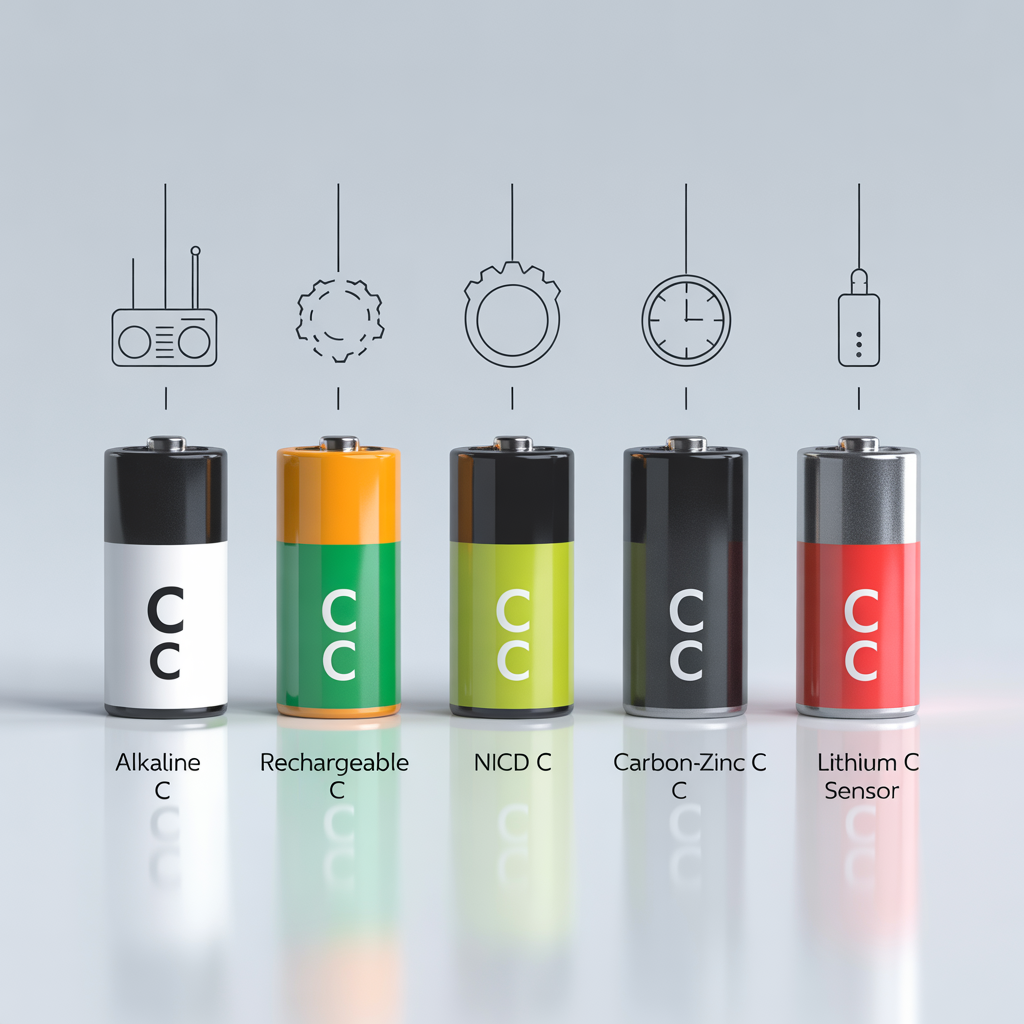
C batteries are produced in several chemistries, each tailored to different applications:
-
Alkaline C (LR14): The most common type, delivering 1.5 V and around 6,000–8,000 mAh. Ideal for radios, toys, and mid-sized flashlights where long shelf life and steady power matter.
-
Rechargeable C batteries (NiMH, HR14): Provide about 1.2 V and 4,000–6,000 mAh, with the advantage of being reused hundreds of times. Perfect for devices used frequently, such as LED flashlights or toys.
-
NiCd C batteries (KR14): Less common today but valued in industrial or emergency lighting setups for their durability and ability to withstand rugged conditions, despite lower capacity (2,000–3,000 mAh).
-
Carbon-zinc C (R14): An older type offering only 3,000–4,000 mAh, best for low-drain devices like clocks or simple toys.
-
Lithium C cells (ER26500): Specialized batteries with 3.6 V and up to 9,000 mAh, used in industrial gear, sensors, and backup systems where long life and temperature tolerance are essential.
C battery Key Specifications
In the world of cylindrical cells, the C battery (IEC LR14 for alkaline, HR14 for NiMH) sits in the sweet spot between AA/AAA convenience and D-cell endurance.
Here’s a practical specification sheet of C battery;
| Feature | C Battery (Alkaline – LR14) | C Battery (Rechargeable – NiMH/HR14) | What it means in practice |
| Size (Ø × H) | 26.2 × 50.0 mm | 26.2 × 50.0 mm | Same physical fit across chemistries; easy drop-in replacement if device allows rechargeables. |
| Nominal Voltage | 1.5 V | 1.2 V | Voltage is chemistry-specific; most devices tolerate either if specified. |
| Typical Capacity | 6,000–8,000 mAh | 4,000–6,000 mAh | Alkaline wins on single-use runtime; NiMH wins on total cost over many cycles. |
| Weight | ~65–70 g | ~65–75 g | Heavier than AA, far lighter than D—good portability/runtime balance. |
| Internal Resistance | Low–moderate | Low | NiMH handles higher currents and maintains voltage better under load. |
| Shelf Life | 5–10 years | Low-self-discharge: 1–3 years to 70–85% | Alkaline is great for emergency kits; LSD-NiMH is reliable for standby devices. |
| Operating Temp (discharge) | ~–18 to +55 °C | ~–20 to +50 °C | Cold reduces available capacity for any chemistry; lithium C (rarer) does better in extreme cold. |
| IEC / ANSI | LR14 / 14A (alkaline) | HR14 (NiMH) | Label variations you’ll see on datasheets and packaging. |
Features and Capabilities of the C Battery
The C battery is often described as the middle ground of cylindrical cells. It is stronger and longer-lasting than an AA, yet lighter and more compact than the bulkier D battery.
This balance of size, capacity, and versatility makes it a reliable choice for devices that need steady, moderate power without unnecessary bulk.
Whether it’s radios, toys, mid-sized flashlights, or handheld instruments, the C LR14 battery is built to keep things running smoothly while staying portable. Here is what makes it such a practical workhorse:
Capacity
A quality alkaline C battery typically provides 6,000–8,000 mAh (6–8 Ah) of charge. That is enough to power small currents for long durations or handle moderate drains for a decent runtime.
Older zinc-carbon R14 batteries, which offered just 3,000–4,000 mAh, are now rarely used.
Rechargeable C batteries, such as NiMH HR14, generally offer 4,000–6,000 mAh, making them suitable for high-use devices where recharging offsets the slightly lower capacity per cycle.
Weight
An alkaline C cell usually weighs about 65–70 grams. The weight reflects the amount of active chemical material inside. More weight in similar chemistries usually means more stored energy.
Compared to a D cell, it is much lighter, making it ideal when portability matters.
Compact Stamina
Think of the C battery as compact stamina on demand. It delivers enough capacity to keep medium-drain devices such as portable radios, toys, or mid-sized flashlights running longer without the extra heft of D batteries.
Chemistry Flexibility
C batteries are available in a range of chemistries:
-
Alkaline C (LR14): Single-use, long shelf life, and great for everyday use.
-
Rechargeable C batteries (NiMH, HR14): Eco-friendly, handle high currents well, and can be recharged hundreds of times.
This flexibility allows users to choose between disposable convenience and long-term cost savings.
Good Current Handling
Especially in their NiMH form, C batteries handle higher current demands comfortably, maintaining steady performance in devices like LED flashlights or motorized toys.
Their ability to tolerate frequent recharge cycles makes them a cost-effective solution for heavy use.
Straightforward Series Packs
Many devices are designed to use multiple C batteries in series, commonly 2×C or 3×C, to produce higher voltages (3.0–4.5 V for alkaline, 2.4–3.6 V for NiMH).
This makes them easy to design with, simple to replace, and highly practical in everyday electronics.
What is a D Battery?
The D battery, known as LR20 in its alkaline form, is one of the largest and most powerful cylindrical batteries in consumer electronics. Often called the heavyweight of the battery family, it stands out both for its size and for the energy it can deliver.

A standard D cell measures about 34.2 mm in diameter and 61.5 mm in height, making it noticeably thicker and slightly taller than a C battery.
This larger size provides more than twice the internal volume of a C cell, which directly translates to much longer runtimes.
In terms of output, the D battery voltage is the same as other cylindrical cells: around 1.5 V for alkaline versions and 1.2 V for rechargeable NiMH models. The key difference lies in capacity—D batteries simply hold and deliver much more energy.
Because of this, D batteries are widely used in applications that demand steady, long-lasting power. From emergency lanterns and heavy-duty flashlights to boomboxes, industrial tools, and safety equipment, the D battery is built for endurance.
Flywing-Tech’s FDK LR20 F D batteries combine the reliability of Japanese manufacturing with the high capacity performance that D-cell applications demand.
Types of D Battery
D batteries are available in several chemistries, each designed for specific needs:

-
Alkaline D (LR20): The most common type, delivering 1.5 V and 12,000–18,000 mAh. With a shelf life of up to 10 years, these are ideal for radios, flashlights, and emergency gear.
-
Rechargeable D NiMH (HR20): Provide 1.2 V and 8,000–10,000 mAh. Perfect for high-drain devices like portable speakers, boomboxes, and industrial electronics, with the benefit of hundreds of recharge cycles.
-
NiCd D (KR20): Offer 2,500–4,000 mAh and are valued in industrial settings for their durability and ability to withstand deep discharge cycles, despite lower capacity.
-
Carbon-zinc D (R20): Budget-friendly with 6,000–8,000 mAh, suited for low-drain devices such as clocks or simple electronics.
-
Lithium D (ER34615): Specialized cells with 3.6 V and up to 19,000 mAh, used in professional-grade applications like medical equipment, remote monitoring, and backup power systems.
In short, the D battery delivers unmatched endurance compared to smaller cells. Whether disposable or rechargeable, it’s the clear choice for devices where power, reliability, and runtime cannot be compromised.
Key Specifications: D Battery (LR20 / HR20)
The D battery known as LR20 for alkaline and HR20 for rechargeable NiMH is the heavyweight of common cylindrical cells. With a much larger volume than C batteries, it delivers higher capacity and longer runtime, making it a staple in high-drain and endurance-critical devices.
| Feature | D Battery (Alkaline – LR20) | D Battery (Rechargeable – NiMH/HR20) | What it means in practice |
| Size (Diameter × Height) | 34.2 × 61.5 mm | 34.2 × 61.5 mm | Significantly larger than a C cell; more active material means much longer runtime. |
| Nominal Voltage | 1.5 V | 1.2 V | Same voltage range as C cells—devices designed for D expect extended performance, not higher voltage. |
| Typical Capacity | 12,000–18,000 mAh | 8,000–10,000 mAh | Delivers 2× or more the runtime of C cells; rechargeables offer solid high-drain performance. |
| Weight | 130–160 g | 140–165 g | Heavier but energy-dense; ideal for devices where endurance matters more than portability. |
| Shelf Life | 5–10 years | 1–3 years (low-self-discharge NiMH) | Alkaline suits emergency kits; LSD-NiMH is dependable for frequent reuse. |
| IEC/ANSI Codes | LR20 / 13A | HR20 | Common standards for identification and datasheets. |
C vs D Battery: Side-by-Side Comparison
Now that we’ve explored C batteries and D batteries individually, it’s time to see how they really stack up against each other. At first glance, they seem similar—both are cylindrical cells that typically provide 1.5 V in their alkaline form or 1.2 V in rechargeable NiMH/NiCd versions.
You’ll often find them sitting next to each other on store shelves, but once put into use, the performance gap becomes clear.
| Parameter | C Battery (LR14) | D Battery (LR20) |
|---|---|---|
| Size (Diameter × Height) | 26.2 × 50.0 mm (≈1.03″ × 1.97″) | 34.2 × 61.5 mm (≈1.35″ × 2.42″) |
| Weight (Alkaline) | ~70 g | ~130 g |
| Nominal Voltage (Alkaline) | 1.5 V | 1.5 V |
| Nominal Voltage (Rechargeable) | 1.2 V (NiMH/NiCd) | 1.2 V (NiMH/NiCd) |
| Typical Capacity – Alkaline | ~6,000–8,000 mAh | ~12,000–18,000 mAh |
| Typical Capacity – Rechargeable | ~4,000–5,000 mAh | ~8,000–10,000 mAh |
| IEC Designation | R14 (zinc-carbon), LR14 (alkaline), HR14 (NiMH) | R20 (zinc-carbon), LR20 (alkaline), HR20 (NiMH) |
| ANSI/NEDA Code | 14A (alkaline), 14D (carbon-zinc) | 13A (alkaline), 13D (carbon-zinc) |
| Common Applications | Medium-drain devices: toys, mid-size flashlights, radios | High-drain & long-duration devices: lanterns, boomboxes, tools |
| Typical Configuration | Often 2–4 cells in series (e.g., 3×C = 4.5 V) | Often 2–6 cells in series (e.g., 4×D = 6 V lanterns) |
When it comes to size and energy storage, the D battery dwarfs the C battery. Both will power up a device with the same starting voltage, but the D cell offers 1.5 to 2.5 times the capacity of a C cell in the same chemistry.
That translates to about 12 Wh of energy in a C battery versus 22–27 Wh in a D battery.
In real-world use, this means a flashlight running on C batteries will work, but it won’t shine as long or as bright as one powered by D batteries. In other words, C batteries prioritize portability, while D batteries prioritize endurance.
When to Choose C Battery vs D Battery
Deciding between a C battery vs D battery is not just about size. It depends on the balance between power needs, portability, cost, and how long you expect the device to run.
Power Requirements
A D battery is the better option for equipment that draws continuous or peak current for long periods. Examples include emergency lanterns, boomboxes, and industrial-grade flashlights.
These applications benefit from the higher capacity of a D cell, often more than twice that of a C battery.
In contrast, the C LR14 battery is more suited for devices that consume moderate power, such as toys, small radios, and portable measuring tools.
These devices operate effectively with less energy, and using a D battery would only add unnecessary bulk.
Portability vs Runtime
If your priority is keeping the device light and easy to carry, C batteries are the practical choice.
Their smaller size makes them a good fit for handheld electronics or items meant to be moved around frequently.
On the other hand, if runtime is more important than weight, D batteries are unmatched.
A camping lantern powered by four D cells, for instance, can last several nights of continuous use, something that C batteries would struggle to match.
Cost Considerations
Although D batteries cost more upfront, they often prove more economical for high-drain or long-duration applications. Because of their higher capacity, you will replace them less often than C batteries.
For devices used daily, investing in rechargeable C or D batteries can be cost-effective. NiMH versions, which provide 1.2 V per cell, can be reused hundreds of times, reducing long-term expense and environmental waste.
Flywing-Tech supplies chargers that support both C and D sizes, allowing users to switch between battery types without buying multiple charging systems.
Shelf Life and Storage
Quality alkaline C and D batteries typically last five to ten years in storage, making them reliable for emergency kits.
Lithium primary cells in these sizes offer even longer shelf life, sometimes exceeding 15 years, and maintain performance in extreme heat or cold.
This makes lithium versions attractive for professional or outdoor use, such as backup power for medical equipment or remote monitoring systems.
Application Match
In practice, choose C batteries when you need moderate power in a portable form factor, and choose D batteries when endurance and reliability are critical.
Following the device manufacturer’s specifications remains the best approach, but understanding these distinctions helps ensure better performance and cost savings over time.
Applications and Use Cases
Understanding these real-world applications makes it easier to pick the right option—whether your priority is portability, endurance, or handling high current loads.
C Battery Applications
The C battery (LR14/HR14) is built for medium-drain devices, striking a practical balance between runtime and portability. It fills the gap where AA batteries drain too quickly and D cells feel unnecessarily bulky. Common applications include:
-
Portable Radios and Compact Boomboxes: Provide steady performance without adding too much weight.
-
Toys and Learning Devices: Deliver longer playtime, keeping motors, lights, and sound modules running smoothly.
-
Mid-Sized Flashlights: Ensure reliable brightness for daily tasks, especially when paired with rechargeable C batteries (NiMH HR14).
-
Handheld Instruments and Test Tools: Power devices such as label makers, multimeters, or small lab instruments.
-
Educational Kits: Widely used in STEM learning projects where size and runtime need to be balanced.
In short, C batteries excel when portability and moderate power are key. They are ideal for devices that are used often but don’t demand continuous heavy current.
D Battery Applications
The D battery (LR20/HR20) is the heavyweight of the family, designed for high-drain and long-duration applications. Its larger size translates directly into much greater energy storage, which is why it’s the preferred choice for power-hungry or mission-critical devices. Common applications include:
-
Camping Lanterns and Large Flashlights: Deliver bright, long-lasting light during extended outdoor or emergency use.
-
High-Power Audio Devices (Boomboxes): Handle heavy current draw without voltage drop, ensuring consistent sound quality.
-
Industrial Equipment: Power sensors, inspection tools, and data loggers that must run continuously.
-
Medical and Safety Devices: Provide dependable energy for alarms, beacons, and backup lighting where reliability cannot be compromised.
-
Emergency Kits: With a shelf life of up to 10 years, alkaline D cells are a trusted standby for disaster preparedness and safety gear.
When runtime, durability, and steady power delivery matter most, D batteries stand unmatched. They are the go-to choice for heavy-duty consumer devices as well as professional-grade applications.
Final Thoughts
Choosing between a C battery vs D battery is less about voltage and more about fit for purpose.
Both deliver familiar outputs—about 1.5 V for alkaline and 1.2 V for NiMH—but their size, capacity, and current handling set them apart.
If your goal is a lighter device that still runs reliably, the C LR14 battery is a smart, portable choice for medium-drain gear like toys, radios, and mid-size flashlights.
When the job calls for long runtime and steady performance under heavier loads, the D battery (LR20/HR20) is the dependable workhorse for lanterns, boomboxes, industrial tools, and safety equipment.
For routine use, rechargeable C and D batteries can cut total cost and waste while delivering consistent performance. For standby and emergency kits, alkaline variants shine with long shelf life.
The best results come from matching what your device draws with the battery’s strengths, then choosing the chemistry—alkaline or NiMH—that fits how often you use it.
If you’re still deciding, use this simple rule of thumb:
- Pick C for portability and moderate power.
- Pick D for endurance and high demand.
If you looking to buy C and D batteries, Flywing-Tech offers an extensive range of both C (LR14) and D (LR20) alkaline batteries through their partnership with FDK America, Inc., a member of the Fujitsu Group.
Their catalog includes 44 different C battery configurations and 22 D battery variations, covering single cells, battery packs, and custom voltage configurations.
Frequently Asked Questions (FAQs)
Q1. Do C and D batteries have the same voltage?
Yes. Both C batteries and D batteries provide about 1.5 V in their alkaline form and 1.2 V in rechargeable NiMH or NiCd versions. The difference lies in their size and capacity, not in voltage.
Q2. Why does a D battery last longer than a C battery?
A D battery is physically larger, which means it holds more active material. This translates into roughly 12,000–18,000 mAh for alkaline D batteries, compared to 6,000–8,000 mAh for alkaline C LR14 batteries. More capacity means more runtime.
Q3. Can I use a C battery instead of a D battery?
Not directly. Some adapters let you fit a C battery into a D battery slot, but performance will suffer because a C battery has far less capacity. Your device will work, but it won’t run as long.
Q4. Are rechargeable C and D batteries worth it?
Yes, if you use your devices frequently. Rechargeable C batteries (HR14) typically provide 4,000–6,000 mAh, while rechargeable D batteries (HR20) deliver 8,000–10,000 mAh. They can be recharged hundreds of times, saving money and reducing waste compared to disposables.
Q5. What devices typically use C batteries?
C batteries are common in portable radios, toys, mid-sized flashlights, educational kits, and handheld test tools. They’re best for medium-drain applications where AA batteries drain too fast but D cells feel unnecessarily bulky.
Q6. What devices typically use D batteries?
D batteries power camping lanterns, large flashlights, boomboxes, industrial equipment, medical devices, and emergency kits. They’re ideal for high-drain or mission-critical applications where long runtime is essential.
Q7. What is the shelf life of C battery vs D battery?
Quality alkaline C and D batteries last 5 to 10 years in storage. Lithium versions can last even longer, sometimes exceeding 15 years, and they perform better in extreme temperatures. Rechargeables (NiMH) hold charge for about 1–3 years depending on usage.
Q8. Why do both C and D batteries have the same voltage if they’re different sizes?
The chemistry determines voltage. Since alkaline and NiMH chemistries are the same across sizes, they all deliver similar voltage. The difference in size simply means more or less chemical material, which affects how long the battery lasts.
Q9. How much energy does each type actually store?
An alkaline C battery stores about 12 Wh, while a D battery can hold 22–27 Wh. That’s why a lantern running on D batteries lasts much longer than one powered by C cells.
Q10. Which is more cost-effective in the long run: C Battery vs D Battery?
It depends on the device. For moderate-drain and portable gadgets, C batteries are more practical. For heavy-use, long-runtime equipment, D batteries are more cost-effective because they last longer per charge. In both cases, rechargeable C or D batteries provide the best long-term savings.
