Wireless charging is shifting how we power our wearables, accessories, smartphones, and cars efficiently. Wireless charging technology has eliminated the need to cater to the tangled cable hustle for a quiet, safe charging experience. For instance, it is also becoming increasingly fast without worrying about keeping the specific charger for each device.
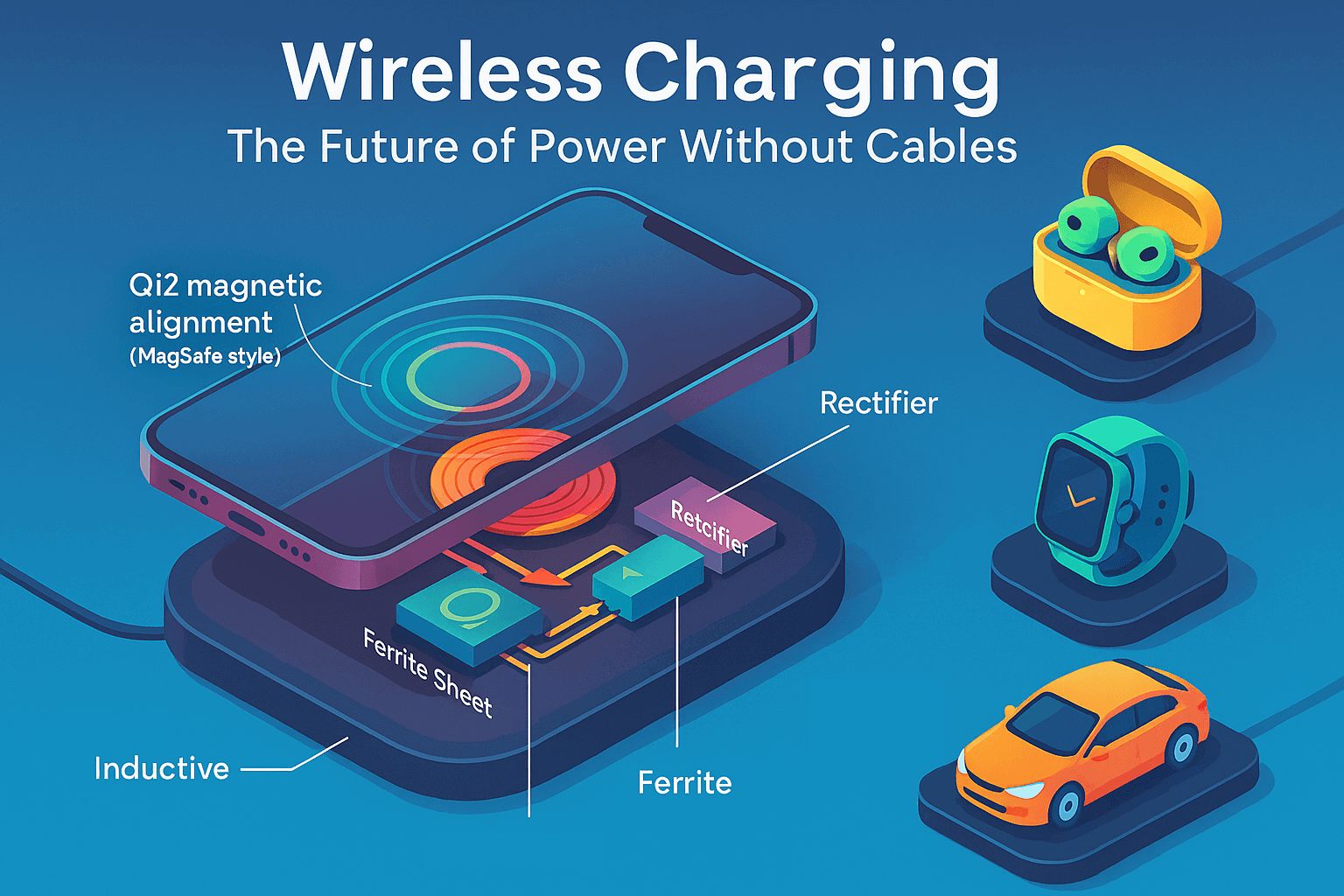
In this article, we’ll explore the wireless charging landscape, including the origin of wireless power delivery and the functional mechanisms of resonant and inductive systems. We’ll see how Qi / Qi2 and MagSafe standards raised the bar on pad alignment and efficiency. Finally, we’ll see what technology translates to for iPhone, Samsung, and Android users, in wireless charging pads and stands products. Further, we’ll take a peek into the future of wireless charging from desktop mats to cars.
From Nikola Tesla to Qi Standards
The wireless charging concepts are surprisingly old enough to be noticed by the generation raised on the internet, smartphones, and the AI era. Nikola Tesla demonstrated wireless energy transfer experiments using magnetic fields and resonant coupling in the 1890s. Standing on the shoulders of giants, modern power transfer systems refine the same core physics of electromagnetic induction and magnetic resonance. Additionally, it adds the benefits of advanced and efficient power electronics, closed-loop control, and safety layers.
Today, the Wireless Power Consortium (WPC) curates the Qi and Qi2 standards used by most smartphones. Qi2 standard adds a magnetic attachment, which effectively boosts the real-world wireless power transfer efficiency. The Qi2 standard brings standardized 15W wireless charging with magnetic alignment for supported devices, including iPhones that can use a wireless iPhone charger or wireless charging stand. A newer Qi2 25W standard (launched in 2025) offers faster charging on compatible devices. While these wireless charger options work with various Qi2-enabled products, it’s important to note that Apple AirPods 3rd generation support standard Qi and MagSafe wireless charging, but were released before the Qi2 standard.
Early Applications of Wireless Power Delivery
Wireless charging first powered electric toothbrushes and biomedical implants. In fact, it also charged industrial tools where sealed interfaces were critical. These early systems paved the way for durable, and contactless interfaces for device charging systems.
Modern Resurgence of Wireless Power
Smartphone growth made wireless charging mainstream. Standards groups like WPC (Qi/Qi2) and AirFuel Alliance (Resonant) set international standards. This ensured that chargers and devices could work together. The magnetic resonance (AirFuel Resonant) focuses on wide spatial freedom and multi-device charging surfaces, whereas the Qi2 standard focuses on magnetic alignment (between transmitter and receiver coils) and tight coupling for efficient, phone-centric pads.
What Is Wireless Charging and How Does It Work?
At its core, wireless charging uses an actively driven transmitter coil (TX) operating at a specific resonant frequency to generate a magnetic flux field. A corresponding receiver coil (RX) (installed in a smartphone or EV) positioned within this field experiences electromagnetic induction. Simultaneously, the alternating magnetic flux induces an electromotive force (EMF) across the coil terminals. This induced AC voltage is subsequently rectified and regulated to produce a DC output needed for the device’s battery management system (BMS) and charging circuitry.
The Science of Wireless Charging: Inductive vs Resonant
Wireless power transfer is built on electromagnetic induction principles. Modern implementations of these principles have evolved into two primary approaches:
- Inductive charging for close-range and high-efficiency power delivery, and
- Resonant charging for greater spatial flexibility.
Each method has unique trade-offs. These include efficiency, charging distance, and system complexity.
Inductive Charging Explained
Inductive charging uses near-field magnetic coupling between two coils placed closely. An alternating current in the transmitter coil generates a time-varying magnetic field that induces voltage in the receiver coil through electromagnetic induction. This energy transfer works effectively over distances of a few millimeters, making coil alignment critical for power transfer efficiency.
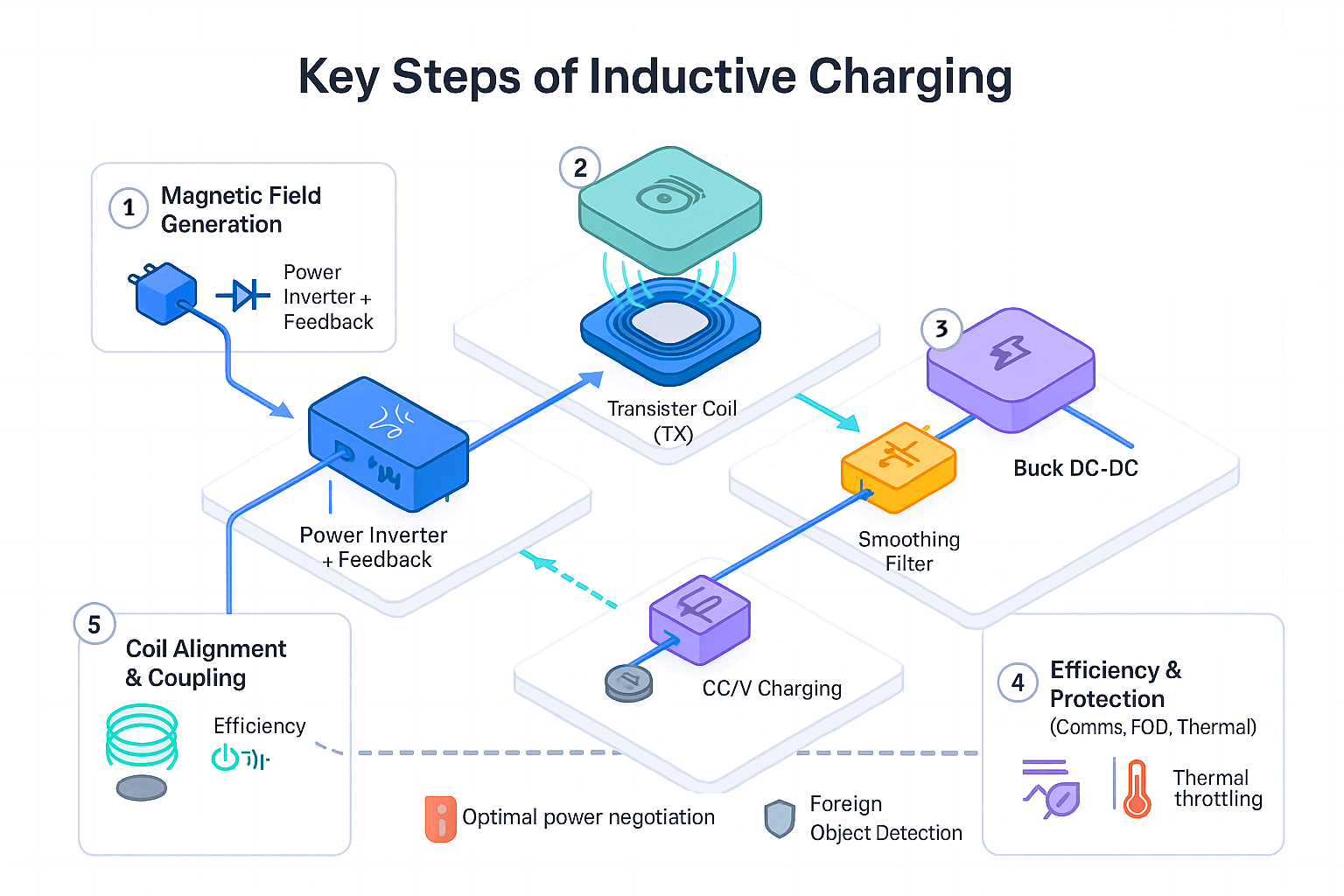
For wireless inductive charging, there are usually 5 steps involved:
- Magnetic Field Generation: A transmitter coil (TX), driven by a power inverter with feedback control, generates an alternating magnetic field that transfers energy wirelessly to the receiver.
- Coil Alignment and Coupling: Magnetic alignment systems (e.g., Qi2/MagSafe) ensure optimal coil positioning, maximizing coupling efficiency and minimizing power losses during transmission.
- AC-DC Rectification: The AC voltage induced in the receiver coil (RX) is converted to DC through a full-bridge rectifier and smoothing filter, creating a stable voltage for downstream charging circuits.
- Battery Charge Management: A DC-DC converter stage (buck topology) regulates the output current and voltage to safely match the battery’s charging profile and state of charge.
- Efficiency Optimization: Communication protocols enable optimal power levels while Foreign Object Detection (FOD) and thermal monitoring systems protect against metallic interference and overheating conditions.
Modern and advanced standards like Qi and Qi2 use magnetic positioning to ensure optimal alignment. These systems typically operate at 100-205 kHz and deliver power ranging from 5W for standard charging to 15W or higher for fast-charging applications.
Resonant Charging
Resonant charging builds on inductive principles by tuning both transmitter and receiver circuits to the same resonant frequency using LC circuits. This resonance creates a more efficient energy coupling that works over larger distances and tolerates greater misalignment. The main advantages are improved spatial freedom and the ability to charge multiple devices simultaneously. However, resonant systems require more complex tuning and control electronics to maintain efficiency across different loading conditions and device positions.

Key Components of a Wireless Charging System
A wireless charging system consists of two major integrated components that collectively make electromagnetic power transfer possible: the transmitter unit (charging pad) that generates the magnetic field, and the receiver module embedded within the device that captures and converts this energy. Supporting electronics, sensors, and communication interfaces ensures these subsystems operate safely and efficiently under varying conditions.
Wireless Charging – Transmitter
A transmitter unit (TX) has several components working together. The power source converts AC into usable DC voltage, which drives the transmitting coil. This coil is a wound copper conductor that generates the alternating magnetic field. A compensation network of capacitors tunes the circuit to its optimal operating frequency for efficient power transfer. Behind the coil, a ferrite backing layer acts as magnetic shielding, directing the field toward the receiver while preventing energy loss into surrounding objects.
A dedicated IC in the transmitter base manages the entire charging process by implementing protocol requirements for standards like Qi, Qi2, or resonant systems. This chip continuously monitors power delivery, responds to feedback from the receiver, and adjusts operating parameters in real-time. Brands like Belkin, Anker, and Samsung use these components in compact pads or stands. Magnetic assemblies balance charging speed, efficiency, and safety.
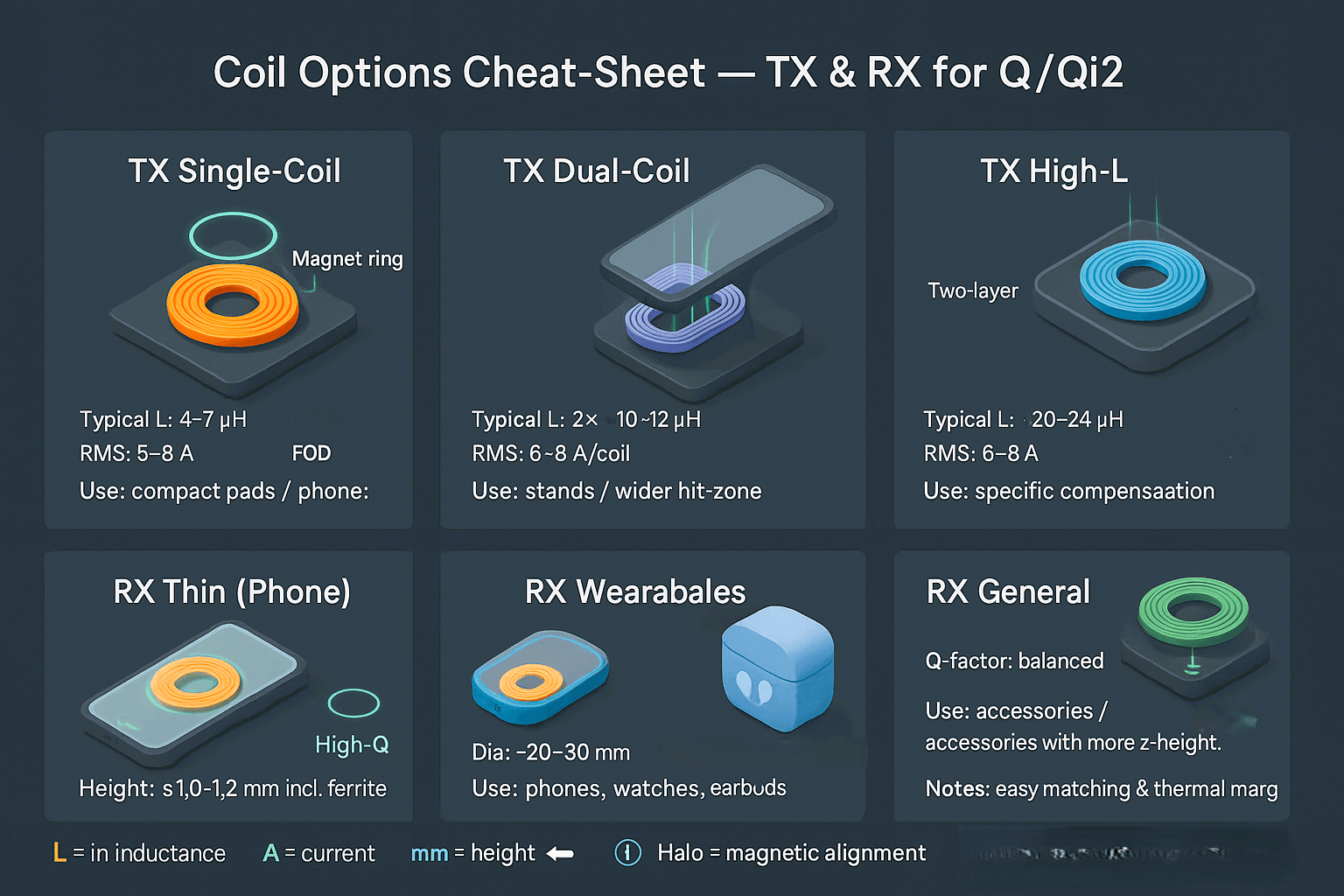
If you’d like to build your own pad, start by selecting a TX coil that hits your inductance/current targets. You can choose Würth Elektronik 760308101302 TX coil with ~5.3 µH inductance, and 8 A current for compact pads.
On higher-power or multi-device surfaces, you can use see 2-coil or arrayed TX structures for which you can use Würth Elektronik 760308104119 with TX 2-coil, and approximately 12 µH and 11.5 µH inductances, and 8 A current supporting more spatial coverage.
Wireless Chagring – Receiver
The receiver module in smartphones and other devices contains a receiving coil (RX) that captures the magnetic field and converts it into AC voltage through electromagnetic induction. A rectifier circuit converts the AC into DC power. A communication front-end exchanges data on power requirements and charging status with the transmitter.
A DC-DC converter stage regulates the output to match the battery’s specific charging profile, ensuring safe current and voltage levels. These integrated components work together to deliver reliable power while protecting the battery from overcharging and thermal issues.
Similar to a custom TX setup, you can use your own RX setup. For that, you can use TDK WR222230-26M8-G, a compact coil with established vendor models for EM simulation and thermal planning. Likewise, you can use Würth Elektronik 760308102308 (WE-WPCC series), which is a popular RX coil family with detailed characterization, simplifying matching, and thermal prediction
Supporting Components
Transmitter-receiver system efficiency depends on several key factors. Coil alignment determines how much magnetic field the receiver captures. Misalignment significantly reduces power transfer.
The Q-factor measures how well coils store magnetic energy; higher values mean lower resistive losses.
Compensation networks tune the system to resonance. This allows for maximum power transfer. Rectifiers and DC-DC converters add losses via voltage conversion and regulation.
Modern standards incorporate critical safety features. Foreign Object Detection (FOD) algorithms monitor for metallic objects like keys or coins between the charger and device, immediately stopping power to prevent dangerous heating. Thermal monitoring limits power transfer if temperature thresholds are exceeded. Qi v1.3 enhanced FOD sensitivity to reduce false positives where legitimate devices are incorrectly flagged while maintaining robust protection against actual hazards.
Wireless vs Wired Charging
Wireless and wired charging are not exactly an apples-to-apples comparison since they solve two different problems. Wired (USB-C PD) still wins when you want fast speed and high-power transfer efficiency. Wireless, on the other hand, introduces an air gap, coil alignment variables, and efficiency degradation due to thermals. But as Qi2/MagSafe-style magnetic alignment tightens the coil-to-coil position, and efficiency gap gets smaller. Where wireless wins noticeably is convenience and long-term device durability. Placing a phone on a pad means zero port wear, fewer broken cables, and easier charging in cars and public spaces. On safety, modern Qi/Qi2 stacks are very conservative. FOD, thermal monitoring, and iterative spec updates keep wireless charging in the high safety zone, close to many wired scenarios.
Comparing Speed, Efficiency, and Safety
While USB-C PD can speedily power phones and laptops, wireless charging efficiency depends heavily on alignment, coil-to-coil distance, materials, and protocol controls. Wired systems can achieve ~85–95% efficiency at the adapter-to-device boundary. Most Qi implementations land within the ~60–80% range. The gap between wireless and wired charging efficiencies narrows with magnetic alignment (Qi2/MagSafe) and well-tuned thermal designs.
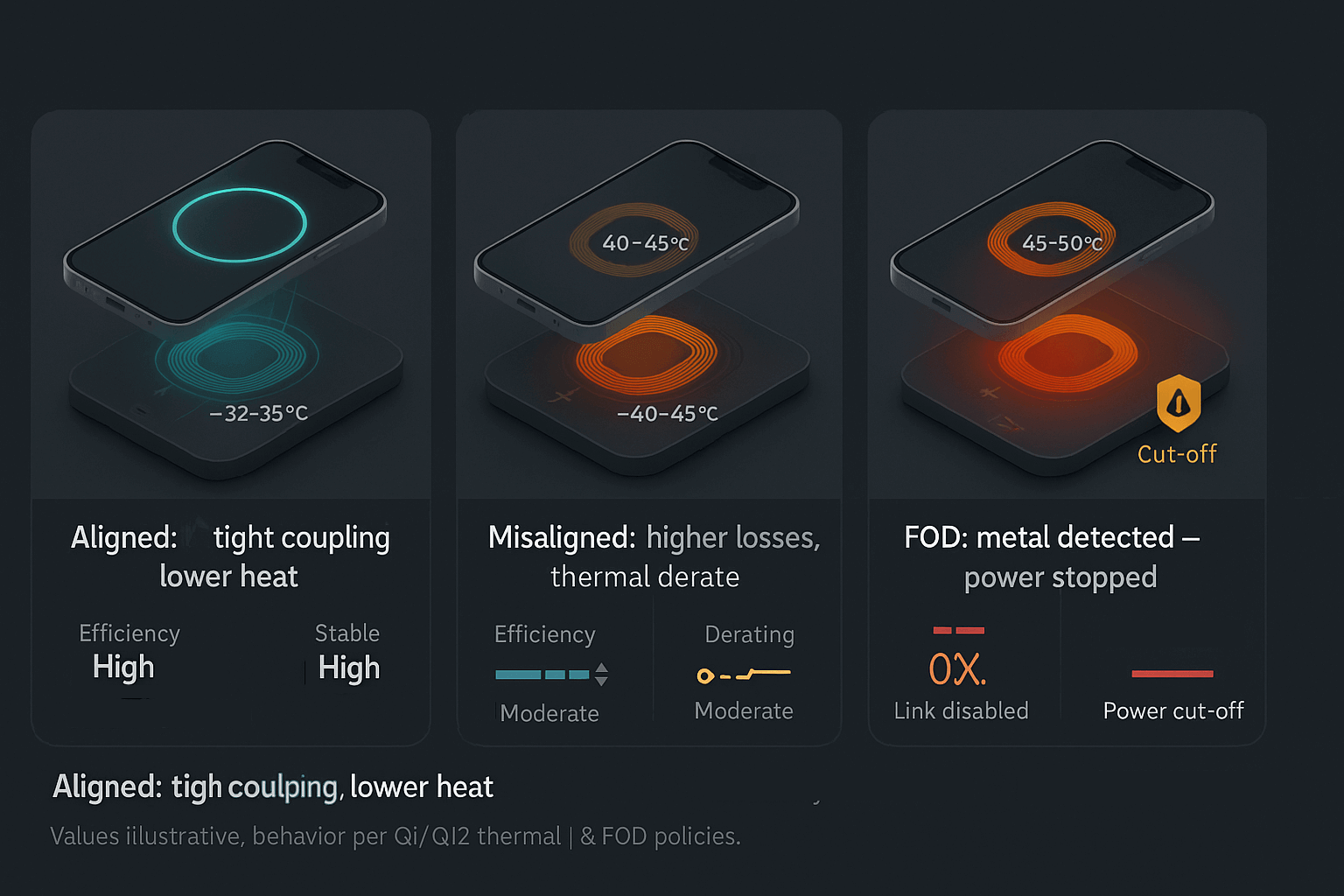
Qi and Qi2 include FOD and thermal monitoring for safety. High safety is embodied in the certification updates. Examples include v1.3 improvements and Qi2’s tight alignment.
Below is a practical comparison of wireless vs wired charging for smartphones:
| Factor | Wired (USB-C PD) | Wireless (Qi/Qi2/MagSafe) |
|---|---|---|
| Speed | Faster | Moderate |
| Heat | Lower | Higher |
| Ease | Medium | Excellent |
| Safety | High | Very High with Qi |
Between wireless and wired charging, however, trade-offs appear for port wear & convenience. Frequent plug cycles in wired charging stress connectors, whereas wireless pads reduce mechanical wear. For connector ratings and safety context review, Everything You Need to Know About Electrical Connectors.
Wireless Charging in Everyday Devices
Wireless charging has now been widely incorporated as a standard capability across consumer electronics. Modern smartphones, wearables, audio accessories, and even EVs integrate Qi-compliant or proprietary wireless charging receivers in homes, offices, and vehicles. Implementations vary by manufacturer, with some adopting open standards while others develop proprietary enhancements. Apple’s MagSafe system adds magnetic alignment to Qi charging, while Samsung leverages multi-device charging pads that adjust power dynamically.
Smartphones and Accessories
Apple’s MagSafe snaps a magnetic ring to your iPhone on supported models. This magnetic ring ensures perfect alignment with a MagSafe charger and consistent wireless iPhone charger performance. Apple’s support docs specify recommended adapter wattage (e.g., 30 W for MagSafe puck) and note how MagSafe Duo negotiates up to 14 W peak depending on adapter and device (12 W on some minis).
Samsung wireless charger pads and stand leverage Qi/Qi2 compatibility and adaptive limits. Make sure to use official compatibility lists for exact models, cases, and watch variants.
Wireless Charging Pads and Stands
Wireless charging pads feature flat surfaces with embedded transmitter coils that allow users to just place devices down for charging. These pads contain single or multiple overlapping coils to accommodate various device sizes and positions, though the charging efficiency highly depends upon the alignment. Premium models incorporate cooling mechanisms to manage thermal buildup during prolonged charging sessions, especially when powering levels are above 10W.
Charging stands present an alternative orientation that keeps device screens visible, making them popular for desk use. The vertical charging stand position requires careful TX coil placement to maintain coupling efficiency for various device heights and screen sizes. Many stands incorporate adjustable angles to accommodate both portrait and landscape orientations. Multi-device charging stations extend this concept further, integrating multiple charging zones optimized for smartphones, wearables, and audio accessories simultaneously.
Wireless Charging for Earbuds and Wearables
True wireless earbuds have embraced wireless power transfer, with premium and mid-range models now featuring Qi-compatible charging cases. These cases contain receiver coils ranging from 1W to 5W power delivery, sufficient for small capacity batteries. The compact form factor of these cases raises a unique challenge. Coil miniaturization reduces coupling area and Q-factor, making these devices more sensitive to pad alignment and FOD interference.
Smartwatches implement similar wireless charging principles but use proprietary charging pucks instead of universal Qi pads. Apple Watch uses a modified Qi implementation with device authentication, while the Samsung Galaxy Watch series supports both Samsung’s wireless charging pads and WPC-certified chargers.
Fitness trackers integrate wireless charging to remove charging contacts that are vulnerable to water damage. The lower power requirements of wearables are typically 2-5W and allow for overnight charging, though charging times remain longer than wired due to the efficiency losses of wireless power transfer.
Safety Standards, Alignment, and FOD
Qi2’s Magnetic Power Profile addresses safety challenges through its ring of permanent magnets to ensure perfect TX-RX coil alignment, improving energy efficiency and misalignment-related heating issues.
Modern implementations incorporate comprehensive safety layers, including authentication protocols, continuous temperature monitoring, and dynamic power management systems.
The Foreign Object Detection has evolved significantly across Qi versions, with transmitters employing Pre-Power FOD before power delivery and In-Power FOD to detect metallic objects consuming energy.
Safety in Wireless Charging
Qi and Qi2 safety standards incorporate protective layers, including mandatory authentication protocols that verify transmitter certificates before allowing power transfer above 5W. The protocol also ensures temperature monitoring through embedded thermal sensors, FOD mechanisms, and negotiated power limits between transmitter and receiver.
The WPC’s evolution of the FOD feature demonstrates safety improvements, with Qi v1.3.2 introducing enhanced detection methods based on Q-factor, resonance frequency, and power loss.
FOD in Wireless Charging
Foreign Object Detection (FOD) works in two main ways to keep charging safe. First, in the Pre-Power FOD method, the charger checks for changes in the quality factor of the air before it starts sending power. This helps spot any unwanted objects. Second, with In-Power FOD, the charger monitors how much power is actually received compared to how much it sends out. If there’s a difference, it could mean a foreign object is using some of the energy, alerting the system to a potential problem.
Transmitter-Receiver Coils Alignment
Qi2’s Magnetic Power Profile (MPP) fundamentally addresses misalignment heating issues through its ring of magnets that perfectly align transmitter and receiver coils, with MPP ensuring devices snap into optimal charging positions automatically.
This magnetic alignment technology reduces heat buildup by making sure of direct coil coupling. This further creates a more thermally stable charging experience compared to legacy Qi implementations, where misalignment could cause inefficiency, overheating, and potential device damage
Battery Health & Heat Management
Wireless charger designers take charging efficiency very seriously because every increased percentage point in efficiency reduces heat and throttling. In EV wireless power transfer, academic reviews note that higher-power WPT makes thermal management the key bottleneck for both safety and longevity. Therefore, better alignment, compensation, and DC-DC stages keep battery cells cooler.
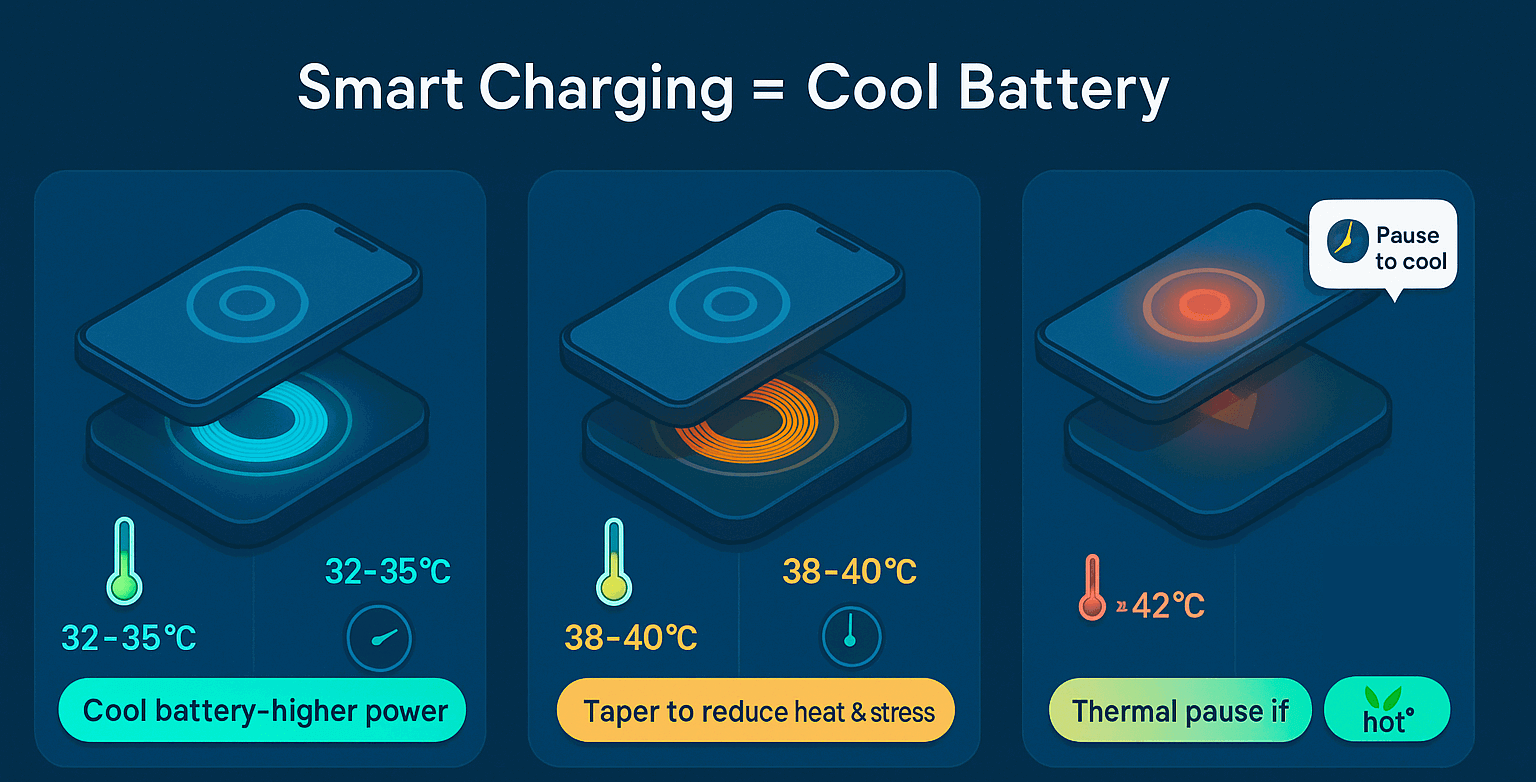
In the smartphone arena, Apple’s docs also hint at temperature-aware battery charging behavior (e.g., iPhone may limit charging above 80% when hot. This is a real-world proof that heat management via firmware plays an active role in protecting battery health during wireless charging.
The Future of Wireless Charging
Universal wireless charging standard Qi2 normalized magnetic alignment and higher power classes. The resonant systems in wireless charging are enabling spatially free surfaces that power several devices at once, and EV WPT is pushing toward dynamic charging on roads.
In the future of wireless power transfer, expect smarter thermal models, better materials, and tighter PD coordination with wired USB-C ecosystems as regulations nudge chargers to be more efficient and interoperable, even affecting wireless chargers bundled or sold in certain markets.
For designers and buyers, the wins are clear: device charging convenience that is coupled with speed, safety, and interoperability, and a broadening set of coils and modules to bring the next wireless charging pad or stand to life.
Conclusion
The promise of wireless charging isn’t just about losing the cable. It is about turning the entire power path into a smarter, safer, and more context-aware charging system. With Qi2 magnetic alignment, tightening coil coupling, and reducing thermal burden, real-world wireless power transfer efficiency now holds its own for phones, earbuds, and wearables during everyday top-ups.
Well-designed wireless charging pads and stands, paired with capable TX/RX coils, rectifiers, and buck stages, deliver consistent power without the connector wear that comes from daily wired charger plug-ins.
Looking forward, incremental gains will compound better magnetics and shielding, cooler high-frequency drivers, tighter control loops, and firmware that coordinates power with battery health in real time.
You can expect wireless charger ecosystems to broaden from desks and cars to furniture and multi-device mats as the standards converge on higher, sustained wattage with predictable thermals.
For builders, the blueprint is clear: start with alignment and losses, choose coils and converters that meet your thermal budget, and validate with certification-grade safety.
For users, the takeaway is simpler: drop, snap, and go, contactless power that finally feels as fast and trustworthy as plugging in, only without the plug.
Glossary
| Terminology | Explanation |
|---|---|
| Qi/Qi2 | Global wireless charging standard for consumer electronics, developed by the WPC |
| WPC | Wireless Power Consortium, an organization that develops & manages the Qi and Qi2. |
| MagSafe | Apple’s proprietary magnetic wireless charging technology is built upon the Qi standard |
| EV | An Electric Vehicle that uses one or more electric motors for propulsion. |
| TX/RX | Transmitter (TX) coil in the charging pad & Receiver (RX) coil in the device being charged |
| Magnetic Flux | Measure of the total magnetic field passing through a given area. |
| EMF | Electromotive Force is the potential difference of a power source (like a battery) |
| BMS | Battery Management System – Controls charging, discharging & safety of battery |
| FOD | Foreign Object Detection, safety feature that stops charging on metal object detection |
| MPP | Magnetic Power Profile, a feature of Qi2 that uses magnets for perfect coil alignment. |
FAQs
Wireless charging uses inductive charging, where an electromagnetic field transfers energy between a (transmitter-TX) coil in the charging pad and a wireless charging receiver (RX coil) in your device. The wireless charging distance is just a few millimeters, requiring direct pad contact.
Qi wireless charging is the universal wireless charging technology standard that makes sure of device-charger compatibility at inductive charging of 5W-15W. Qi2 is the upgraded version that adds magnetic alignment (between TX and RX coils) for better efficiency and a better future of wireless charging with improved safety. Both standards make wireless charging interoperable across brands.
No. Wireless charging doesn’t damage device batteries any more than wired charging. Both mechanisms generate heat in the battery, which is the main factor affecting battery life. It is, however, worth noting that wireless charging may induce slightly more heat, with lower charging efficiency (70-80% vs 85-95% wired).
No, current iPads don’t support wireless charging and require wired charging via Lightning or USB-C. Apple hasn’t implemented wireless charging technology in iPads, likely due to larger batteries needing more power than current standards efficiently provide.
Yes, iPhone 11 supports wireless charging at 7.5W Qi speeds. iPhone 12, 13, and 14 support Qi (7.5W) and MagSafe (15W) with the best wireless charging pad options.
Check your device specs for Qi support, or test it on a wireless charging pad. Alternatively, look for battery settings mentioning wireless charging to confirm the wireless charging feature in your phone.
What happens if I plug in my phone while it’s on a wireless charger?
When you plug in a wired charger to your phone while it is wirelessly charging, your phone automatically prioritizes wired charging and stops wireless charging to prevent heat and conflicts.
Popular accessories include wireless ear buds (e.g. AirPods (2nd gen+), AirPods Pro, Samsung Galaxy Buds), and smartwatches (Apple Watch, Galaxy Watch). Wireless charging for cars is now common in BMW, Tesla, and Ford vehicles.
Advantages of wireless charging: Cable-free convenience, no port wear, universal Qi compatibility, and easy charging.
Disadvantages of wireless charging: Slower charging speed than wired charging, inefficient than wired charging, need for precise placement, and higher costs for wireless charging pad.
Yes, wireless charging is safe as long as you use certified Qi chargers, which include foreign object detection, temperature monitoring, and automatic shutoff. Qi2 and advancing wireless charging continue to improve safety & efficiency standards.
Plug the pad into power, center your Qi-compatible phone on it (works with cases under 3mm), and watch for charging indicators. For the best wireless charging technology results, remove thick cases, ensure TX-RX coil alignment, and use chargers that match your phone’s maximum speed (7.5W-15W).