Introduction to DRV8825 Stepper Motor Driver
The DRV8825 is a high-performance stepper motor driver IC from Texas Instruments, designed for bipolar stepper motors in high precision applications. DRV8825 has great reliability and is versatile; it is one of the most widely used driver types by hobbyists, engineers, and CNC enthusiasts in projects from 3D printers, CNC router applications, and robotics to others. The integrated circuit is capable of microstepping down to 1/32-step resolution, includes strong current regulation features, and has complicated protection elements that are key to automation applications.
Built by Texas Instruments, a trusted manufacturer of semiconductor solutions, the DRV8825 will give consistent reliability for DIY and professional use alike. Whether connecting it up to an Arduino for a custom CNC machine/robotic system, or connecting it up to a commercial robotics system. This driver boasts reliability, precision, and motor angular positioning to bring your projects to life. In this guide we will address the common features of the DRV8825, the pinout, and the specific role in CNCs to highlight useful content for makers and engineers in the United States.
For those interested in using bipolar stepper motors, the DRV8825 presents an available and advanced solution. Its compatibility with the Arduino and Raspberry Pi enables hobbyists to advance their projects and professionals with reliable thermal protections and a high current carrying capacity.
Ready to start your next project with the DRV8825? Check out trusted US retailers like flywing-tech for your DRV8825 stepper motor driver today, and view our free setup guide for in-depth step-by-step instructions.
Key Features of DRV8825 Stepper Motor Driver IC
The DRV8825 stepper motor driver IC from Texas Instruments incorporates a balance of advanced features and is, therefore, very popular within the applications requiring precision in motor control. From high-resolution microstepping to robust protection mechanisms, the DRV8825 is designed to power bipolar stepper motors for applications such as CNC machines, 3D printers, and robotics. Below, we delve into the key features of the DRV8825, offering hobbyists and engineers some valuable insight in how to optimize their projects.
Microstepping Capabilities of DRV8825
The DRV8825 features up to 1/32-step resolution in microstepping, allowing for amazingly smooth movement and very accurate positioning. For those involved in US-based CNC projects and 3D printing, this high-resolution stepper control is the ideal tool, given the fine-grain motor movements they may require. Changing the mode with control pins can give even smoother operation and reduce vibration, enhancing performance on higher-precision projects.
Current Regulation and Protection Features
The DRV8825 features adjustable current regulation, allowing users to configure the current limit for their stepper motor according to their needs. This feature maximizes torque and provides a fail-safe to prevent overheating. The built-in protection mechanism for the stepper motor includes a short-circuit protection mechanism, providing peace of mind when a engineer is working long hours on a project in which the stepper motor is at risk of overheating.
Voltage and Current Ratings for DRV8825
The DRV8825 will operate with a supply voltage range of 8.2V to 45V and has a maximum current capacity of up to 2.5A per coil with adequate heatsinking. The 2.5A current capacity is a robust amount of stepper motor current capacity. That makes it compatible with well-known motors like NEMA 17 which is widely used across many DIY CNC and robotics projects. The wide voltage range allows manufacturers flexibility in regards to different power systems and potential voltage drop across systems used by hobbyists and professionals alike.
Thermal Shutdown and Overcurrent Protection in DRV8825
The DRV8825 encourages a good measure of safety thanks to its thermal shutdown (to avoid damage due to overheating) and overcurrent protection (to prevent your user button for the unexpected surge). This creates a reliable unit across many applications, especially when used continuously and at high performance in CNC routers and 3D printers. Makers should have a strong resolve that their systems will operate correctly under acceptable operating conditions when engineered, and tested, with the DRV8825.
DRV8825 Pinout Diagram and Pin Descriptions
The DRV8825 stepper motor driver IC by Texas Instruments is a versatile component for controlling bipolar stepper motors, prevalent in many US-based CNC, 3D printing, and robotics projects. Knowing the pinout is important to easily integrate with microcontrollers like the Arduino or Raspberry Pi. In this section, we will detail the DRV8825 pinout, including input, output, power, and ground pins, to provide experts with the confidence to wire their projects correctly.
Detailed DRV8825 Pinout Breakdown
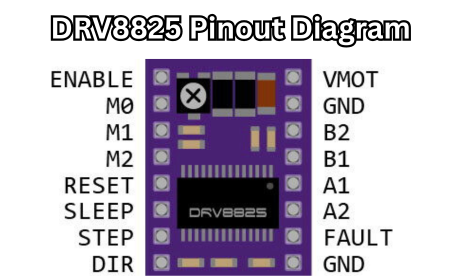
The DRV8825 is a 28-pin IC that has a clear pinout for your ease of controlling a stepper motor. Some of the more notable pins include motor outputs (AOUT1, AOUT2, BOUT1, BOUT2), control signals (STEP, DIR, ENABLE), and power (VMOT, VDD). When using the DRV8825, having a pinout diagram is important for the proper wiring of the system to make sure you have accurate control of the motor in your application (an example of this would be using a DRV8825 with a CNC router). As always, refer to Texas Instruments official datasheet for an example DRV8825 pinout diagram as you put the wiring project together.
Input Pins for Control Signals in DRV8825
The DRV8825 also has input pins like STEP (controls pulse for each step), DIR (direction of rotation), and ENABLE (activates/deactivates driver). These control signals allow for accurate communications with your microcontroller for the DRV8825 to control stepper motor motion. The DRV8825 is likely to be used by many makers who are building CNC Machines, or some form of robotics with Arduino. If the pin connections are configured properly the driver communication signals are likely to work smoothly and will allow the code (for example GRBL).
Output Pins for Stepper Motor Connections
The output pins (AOUT1, AOUT2, BOUT1, BOUT2) of the DRV8825 connect directly to the coils of a bipolar stepper motor, a common NEMA 17 style motor, often found in DIY builds in the United States. Following the correct wiring for your stepper motor coils is extremely important. Incorrectly wired stepper motors can cause problems, including missed steps and overheating. Always double-check your coil pairing (A1-A2, B1-B2), using a multimeter. To ensure the correctness of the connections to the stepper motor so that it operates reliably.
Power Supply and Ground Pins on DRV8825
The DRV8825 requires two power supplies: VMOT (8.2V–45V for motor power) and VDD (3V–5.5V for logic). Ground pins (GND) ensure stable operation by providing a common reference. Proper power management is key for engineers working on high-performance CNC systems, as incorrect voltage can damage the IC or motor. Use a heatsink and verify power ratings to maintain efficiency.
How to Interface DRV8825 with Microcontrollers
The DRV8825 stepper motor driver IC from Texas Instruments is one of the most versatile choices for engineers for bipolar stepper motors interfaced with any microcontroller, such as Arduino or Raspberry Pi. Be it a CNC router, 3D printer, or a robotics project, proper interfacing of the DRV8825 assures accurate motor control for perfect performance. This section covers detailed, step-by-step information on how to wire, set up microstep resolution, current limits, and troubleshoot common problems for makers and professionals.
Wiring DRV8825 to Arduino or Raspberry Pi
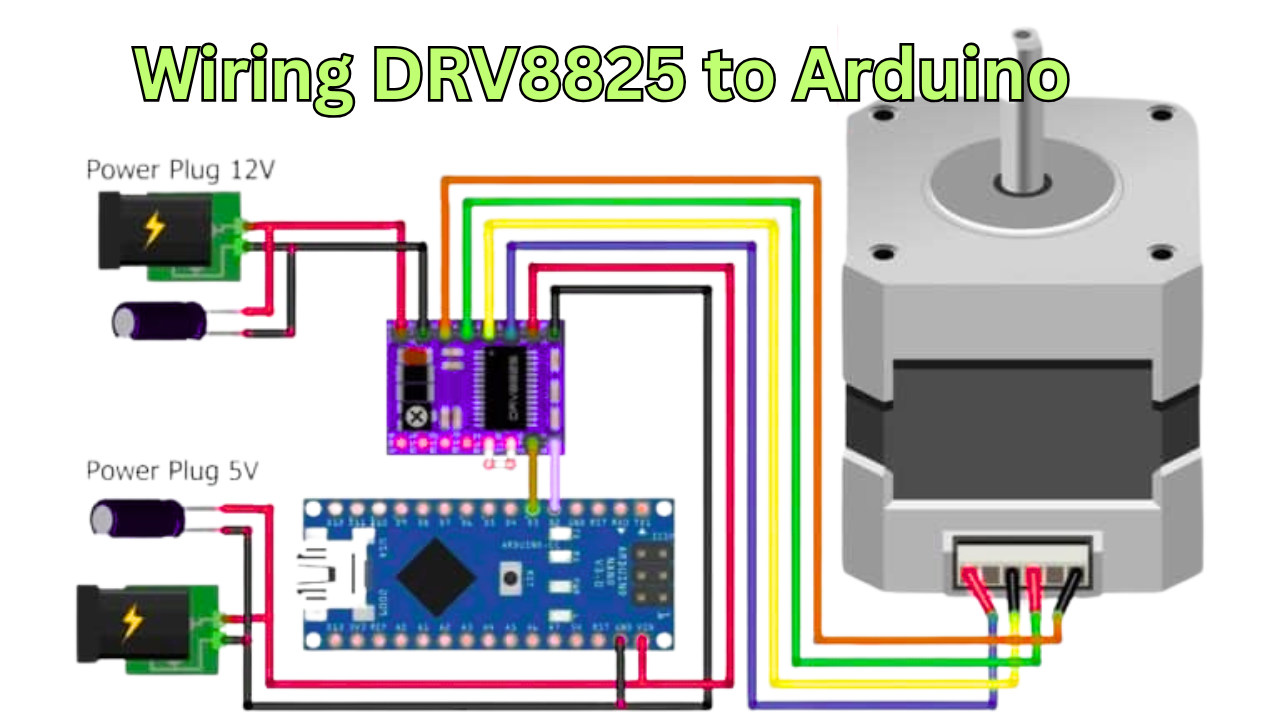
To connect the DRV8825 to an Arduino or Raspberry Pi, the STEP, DIR and ENABLE pins. Each connect to one of the digital pins on your microcontroller. For example, on an Arduino Uno, you might connect STEP to pin 3, DIR to pin 4, and ENABLE to pin 5. The pairs of the motor coils connect to these pins as well (at the outputs), A1-A2 to AOUT1 and AOUT2, B1-B2 to BOUT1 and BOUT2. The VMOT power supply should be a separate 8.2V to 45V, and VDD must be between 3V -5.5V. Make sure to have a proper ground. This configuration works great for studded NEMA 17 motors, and as a side note for DIY CNC projects. Always add a capacitor (100uf) across VMOT and GND for power stabilization.
Setting Microstep Resolution on DRV8825
The DRV8825 provides up to 1/32-step microstepping resolution, allowing smooth and accurate control of a motor’s movement. You can configure it by simply setting the M0, M1 and M2 pins HIGH or LOW, in which case, when all three pins are HIGH, the DRV8825 will be set for 1/32-step microstepping mode. It is particularly important in CNC applications, such as in 3D printing or laser cutting applications. After establishing the mode. You will send precise STEP pulses from a microcontroller so that the position of a motor is accurate at all times. You should try different resolutions so that you obtain the appropriate speed and accuracy for your project.
| MODE2 | MODE1 | MODE0 | STEP MODE | ||
| 0 | 0 | 0 | Full step (2-phase excitation) with 71% current | ||
| 0 | 0 | 1 | 1/2 step (1–2 phase excitation) | ||
| 0 | 1 | 0 | 1/4 step (W1–2 phase excitation) | ||
| 0 | 1 | 1 | 8 microsteps/step | ||
| 1 | 0 | 0 | 16 microsteps/step | ||
| 1 | 0 | 1 | 32 microsteps/step | ||
| 1 | 1 | 0 | 32 microsteps/step | ||
| 1 | 1 | 1 | 32 microsteps/step | ||
Adjusting Current Limit for Stepper Motors
To optimize performance and prevent overheating, set the current limit of DRV8825 to the rating of your stepper motor, such as 1.7A for a typical NEMA 17. For that, you need to measure the reference voltage VREF at the pot using a multimeter. Then find the corresponding current limit using the formula Current Limit = VREF × 2. Using a VREF of 0.85V would set a 1.7A limit. This step is essential in ensuring efficiency and safety in operating motors for engineers working on robotics or CNC systems.
Common Troubleshooting Tips for DRV8825 Setup
If your DRV8825 stepper motor driver isn’t working properly—whether it’s missing steps, overheating, or not moving at all—most issues come down to wiring, current settings, or logic pin configuration.
Power & Wiring
Ensure a stable 8.2–45 V supply with a shared ground between the driver and microcontroller. Add a 100 µF capacitor near VMOT to prevent voltage dips. Breadboards can cause poor connections—use soldered joints instead. Verify coil pairs with a multimeter and wire as A+, A–, B+, B–.
Current & Heat
Set the current limit (VREF) correctly; too high leads to overheating or shutdown. Use a heatsink or fan for currents above 1 A, especially during long runs. Start low (around 1 A) and increase gradually.
Logic Pins & Signals
Keep ENABLE = LOW, and tie RESET and SLEEP together to 5 V. Floating pins can disable outputs. If the motor doesn’t move, check these first. Use verified step signals—libraries like AccelStepper help maintain consistent timing.
Common Motion Issues
Missed or jerky steps usually mean pulse rate too high, unstable microstepping pins, or insufficient delay in code. Start at low speed and test incrementally. Enable microstepping (1/8 or 1/16) to reduce vibration.
If problems persist, test with another DRV8825 to rule out hardware failure. Inspect solder joints, measure VREF, and confirm correct polarity.
DRV8825 Applications in CNC Machines
The DRV8825 stepper motor driver IC, crafted by Texas Instruments, is a powerhouse for CNC applications, making it a favorite among professionals building CNC routers, mills, and engravers. Its high current capacity, microstepping precision, and robust protection features enable precise control of bipolar stepper motors in demanding CNC environments.
Role of DRV8825 in CNC Router Control
The DRV8825 is the driver used to drive stepper motors in CNC routers, allowing for accurate movement in X, Y, and Z axes. It can supply a maximum of 2.5A per coil (with the use of a heatsink). So, it is perfect for powering either a NEMA 17 or NEMA 23 motor used in a kit. It will provide continuous torque, with smooth motion for predictable cuts and engravings for woodworkers and makers.
Using DRV8825 for Precision Stepper Motor Driving in CNC
The DRV8825 offers remarkable stepper motor CNC accuracy with microstepping up to 1/32-step resolution, which is essential for complex designs in CNC machining. This precision is vital for professionals creating detailed prototypes or hobbyists crafting custom parts. Users can optimize performance for applications like laser cutting or milling by adjusting the microstep settings, which allow them to strike a balance between speed and accuracy.
Integration with GRBL or Other CNC Software
The DRV8825 works well with GRBL, which is a very popular open-source CNC control program used in the US. In order to create an affordable CNC machine, it has STEP and DIR pins that can connect to an Arduino running GRBL and will allow precise control of the motors you are using.
The driver is also compatible with Mach3 and other CNC software for those engineers scaling up their operations to semi-professionals.
As with any project, make sure to ensure accurate pin configuration and corresponding firmware setting up before you try your drill rig or the CNC machine itself.
Case Studies: DRV8825 in DIY CNC Projects
Makers have used the DRV8825 in numerous do-it-yourself CNC projects ranging from homebuilt routers to CNC mills made from 3D printing. One case is a hobbyist located in California who used the motor driver to power a NEMA17-based CNC woodworking router achieving sub millimeter accuracy utilizing GRBL. Another pair of engineers incorporated the DRV8825 into their own engraved CNC machine. Taking advantage of the current regulation in the DRV8825 to keep their motors from overheating when running long engraving jobs. Each of the real examples above indicates just how versatile the driver is for every CNC enthusiast.

Advantages and Limitations of DRV8825 Stepper Driver
The DRV8825 stepper motor driver IC, designed by Texas Instruments, is a robust and versatile solution for controlling bipolar stepper motors in US-based CNC, 3D printing, and robotics projects. Its advanced features make it a top choice for hobbyists and professionals, but like any component. It has its strengths and drawbacks. This section explores the key advantages of the DRV8825, its limitations. Best practices to optimize performance, providing makers with a clear understanding to make informed project decisions.
Benefits Over A4988 and Other Drivers
Compared to the A4988, a popular alternative, the DRV8825 offers superior performance with a higher current capacity (up to 2.5A per coil with heatsinking vs. 2A for A4988) and finer microstepping (1/32-step vs. 1/16-step). This makes it ideal for CNC enthusiasts needing precise control for NEMA 17 or NEMA 23 motors. The DRV8825 also includes enhanced protection features. Such as thermal shutdown and overcurrent protection, ensuring greater reliability in demanding applications like CNC routers or 3D printers.
Potential Drawbacks and Heat Management
While powerful, the DRV8825 can generate significant heat at high currents. Requiring proper heatsinking and active cooling for currents above 1.5A. Without adequate heat management, overheating may lead to thermal shutdown, interrupting operation. Additionally, its microstepping precision can introduce complexity in setup for beginners. It should ensure proper ventilation and use a heatsink to mitigate. These stepper driver drawbacks, especially in continuous-use CNC projects.
Best Practices for Optimal Performance
To maximize the DRV8825’s performance, follow these best practices:
- Use a Heatsink and Cooling: Attach a heatsink and consider a fan for high-current applications to prevent thermal shutdown.
- Adjust Current Limit Precisely: Set the current limit (using VREF × 2 formula) to match your motor’s rating, such as 1.7A for NEMA 17, to optimize torque and efficiency.
- Test Microstepping Settings: Experiment with 1/8 or 1/16-step for less demanding tasks to reduce heat while maintaining accuracy.
- Verify Wiring: Double-check connections to avoid missed steps or motor stalling, common issues in DIY CNC setups.
These stepper motor performance tips ensure reliable operation for engineers and makers working on precision-driven projects.

DRV8825 vs. Similar Stepper Motor Drivers
The DRV8825 stepper motor driver IC, developed by Texas Instruments, is a leading choice for US-based CNC, 3D printing, and robotics projects. Due to its high current capacity and microstepping precision. However, choosing the right stepper motor driver depends on your project’s needs. This section compares the DRV8825 with popular alternatives like the A4988 and TMC2208, highlighting performance, features, and suitability to help hobbyists and engineers make informed decisions for their builds.
Comparison with A4988: Features and Performance
The DRV8825 outperforms the A4988 in several areas, making it a preferred option for CNC enthusiasts. It supports up to 2.5A per coil (with heatsinking) compared to the A4988’s 2A, and offers finer microstepping (1/32-step vs. 1/16-step). Enabling smoother motion for precision tasks like 3D printing. Additionally, the DRV8825’s enhanced thermal shutdown and overcurrent protection provide greater reliability for demanding applications. However, the A4988 is simpler to configure, making it suitable for beginners or less complex DIY projects.
DRV8825 vs. TMC2208: Silent Operation and Efficiency
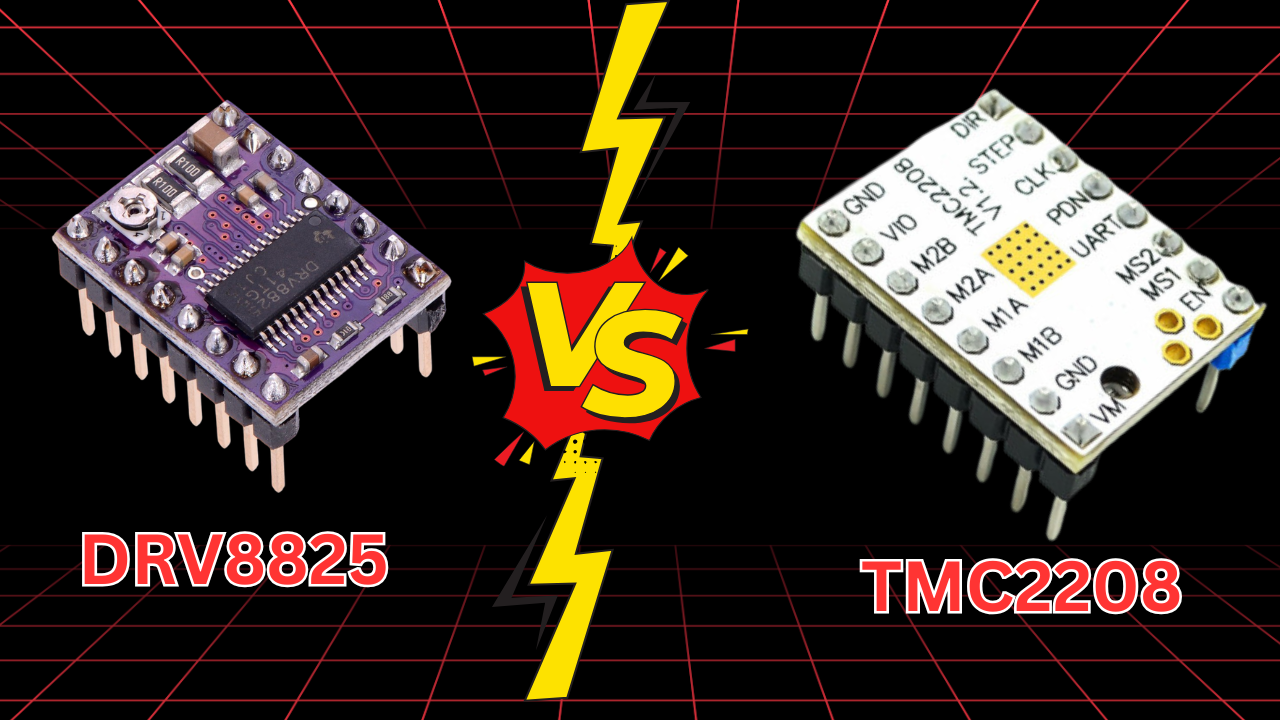
The TMC2208 is recognized for quiet operation. It utilizes StealthChop technology which decreases sounds made by a motor, making it perfect for home-based 3D printers where noise is not wanted. Compared to the DRV8825 that is focused on power. It can handle higher currents (a rated 2.5A vs 2A of the TMC2208) and has a wider voltage (8.2V – 45V vs 4.75V – 36V of the TMC2208). The TMC2208 has efficiency and can slow motors down silently. The TMC2208 can be a better choice for a high torque CNC router or robotics project where power is essential. For individuals operating, you can make a selection based on your noise versus power needs.
Choosing the Right Driver for Your Project
Selecting the best stepper motor driver depends on your project’s requirements:
- DRV8825: Ideal for high-current, high-precision CNC and robotics projects, especially with NEMA 17 or NEMA 23 motors, common in workshops.
- A4988: Best for simpler, budget-friendly DIY projects with lower current demands.
- TMC2208: Perfect for noise-sensitive applications like home 3D printers.
Consider factors like current rating, microstepping needs, and cooling requirements. For makers, the DRV8825’s versatility makes it a top choice for demanding applications. While its compatibility with Arduino and GRBL ensures easy integration.
Conclusion: Why Choose DRV8825 for Your Projects
The DRV8825 stepper motor driver IC from Texas Instruments is a popular option to use in all of your US-based CNC, 3D printing, and robotics projects. It has a high current rating (2.5A max per coil), a microstepping ability with up to 1/32-step resolution, and also very nice protective features (like thermal shutdown) and is perfect for driving a NEMA 17 or NEMA 23 motor accurately!
The DRV8825 continues to be your best option as the go-to stepper motor driver for engineers – nothing is as versatile to build a DIY CNC router or even a professional 3D printer. It could be used for firmware implementations with a Raspberry Pi, an Arduino, and even GRBL software.
Call to Action: Start Your DRV8825 Project Today
Are you ready to power your CNC, 3D printing, or robotics project with the DRV8825 stepper motor driver IC? Designed by Texas Instruments, the DRV8825 provides precision and reliability for US-based makers and engineers. Buy your DRV8825 from a trusted US retailer like flywing-tech to ensure quality and fast delivery. Join our stepper motor community to get tips and project ideas with support from other US-based hobbyists. Download our free guide to get step-by-step instructions for your next project with a DRV8825!
FAQs About DRV8825
The DRV8825 stepper motor driver IC, from Texas Instruments, is ideal for CNC, 3D printing, and robotics projects. Below are the short answers to common questions about its current rating, heat dissipation, and NEMA 17 motor suitability. To help makers on their path to success.
What is the Maximum Current Rating for DRV8825?
The DRV8825 has a maximum current rating of 2.5A per coil with heatsinking, which is well suited to NEMA 17 or NEMA 23 motors for your CNC project. To set the current limit, use VREF × 2.
How to Calculate Heat Dissipation in DRV8825?
Heat dissipation can be calculated as I² × 0.4W (where I is the current per coil, as an example, a NEMA 17 would use approximately 1.7A, which would dissipate heat at a rate of ≈1.16W). For currents over 1.5A, it is recommended to use heatsink and fan cooling.
Can DRV8825 Drive NEMA 17 Stepper Motors?
Yes, it is the perfect driver for NEMA 17 motors (1.5A – 1.8A), for CNC and 3D printing. Just be sure that you are wire correctly and are setting the proper current limits.