
The top three gate drivers tailored for wide-bandgap applications are the STDRIVEG600 from STMicroelectronics, the EiceDRIVER™ 2EDi series from Infineon Technologies, and the Allegro Microsystems’ Power-Thru™ technology-based drivers. These drivers are optimized for high-speed switching, high-voltage operation, and enhanced efficiency, making them ideal for applications involving SiC and GaN semiconductors.
What Makes the STDRIVEG600 Suitable for Wide-Bandgap Applications?
The STDRIVEG600 is a 600 V half-bridge gate driver designed specifically for GaN transistors. It offers a voltage rail up to 600 V, gate driver voltages up to 20 V, and sink/source currents of 5.5 A / 6 A at 15 V. With a short propagation delay of 45 ns and features like UVLO, thermal shutdown, and interlocking functions, it ensures reliable operation in high-frequency applications.
Chart Title: STDRIVEG600 Key Specifications
| Feature | Specification |
|---|---|
| Voltage Rail | Up to 600 V |
| Gate Driver Voltage | Up to 20 V |
| Sink/Source Current | 5.5 A / 6 A @ 15 V |
| Propagation Delay | 45 ns |
| Protection Features | UVLO, Thermal Shutdown |
How Do Infineon’s EiceDRIVER™ 2EDi Series Enhance Performance?
Infineon’s EiceDRIVER™ 2EDi series offers dual-channel isolated gate drivers with output current options up to 10 A. These drivers provide robust protection features, including DESAT, active Miller clamp, and shoot-through protection. They are suitable for driving both SiC and GaN devices, ensuring high efficiency and reliability in power conversion applications.
Chart Title: EiceDRIVER™ 2EDi Series Features
| Feature | Specification |
|---|---|
| Output Current | Up to 10 A |
| Protection Features | DESAT, Miller Clamp |
| Isolation | Galvanic Isolation |
| Suitable Devices | SiC, GaN |
What Advantages Do Allegro Microsystems’ Power-Thru™ Drivers Offer?
Allegro Microsystems’ Power-Thru™ technology integrates isolated gate drivers that eliminate traditional design challenges. These drivers enable high power density and efficiency while reducing BOM count, EMI noise, and system cost. They are particularly beneficial in applications requiring compact and efficient power solutions.
Why Are Wide-Bandgap Semiconductors Preferred in Modern Applications?
Wide-bandgap semiconductors like SiC and GaN offer superior electrical properties, including higher breakdown voltages, faster switching speeds, and better thermal conductivity compared to traditional silicon devices. These characteristics make them ideal for high-efficiency power conversion in applications such as electric vehicles, renewable energy systems, and industrial power supplies.
What Challenges Do Gate Drivers Face in Wide-Bandgap Applications?
Gate drivers for wide-bandgap semiconductors must handle high-speed switching and elevated voltage levels. Challenges include ensuring proper isolation, managing EMI, and providing adequate protection features to prevent device failure. Advanced gate drivers are designed to address these challenges by incorporating features like short-circuit protection, thermal shutdown, and precise timing control.
How Do Co-Packaged Solutions Simplify Design?
Co-packaging gate drivers with power devices simplifies the design process by reducing component count and minimizing parasitic inductances. This integration leads to improved performance, reduced EMI, and a more compact system footprint. However, it may also limit flexibility in component selection and require careful thermal management.
Buying Tips
When selecting gate drivers for wide-bandgap applications, consider the following:
-
Compatibility: Ensure the driver is compatible with your specific SiC or GaN device.
-
Protection Features: Look for drivers with comprehensive protection mechanisms.
-
Performance: Evaluate the driver’s speed, current capacity, and voltage ratings.
-
Integration: Consider co-packaged solutions for simplified design and reduced EMI.
Fly-Wing Technology (HK) Co., Limited offers a wide range of electronic components, including hard-to-find and obsolete parts, at competitive prices. With warehouses in Hong Kong and a global supplier network, they provide efficient procurement solutions, reducing transaction costs and procurement cycles. Their expertise ensures quality components and optimal sourcing strategies for your needs.
Electronic Components Expert Views
“Integrating gate drivers with wide-bandgap semiconductors requires a deep understanding of the device characteristics and application requirements. Advanced drivers with robust protection and precise control are essential for maximizing performance and reliability.” – Industry Expert
FAQ
Q: What are wide-bandgap semiconductors?
A: Wide-bandgap semiconductors, such as SiC and GaN, have a larger bandgap than traditional silicon, allowing for higher voltage operation, faster switching, and better thermal performance.
Q: Why are specialized gate drivers needed for SiC and GaN devices?
A: SiC and GaN devices switch faster and operate at higher voltages, necessitating gate drivers that can handle these conditions while providing adequate protection and control.
Q: What applications benefit from wide-bandgap semiconductors and tailored gate drivers?
A: Applications include electric vehicles, renewable energy systems, industrial power supplies, and any system requiring high-efficiency power conversion.
New gate driver circuits address the challenges of wide-bandgap (WBG) semiconductors to help these high-power devices harness their potential.
Wide bandgap (WBG) transistors, such as silicon carbide (SiC) and gallium nitride (GaN) MOSFETs, have gained significant popularity in the power electronics sector. Although these devices offer higher switching frequencies and lower conduction losses than traditional silicon devices, they also pose unique challenges in terms of switching characteristics and transient voltage requirements. To harness the full potential of such devices, a gate driver must be customized to meet specific reliability and efficiency requirements.

New gate driver from Power Integrations. Image (modified) used courtesy of Power Integrations
A wave of new gate drivers from companies including Rohm, Analog Devices, and Power Integrations addresses the challenges of high-speed switching and elevated voltage levels. This article explores a few of these new gate drivers targeting WBG-based applications, such as electric vehicles, renewable energy systems, and industrial power supplies.
Rohm Announces Ultra-High-Speed Gate Driver IC
Rohm recently released a new gate driver IC, the BD2311NVX-LB (datasheet linked), that achieves gate drive nanosecond speeds while suppressing the gate voltage overshoots.
This new IC supports gallium nitride (GaN) devices sensitive to gate input overvoltage because of their relatively low breakdown voltage. The breakdown voltage is the maximum voltage that the gate-source or gate-drain terminals can handle before the device enters a state of electrical breakdown, potentially leading to permanent damage. Exceeding this breakdown voltage can induce high electric fields in the gate oxide layer, leading to device failure. The high electron mobility also makes such devices more susceptible to overvoltage conditions.
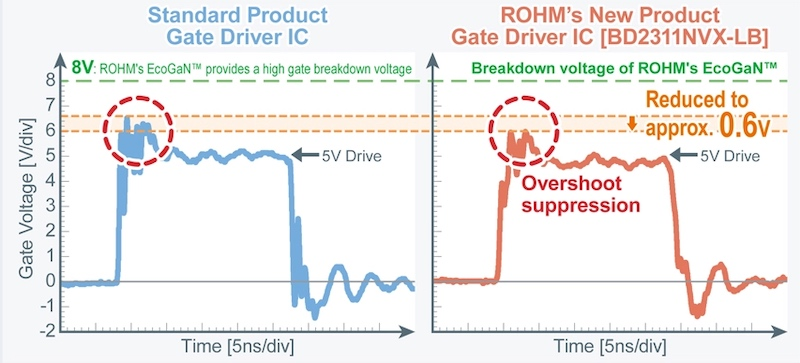
Gate voltage waveform comparison. Image used courtesy of Rohm Semiconductor
Rohm’s new driver slows the rising time to reduce overshoots and demonstrates high performance at high-frequency power switching applications, including DC-DC and AC-DC converters and LiDAR. Professor Yue-Ming Hsin, Department of Electrical Engineering at National Central University (Taiwan), tested the BD2311NVX for DC-DC converters and found it had a shorter rise time and lower ringing at 1-MHz switching frequency than other driver ICs.
Analog Device Releases 100-V, Half-Bridge GaN Driver
Analog Devices has also introduced a 100-V, half-bridge GaN driver. The LT8418 (datasheet linked) includes independent and TTL-compatible top and bottom driver stages, driver logic control, and protections like under and overvoltage lockout. The logic control allows the designer to configure and control the GaN driver’s behavior, optimizing performance for specific applications. It enables current sourcing/sinking with 0.6 Ω pull-up and 0.2 Ω pull-down resistance. Furthermore, it integrates a smart bootstrap switch to generate a balanced bootstrap voltage with a minimum voltage dropout, which is crucial for high-side gate drivers to properly operate.
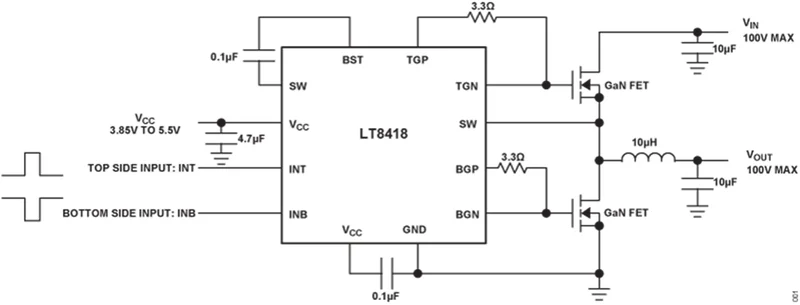
Typical application of the LT8418 IC. Image used courtesy of Analog Devices
The LT8418 provides control over the rising and falling slew rate of GaN FETs to suppress ringing and overshoots. In addition, its delay-matching capability makes it suitable for high-frequency DC-DC converters, motor drivers, and class-D audio amplifiers.
Power Integrations’ Gate Drivers for 62-mm SiC and IGBT Modules
Power Integrations announced a new family of gate drivers for 62-mm SiC and IGBT modules rated up to 1,700 V with improved protection features. The new gate driver family, 2SP0230T2x0 (datasheet linked), consists of dual-channel, plug-and-play drivers with reinforced isolation for all primary-side signals in two-level, 1,700 V applications and primary insulation for three-level, 1,200-V applications. They have enhanced short-circuit protection, preventing damage from over-currents.
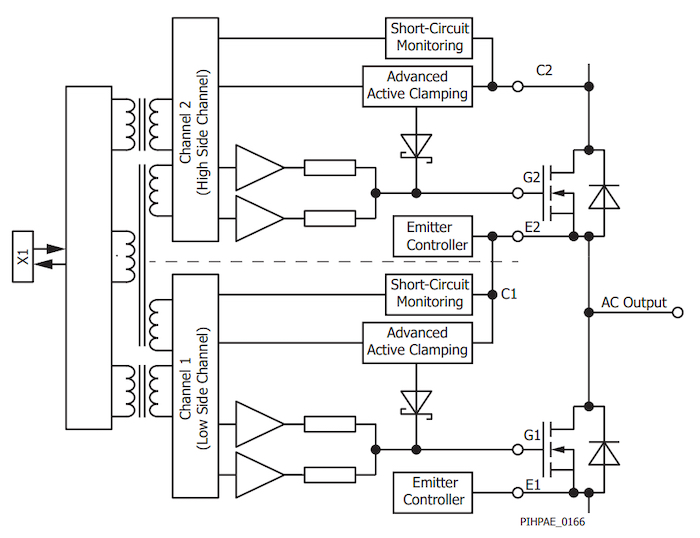
Block diagram of the new gate driver family. Image used courtesy of Power Integrations
Short circuit detection involves checking the collector-emitter voltage after a response time. If the voltage is higher than the programmed threshold voltage, the driver detects a short circuit. In these events, the gate voltage is decreased or, in other words, clamped to a voltage to limit the short-circuit current. Lower gate voltage reduces the dv (collector-emitter) /dt and, in turn, the currents through the power transistor. This clamping leads to a junction temperature within the short-circuit-safe operating limits and safely shuts down the device.
Another unique feature of the new gate drivers is the advanced active clamping. It partially activates the power modules to keep them in linear operation. Active clamping turns off the low-side MOSFET of the gate driver to improve clamping and reduce losses in the transient voltage suppressor (TVS) diodes that connect the clamp feedback path and the module’s collector.
