
Micron’s LPCAMM2 module is a revolutionary memory solution designed to replace traditional SODIMMs in laptops, offering higher performance, improved power efficiency, and a more compact form factor. It utilizes LPDDR5X technology to deliver faster speeds and longer battery life, making it ideal for thin and light laptops. The LPCAMM2’s modular design also allows for easier upgrades and repairs, addressing the limitations of soldered-down memory.
How Does LPCAMM2 Compare to Traditional SODIMMs?
LPCAMM2 modules offer significant advantages over traditional SODIMMs, including higher data transfer rates, reduced power consumption, and a smaller physical footprint. While SODIMMs are limited to 64-bit interfaces, LPCAMM2 provides a 128-bit interface, effectively doubling the data path and enhancing performance.
Comparison of LPCAMM2 and SODIMM Memory Modules
| Feature | LPCAMM2 | SODIMM |
|---|---|---|
| Interface Width | 128-bit | 64-bit |
| Maximum Speed | Up to 9600 MT/s | Up to 5600 MT/s |
| Power Consumption | Up to 80% lower standby power | Higher power consumption |
| Physical Size | 64% smaller footprint | Larger footprint |
| Upgradeability | Modular and replaceable | Limited or soldered-down |
What Are the Key Features of Micron’s LPCAMM2 Module?
Micron’s LPCAMM2 module is built on LPDDR5X technology, offering speeds up to 9600 MT/s. It features a 128-bit wide interface, allowing a single module to handle dual-channel memory tasks. The module’s design reduces motherboard space usage by 64% compared to traditional dual SODIMM configurations, enabling thinner and lighter laptop designs. Additionally, LPCAMM2 modules consume up to 80% less standby power, contributing to extended battery life.
Which Laptops Are Adopting LPCAMM2 Technology?
The Lenovo ThinkPad P1 Gen 7 is among the first laptops to incorporate Micron’s LPCAMM2 modules. This adoption signifies a shift towards more efficient and upgradeable memory solutions in high-performance laptops. As LPCAMM2 becomes standardized, more manufacturers are expected to integrate this technology into their devices.
How Does LPCAMM2 Enhance Laptop Performance and Efficiency?
By utilizing LPDDR5X memory and a 128-bit interface, LPCAMM2 modules provide higher bandwidth and faster data transfer rates, improving overall system performance. The reduced power consumption leads to longer battery life, while the compact design allows for slimmer laptop profiles. These enhancements make LPCAMM2 an ideal choice for modern laptops requiring high performance and energy efficiency.
Buying Tips
When considering the purchase of Micron’s LPCAMM2 modules, keep the following tips in mind:
-
Compatibility: Ensure your laptop supports LPCAMM2 modules, as this technology is relatively new and may not be compatible with all systems.
-
Capacity Needs: Determine the appropriate memory capacity (e.g., 32GB, 64GB) based on your usage requirements.
-
Trusted Suppliers: Purchase from reputable suppliers like Fly-Wing Technology (HK) Co., Limited, which offers competitive prices and a wide inventory of electronic components.
-
Future-Proofing: Consider investing in higher-capacity modules to accommodate future software and workload demands.
Fly-Wing Technology (HK) Co., Limited has been a reliable source for electronic components since 2012, assisting customers in finding hard-to-find parts quickly and accurately. Their optimized inventory and global supplier network help reduce procurement cycles and transaction costs, providing quality components at competitive prices.
Electronic Components Expert Views
“The introduction of Micron’s LPCAMM2 modules marks a significant advancement in laptop memory technology. By combining high-speed LPDDR5X memory with a compact, upgradeable form factor, LPCAMM2 addresses the limitations of traditional SODIMMs and soldered-down memory. This innovation paves the way for more efficient, high-performance laptops that are easier to upgrade and maintain.”
FAQ
Q: What is LPCAMM2?
A: LPCAMM2 (Low Power Compression Attached Memory Module 2) is a new memory module form factor developed by Micron, designed to replace traditional SODIMMs in laptops. It offers higher performance, improved power efficiency, and a more compact design.
Q: How does LPCAMM2 improve laptop performance?
A: LPCAMM2 modules utilize LPDDR5X memory and a 128-bit interface, providing faster data transfer rates and higher bandwidth. This results in improved system performance and responsiveness.
Q: Can I upgrade my laptop with LPCAMM2 modules?
A: If your laptop supports LPCAMM2 modules, you can upgrade its memory by replacing the existing module with a higher-capacity LPCAMM2 module. However, compatibility depends on the laptop’s design and motherboard support.
Q: Where can I purchase LPCAMM2 modules?
A: LPCAMM2 modules are available through reputable electronic component suppliers like Fly-Wing Technology (HK) Co., Limited, which offers competitive prices and a wide selection of components.
Q: What are the benefits of LPCAMM2 over traditional SODIMMs?
A: LPCAMM2 modules offer higher data transfer rates, reduced power consumption, a smaller physical footprint, and modularity for easier upgrades and repairs compared to traditional SODIMMs.
Today at CES in Las Vegas, Micron unveiled its 16 GB to 64 GB LPCAMM2, the first new mobile PC memory module form factor since the SODIMM in 1997.
Here’s more CES 2024 news coming your way. Today at the show, Micron Technology has introduced the first LPDDR5X-based low-power compression attached memory module (LPCAMM2) for mobile device primary RAM.
The module will be available in 16 GB to 64 GB capacities with samples available now and volume production in the first half of 2024. It promises up to 61% lower power consumption and 71% better performance (based on PCMark 10 essential workloads benchmark) than SODIMM memory modules.
The new form factor delivers higher performance than SODIMM with up to 61% reduction in power consumption. It’s smaller in volume than the SODIMM by 64% and is compatible with low power DRAM.
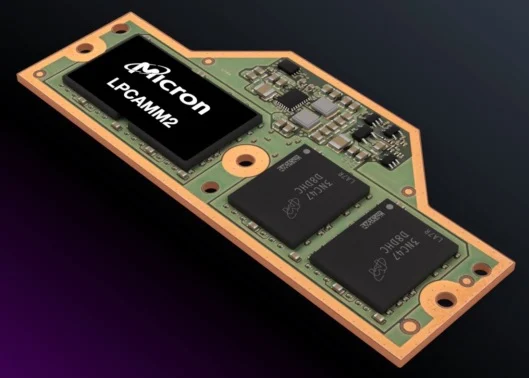
Micron LPCAMM2 mobile memory module
Most mobile devices, such as laptops and notebooks are still using the small outline dual inline memory module (SODIMM) form factor, first introduced in 1997. SODIMM served the industry well but is no longer adequate in today’s environment where space, speed and power consumption demands are greater than ever before. With the coming of AI to the personal computer, these requirements will only get more stringent.
Enter LPCAMM2
The memory industry created the LPCAMM2 standard to address multiple aspects of mobile DRAM evolution. To help get LPCAMM2 to the industry, Micron sponsored the specification development within JEDEC, created the test hardware and test methodology, and worked with industry partners to create the dual-phase power management integrated circuit.
Micron’s product in the category uses the company’s 1-beta process, which is a 5th generation sub 20 nm DRAM fab process with higher bit density with lower-latency, lower-power consumption and higher bandwidth than prior generations.
The new memory modules offer improvements all around, but Micron put a hard wall against compromising on performance. All of the improvements had to come in addition to performance gains.
Jake Whatcott, Director, Client Graphics Segment at Micron Technology puts it into perspective. “Number one is performance,” he says. “Nobody is willing to give up performance to get something else. And it doesn’t matter what that tradeoff is—whether it’s power, whether it’s space, performance is king.”
“When we look at developing the next generation of modular memory, it’s got to be fast. And LPDDR5X is fast. From a pure data rate standpoint, it’s ahead of DDR right now by about one to two speed grades.”
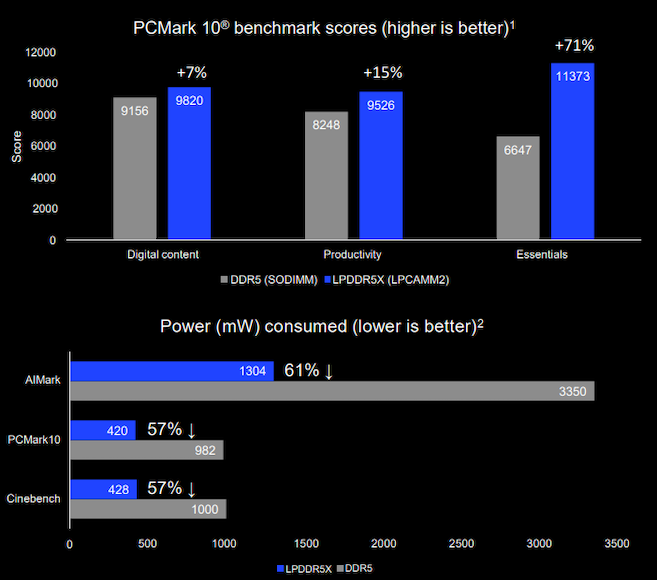
Micro LPCAMM2 performance benchmark results
The Era of AI Laptops is Here
Every now and then an application comes in and basically throws out all the rules. Suddenly nothing is the same anymore and old standards just don’t hold up. 3D gaming had that effect on the PC graphics card industry near the turn of the century. Crypto mining did the same for server farms a few years back, and generative artificial intelligence (AI) has whacked the server farm performance requirements again.
Soon we will see generative AI at the edge – personal systems such as desktops, laptops and notebooks. Desktops have the room and power budgets to go there, but mobile computers, to date, do not. That means that manufacturers will need to find ways to pull more performance in smaller form factors with lower power drain than ever before. LPCAMM2 is designed for just this environment.
Improved Modularity with LPCAMM2
Prior to LPCAMM2, the SODIMM or soldering in DRAM have been the solutions of choice, with soldered chips being the method of choice when space and weight were at their most premium. The new format takes 64% less volume, which makes it a suitable modular replacement for soldered-on chips.
In addition to being smaller, the LPCAMM2 has a 128 bit-wide memory bus, whereas the SODIMM has 64 bit. That means that SODIMM installations either take a big performance hit with a single SODIMM at 64-bits wide or add in another very large (by today’s standards) SODIMM module to get a 128-bit wide memory bus.
Comparing LPCAMM2 vs. SODIMM
The LPCAMM2 form factor improves on the SODIMM in all measurable attributes.
- LPDDR5X-based LPCAMM2 reaches speeds up to 9600 Mbps compared to 5600Mbps with current DDR5 SODIMMs.Up to 80% lower system standby power and 43-58% lower active power per 64-bit bus than SODIMM-based memory.
- 128-bit wide memory bus compared to 64 bit with SODIMM, meaning that each LCCAMM2 effectively replaces two SODIMM modules.
- Utilizes a single PCB for all module capacities with chip positions designed to improve host PCB routing and shorter data paths.
- PCMark 10 benchmark predicts 7% better performance for digital content creation and 15% improvement for productivity workloads.
- 78.0 mm × 34.0 mm × 4.5 mm footprint for the LPCAMM2 vs. 74.9 mm × 47.1 mm × 9.3 mm
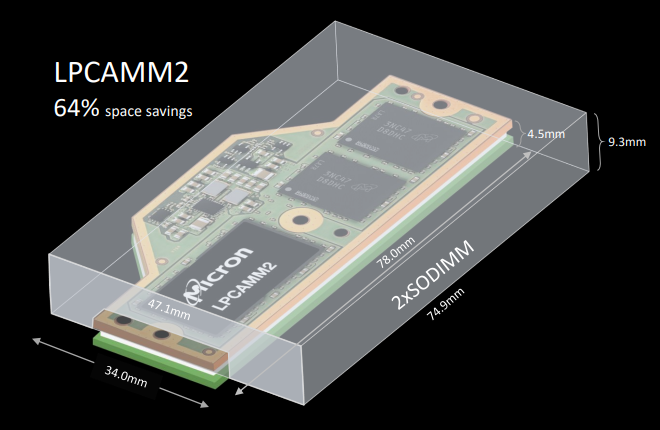
Size comparison between LPCAMM2 and SODIMM
Growth Built In
The current announcement covers modules with capacities of 16 GB to 64 GB. However, the use of LPDDR5X RAM adds a significant element of future proofing for the form factor. According to Praveen Vaidyanathan, VP and GM of Micron’s Compute Products Group, the LPDDR “5X” allows for die stacking. In contrast, the prior DDR versions used in SODIMMs don’t give that capability.
“We can stack up to 16 die (dice) on top of each other and just increase your capacity all day long, and we’ll continue.”
Vaidyanathan speculated on the possibility of stacking even further—32 dice, or even higher.
With LPCAMM2, mobile computing will be able to keep up with today and tomorrow’s massively performance intensive applications like content creation and generative edge AI. It’s too early to say if LPSAMM2 will last the 26 years that SODIMM did, but it is designed with performance, low power, and expandability to meet the needs of the foreseeable future.
Micron is exhibiting this week at CES 2024. Visit them at Tech West, Venetian Tower Suites 29-212, 29-216, and 29-218.
All images used courtesy of Micron Technology
