
Introduction
If you’re working on an embedded system, you may have considered STM32 vs ESP32. Both are popular 32-bit microcontrollers, but they serve different design goals.
STM32 from STMicroelectronics is widely used in industrial automation, robotics, and high-reliability systems.
On the other hands, ESP32 by Espressif is known for its integrated Wi-Fi and Bluetooth, making it a go-to choice for IoT and connected applications.
In this article, we’ll compare the STM32 vs ESP32, including architecture, clock speeds, memory, I/O flexibility, power consumption, development tools, and cost.
You’ll also see how each platform fits into different real-world applications.
Architecture and Processing Power
When choosing a microcontroller, performance goes beyond raw clock speed. Parallel tasks, real-time responsiveness, and integration with development tools are also factors to consider.
STM32 vs ESP32 take different design paths, each optimized for specific priorities.
Let’s walk through how their architectures differ, compare in compute performance, and what this means for your embedded application.
Core Architecture
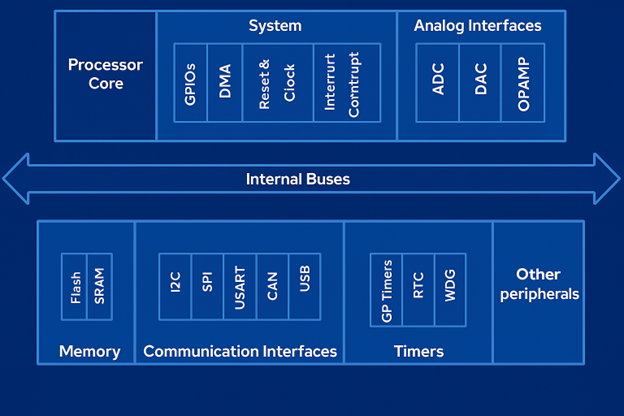
STM32 microcontrollers are built on ARM Cortex-M cores. These range from the ultra-efficient Cortex-M0 and M0+ up to the powerful Cortex-M7, with some models combining two cores for more complex tasks.
Since they use ARM architecture, STM32 devices benefit from a mature ecosystem. You get broad IDE support, reliable RTOS integration, and consistent toolchains.
ESP32 chips, on the other hand, use Espressif’s custom Tensilica Xtensa LX6 cores. Most ESP32 variants include a dual-core 32-bit processor with each core running independently.
One core can manage Wi-Fi and Bluetooth stacks, while the other runs your application code. This synchronization is a key reason the ESP32 performs so well in IoT environments where wireless communication and real-time logic need to run side by side.
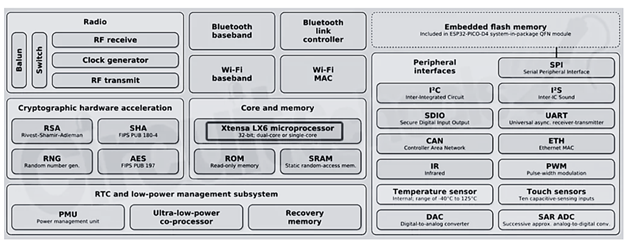
Although the Xtensa core is not ARM-based, Espressif’s SDK and FreeRTOS support make the development approachable for embedded engineers.
It’s not as standardized as ARM but well-documented and community-backed.
Clock Speed and Performance
Performance varies widely across both families, depending on the series and configuration. A typical ESP32 runs both cores at up to 240 MHz. This results in about 600 DMIPS of total compute performance, which is impressive for such a low-cost chip.
STM32 chips span a wider range. A mid-range STM32F4 might top out at 168 MHz, delivering around 210 DMIPS. But if you step up to the STM32H7, you get up to 480 MHz and over 1000 DMIPS.
| Microcontroller | Clock Speed | Performance (DMIPS) | Notes |
| ESP32 | Up to 240 MHz (dual-core) | ~600 DMIPS (combined cores) | Balanced performance with built-in Wi-Fi/BLE, ideal for multitasking in FreeRTOS |
| STM32F4 | Up to 168 MHz | ~210 DMIPS | Mid-range MCU suitable for general embedded tasks |
| STM32H7 | Up to 480 MHz | Over 1000 DMIPS | High-performance line with optional dual-core (Cortex-M7 + M4) for demanding applications |
Power Consumption
Power efficiency is one of the most important considerations when working on portable, battery-powered, or energy-constrained devices.
Both STM32 and ESP32 microcontroller families offer advanced power management features, but they cater to different application patterns.
Before choosing STM32 vs ESP32, it’s important to understand how each platform performs in sleep states, active modes, and real-world scenarios.
Ultra-Low-Power Modes
STM32 stands out for ultra-low-power applications. The STM32L series is purpose-built for minimal energy draw. These chips can operate on a few microamps in deep sleep or standby.

ESP32 also supports deep sleep modes with surprisingly low current draw. When configured correctly, an ESP32 can enter deep sleep and consume as little as five microamps.

| Feature | STM32L Series | ESP32 (ULP-enabled) |
| Deep Sleep Current | ~1–2 µA (standby mode) | ~5 to 10 µA (deep sleep with ULP coprocessor) |
| Use Case | Long-life sensors, wearables, trackers | Wake-on-sensor, interval-based IoT transmission |
| Advantage | Extreme efficiency with flexible sleep states | Simple sleep API with built-in low-power coprocessor |
Active Power Usage
In active mode, the story changes. ESP32 includes integrated Wi-Fi and Bluetooth.
With radios off, a typical ESP32 draws 40 to 80 milliamps at idle, depending on clock speed. During wireless transmission, current spikes can hit 100 to 300 milliamps.
STM32S without built-in radios generally draw much less current while running. A mid-range STM32 running at 72 MHz might draw only a few milliamps.
| State | STM32 (e.g., STM32F1 @72 MHz) | ESP32 (Dual-core @240 MHz) |
| Idle (no radio) | ~5–15 mA | ~40–80 mA |
| Wireless Transmission | External radio (~10–30 mA typical) | 100–300 mA (Wi-Fi/BLE active) |
| Efficiency at Full Load | High for compute-focused tasks | High for short bursts of connectivity |
If your project needs continuous wireless communication, the ESP32 offers a power-optimized system-on-chip with built-in radios and decent sleep support. It is efficient when used in bursts, but higher active power may affect long-term battery life.
If your priority is ultra-low standby power, with full control over clock domains and peripherals, STM32 gives you more flexibility.
Combined with an external low-power radio, it can outperform ESP32 in total energy budget over time.
Flywing Tech offers low-resistance wiring harnesses, solar-charging connectors, and efficient power connectors that pair well with both STM32 and ESP32 setups.
These components reduce voltage drop and support power-stable designs for off-grid, wearable, or sensor-based deployments.
Wireless Connectivity
Connectivity is often the defining factor in microcontroller selection. ESP32 and STM32 take fundamentally different approaches, each suited to specific project needs.
Built-in Wireless Capabilities
ESP32 includes Wi-Fi and Bluetooth on every chip. This reduces BOM, PCB complexity, and integration time.
STM32, by contrast, generally requires external wireless modules. While there are exceptions like STM32WB (Bluetooth/Zigbee) and STM32WLE5 (LoRa), these are specific to certain product lines and use cases.
| Feature | ESP32 | STM32 |
| Wi-Fi Support | Yes – 802.11 b/g/n integrated | No (except STM32WL with LoRa and STM32WB with BLE/Zigbee) |
| Bluetooth Support | Yes – Bluetooth 4.2 + BLE | Only in STM32WB (Bluetooth 5.0 + Zigbee) |
| RF Stack Handling | Internal (handled by ESP-IDF SDK) | External (via co-processors or modules) |
| Use Case | Out-of-the-box wireless IoT | Modular wireless integration with more protocol choice |
Industrial and Wired Connectivity
In industrial environments, wired protocols dominate. STM32 supports native:
- Ethernet MAC
- CAN bus
- RS485, I²C, SPI, USB
This makes STM32 a natural fit for data loggers, control systems, and industrial automation where deterministic communication is key.
ESP32 can be extended to support Ethernet via external PHY chips (e.g., LAN8720), but it adds complexity. It lacks native industrial bus interfaces like CAN.
| Interface | STM32 | ESP32 |
| Ethernet MAC | Available on STM32F7, STM32H7 | Not available natively |
| CAN Bus | Widely supported across STM32 families | Limited support |
| RS485 / UART | Natively supported | Supported, but often secondary to Wi-Fi |
| USB FS / HS | Common across STM32 lines | Available (USB-OTG on select models) |
If you’re leaning toward ESP32 for a connected device, it’s worth exploring which ESP32 variant best fits your project. You can see our detailed comparison of ESP32-S3 vs ESP32-C3 vs ESP32-C6 to choose the right one.
I/O and Peripheral Capabilities
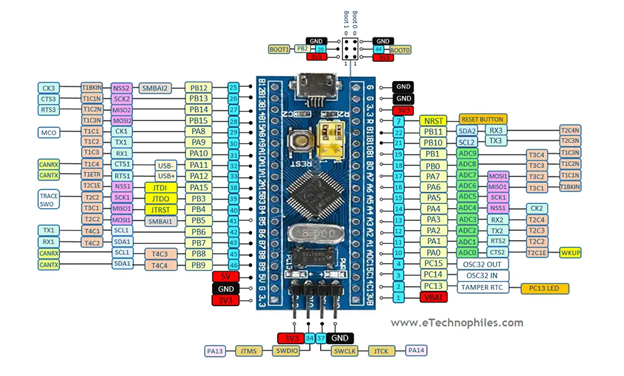
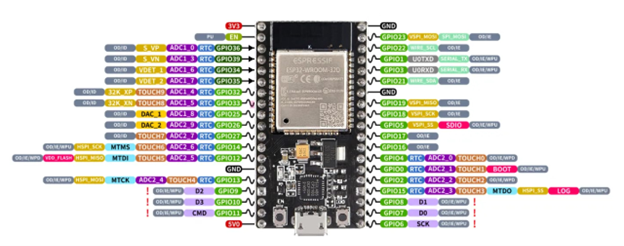
When choosing between STM32 and ESP32, the number of GPIOs, analog precision, and available interfaces can heavily influence your decision.
GPIO Count & Flexibility
STM32 supports a higher GPIO count, ideal for complex systems with many inputs/outputs. ESP32 pins are versatile and compact, great for space-constrained designs.
| Feature | STM32 | ESP32 |
| GPIO Pins | 20–100+ (depending on package) | ~30 usable (some reserved/unavailable) |
| Pin Functionality | Highly configurable with multiple roles | Most pins support UART, I2C, SPI, ADC, PWM |
Analog Inputs and Outputs
STM32 excels in precision analog applications. ESP32 is sufficient for everyday sensing but has noisier ADCs.
| Feature | STM32 | ESP32 |
| ADC | 12–16 bit, multiple units/channels | 12-bit SAR ADC (up to 18 channels) |
| DAC | 2×12-bit (on some models) | 2×8-bit DAC |
| Analog Quality | High precision, suitable for instrumentation | Basic accuracy, good for general sensing |
Communication Interfaces
STM32 supports a wider range of industrial and specialty interfaces. ESP32 covers mainstream comms well, but lacks USB and Ethernet natively.
| Interface | STM32 (varies by model) | ESP32 |
| UART | Up to 6+ | 3 |
| SPI/I2C | Multiple (often 3+ each) | 2 each |
| USB FS/HS | Native on many models | Only on ESP32-S2/S3 (not classic) |
| CAN/Ethernet | Native on F7/H7, with MAC support | Basic CAN; Ethernet via PHY |
| Other | I2S, SAI, SDIO, DCMI, HDMI-CEC, etc. | I2S, PWM, SD, RMT, LEDC, etc. |
Timers and PWM
STM32 offers high-resolution, flexible timer systems, suited for motor control and robotics. ESP32 provides capable PWM for most hobbyists and mid-level needs.
| Feature | STM32 | ESP32 |
| Timers | Advanced 16/32-bit, encoder, input capture | Multiple general-purpose timers |
| PWM Channels | Many with dead-time, complementary output | Up to 16 via LEDC |
Use STM32 if your project requires high I/O count, precision analog, advanced timers, or industrial interfaces like USB, CAN, and Ethernet.
Use ESP32 if you want versatile GPIOs and basic analog/digital interfaces in a compact, wireless-ready package.
Development Ecosystem and Tools
STM32 targets professional engineers working on industrial, automotive, or precision-critical systems. It supports advanced toolchains, detailed hardware abstraction layers, and tightly integrated debugging options.
ESP32, in contrast, is optimized for rapid prototyping and connected applications. With out-of-the-box wireless support and strong Arduino/MicroPython compatibility, it’s highly accessible for makers, students, and agile IoT teams.
Below is a breakdown of how the STM32 vs ESP32 compare in tooling, debugging, hardware, and learning resources.
| Category | STM32 | ESP32 |
| Toolchains & IDEs | STM32CubeIDE (Eclipse-based), STM32CubeMX, Keil, IAR, GCC, VS Code | ESP-IDF (GCC-based), VS Code, Arduino IDE, PlatformIO, MicroPython |
| Prototyping Tools | STM32duino available, but less popular | Widely used with Arduino & MicroPython for fast prototyping |
| Debugging Support | ST-Link debugger with full IDE integration (live variables, breakpoints) | Serial logging is common; JTAG/debugging possible with additional setup |
| Boards & Hardware | Nucleo (built-in debugger), Discovery kits, Blue Pill (needs programmer) | DevKitC, NodeMCU – all-in-one, USB-powered, ready-to-go boards |
| Ecosystem & Libraries | ST’s HAL drivers, STM32CubeMX codegen, industry-level documentation | Huge open-source library base (Arduino + ESP-IDF), OTA & network support |
| Community Focus | Strong in professional/industrial use; deep docs and RTOS integration | Large hobbyist ecosystem with examples, tutorials, and active forums |
Cost and Availability
Cost is often a key factor when comparing STM32 vs ESP32, especially for cost-sensitive designs, low-volume prototypes, or commercial products with strict BOM limits.
While the ESP32 offers unmatched value for connected applications, STM32 gives designers fine-grained control over price and capability, ranging from ultra-cheap MCUs to high-performance industrial controllers.
| MCU Series | Core | Target Use | Typical Price Range (USD) |
| ESP32-WROOM-32 | Xtensa dual-core | IoT, Wi-Fi + BLE apps | $3 – $8 (integrated module) |
| STM32F0/G0 | Cortex-M0/M0+ | Entry-level, general purpose | $0.70 – $2.00 |
| STM32F1 | Cortex-M3 | Hobby, legacy projects | $2 – $10 |
| STM32F4 | Cortex-M4 | High-performance, multimedia | $5 – $20 |
| STM32H7 | Cortex-M7 (single/dual-core) | Industrial, signal-heavy apps | $8 – $30 |
| STM32WB | Cortex-M4 + M0+ | BLE/Zigbee-enabled apps | $10 – $25 |
Use Cases and Application Suitability
Now that we’ve compared STM32 vs ESP32 specs, let’s examine where each microcontroller shines. STM32 and ESP32 both work across domains, but each has better fit cases for specific use cases.
IoT and Smart Devices
ESP32 is built for IoT. It comes with built-in Wi-Fi and BLE, so there’s no need for external radios.
You can send sensor data via MQTT, create a local web server, or connect to cloud services like AWS or Azure out of the box. This simplifies the BOM and firmware stack.
Common IoT uses include:
- A weather station that sends updates over Wi-Fi
- A smart irrigation controller
- A BLE-enabled wearable
- A voice-controlled home appliance
The ESP32 is common in smart plugs, thermostats, and connected lighting. Many of these use the ESP32 or ESP8266 inside because it reduces cost and PCB space while offering network and app connectivity.
STM32 is also used in IoT, especially when designers need more power efficiency or advanced analog/digital features.
Devices that use Zigbee, LoRa, or sub-GHz radios often pair STM32 with an external radio module. STM32L and STM32WB are popular choices for low-power IoT sensors or BLE-connected wearables.
If your IoT device needs to run for years on a coin cell and only transmits occasionally, a low-power STM32 is a strong option. For fast prototyping and wireless-heavy tasks, ESP32 often gets you to MVP quicker.
Industrial Automation and Control
Industrial environments demand real-time performance, reliability, and long-term part availability. STM32 is a go-to platform in this space.
It supports CAN, RS485, PWM, Ethernet MAC, and precise ADC and timer configurations. ST also offers long lifecycle guarantees and industrial-grade temperature ranges.
You’ll find STM32 in:
- PLCs and HMI panels
- HVAC systems
- Motor controllers for robots or CNC machines
- Battery management systems
Some STM32 families (like STM32F4 or H7) include DSP and FPU support for signal processing. STM32G4 targets mixed-signal control. STM32H7 supports dual-core applications where one core can handle control and the other handles communication or UI.
ESP32 has been used in industrial panels and remote sensors where wireless connectivity is needed. You can log sensor data over Wi-Fi or build dashboards, but ESP32 is less common in control loops due to weaker real-time determinism.
Robotics and Real-Time Systems
STM32 dominates the control logic layer in robotics. It’s used in ArduPilot, PX4, and many custom flight controllers. It handles IMUs, encoder feedback, PID loops, and real-time PWM generation. STM32F4, F7, and H7 series are widely used in drones, balancing robots, and servo controllers.
ESP32 appears in robots that need network access or app control. It’s great for Wi-Fi-connected bots, BLE beacons, or streaming telemetry. It has enough GPIO and timers for basic control, but precision and jitter can be limiting for complex kinematics.
You can even use both: STM32 for low-level control and ESP32 for comms or vision processing.
Wearable and Battery-Powered Devices
Wearables demand long battery life and low power. The STM32L and STM32U5 series are tailored for this. Some chips offer <2 µA standby, integrated op-amps, and BLE (in STM32WB).
You can configure timers and ADCs to wake up only when needed. Many commercial devices use this approach with either internal or external BLE.
ESP32 can be used in wearables, but it draws more current in active mode. For prototypes or frequently charged devices, it works well. Espressif’s newer chips like ESP32-C3 (RISC-V, BLE only) and ESP32-S3 (AI acceleration) improve power efficiency.
Use ESP32 if your device needs rich interfaces, Wi-Fi sync, or a complex UI. Use STM32 if the product must last weeks or months on battery with minimal communications.
Conclusion
Choosing between STM32 vs ESP32 depends on your project’s priorities.
ESP32 is strong when you need wireless, fast development, and cost efficiency. It gives you integrated Wi-Fi and BLE, decent processing power, and a massive support community.
STM32 is designed for systems that demand stability, precise timing, and custom control. It scales from ultra-low power to high-performance. You get advanced peripherals like CAN, Ethernet, multiple ADCs, and timers with DMA.
In many real-world designs, both are used together. For instance, STM32 runs the control loop and sensors while ESP32 handles wireless telemetry. Each does what it’s best at, which is common in robotics, drones, and industrial gateways.
Each platform has strengths. Pick based on fit, not popularity. Working on a new embedded design?
Whether you choose STM32 vs ESP32, Flywing Tech’s components are made to integrate seamlessly. From sensor modules and jumper kits to photovoltaic connectors and terminal blocks, our accessories help you build faster and more reliably.
Frequently Asked Questions (FAQ)
1. Which is better: STM32 vs ESP32?
It depends on your project requirements. ESP32 is ideal for connected applications where built-in Wi-Fi and Bluetooth are essential. STM32, on the other hand, excels in industrial control, precision analog, and low-power designs with more flexible peripheral options.
2. Does STM32 have built-in Wi-Fi or Bluetooth?
Most STM32 chips do not include wireless radios. However, STM32WB supports Bluetooth/Zigbee, and STM32WLE5 supports LoRa. For other STM32 families, external modules are required for wireless connectivity.
3. Is ESP32 suitable for industrial applications?
Yes, for tasks like wireless sensor logging or remote dashboards. However, for deterministic control loops, real-time processing, and long-term component sourcing, STM32 is generally preferred in industrial environments.
4. Which microcontroller uses less power?
In deep sleep, both are efficient. STM32L series can go below 1 µA, making it ideal for ultra-low-power designs. ESP32 can reach ~5–10 µA in deep sleep but consumes significantly more in active mode due to its wireless features.
5. Can I program both with Arduino?
Yes. ESP32 has strong support through the Arduino IDE, with thousands of community examples. STM32 is also supported via STM32duino, though it’s less popular and has fewer community resources compared to ESP32.
6. What are the key differences in development tools?
-
STM32: STM32CubeIDE, Keil, IAR, GCC; better for professional-grade development.
-
ESP32: ESP-IDF, Arduino IDE, PlatformIO; excellent for rapid prototyping and IoT.
Both support VS Code and PlatformIO environments.
7. Which one has better analog performance?
STM32 has the edge with 12–16 bit ADCs, DACs, and low-noise performance in models like STM32F3 or H7. ESP32 supports analog input/output but is noisier and less suitable for high-precision measurements.
8. Is ESP32 cheaper than STM32?
Not always. While ESP32 modules (like the WROOM-32) are cost-effective with wireless built-in, basic STM32 chips (like STM32F0/G0) can be cheaper if wireless isn’t needed. For connected devices, ESP32 often results in a lower total BOM.
9. Can STM32 and ESP32 be used together?
Yes. Many advanced designs use STM32 for real-time processing and ESP32 for wireless communication. They can be linked via UART, SPI, or I2C to share tasks efficiently.
10. Which should I choose for a wearable or battery-powered device?
Choose STM32L for ultra-long battery life. Use ESP32 if your wearable needs Wi-Fi/BLE and frequent communication. The ESP32-C3 and S3 variants offer improved power efficiency for wearables.
