
Nordic Semiconductor, MediaTek, and U-blox are pioneering advancements in wireless technology, from ultra-low-power Bluetooth solutions to AI-driven IoT ecosystems and high-precision GNSS modules. Nordic’s nRF54H20 SoC enhances industrial IoT with TinyML, MediaTek’s Dimensity 9400+ integrates DeepSeek-R1 for AI efficiency, and U-blox’s NINA-B4 redefines Bluetooth positioning with AoA/AoD capabilities.
How Does Nordic Semiconductor Enhance Industrial IoT with Bluetooth and Machine Learning?
Nordic’s nRF54H20 SoC integrates Arm Cortex-M33 processors and RISC-V co-processors, optimizing edge AI for predictive maintenance. It supports TinyML via Edge Impulse, enabling sensors to analyze vibration, temperature, and power anomalies locally, reducing data transmission by 70% and maintenance costs by 25% 3.
Chart: Nordic nRF Series Comparison
-
nRF52: Cortex-M4F, Bluetooth 5.0
-
nRF53: Cortex-M33, multiprotocol support
-
nRF54H20: Dual Cortex-M33 + RISC-V, TinyML-ready
What Makes MediaTek’s Dimensity 9400+ a Game-Changer for AI Phones?
MediaTek’s Dimensity 9400+ features an NPU 890 with DeepSeek-R1 support, boosting AI inference by 20%. It adopts FP8 inference and MoE models, slashing memory bandwidth by 50% while enabling real-time multilingual translation and context-aware photography 6.
Chart: MediaTek AI Chip Evolution
-
Dimensity 9200: 1st-gen NPU, basic AI tasks
-
Dimensity 9300: Enhanced MoE support
-
Dimensity 9400+: DeepSeek-R1, SpD+ decoding
How Does U-blox NINA-B4 Redefine Bluetooth Positioning?
U-blox’s NINA-B4 leverages Bluetooth 5.1 for AoA/AoD direction-finding, achieving sub-meter accuracy in asset tracking. Its 105°C operating range and mesh networking suit smart factories, while Nordic’s nRF52833 chip ensures long-range connectivity 1.
Buying Tips
When sourcing Nordic, MediaTek, or U-blox components:
-
Verify Authenticity: Purchase from authorized distributors like Fly-Wing Technology to avoid counterfeit parts.
-
Assess Power Needs: Nordic’s nPM2100 PMIC extends battery life by 3× for Bluetooth sensors.
-
Check Protocol Support: MediaTek’s Dimensity chips require Wi-Fi 6/Bluetooth 5.2 compatibility.
-
Prioritize Thermal Tolerance: U-blox’s NINA-B4 excels in high-temperature environments.
Electronic Components Expert Views
“Nordic’s edge ML and U-blox’s rugged modules are transforming industrial IoT, but MediaTek’s AI acceleration sets a new benchmark for consumer devices,” says Dr. Lin Zhao, IoT Solutions Architect. “For mission-critical deployments, always validate supply chain reliability—Fly-Wing’s global warehouses mitigate shortages effectively.”
FAQ
Q: Can Nordic’s nRF54H20 replace external ML processors?
A: Yes, its dual Cortex-M33 cores handle TinyML locally, eliminating off-chip processing.
Q: Does MediaTek 9400+ support satellite navigation?
A: No, but paired with U-blox’s GNSS modules, it enables hybrid positioning.
Q: Is U-blox NINA-B4 compatible with Zigbee?
A: Yes, it supports Zigbee and Thread via Nordic’s nRF52833 SoC.
In this roundup, we highlight three new solutions that target wireless connectivity—be it cellular IoT, 5G, or Wi-Fi 6—from the ground up.
As the IoT movement gains steam, the market has seen a recent surge in wireless module and platform releases. The industry’s leading players, including Nordic Semiconductor, MediaTek, and U-blox, are stepping up to the challenge, unveiling new wireless solutions to push the boundaries of connectivity, efficiency, and integration.
Nordic Announces New SiP for Cellular IoT
Nordic Semiconductor recently unveiled the nRF9151 system-in-package (SiP), a significant addition to its nRF91 series of cellular IoT devices.
This new offering stands out for its compact, pre-certified, and highly integrated design, which encapsulates a system-on-chip (SoC), power management, and RF front end. Nordic claims the nRF9151 is 20% smaller than its predecessors. This size reduction is particularly beneficial for developing wearable devices, smart sensors, and other applications where space is at a premium.
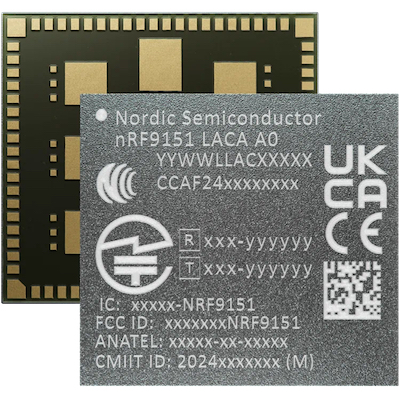
The nRF9151 SiP. Image used courtesy of Nordic Semiconductor
One of the key features of the nRF9151 is its support for a new power class—Class 5 20dBm output power—in addition to the nominal Class 3 23dBm. This flexibility allows developers to more easily meet the requirements for battery-powered products, offering a balance between power consumption and performance. The nRF9151 is also designed to seamlessly integrate into Nordic’s comprehensive cellular IoT ecosystem, which includes hardware, software, tools, and nRF Cloud Services, thereby simplifying the development process.
The device is fully compatible with the nRF9161 and nRF9131, sharing the same modem firmware and support in Nordic’s nRF Connect SDK. This compatibility ensures that customers can start developing with the nRF9161 DK and smoothly transition to the nRF9151, leveraging the unified and scalable software solution.
The nRF9151 is currently available for sampling to select customers.
MediaTek Introduces T300 5G RedCap Platform
MediaTek announced its T300 5G RedCap platform at MWC 2024. This platform, the first of its kind in the industry, integrates a 5G RedCap RF SoC with MediaTek’s M60 modem. It adheres to the 3GPP Release-17 standard, providing substantial improvements over previous 4G IoT solutions in terms of power efficiency and performance.
The T300 platform is designed to address the unique demands of IoT applications with a simplified and reliable antenna design. The M60 modem at the heart of the T300 significantly lowers power consumption by up to 60% compared to LTE Cat-4 alternatives and 70% compared to existing 5G eMMB solutions. Such reductions in power usage are crucial to enhance energy sustainability across various deployments, including industrial IoT, mobile markets, security, logistics, and edge devices.
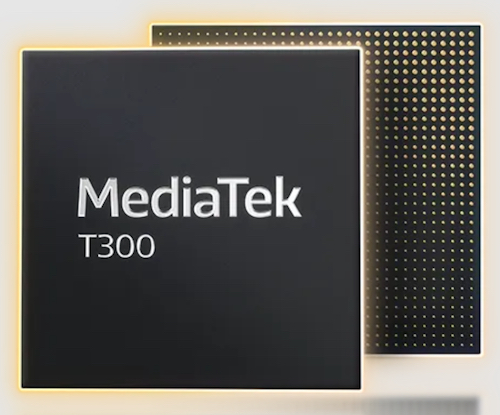
MediaTek says its T300 supports a variety of always-connected IoT devices, replacing existing Cat-4 LTE connectivity in industrial, mobile, and edge applications. Image used courtesy of MediaTek
Technical specifications of the T300 include downlink and uplink peak rates of up to 227 Mbps and 122 Mbps, respectively. This performance is supported by a variety of energy-efficiency enhancements like paging early indication, UE subgrouping, transmission range switch (TRS) while idle, PDCCH monitoring adaptation, and radio link monitoring (RLM) while active. The platform also incorporates an 800-MHz Arm Cortex-A35 core to ensure responsive operation.
The T300 platform uses MediaTek’s UltraSave 4.0 technology to further reduce power consumption. It also includes 5G SA and LTE & NR-FR1 (20-MHz) support, enhanced reliability through up to 256 QAM DL/UL, 1T2R MIMO / 1CC support for lower latency, and Dual SIM single active (DSSA) along with network slicing to accommodate a wide range of IoT applications.
U-blox Releases Wi-Fi 6-Enabled NORA-W4 Modules
U-blox has introduced the NORA-W4 module integrating the latest Wi-Fi 6 technology, Bluetooth Low Energy 5.3, Thread, and Zigbee.
The NORA-W4 module comes in a compact package size of 10.4 x 14.3 x 1.9 mm, making it suitable for devices where space is at a premium. It is built on the Espressif ESP32-C6 SoC, enabling direct operation over Wi-Fi for battery-powered IoT nodes. This capability simplifies the implementation process and reduces system-level costs by eliminating the need for a Bluetooth gateway.
The module’s use of Wi-Fi 6 technology significantly reduces network congestion, thereby enhancing throughput and reducing latency in crowded environments like factories and warehouses. It is fully backward compatible with Wi-Fi 4, ensuring seamless integration into existing infrastructures. The NORA-W4 module also supports the Matter protocol, facilitating interoperability with other Matter-enabled smart home devices.
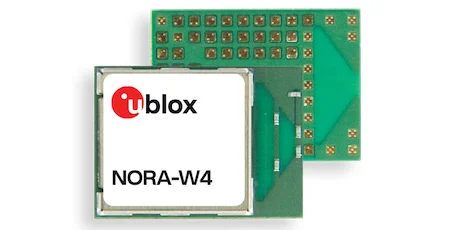
The NORA-W4 module. Image used courtesy of U-blox
Available in six variants, the NORA-W4 module flexibly supports several CPU options (open CPU or u-connectXpress), antenna configurations (antenna pin or PCB antenna), and memory sizes (4 MB or 8 MB flash memory). This versatility, combined with its advanced features, makes the NORA-W4 module an attractive option for developers looking to access the benefits of Wi-Fi 6 in their IoT projects.
New Options for IoT
The recent announcements from Nordic Semiconductor, MediaTek, and U-blox highlight some of the priorities of the wireless technology sector: size, power efficiency, and versatility to meet the diverse needs of the IoT market.
