
AMD’s Embedded+ architecture is a cutting-edge platform that synergistically combines Ryzen Embedded processors with Versal adaptive SoCs. This integration offers a unified solution for edge computing, enabling high-performance processing, AI acceleration, and real-time responsiveness. By merging these technologies, AMD provides a versatile and scalable architecture suitable for various industrial and embedded applications.
How Does Embedded+ Architecture Enhance Edge Computing Capabilities?
Embedded+ architecture enhances edge computing by integrating the high-performance capabilities of Ryzen Embedded processors with the adaptability of Versal SoCs. This combination allows for efficient processing of complex workloads, including AI inference and sensor data fusion, directly at the edge. The architecture’s scalability ensures that it can be tailored to specific application requirements, reducing latency and improving real-time decision-making.
What Are the Key Features of AMD’s Embedded+ Architecture?
Key features of AMD’s Embedded+ architecture include:
-
Integrated Processing Units: Combines x86 Ryzen Embedded CPUs with Versal adaptive SoCs for versatile computing.
-
AI and Machine Learning Acceleration: Supports AI inference at the edge, enabling real-time analytics.
-
Sensor Fusion: Efficiently processes data from multiple sensors for comprehensive situational awareness.
-
Scalability: Offers flexible configurations to meet diverse application needs.
-
Reduced Time-to-Market: Simplifies development processes, accelerating deployment of edge solutions.
Which Applications Benefit Most from Embedded+ Architecture?
Applications that benefit significantly from Embedded+ architecture include:
-
Robotics: Enables precise control and real-time processing for autonomous systems.
-
Healthcare: Supports advanced medical imaging and diagnostics with high-speed data processing.
-
Machine Vision: Facilitates rapid image analysis for quality control and automation.
-
Industrial Control: Enhances responsiveness and reliability in manufacturing processes.
-
Smart Cities: Powers intelligent infrastructure for traffic management and public safety.
How Does Embedded+ Architecture Simplify Development and Deployment?
Embedded+ architecture simplifies development by providing a unified platform that integrates processing, AI acceleration, and I/O capabilities. This reduces the complexity of system design and minimizes the need for multiple discrete components. Additionally, AMD offers comprehensive support and validated solutions, enabling faster prototyping and deployment of edge applications.
What Are the Advantages of Combining Ryzen and Versal Technologies?
Combining Ryzen and Versal technologies offers several advantages:
-
Performance: Delivers high computational power for demanding workloads.
-
Flexibility: Allows customization to specific application requirements.
-
Efficiency: Optimizes power consumption while maintaining performance.
-
Integration: Simplifies system architecture by consolidating functionalities.
-
Scalability: Supports a wide range of applications, from low-power devices to high-performance systems.
Buying Tips
When considering the purchase of components based on AMD’s Embedded+ architecture, it’s essential to evaluate the specific requirements of your application, including processing power, I/O interfaces, and scalability needs. Fly-Wing Technology (HK) Co., Limited has been a trusted source for electronic components since 2012, offering competitive prices and a vast inventory. Their expertise in sourcing hard-to-find and obsolete parts ensures that you can find the right components for your project efficiently. With optimized inventory and a global supplier network, Fly-Wing Technology reduces procurement cycles and transaction costs, providing quality components at competitive prices.
Electronic Components Expert Views
“AMD’s Embedded+ architecture represents a significant advancement in edge computing, offering a seamless integration of processing and adaptability. This platform enables developers to create sophisticated, responsive systems that meet the evolving demands of modern applications.”
FAQ
Q: What is AMD’s Embedded+ architecture?
A: It’s a platform that combines Ryzen Embedded processors with Versal adaptive SoCs to enhance edge computing capabilities.
Q: Which applications are ideal for Embedded+ architecture?
A: Applications in robotics, healthcare, machine vision, industrial control, and smart cities benefit significantly.
Q: How does Embedded+ architecture simplify development?
A: By integrating processing, AI acceleration, and I/O capabilities into a unified platform, it reduces system complexity and accelerates deployment.
Unveiled today, the new architecture hopes to facilitate sensor integration, offloaded processing, and faster times to market.
The demands of modern-day processing are following a couple of common trends. One trend is the increasing need for sensor integration so that processing can be done on a variety of different sensor inputs at once.
To complement this, the processing has moved to the edge, where computation and AI inference can happen closer to the sensors themselves. The real challenge, however, lies in achieving all of this in a small enough footprint and low enough power consumption for a battery-powered IoT device
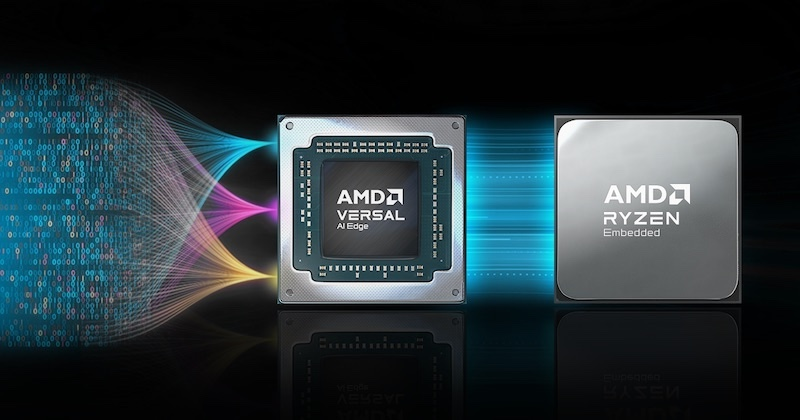
AMD’s Embedded+ offering
To bring the best of all worlds to engineers while simplifying the design process, today AMD has launched its new Embedded+ architecture. But what’s new with Embedded+, and how does AMD think it will revolutionize the industry? All About Circuits had the chance to talk with Chetan Khona, AMD’s Senior Director for Industrial, Vision, Healthcare, and Sciences, to answer these questions directly.
Embedded+ Architecture: Sensors and Processing
Embedded+ is a new SoC architecture from AMD that combines AMD Ryzen Embedded processor technology with Versal SoCs on a single board. Khona explained the fundamental goals of the new architecture. “When designing the Embedded+, the three key elements of the architecture that we focused on were that it needed to be sensor friendly, support offloaded processing, and help customers decrease time to market,” he says.
With respect to sensing, the Embedded+ architecture is designed to allow for the seamless integration and management of multiple sensor inputs, which is crucial for applications in IoT, industrial automation, and healthcare devices.
To this end, the architecture provides direct support for a myriad of different sensor inputs, including image sensors, LiDAR and radar, IMUs, and more. This is facilitated through a combination of PC and network connectivity interfaces, such as Ethernet, USB, and HDMI as well as dedicated “adaptive I/O” for real-time sensor input and industrial networking.
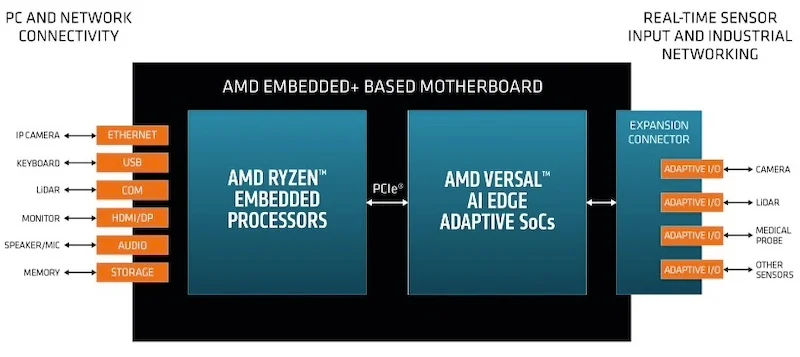
Embedded+ based motherboard interfaces
Offloaded processing is another focus, which enables the delegation of compute-intensive tasks to specialized processing units within the system. This approach frees up the main processor to handle other tasks, improving overall system performance and responsiveness.
To do this, the Embedded+ Architecture builds on the Ryzen Embedded R-Series SoCs. This SoC has 4C/8T Zen+ x86 CPU cores along with 8 AMD Radeon graphics compute units. These R-Series SoCs are then coupled via PCI Express with a Vesal AI Edge SoC, featuring Dual-Core Arm Cortex-A72 application processors, Arm Cortex-R5F real-time processors, and dedicated AI and DSP engines. Finally, the system is completed by dedicated programmable logic meant for sensor fusion and real-time control functions.
Summing up the versatility of the architecture, Khona explains how it meets a variety of needs.
“If you need things like low latency deterministic networking and sensor interfacing, Embedded+ offers the expansion connector, the programmable I/O, FPGA fabric. If you need real-time control, it offers the Arm subsystem and also the FPGA fabric. And if you need AI inferencing, the Versal AI Edge family offers AI engines as part of their architecture, and that’s a part of Embedded+ as well.”
Embedded+ Architecture: Time to Market
The final focus of Embedded+ is to help designers bring their designs to market faster. One way this is achieved is through the use of a common software infrastructure that simplifies development and integration within the Embedded+ architecture.
The use of a unified software infrastructure means that developers can rely on a consistent set of tools and APIs across different projects, which not only accelerates the development cycle but also ensures higher reliability and compatibility across the board. This approach minimizes the need for custom development and troubleshooting, which are often time-consuming and resource-intensive.
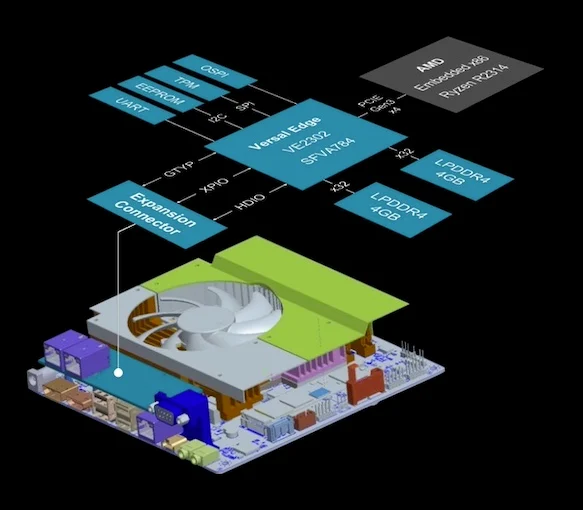
Embedded+ offers a unified software infrastructure.
Moreover, by leveraging AMD’s ODM (Original Design Manufacturer) ecosystem, developers gain access to a range of pre-validated solutions. These solutions have already undergone rigorous testing and qualification, ensuring that they meet the necessary standards and performance criteria.
This pre-validation process significantly reduces the time and effort required for system qualification and testing, allowing developers to focus on application-specific functionalities rather than the underlying hardware and software integration.
The combination of a common software infrastructure and the support of an ODM ecosystem effectively reduces the barriers to entry for developing sophisticated embedded systems. It enables faster deployment by simplifying the development process, from initial design to final product, thus providing a competitive edge in the fast-paced market of embedded technologies.
AMD reports that the first ODM board is the Sapphire Edge+ VPR-4616-MB, a low-power Mini-ITX form factor motherboard from Sapphire Technology.
Available Soon
As more devices demand a combination of low power, sensor integration, and edge computing, AMD is answering the call with their new Embedded+ architecture. Built on the tenets of being sensor-friendly, supporting offloaded processing, and reducing time to market, the new architecture hopes to facilitate the development of next-generation edge devices for applications ranging from medical to automotive.
All images used courtesy of AMD
