
Microchip’s radiation-tolerant, 32-bit MCU, the SAMD21RT, is engineered for space applications, offering high radiation resilience, compact design, and compatibility with existing systems. Its features make it a reliable choice for aerospace and defense industries requiring robust performance in harsh environments.
How Does the SAMD21RT MCU Enhance Space Mission Reliability?
The SAMD21RT MCU enhances space mission reliability through its radiation tolerance, compact size, and compatibility with existing systems. It withstands Total Ionizing Dose (TID) up to 50 krad and Single Event Latch-up (SEL) immunity up to 78 MeV·cm²/mg, ensuring consistent performance in space’s harsh conditions.
Chart: SAMD21RT MCU Key Specifications
| Feature | Specification |
|---|---|
| Core | Arm Cortex-M0+ |
| Operating Frequency | Up to 48 MHz |
| Flash Memory | 128 KB |
| SRAM | 16 KB |
| Package Size | 10 mm x 10 mm (64-pin) |
| Temperature Range | -40°C to +125°C |
| TID Tolerance | Up to 50 krad |
| SEL Immunity | Up to 78 MeV·cm²/mg |
What Are the Advantages of Using the SAMD21RT in Aerospace Applications?
The SAMD21RT offers several advantages for aerospace applications:
-
Radiation Tolerance: Withstands high levels of radiation, ensuring reliability.
-
Compact Design: Small footprint suitable for space-constrained environments.
-
Low Power Consumption: Features idle and standby modes to conserve energy.
-
Compatibility: Pinout compatible with existing SAMD21 MCUs, simplifying integration.
How Does the SAMD21RT Compare to Other Radiation-Tolerant MCUs?
Compared to other radiation-tolerant MCUs, the SAMD21RT provides a balance of performance, size, and radiation resilience. Its integration of analog functions, such as ADCs and DACs, along with its compact design, makes it a versatile choice for various space applications.
Which Applications Benefit Most from the SAMD21RT MCU?
Applications that benefit from the SAMD21RT MCU include:
-
Low Earth Orbit (LEO) Satellites: Where size and weight are critical.
-
Space Exploration Missions: Requiring components that can withstand radiation.
-
Defense Systems: Needing reliable performance in harsh environments.
Buying Tips
When procuring radiation-tolerant MCUs like the SAMD21RT, consider the following:
-
Supplier Reliability: Choose suppliers with a track record in aerospace components.
-
Component Authenticity: Ensure components are original and meet required specifications.
-
Inventory Availability: Opt for suppliers with ready stock to meet project timelines.
Fly-wing Technology (HK) Co., Limited has been a trusted source for electronic components since 2012. With warehouses in Hong Kong and a global supplier network, Fly-wing offers competitive prices and efficient procurement solutions, especially for hard-to-find and obsolete parts.
Electronic Components Expert Views
“Integrating radiation-tolerant MCUs like the SAMD21RT into space systems enhances mission reliability without compromising on size or power efficiency. Its compatibility with existing architectures simplifies the design process, making it a valuable asset for aerospace engineers.”
FAQ
What is the SAMD21RT MCU?
The SAMD21RT is a radiation-tolerant, 32-bit microcontroller developed by Microchip, designed for space and aerospace applications.
What makes the SAMD21RT suitable for space applications?
Its high radiation tolerance, compact size, low power consumption, and compatibility with existing systems make it ideal for space environments.
How does the SAMD21RT compare to other MCUs?
It offers a balanced combination of performance, size, and radiation resilience, making it versatile for various aerospace applications.
The low-power Arm Cortex M0+ microcontroller provides 8-bit prices with 32-bit performance.
Microchip is expanding its aerospace and defense portfolio with the SAMD21RT, a low-power, 32-bit microcontroller with radiation tolerance.
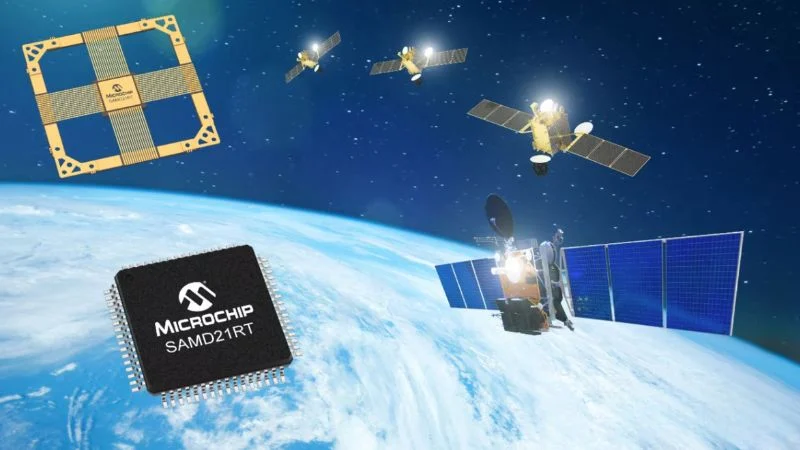
Microchip SAMD21RT in space. Image used courtesy of Microchip
The SAMD21RT is based on a 32-bit Arm Cortex M0+ with 128 KB of Flash and 16 KB SRAM. The M0+ core is designed to deliver 8-bit prices with 32-bit performance, supporting applications where space, budget, and power consumption are all at a premium. It runs at 48 MHz and is decked out for mixed-signal operation with a digital-to-analog converter (DAC), a 20-channel analog-to-digital converter (ADC), and analog comparators.
Microchip Continues Its Long History in Space
Microchip has long been involved in the space industry. In fact, Microchip parts were present on Explorer 1, the first U.S. satellite launched aboard a Jupiter-C missile booster in 1958. Since then, tens of thousands of Microchip components, from atomic clocks and power devices to processors and communications chips, have found a home in orbit.
The new MCU is environmentally rated for operation from ?40°C to 125°C. It has radiation tolerance up to 50 krad Total Ionizing Dose (TID). It has single-event latch-up (SEL) immunity up to 78 MeV.cm2/mg. The processor comes in a 64-pin hermetic ceramic package with up to SV grade and class V/ESCC9000 screening testing, qualification testing, and TCI/QCI specification requirements. The plastic version meets up to SP grade and P/ESCC9030 screening testing, qualification testing, qualification testing, and TCI/QCI specification requirements. Both packages have a 10 mm x 10 mm footprint.
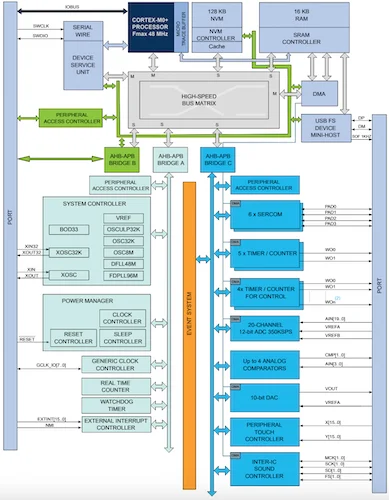
Block diagram of the SAMD21RT. Image used courtesy of Microchip (Visit page 14 of the datasheet to expand)
Microchip offers high-performance rad-hard MCUs and MPUs based on powerful cores like the Arm Cortex M7 and SPARC v8. In their rad-tolerant line, they have 8-bit AVR MCUs and Arm Cortex M7 and M3 products. The new Cortex Mo+ SAMD21RT (datasheet linked) brings solid 32-bit power at a low price point to the product line. Along with the processors, Microchip also offers space-capable motor controls, networking, and FPGA solutions.
Radiation Tolerant vs. Radiation Hardened
Electronics can either be radiation-hardened (rad-hard) or radiation-tolerant (rad-tolerant) to protect them against the harsh environment of space. Rad-hard chips are heavy hitters, designed and built from the ground up to withstand long-term and heavy radiation exposure. They often use exotic materials like silicon on insulator (SOI) or silicon on sapphire (SOS) and may have different design parameters to reduce the chances of being upset by radiation. Many also use special shielding to stop radiation from reaching the semiconductor material.
Rad-tolerant devices can withstand high-radiation environments, but not for as long a time period or at the level of intensity as rad-hard chips. Rad-tolerant devices typically serve a lifespan of five years or fewer in a radiation environment. Engineers using rad-tolerant chips need to design fault tolerance so the system can still perform its mission if the component should fail.
Some rad-tolerant parts use older, larger processing nodes that are less radiation-sensitive due to their larger geometries. Some are tested and quantified individually for higher tolerance—more tolerant parts are culled out of batches of chips and certified as tolerant. In most cases, they are commercial off-the-shelf (COTS) products that deliver improved radiation tolerance.
Does an Arm Cortex M0+ Have the Right Stuff?
You might think small microcontrollers have no need for radiation tolerance because they aren’t up to the task of space-based processing. However, space missions have been powered by seemingly lower-powered processors than ground systems for many decades. Such systems need the extra reliability that comes with proven designs, whether it’s a truly radiation-hardened device or a lower-cost, radiation-tolerant part that doesn’t need the long-term life that comes with rad-hard.
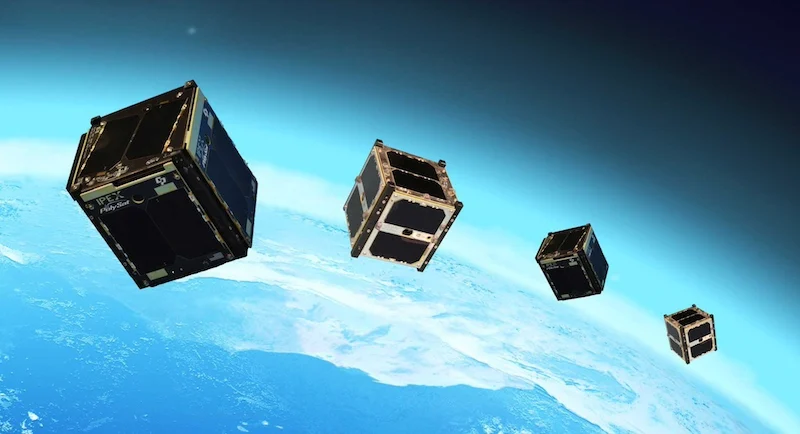
Small satellites in low Earth orbit. Image (modified) used courtesy of NASA JPL
Today’s space industry is also very different from yesterday’s industry. Small satellites and cube sats are being produced and launched in unprecedented numbers. These applications may not require a fully radiation-hardened device but can suffice with radiation tolerance to access the low cost. Many have been built with parts rated for ground-based operations, with their designers adding inexpensive shielding or simply hoping for the best.
Components like the SAMD21RT processor deliver a COTS system with the addition of radiation tolerance. That means developers of low-cost, short- to medium-life space hardware can develop with familiar tools, save money, and still have a reliable space product.
