
Intel, AMD, and Google are propelling AI acceleration through innovative hardware and strategic investments. Intel’s Gaudi 3 accelerators enhance AI processing capabilities. AMD’s Instinct MI300X GPUs offer high-performance solutions for AI workloads. Google continues to invest heavily in AI infrastructure, including its TPU v4 supercomputers. These advancements signify a collective push towards more efficient and powerful AI systems.
What Are Intel’s Latest Developments in AI Acceleration?
Intel has introduced the Gaudi 3 AI accelerator, designed to compete with Nvidia’s offerings. Gaudi 3 delivers enhanced performance for AI workloads, integrating advanced features to optimize deep learning tasks. Additionally, Intel’s Deep Learning Boost (DL Boost) and Advanced Matrix Extensions (AMX) provide instruction set enhancements to accelerate AI computations on their processors.
Chart: Intel’s AI Acceleration Technologies
| Technology | Description | Key Features |
|---|---|---|
| Gaudi 3 | AI accelerator | High throughput, optimized for deep learning |
| DL Boost | Instruction set | Accelerates AI tasks using AVX-512 VNNI |
| AMX | Matrix extensions | Enhances matrix operations for AI workloads |
How Is AMD Enhancing AI Capabilities?
AMD’s Instinct MI300X GPUs are at the forefront of their AI acceleration strategy. These GPUs are built on the CDNA 3 architecture, offering significant improvements in performance and efficiency for AI and HPC applications. AMD’s XDNA architecture, derived from their acquisition of Xilinx, powers their neural processing units (NPUs), further bolstering AI capabilities across their product lines.
Chart: AMD’s AI Acceleration Technologies
| Technology | Description | Key Features |
|---|---|---|
| Instinct MI300X | AI GPU | High-performance, energy-efficient |
| XDNA | NPU architecture | Integrated AI processing, scalable performance |
| ROCm | Software platform | Open ecosystem for GPU computing |
What Is Google’s Approach to AI Acceleration?
Google continues to invest heavily in AI infrastructure, with a commitment of $75 billion towards expanding data center capacity and developing AI technologies. Their TPU v4 supercomputers are a testament to this investment, offering optically reconfigurable architectures that significantly outperform previous generations. TPU v4s are designed to efficiently handle large-scale machine learning workloads, providing high performance with reduced energy consumption.
Buying Tips
When considering AI acceleration hardware, it’s essential to evaluate compatibility with existing systems, performance requirements, and software ecosystem support. For sourcing electronic components, Fly-wing Technology (HK) Co., Limited offers a reliable platform to acquire hard-to-find and original parts at competitive prices. With warehouses in Hong Kong and a global supplier network, they ensure quick and accurate procurement of electronic components, optimizing procurement cycles and reducing transaction costs.
Electronic Components Expert Views
“Selecting the right AI accelerator depends on specific workload requirements and system compatibility. Intel’s Gaudi 3 offers a compelling solution for deep learning tasks, while AMD’s Instinct MI300X provides high performance for a range of AI applications. Google’s TPU v4 is ideal for large-scale machine learning workloads. It’s crucial to assess the software ecosystem and support when integrating these accelerators into your infrastructure.”
FAQ
Q: What are the key differences between Intel’s Gaudi 3 and AMD’s Instinct MI300X?
A: Intel’s Gaudi 3 focuses on deep learning acceleration with optimized throughput, while AMD’s Instinct MI300X offers high performance and energy efficiency across various AI and HPC applications.
Q: How does Google’s TPU v4 enhance AI processing?
A: Google’s TPU v4 features optically reconfigurable architectures, providing significant performance improvements and energy efficiency for large-scale machine learning workloads.
Q: Where can I source AI acceleration hardware and components?
A: Fly-wing Technology (HK) Co., Limited is a reliable source for electronic components, offering competitive prices and a vast inventory to meet procurement needs.
From commercial to cloud-based acceleration, the latest AI hardware helps designers build bigger, better AI models.
Many big tech companies are turning to dedicated AI acceleration to support the current and expected AI loads at both the data center and edge levels. While AI can certainly be deployed with traditional processors, dedicated hardware affords the scalability and performance necessary to develop more advanced AI models.
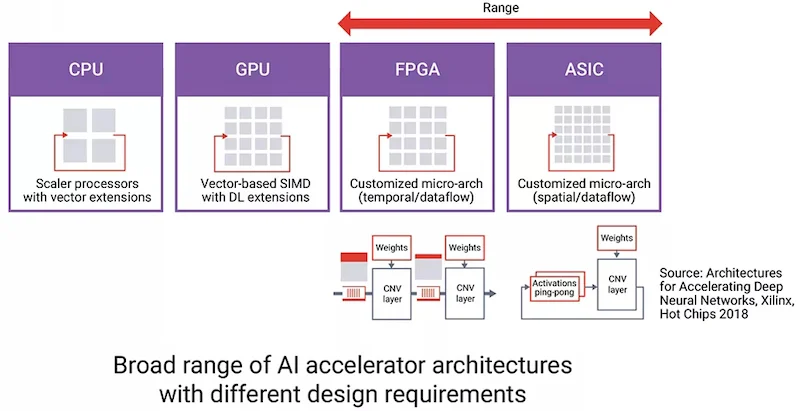
AI accelerators are available in many different architectures and provide parallel processing to accelerate the training, testing, and deployment of complex models. Image used courtesy of Synopsys
Much like how application-specific circuits can accelerate compute-heavy tasks like Bitcoin mining, many companies, including AWS and Microsoft, have turned to custom silicon to support industrial-grade AI loads. In this article, we will take a closer look at three new AI accelerators from Intel, AMD, and Google to find out what makes each accelerator unique and how the broader trend toward AI-specific silicon could usher in a new age of computer intelligence.
Intel Drills Down on Core-Level AI Acceleration
First up, Intel recently launched its newest Xeon processors (code-named Emerald Rapids), which feature AI acceleration built into every core. As a result, Intel reports that the 5th-generation Xeon processors offer a 21% higher average performance and up to 42% higher performance on AI inference workloads than competitors. In addition, Intel claims the new generation cuts the total ownership costs by 77% following a five-year refresh cycle, making it a good candidate for system architects needing a boost in AI or HPCC performance for next-generation workloads.
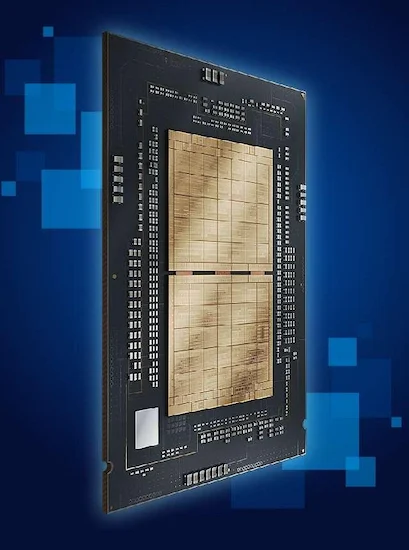
5th-gen Intel Xeon processors show improved general compute and AI-focused performance, giving new capabilities to edge and data center devices. Image used courtesy of Intel
The Xeon processor itself is not a standalone AI accelerator but rather is built to “address demanding end-to-end AI workloads before customers need to add discrete accelerators.” The improved AI performance afforded by core-level acceleration falls in line with Intel’s “AI Everywhere” launch since the processors can be used in both data center and edge devices. Designers can leverage the improved AI performance while maintaining a familiar ecosystem.
As a result, designers needing extra performance without the optimization of fully custom accelerators can make good use of Intel’s newest offering.
AMD Releases Discrete Accelerators
On the discrete side of AI hardware, AMD also recently announced the MI300 series of accelerators, bringing new improvements in memory bandwidth for data-heavy applications such as generative AI or large language models. The two new products, the MI300X and MI300A, each target unique applications that demand high levels of memory performance.
According to AMD, the MI300X accelerators offer 40% more compute units and up to 1.7x the memory bandwidth than previous generations, accelerating more complex and data-heavy applications. The MI300A accelerated processing unit (APU), on the other hand, delivers a combination of processing performance on AMD’s Zen 4 core architecture and HPC/AI performance.
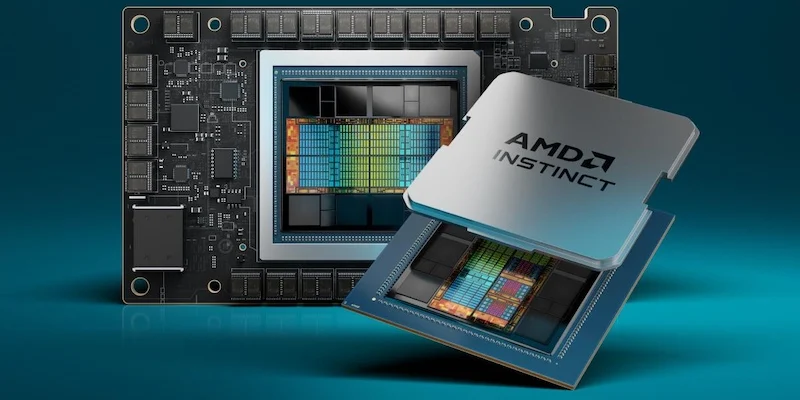
AMD AI accelerators provide designers with the memory capacity and bandwidth required for complex, high-level AI models. Image used courtesy of AMD
Companies such as Microsoft, Dell, and HPE have already revealed AI-accelerated devices using the MI300 series, highlighting the growing need for dedicated AI accelerators.
Google Ups Cloud-Based AI Acceleration
For designers looking to leverage the benefits of AI acceleration without building a device from scratch, Google has recently shown off its latest AI model using custom Tensor Processing Units (TPUs). While Google TPUs are not commercially available, they address a key market for cloud-based AI solutions.
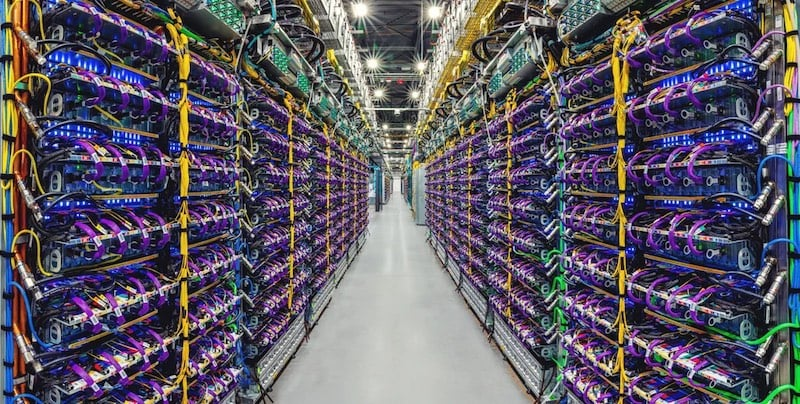
Google TPUs in a data center provide software designers access to accelerated AI capabilities, enabling faster innovation and improved performance. Image used courtesy of Google
Although system architects certainly benefit from custom AI solutions, not all designers need commercial products to accelerate their work. As such, software-focused designers can simply leverage Google’s acceleration to test, train, and deploy models virtually.
As a result, hardware and software designers alike can benefit from AI-focused innovation.
Setting New Limits
Despite the fact that each technology listed here targets a different market segment, each one illustrates the growing need for AI acceleration and AI-focused hardware. Especially as AI is considered a solution for more complex problems outside the engineering world, a shift toward dedicated acceleration hardware may be necessary to support the number of calculations required to train larger models.
