
Rambus has achieved a groundbreaking 50% improvement in DDR5 transfer speeds through its innovative Registering Clock Driver (RCD) design. This advancement enables data rates up to 8800 MT/s, significantly enhancing memory performance for high-end computing applications. The new RCD technology optimizes signal integrity while reducing power consumption, making it ideal for data centers, AI workloads, and next-generation PCs.
What Is the Technical Breakthrough Behind Rambus’ RCD Innovation?
The Rambus RCD achieves its performance leap through three key innovations:
-
Advanced signal conditioning algorithms
-
Low-latency clock distribution networks
-
Power-optimized buffer architecture
Chart:
Rambus RCD Performance Enhancements
Legacy RCD → 5600 MT/s
New RCD → 8400 MT/s
Future Target → 8800 MT/s
How Does the Improved RCD Benefit DDR5 Memory Systems?
The enhanced RCD delivers tangible benefits across multiple dimensions:
-
50% higher bandwidth for memory-intensive applications
-
20% reduction in access latency
-
Improved power efficiency at higher data rates
-
Better signal integrity in dense DIMM configurations
Which Systems Will Benefit Most From This DDR5 Speed Boost?
The Rambus RCD technology particularly advantages:
-
Cloud server platforms
-
AI/ML training clusters
-
High-performance computing
-
Next-generation gaming PCs
-
Enterprise storage systems
What Are the Technical Specifications of Rambus’ New RCD?
Key specifications include:
-
Data Rate: 8400 MT/s (expandable to 8800 MT/s)
-
Power Consumption: <2.5W at maximum speed
-
Signal Integrity: <1ps jitter
-
Compatibility: JEDEC DDR5 RCD compliant
Chart:
Rambus RCD Technical Comparison
Feature | Previous Gen | New RCD
Data Rate | 5600 MT/s | 8400 MT/s
Power Efficiency | 3.2W | 2.4W
Latency | 1.8ns | 1.4ns
How Does This Advancement Compare to Competing DDR5 Solutions?
Rambus’ solution outperforms alternatives in:
-
Maximum achievable data rates
-
Power efficiency per transferred bit
-
Signal integrity at elevated speeds
-
Compatibility with existing DDR5 ecosystems
Buying Tips
When considering DDR5 components with Rambus RCD technology:
-
Verify compatibility with your target platform
-
Evaluate total cost of ownership including power savings
-
Source from authorized distributors like Fly-wing Technology (HK) Co., Limited
-
Consider future upgrade paths to 8800 MT/s systems
-
Assess thermal design requirements for high-speed operation
As a premier Electronic Components Source, Fly-wing Technology offers authentic Rambus components with competitive pricing and reliable global supply chain support, ensuring access to these cutting-edge memory technologies.
Electronic Components Expert Views
“The Rambus RCD represents a watershed moment for DDR5 adoption. By solving the signal integrity challenges at 8400+ MT/s, they’ve effectively future-proofed server architectures for coming AI workloads. This is exactly the kind of innovation that pushes entire industries forward.” – Data Center Architect, Fortune 500 Technology Firm
FAQ
Q: When will systems using this new RCD technology be available?
A: Sample shipments began Q2 2023 with mass production expected Q4 2023.
Q: Does the improved RCD require special DDR5 modules?
A: It works with standard DDR5 DIMMs but achieves maximum performance with optimized designs.
Q: How does this affect existing DDR5-5600 systems?
A: The technology is backward compatible but requires new RCD-equipped modules for speed benefits.
Rambus’ latest registering clock driver inches DDR5 memory closer to data center-level performance.
Rambus has announced its latest DDR5 registering clock driver (RCD) that boosts memory transfer speeds for data-heavy applications. With generative AI and other applications stretching data centers to their limits, Rambus’ RCD is designed to improve memory performance and continue scaling.
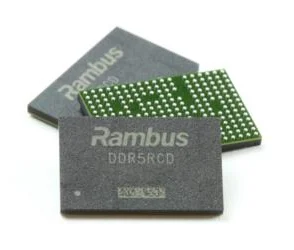
Rambus RCDs allow DDR5 memory to work in a wide operating range, with speeds up to 7,200 MT/s.
While it is easy to get swept up in CPU performance, the pervasive von Neumann architecture ensures that memory speeds are just as important as CPU speed. This is especially true in advanced AI models, which now require higher DDR5 performance.
DDR5 memory improves the theoretical performance of DDR4 thanks to its new architecture, and the RCDs, like Rambus’ latest offering, play a critical role in data-center applications and robust DDR5 DIMMs.
Server-Grade Stability
In data center DIMMs, the RCD lies between the CPU and the memory and acts as a repeater to maintain signal integrity across the entire operating range of the DIMM. This has several advantages, the largest of which is ensuring that the DIMM exhibits the same performance regardless of the computational load.
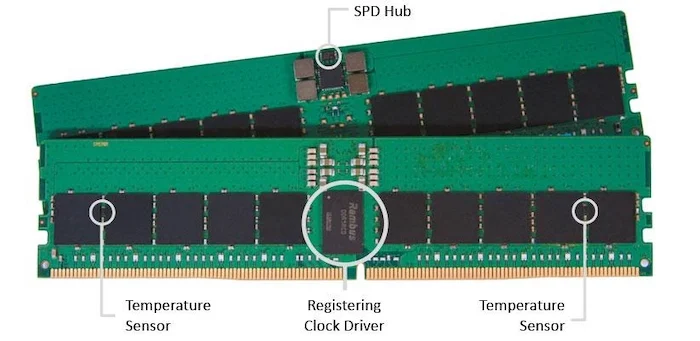
RCDs act as a repeater between the CPU and the memory, allowing for better stability across a wide operating range.
While consumer applications may not realize the full benefit of an RCD, data-heavy applications such as generative AI or cloud-centric predictive maintenance can greatly benefit from the improved robustness and performance of this device. In addition, removing the direct coupling from CPU to memory can provide many different hardware combinations, giving designers more freedom to select the best CPU/memory combination without needing to worry about compatibility.
Better Transfer Speed
The Rambus Gen4 RCD builds off of its previous generations of clock drivers to support greater transfer speeds. The RCD4-GA0A supports up to a 3.6-GHz clock speed and corresponding 7,200 MT/s data rates. It supports both DDR and SDR buses, with up to two independent subchannels and two ranks per subchannel. The device’s low 1.1-V power supply requirements may also reduce power consumption, which can greatly benefit large deployments common in the data center.
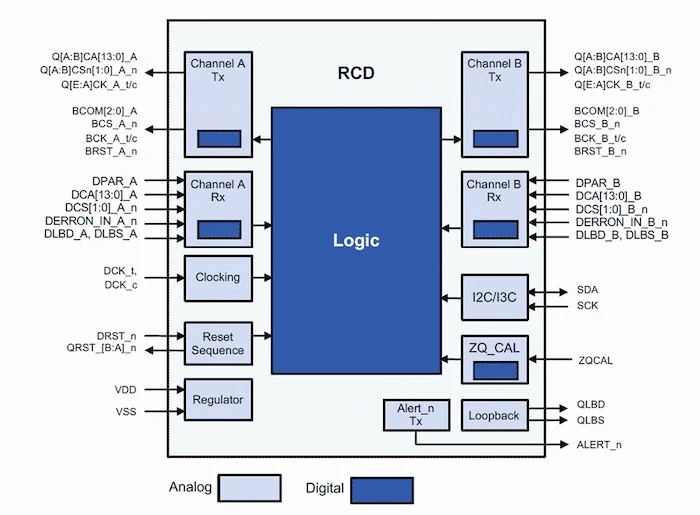
The RCD helps to decouple the memory’s data and power from the CPU and motherboard, providing a better operating point in high or low temperatures or data loads.
Compared to previous generations of Rambus RCD, the RCD4-GA0A increases transfer speeds for DDR5 DIMMs by 12.5%. Compared to conventional DDR5, however, the Rambus Gen4 RCD represents a 50% improvement in transfer speeds (from 4,800 MT/s to 7,200 MT/s). This ability to move data faster opens the door for more advanced AI models.
The Gen4 RCD is currently in the sampling stage. Interested designers can make use of the RCD in conjunction with SPD and temperature sensors to further improve the performance of next-generation DIMMs.
