IoT devices do more than just sense and respond. Most of them also record information over time, a process known as IoT data logging.
This logged data can include sensor readings like temperature or humidity, system events such as errors or restarts, and usage information that helps track how the device is behaving in the real world.
The system must store this data safely, even when the device restarts or loses power.
Non-volatile memory keeps data intact when power is removed, which is essential for reliable IoT data logging.
Two of the most common non-volatile memory options for this purpose are EEPROM and Flash memory.
It can be difficult to choose between these types of memory options, especially if you are new to embedded or IoT design.
Each memory type behaves differently, and those differences directly affect how data logging works in practice.
This guide breaks down EEPROM vs Flash memory for IoT data logging, starting with the basics and then showing when to use an EEPROM chip, when Flash memory is a better choice, and when using both makes sense.
EEPROM Basics
EEPROM, short for Electrically Erasable Programmable Read-Only Memory, stores small but critical data in embedded systems and IoT devices.
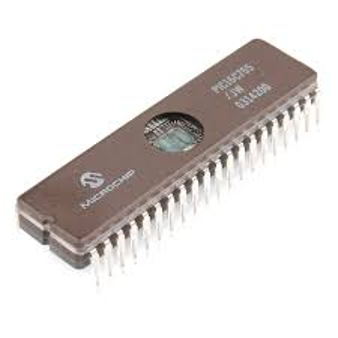
The key feature of EEPROM is its byte-level write and erase capability. This allows individual values to update without affecting nearby data.
Internally, EEPROM uses floating-gate transistors with separate control for storage and erase operations.
This design makes EEPROM reliable and precise, but it also limits storage density and increases the cost per bit compared to Flash memory.
In practical IoT applications, we use EEPROM chip for predictable behavior. EEPROM also provides high write endurance, often supporting hundreds of thousands to around one million write cycles per memory location, along with long data retention.
Because of these tradeoffs, EEPROM typically offers small storage capacity, ranging from a few kilobits to a few megabits, and commonly connects via I2C or SPI.
In IoT devices, we use EEPROM to store configuration settings, calibration values, device identifiers, and small logs that must persist across resets and power cycles.
Flash Memory Overview
Flash memory also serves as a type of non-volatile memory, but designers build it for larger storage capacity and scalability.
Although Flash is technically related to EEPROM, it behaves very differently. Instead of byte-level updates, Flash memory erases and writes data in blocks or sectors.
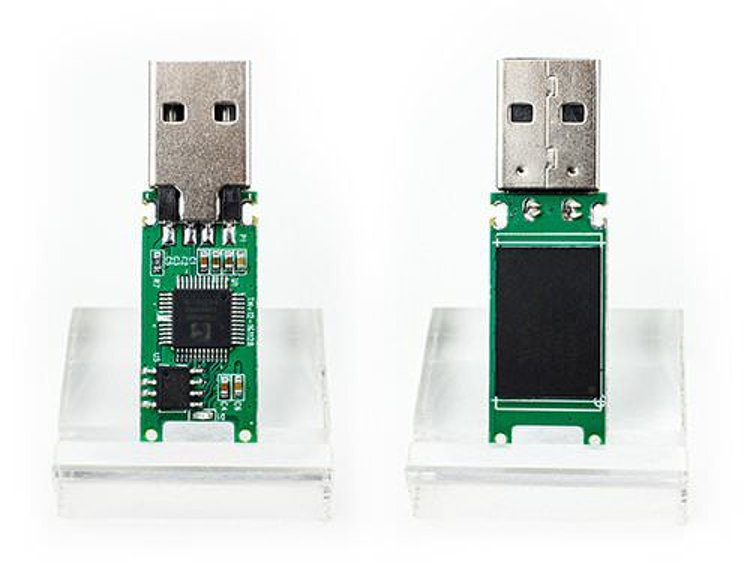
Flash memory uses a single floating-gate transistor per bit, which allows much higher storage density and a lower cost per byte than EEPROM.
This is why we use Flash memory for firmware storage in microcontrollers, as well as in SD cards, SSDs, and other mass-storage devices.
There are two main types of Flash memory. NOR Flash offers fast random access and is commonly used for firmware and code storage.
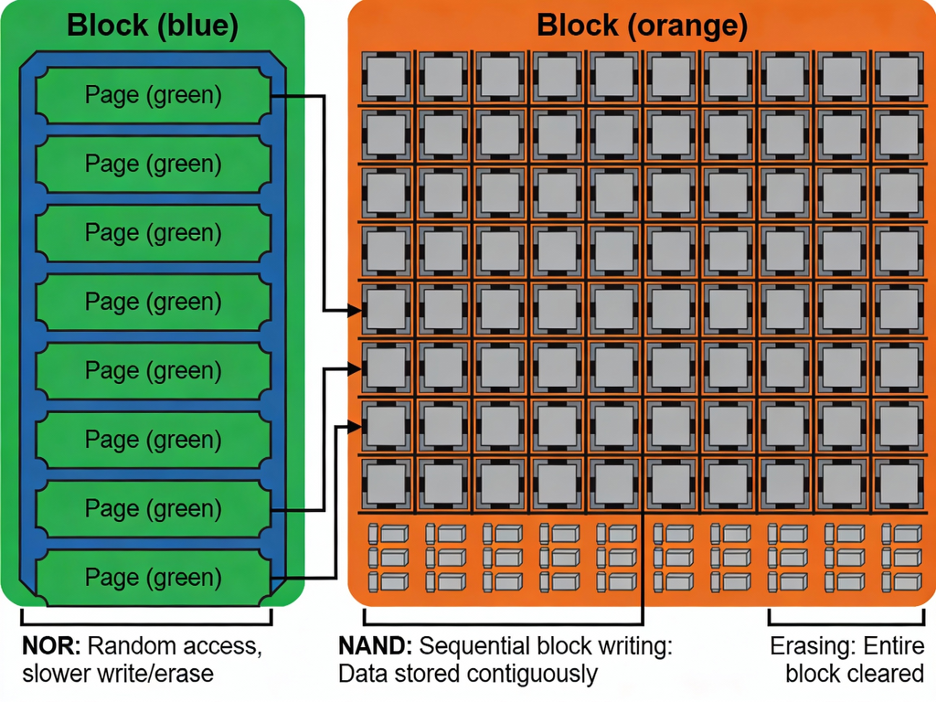
NAND Flash provides very high density, and manufacturers use it in bulk storage devices such as SD cards and eMMC modules. In most IoT devices, external SPI Flash memory is typically NOR Flash.
Flash memory performs best with sequential writes. Reads are fast, and once a block is erased, data can be written efficiently in pages.
This makes Flash memory well suited for sensor logs, event histories, and firmware images. The tradeoff is flexibility.
Because Flash requires block erases, it is not ideal for small, frequent updates.
In IoT systems, Flash memory is commonly used for data logging, circular buffers, firmware storage, OTA updates, and diagnostic data.
When an IoT device needs to store megabytes of data at low cost, Flash memory is usually the practical choice.
EEPROM vs Flash memory for IoT data logging
Now that we understand how each memory type works, we can look at EEPROM vs Flash memory from a data logging perspective.
The real difference comes from how each memory handles writes, endurance, power loss, and cost.

Write and erase behavior
EEPROM allows data to be updated one byte at a time. Flash memory requires entire blocks to be erased before new data is written.
Even a small change in Flash may involve rewriting a large section of memory.
This difference directly shapes how engineers use each memory type. EEPROM fits small and occasional updates. Flash memory fits continuous or sequential logging.
Write speed and performance
EEPROM is designed for accuracy, not throughput. Writing a single value is simple, but writing large amounts of data is slow.
Flash memory is optimized for bulk data. Once a block is prepared, data can be written and read very quickly, especially using SPI or QSPI interfaces.
For IoT data logging, Flash memory handles high data rates far better. EEPROM works best when only a few bytes are written at a time.
Endurance and lifetime
EEPROM typically supports very high write endurance per memory location. Flash memory supports fewer erase cycles per block, but it compensates by offering many blocks that can share the wear.
This means neither option is automatically safer. The logging strategy matters.
EEPROM benefits from rotating write locations. Flash memory benefits from circular logging and wear leveling.
Data retention and power loss behavior
EEPROM tends to fail gracefully. If power fails during a write, the impact usually affects only the updated value.
Flash memory is more sensitive because block erases affect larger areas. For battery-powered or unstable systems, EEPROM is often safer for critical values.
Flash memory requires careful design, such as append-only logs, integrity checks, or buffering, to avoid corruption during power loss.
Capacity and cost
EEPROM offers limited capacity and a higher cost per byte, but the total chip cost is low for small sizes. Flash memory offers large capacity at a very low cost per byte.
For IoT designs, the choice is usually simple. Use EEPROM for kilobytes of critical data and flash memory for megabytes of logs and history.
Use both when you need reliability for configuration and capacity for logging
Real-World Constraints in IoT Data Logging
Choosing memory for IoT data logging is not just about technical specifications.
Real devices operate under limits such as power availability, long operating lifetimes, environmental stress, and unpredictable usage patterns.
The right storage strategy depends on how the device behaves over time.
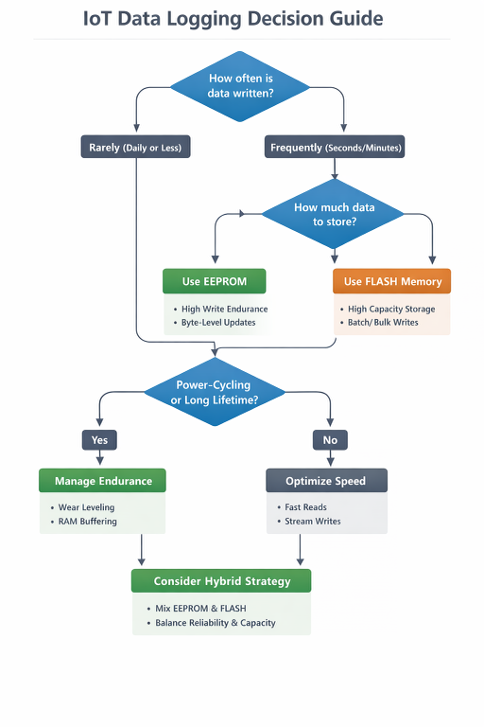
Logging frequency
How often the device writes data has a direct impact on memory lifetime. Low-rate logging, such as a few writes per hour or per day, is rarely a problem for either EEPROM or Flash.
At higher write rates, endurance becomes a design constraint. Frequent updates require careful planning, such as rotating write locations, using circular logs, or buffering data in RAM and committing it less often to non-volatile memory.
Data volume
The store data strongly influences the memory choice. Small datasets such as configuration values, counters, or status flags fit naturally into EEPROM.
Larger datasets, including multi-day sensor logs or historical records, quickly exceed EEPROM capacity and require Flash memory or removable storage. Matching memory size to actual data needs avoids unnecessary cost and complexity.
Power availability
Power stability affects how safely data can be written. Battery-powered or frequently power-cycled devices must account for write energy and incomplete operations.
Flash erase operations draw higher current for short periods, while EEPROM updates typically involve smaller energy bursts.
In low-power designs, batching writes and delaying non-critical storage until stable power is available can improve reliability and efficiency.
Access speed
Some IoT devices only store data, while others must retrieve and transmit it quickly. Access speed matters when large volumes of logged data need to be read or uploaded.
Flash memory handles large, sequential reads efficiently, whereas EEPROM access becomes slower as data size grows. This makes Flash a better fit for high-throughput data retrieval.
Environmental conditions
Temperature extremes, electrical noise, and vibration can affect memory reliability. Both EEPROM and Flash are available in industrial and automotive grades.
In harsh environments, we might requireadditional measures such as redundancy or integrity checks to protect critical data.
Longevity and compliance
For devices expected to operate for many years, total write count over the product lifetime becomes critical.
Long-lived designs often rely on Flash memory with sufficient wear-leveling space.
When data must be retained for compliance or diagnostics, we should consider capacity planning and retention requirements early in the design.
Where Each Memory Type Fits Best
In real IoT products, EEPROM and Flash memory serve different roles, often side by side.
This section focuses on where Where each memory type fits best.
When EEPROM Is the Right Choice
Engineers use EEPROM for small, essential data that must survive power loss and does not change frequently.
Common EEPROM use cases include:
Configuration and calibration data
Engineers typically store network credentials, calibration offsets, device IDs, and encryption keys as only a few bytes, and they update these values infrequently. EEPROM allows engineers to modify each value without disturbing other stored data.
Critical event markers
Devices actively record reset counters, tamper flags, or the last known error code. These records remain small but important, and EEPROM preserves them reliably across resets and power cycles.
Per-device manufacturing data
Manufacturers usually write serial numbers, factory test values, and provisioning data once or only during servicing. EEPROM provides a reliable and appropriate storage option for this information.
User preferences
Devices store settings such as brightness levels, operating modes, or thresholds as small values and update them only when a user changes a setting.
Low-rate summary data
For example, a sensor that records one daily average value over a month needs space for only a few dozen entries. EEPROM handles this use case easily without adding firmware complexity.
In many microcontrollers, a small internal EEPROM exists specifically to support these kinds of tasks.
For designs that require reliable storage of small configuration data, an I2C EEPROM is a common choice.
Flywing Tech supplies the AT24C02D-XHM-B EEPROM as part of its range of memory components for embedded and IoT applications.
When Flash Memory Is the Better Choice
Flash memory is used when data volume or logging activity grows beyond what EEPROM can handle.
Typical Flash memory use cases include:
High-volume sensor logging
Devices such as weather stations, GPS trackers, and vibration monitors log data every second or minute and quickly generate large datasets.
Continuous or burst data capture
Applications like audio sampling, waveform recording, and vibration analysis demand fast, repeated writes that EEPROM cannot support reliably.
Firmware storage and OTA updates
Devices store firmware images as large blocks and update them during upgrades. Flash memory supports this process by design and handles block-based updates efficiently.
File-based data access
Devices expose logs as files or use SD cards, eMMC, or USB storage by relying on Flash-based file systems.
Temporary offline buffering
Systems such as remote sensors or industrial loggers collect data while disconnected and use Flash memory to buffer hours or days of data until transmission becomes available.
Flash memory provides the capacity and write efficiency needed for these scenarios.
For applications that require large sensor logs or OTA firmware storage, SPI Flash memories such as Winbond W25Q-series devices are commonly used due to their high capacity and fast read performance.

How to Choose Between EEPROM and Flash for Data Logging
This section explains how to make the design decision, without repeating the use cases above.
1. Estimate Required Storage Capacity
Start by calculating how much non-volatile storage your application truly needs.
- Very small storage needs favor simpler memory solutions.
- Larger datasets immediately narrow the choice toward higher-density options.
This step alone often eliminates one option early.
2. Analyze Write Behavior
Focus on how your system writes data, not just how much data it stores.
Ask whether the device writes small, localized updates or larger chunks of data.
Check whether the system appends data sequentially or overwrites existing values in place.
When you match the memory type to the write pattern, you reduce wear and simplify firmware design.
3. Consider Power-Loss Risk
Consider what happens when the system loses power during a write operation.
Identify which data must never suffer corruption.
Decide which data can tolerate losing the most recent record.
These decisions determine whether the design needs safeguards such as buffering, CRC checks, or commit markers.
4. Evaluate Performance Needs
Determine how quickly the system must write and retrieve data.
- Slow access is acceptable for infrequent configuration reads.
- High-throughput access matters when dumping logs or streaming data.
Interface choice (I2C vs SPI) becomes important at this stage.
5. Factor in Cost and Availability
Check what memory already exists on your microcontroller.
- Using internal memory can reduce BOM cost and complexity.
- External memory may be necessary when capacity or endurance limits are exceeded.
Always balance hardware cost against firmware effort.
6. Decide on a Single vs Hybrid Design
Many systems naturally separate data into:
- Essential state information
- Bulk historical data
Using different memory types for different roles can improve reliability, but it should only be done if the added complexity is justified.
7. Prototype and Validate
Finally, test the design under real conditions.
- Simulate power loss.
- Measure write frequency over time.
- Verify recovery behavior after resets.
This step ensures that theoretical limits align with real-world usage.
Final Thoughts
Choosing between EEPROM and Flash memory for IoT data logging is about using the right tool for the right task. EEPROM offers simplicity, byte-level control, and high write endurance. This makes it well suited for configuration data and small, frequently updated values.
Flash memory provides high capacity, fast performance, and low cost per bit, which makes it ideal for large logs and firmware storage.
In many IoT products, the best solution is to use both. Critical settings can be stored in EEPROM, while bulk sensor data and historical logs are kept in Flash memory. This hybrid approach balances reliability, capacity, and cost.
By understanding how Flash memory vs EEPROM differs in write behavior, endurance, and power-failure handling, engineers can make informed decisions.
Consider what data you are logging, how often it changes, and how much storage you need. With the right memory strategy, IoT devices can log data safely and reliably throughout their lifetime.
If you are selecting components for your next design, Flywing tech offers a wide range of EEPROM chips, SPI Flash memory, and related accessories suitable for IoT data logging applications.
Whether you need small non-volatile storage for configuration data or high-capacity Flash for sensor logs and firmware, Flywing tech helps you source the right components with confidence.
Frequently Asked Questions (FAQ)
What is IoT data logging?
IoT data logging means storing information that an IoT device collects over time. Devices log sensor readings, system events, error states, and usage data so engineers can monitor performance, diagnose issues, and analyze behavior even after power loss or restarts.
What is the main difference between EEPROM vs Flash memory?
The main difference between EEPROM vs Flash memory lies in how they write data. EEPROM updates data one byte at a time, while Flash memory erases and writes data in blocks. This difference affects endurance, performance, and how each memory handles power loss.
When should I use EEPROM for IoT data logging?
You should use EEPROM when your device stores small, critical data that changes occasionally. EEPROM works well for configuration settings, calibration values, counters, device IDs, and security keys because it supports byte-level updates and high write endurance.
When does Flash memory make more sense than EEPROM?
Flash memory makes more sense when your device logs large amounts of data or writes data frequently. Engineers use Flash memory for sensor logs, event histories, firmware storage, OTA updates, and temporary offline buffering because it offers high capacity at a low cost per byte.
Can I use Flash memory for small configuration data?
You can use Flash memory for small configuration data, but it often adds unnecessary complexity. Flash requires block erases, which increase wear and risk during power loss. EEPROM handles small updates more safely and efficiently in most IoT designs.
Which memory handles power loss better, EEPROM or Flash?
EEPROM handles power loss more gracefully for small updates because it limits changes to individual bytes. Flash memory requires careful design, such as append-only logs and integrity checks, because block erases affect larger memory areas during write operations.
How does write endurance affect EEPROM vs Flash memory?
EEPROM offers very high write endurance per memory location, which suits frequent small updates. Flash memory supports fewer erase cycles per block, but designers extend its lifetime by spreading writes across many blocks using circular logging or wear leveling.
Can one IoT device use both EEPROM and Flash memory?
Yes, many IoT devices use both EEPROM and Flash memory. Engineers store critical configuration data in EEPROM and place large sensor logs and firmware images in Flash memory. This hybrid approach balances reliability, capacity, and cost.
Does interface speed matter for IoT data logging?
Interface speed matters when devices read or transmit large logs. SPI Flash memory transfers data much faster than I2C EEPROM, which makes Flash a better choice for bulk data retrieval and high-throughput logging.
How do I choose between EEPROM vs Flash memory for my design?
Start by estimating data size, write frequency, and power stability. Choose EEPROM for small, critical, infrequently updated data. Choose Flash memory for large, frequent, or sequential data. Use both when your design needs reliability for configuration and capacity for logging.