
A dimmable LED driver does more than power an LED. It controls how much current or voltage reaches the LED while responding to a dimming signal from a wall dimmer, controller, or smart lighting system.
This matters because LEDs are sensitive to electrical changes. If the driver is not matched correctly, the result can be flicker, buzzing, poor low-end dimming, overheating, or early failure.
For LED strips, you may need a 24V dimmable LED driver. For COB LEDs or high-power LED modules, you may need a dimmable constant current LED driver instead.
The right choice depends on the LED load, dimming method, wiring setup, wattage margin, and installation environment.
In this guide, we’ll explain what a dimmable LED driver is, how it works, the main types available, how to wire a dimmable LED driver, and how to choose the right option for your lighting project.
What Is a Dimmable LED Driver?
If you want the plain answer to what is a dimmable LED driver, it is an LED driver that both powers the LED correctly and changes light output in response to a control signal.

In Mean Well’s installation manual, an LED power supply is described as a dedicated LED driving device that can deliver constant current, constant voltage, or an adjustable current controlled by an external dimmer.
That is the practical definition specifiers need.
A dimmable LED driver is both a power converter and an interpreter of dimming intent.
The reason this matters is electrical, not just semantic.
Analog Devices explains that LEDs are best driven with constant current when you need predictable luminous intensity and chromaticity.
In simple words, the driver keeps the LED operating point stable so the brightness and colour remain repeatable.
A normal LED driver may only provide fixed output.
A dimmable LED driver adds a control function so the light level can change smoothly and safely.
How Does a Dimmable LED Driver Work?
A LED dimmable driver works by changing the average LED current.
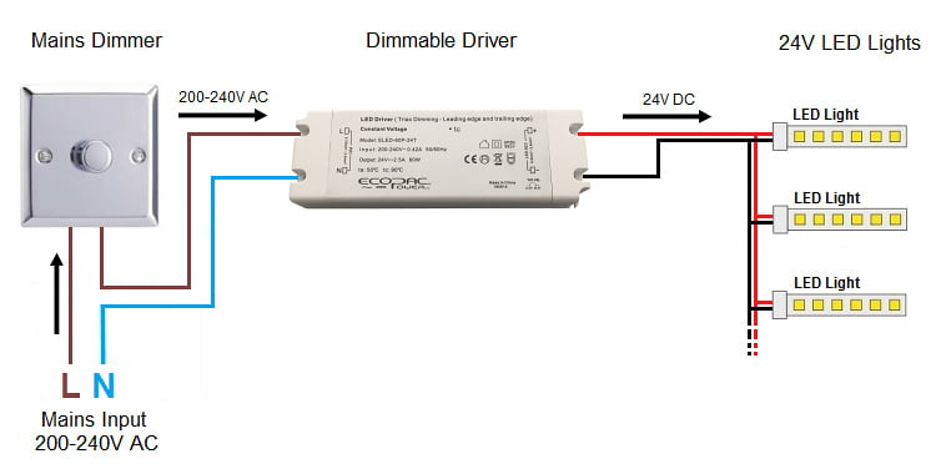
It can do this in two broad ways.
- The first method is switching the current on and off quickly. This is called PWM dimming.
- The second method is reducing the current level itself. This is called analogue dimming.
PWM dimming restarts LED current in short intervals, while analogue dimming changes the constant current level directly.
PWM dimming usually preserves colour better because the LED still receives its normal current during each “on” pulse.
Analogue dimming can be simpler and quieter, but it may shift colour in applications where constant colour temperature matters.
This same idea scales up to larger lighting systems.
A phase-cut driver decodes the chopped AC waveform from a wall dimmer.
A 0–10V driver reads a low-voltage dimming line.
A DALI driver listens to digital commands from a lighting control network.
Each method can reduce light output, but the mechanism, wiring method, and compatibility risks are different.
That is why “dimmable” alone is not enough.
A proper specification should include the LED load type, dimming method, expected dimming floor, and approved control ecosystem.
Dimmable LED Driver vs Non-Dimmable Driver
A non-dimmable LED driver provides a fixed output.
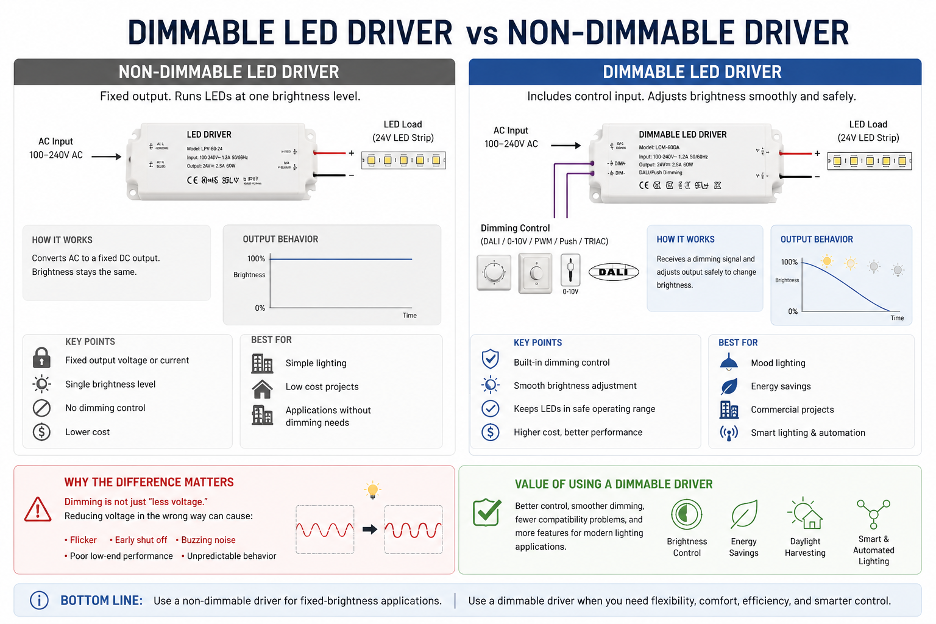
It is designed to run the LED at one brightness level, assuming the LED load stays within the driver’s rated range.
A dimmable LED driver includes a control input or dimming-compatible power stage.
This allows the light output to change without pushing the LED outside its safe operating range.
The difference matters because dimming is not just “less voltage.”
If you reduce voltage in the wrong way, the LED may flicker, shut off early, buzz, or behave unpredictably.
A dimmable driver is worth using when you need brightness control, mood lighting, energy savings, daylight harvesting, smart lighting, or commercial lighting automation.
It may cost more than a fixed-output driver, but it gives better control and fewer compatibility problems when selected correctly.
Types of Dimmable LED Drivers
The main types of dimmable LED drivers are based on the dimming method they support.
The most common options are TRIAC or phase-cut, 0–10V, PWM, analogue, and DALI.
Each one has a different control method and a different use case.
| Dimming Method | How It Controls Light | Main Strengths | Common Issues | Typical Use |
| TRIAC / Phase-Cut | Chops the AC waveform before the driver | Works with many wall dimmers | Flicker, buzz, dead travel, compatibility issues | Residential retrofit lighting |
| PWM | Switches LED current on and off rapidly | Good colour stability and wide dimming range | Frequency and noise issues if poorly designed | LED strips, electronics, signage |
| Analogue | Reduces LED current amplitude | Simple and quiet | Possible colour shift | Constant-current LED systems |
| 0–10V | Uses low-voltage control wiring | Stable and common in commercial lighting | Dimming floor varies by driver | Panels, troffers, commercial luminaires |
| DALI | Uses digital two-wire communication | Addressable and smart-system friendly | More setup required | Smart buildings and professional lighting |
The table above is a practical summary.
TI’s notes explain PWM and analogue behaviour, DOE documents phase-cut compatibility issues, and the DALI Alliance explains the two-wire digital nature of DALI systems.
TRIAC (Phase-Cut) Dimmable LED Driver
A TRIAC dimmable LED driver controls brightness by interpreting a modified AC waveform from a wall dimmer.
The dimmer reduces the effective power before it reaches the driver.
The driver then converts this into a controlled output for the LED.
This type is commonly used in residential lighting where wall dimmers are already installed.
TI’s LM3450 material explains how phase-cut drivers detect the dimming angle of the rectified AC line.
0–10V Dimmable LED Driver
A 0–10V dimmable LED driver uses a low-voltage control signal to adjust brightness.
The driver receives a voltage signal between 0V and 10V and adjusts the light output accordingly.
This method is widely used in commercial lighting because it provides stable and predictable dimming.
PWM Dimmable LED Driver
A PWM (Pulse Width Modulation) dimmable LED driver controls brightness by switching the LED current on and off at high speed.
The brightness changes based on how long the signal stays “on” during each cycle.
This method is commonly used in LED strips, displays, and electronic lighting systems.
Analogue Dimmable LED Driver
An analogue dimmable LED driver reduces brightness by lowering the current supplied to the LED.
This provides smooth dimming but may affect colour consistency in some applications.
It is often used in constant-current LED systems.
DALI Dimmable LED Driver
A DALI dimmable LED driver uses digital signals to control lighting.
It allows advanced features such as individual light control, grouping, and automation.
This type is commonly used in smart lighting and commercial building systems.
Constant Current vs Constant Voltage Dimmable LED Drivers
The most important technical decision is whether the LED load needs constant current or constant voltage.
This choice matters more than wattage alone.
A driver can have the right power rating and still be the wrong type for the LED load.
Dimmable Constant Current LED Driver
A dimmable constant current LED driver is the right choice when the LED load is specified by current.
You will usually see ratings such as 350mA, 700mA, 1050mA, or 1A.
This type of driver is common for COB LEDs, high-power LED modules, and series LED strings.
The driver regulates current while allowing voltage to vary within a defined output range.
This matters because LEDs are current-driven devices.
Constant current helps keep brightness and colour more predictable.
It also helps protect the LED from overcurrent conditions.
Once dimming is added, the driver must still keep the LED inside its safe operating window.
PWM on a current-regulated driver often gives the best colour stability.
Analogue dimming may be acceptable where low noise is more important than the deepest dimming range.
Either way, the current setpoint and voltage window must remain valid over temperature.
24V Dimmable LED Driver (Constant Voltage)
A 24V dimmable LED driver is normally a constant-voltage driver.
It is commonly used for LED strips and LED modules designed for 24V input.
In this setup, the strip or module usually has onboard current-limiting or current-control elements.
The driver supplies a stable 24V output, and the LED product manages current locally.
This is why most 24V flexible LED strip systems use constant-voltage drivers.
For example, an American Bright AB-FB02408-19712-8A1 is designed to run on a stable 24V DC supply, making it a typical use case for a constant voltage dimmable LED driver.
Similarly, a JKL ZFS-84000-WW operates within a defined voltage range and relies on the driver to provide consistent output while supporting dimming.
Both are the kind of loads that normally call for a constant-voltage dimmable driver.
Which One Should You Choose?
Use the label or datasheet as your first guide.
If the LED product says 12V, 24V, or 48V input, think constant voltage first.
If it says 350mA, 700mA, or 1A drive current, think constant current first.
Then check the dimming method separately.
A 24V LED strip can still need a specific dimming type, such as PWM, 0–10V, or DALI.
Here is a simple comparison:
| LED Load Type | Best Driver Type | Common Example |
| COB LED rated at 700mA | Dimmable constant current LED driver | High-power LED module |
| 24V LED strip | 24V dimmable LED driver | Flexible LED strip |
| Commercial panel light | 0–10V or DALI dimmable driver | Office lighting |
| Retrofit downlight | TRIAC dimmable driver | Wall dimmer setup |
| Smart lighting system | DALI dimmable driver | Networked building lighting |
How to Choose the Right Dimmable LED Driver
Choosing the right dimmable LED driver is not just about matching watts.
You need to match the LED load, electrical rating, dimming method, environment, and safety requirements.
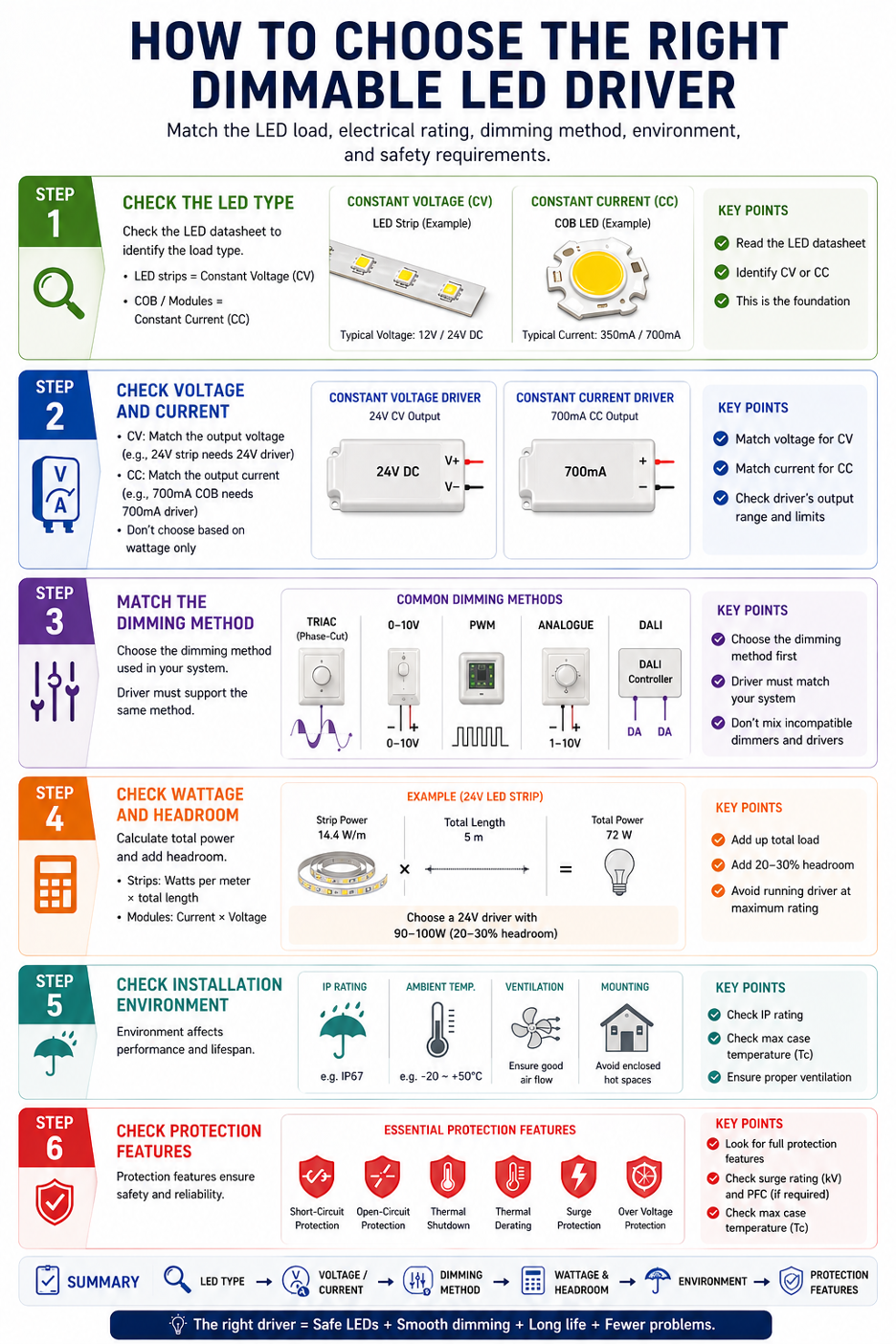
Step 1: Check the LED Type
Start with the LED module, strip, COB, or luminaire datasheet.
Look for whether the load is constant current or constant voltage.
For LED strips, the datasheet usually shows a voltage such as 12V or 24V.
For COB LEDs and high-power modules, the datasheet usually shows a current rating.
Step 2: Check Voltage and Current
For constant-voltage loads, match the output voltage.
A 24V strip needs a 24V driver.
For constant-current loads, match the output current.
A 700mA COB LED needs a driver that can regulate 700mA within the correct voltage range.
Do not choose based on wattage only.
Wattage tells you power capacity, but it does not tell you whether the driver controls current or voltage correctly.
Step 3: Match the Dimming Method
Decide how the light will be dimmed.
Will it use a TRIAC wall dimmer, 0–10V controller, PWM signal, analogue dimming input, or DALI system?
The driver must support that exact dimming method.
A 0–10V driver will not automatically work with a TRIAC wall dimmer.
A non-dimmable driver should not be forced into a dimming setup.
Step 4: Check Wattage and Headroom
After matching type and rating, calculate the total power.
For LED strips, multiply watts per meter by total strip length.
For modules, use the rated current and voltage range.
Choose a driver with sensible headroom.
Running a driver at its absolute maximum rating can increase heat and reduce reliability.
Step 5: Check Installation Environment
Indoor and outdoor installations have different requirements.
For outdoor, damp, dusty, or enclosed installations, check IP rating, case temperature, thermal limits, and ventilation.
Heat is one of the biggest causes of early LED driver failure.
A well-sized driver can still fail early if it is installed in a hot sealed enclosure.
Step 6: Check Protection Features
A good dimmable driver should include protection features.
Look for short-circuit protection, open-circuit protection, thermal shutdown, thermal derating, surge information, and a published operating window.
For higher-power or outdoor projects, also check PFC, ingress protection, and maximum case temperature.
These details separate a reliable driver from a cheap one.
How to Wire a Dimmable LED Driver (Step-by-Step)
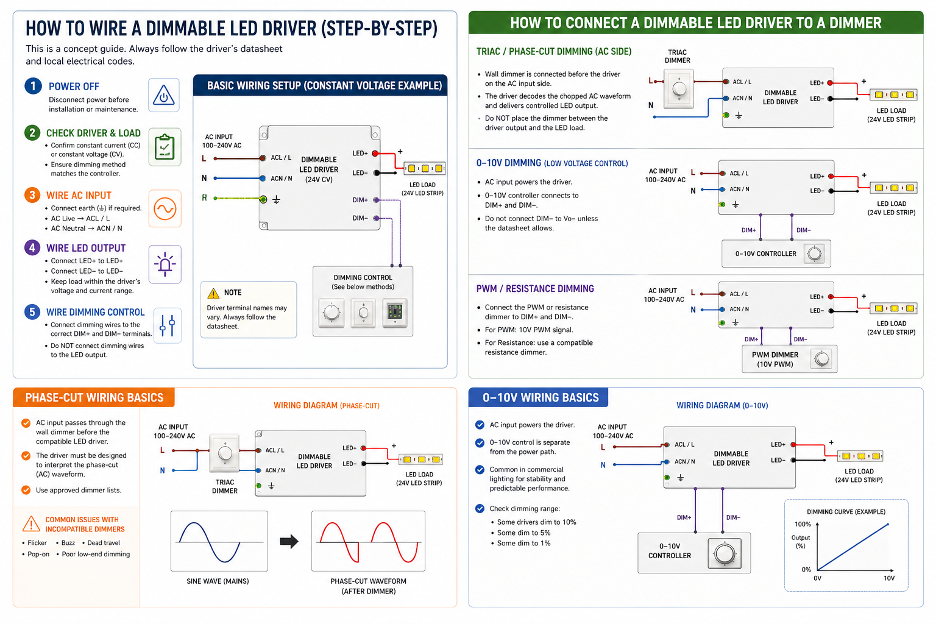
If you want the practical answer to how to wire dimmable LED driver or how to connect dimmable LED driver, the process follows the same basic pattern.
The exact wiring always depends on the driver model.
So use this section as a concept guide, not a replacement for the datasheet.
Basic Wiring Setup
First, disconnect power before installation or maintenance.
Next, confirm whether the driver is constant current or constant voltage.
Also confirm whether the dimming method matches the controller.
Wire the AC side exactly as the driver specifies.
In many drivers, this means connecting earth where required, AC live to ACL/L, and AC neutral to ACN/N.
Then wire the LED output with correct polarity.
Connect LED+ to LED+ and LED− to LED−.
Make sure the LED load stays within the driver’s voltage and current range.
Finally, wire the dimming control to the correct terminals.
Do not connect dimming wires to the LED output unless the datasheet specifically shows that arrangement.
How to Connect a Dimmable LED Driver to a Dimmer
For a TRIAC or phase-cut installation, the dimmer usually goes before the driver on the AC input side.
The driver then decodes the chopped mains waveform and converts it into controlled LED output.
Do not place a wall dimmer between the driver output and the LED module.
That is not how phase-cut dimmable drivers are designed to work.
For 0–10V dimming, the controller connects to the driver’s dedicated dimming wires.
These are often labelled DIM+ and DIM−.
For PWM or resistance dimming, the same idea applies.
Use the correct dimming input wires provided by the driver manufacturer.
Mean Well’s 3-in-1 dimming families accept 0–10VDC, 10V PWM, or resistance between DIM+ and DIM−.
Their documentation also warns not to connect DIM− to Vo− unless the product manual allows it.
Phase-Cut Wiring Basics
In a phase-cut setup, the AC input passes through the wall dimmer before reaching the compatible LED driver.
The driver must be designed to interpret that waveform.
This is why approved dimmer lists matter.
A driver may be technically dimmable but still perform poorly with the wrong wall dimmer.
Common symptoms include flicker, buzz, dead travel, pop-on, and poor low-end dimming.
0–10V Wiring Basics
In a 0–10V setup, the AC input powers the driver normally.
The dimming controller connects separately through low-voltage dimming wires.
This makes 0–10V common in commercial lighting because the power and control paths are separated.
It is often more predictable than using phase-cut dimmers.
However, you still need to check dimming floor, controller loading, and wiring limits.
Some drivers may dim to 10%, some to 5%, and others to 1%.
Common Problems with Dimmable LED Drivers
Dimmable LED drivers can fail or behave poorly when the driver, LED load, and control method do not match.
Most problems come from compatibility, loading, wiring, thermal stress, or poor driver quality.
LED Flickering When Dimmed
If a dimmable LED system flickers, the first suspect is usually system interaction.
It does not always mean the driver has failed.
Flicker can depend on driver loading, dimming level, input waveform, and dimmer compatibility.
A driver that looks stable at full brightness may flicker at low dimming levels.
For phase-cut systems, DOE research shows that compatibility issues can create flashing, ghosting, dead travel, and pop-on or pop-off behaviour.
The practical fix is usually to use an approved driver-dimmer pair or move to 0–10V or DALI where possible.
Buzzing Noise
Buzzing is not imaginary, and it is not always caused by the dimmer itself.
TI notes that audible noise can appear in PWM dimming because rapid load changes increase ripple.
That ripple can excite capacitors, inductors, or other passive components.
This is why some drivers buzz only when dimmed.
If your LED dimmable driver buzzes at low brightness, think waveform interaction, PWM behaviour, or component resonance first.
A better-matched driver, different dimming method, or approved controller may solve the issue.
Limited Dimming Range
Limited dimming range happens when the driver cannot dim as low as expected.
For example, one 0–10V driver may stop at 10%, while another may reach 1%.
This is not always a defect.
It may simply be the driver’s designed dimming floor.
Always check the datasheet before promising deep dimming in a project.
Lights Turning Off at Low Brightness
If lights turn off suddenly at low brightness, the driver and dimmer may not be aligned.
This can happen with phase-cut dimmers when the driver cannot maintain stable operation at a low input angle.
It can also happen when the LED load is too small for the driver.
Some drivers need a minimum load to operate correctly.
Check the driver’s minimum output current, minimum load, and dimming range.
Best Use Cases for Dimmable LED Drivers
The best dimmable LED driver depends on where the light is used.
A driver that works well for LED strips may not be right for a commercial DALI lighting system.
LED Strip Lighting
LED strip lighting usually uses constant-voltage drivers.
For 24V strips, use a 24V dimmable LED driver with enough current and wattage headroom.
This is also where PWM and 0–10V dimming are common.
For Flywing Tech, this section can link to 24V LED strips, LED connectors, wiring accessories, and external LED drivers.
Residential Lighting
Residential dimming often uses TRIAC or phase-cut drivers.
This is common because many homes already have wall dimmers.
The key risk is compatibility.
Always check whether the LED driver and wall dimmer are approved to work together.
Commercial Spaces
Commercial lighting often uses 0–10V dimming.
It is common in offices, retail areas, warehouses, schools, and public buildings.
0–10V gives installers a familiar control method.
It also avoids many of the problems linked to chopped mains dimming.
Smart Lighting Systems
Smart buildings often use DALI.
DALI is useful when each luminaire needs addressing, grouping, scenes, scheduling, or status feedback.
It is more advanced than 0–10V but also requires compatible drivers, controllers, and commissioning.
Example: Choosing a 24V Dimmable LED Driver
For example, if you are using a JKL ZFS-84000-WW, you need a 24V dimmable LED driver that can handle the total load while maintaining stable output.
Pairing it with a driver like the Mean Well IDLV-45-24 ensures proper voltage regulation and allows smooth dimming control.
That implies a load of about 34.6W. That gives about 45.1W available.
This pairing gives roughly 10.5W of headroom.
That is useful for thermal margin and control stability.
For a 24V dimmable LED driver selection, match output voltage first.
Then verify strip current draw, keep power headroom, and confirm the dimming method.
Do not begin with wattage alone.

Example: Choosing a Dimmable Constant Current LED Driver
For example, a Cree CXA1512 LED module requires a fixed drive current, which makes it a strong candidate for a dimmable constant current LED driver.
That points toward a constant-current driver.
A high-power solution such as the Mean Well HVGC-320-3500B provides adjustable current output and is designed for demanding LED applications where stable current control and dimming are required.
On paper, this is the right type of pairing for a dimmable constant current LED driver application.
You would set the driver to 350mA.
Then you would verify that the LED module stays inside the driver’s voltage window across temperature.
Room-temperature values are not enough.
High-brightness LED forward voltage changes with temperature, so the driver needs enough compliance at cold start and enough thermal headroom during operation.
Quick Buyer Checklist
Use this checklist before you place an order:
- Is the LED load constant current or constant voltage?
- Does the driver support the exact dimming method you need?
- What is the real minimum dimming level for this driver model?
- If it is phase-cut, is the dimmer on the approved list?
- If it is 0–10V, can the controller handle the driver’s dimming current?
- If it is DALI, do you need simple broadcast dimming or addressable scenes?
- Does the driver have enough output power headroom?
- Does the driver have enough thermal headroom?
- Are flicker, noise, and protection specs acceptable for the real application?
- Is the driver suitable for the installation environment?
Final Thoughts
Choosing the right dimmable LED driver is not just about power rating or price.
It is about matching the driver to the LED load, the dimming method, and the real-world installation conditions.
A well-matched driver delivers smooth brightness control, stable performance, and longer LED lifespan.
On the other hand, a mismatch can lead to flicker, buzzing, poor dimming range, or early failure.
For most applications, the decision starts with one key question.
Does your LED require constant current or constant voltage?
From there, you can select the correct driver type, confirm the dimming method, and ensure proper wiring and headroom.
For LED strip lighting, a 24V dimmable LED driver is usually the right choice.
For COB LEDs and high-power modules, a dimmable constant current LED driver provides better control and protection.
Finally, always consider the environment and protection features.
Heat, poor ventilation, and electrical stress are some of the most common reasons drivers fail in real installations.
If you take a structured approach to selection, you can avoid most compatibility issues and get reliable, flicker-free dimming performance.
At Flywing Tech, you can explore a wide range of LED drivers, LED modules, connectors, and power solutions designed for both prototyping and production use.
Whether you are working on LED strip lighting, commercial installations, or embedded systems, having access to the right components can simplify your design process and improve long-term reliability.
FAQs About Dimmable LED Drivers
What is a dimmable LED driver?
A dimmable LED driver is a driver that powers an LED correctly and adjusts output in response to a dimming input.
That input may be phase-cut, PWM, analogue, 0–10V, or DALI.
Are all LED drivers dimmable?
No, not all LED drivers are dimmable.
Even products marketed as dimmable can behave differently depending on the dimmer, load, and driver design.
What is the difference between a dimmable constant current LED driver and a 24V dimmable LED driver?
A dimmable constant current LED driver regulates current for LED modules specified in milliamps.
A 24V dimmable LED driver is usually a constant-voltage driver used for 24V LED strips and modules.
Which dimming method is best for clean dimming?
There is no universal best option.
PWM is strong for colour stability, 0–10V is common in commercial lighting, and DALI is best for smart addressable systems.
How do I know whether to use constant current or constant voltage?
Check the LED datasheet.
If the LED load is listed as 24V input, use constant voltage. If it is listed as 350mA or 700mA, use constant current.
How to wire dimmable LED driver safely?
Disconnect power first.
Then wire AC input, LED output, and dimming control according to the driver manual.
Do not connect dimming wires to the wrong side of the circuit.
Why does my dimmable LED driver buzz when dimmed?
Buzzing can happen because of dimmer-driver mismatch, PWM ripple, component resonance, or poor driver design.
It is especially common in poorly matched phase-cut dimming systems.
Why does my LED light not dim smoothly all the way down?
The driver may have a limited dimming range.
The dimmer and driver may also have mismatched control curves, causing dead travel, dropout, or sudden shutoff.
Is DALI better than 0–10V?
DALI is better when you need addressable control, scenes, scheduling, or status feedback.
0–10V is simpler, cheaper, and still widely used in commercial lighting.
What protection features should I look for in a dimmable LED driver?
Look for short-circuit protection, open-circuit protection, thermal shutdown, thermal derating, surge protection, and a published operating temperature range.
For outdoor use, also check IP rating and case temperature limits.

COMMENTS