
IEEE Radio and Wireless Week 2024 (RWW 2024) in San Antonio, Texas, showcased cutting-edge advancements in RF and microwave technologies. Highlights included discussions on RFID-enabled digital twins, biomedical IoT applications, and the integration of AI in wireless systems. The event emphasized the convergence of wireless communication theory, systems, circuits, and device technologies, setting the stage for future innovations in the field.
How Did RWW 2024 Address the Integration of RFID in Digital Twins?
RWW 2024 highlighted the role of RFID technology in enabling digital twins, allowing for real-time monitoring and analysis of physical systems. This integration facilitates predictive maintenance and enhances system efficiency by providing continuous feedback without the need for physical inspections. The discussions underscored RFID’s maturity and its potential in various applications, from infrastructure monitoring to asset tracking.
What Were the Focus Areas of the Biomedical IoT Summit at RWW 2024?
The Seventh IEEE IoT Vertical and Topical Summit at RWW 2024 concentrated on intelligent biomedical applications. Key topics included sensing, signal processing, data storage, and communications technologies vital for healthcare solutions. The summit emphasized the importance of electronics in advancing biomedical devices, highlighting innovations in materials, miniaturization, and AI-driven data interpretation.
Which Emerging Technologies Were Prominent at RWW 2024?
RWW 2024 showcased several emerging technologies:
-
AI and Machine Learning: Their application in adaptive signal processing and wireless system optimization.
-
6G and Beyond: Discussions on the next generation of wireless communication standards.
-
Quantum Technologies: Exploration of quantum communication and sensing applications.
-
Additive Manufacturing: Advancements in 3D printing for RF components.
How Did RWW 2024 Foster Collaboration Among Professionals?
The event facilitated collaboration through various means:
-
Co-located Conferences: Five topical conferences covering diverse aspects of wireless technologies.
-
Workshops and Panels: Interactive sessions on current R&D trends. Demo Track: Hands-on demonstrations of cutting-edge RF technologies.
-
Networking Events: Opportunities for professionals to connect and exchange ideas.
Buying Tips
When sourcing components related to the technologies discussed at RWW 2024, consider the following:
-
Identify Specific Needs: Determine the exact specifications required for your application.
-
Verify Authenticity: Ensure components are genuine and meet industry standards.
-
Consider Lead Times: Account for potential delays in procurement and plan accordingly.
-
Evaluate Suppliers: Choose reputable suppliers with a track record of reliability.
Fly-Wing Technology (HK) Co., Limited has been a trusted source for electronic components since 2012. With warehouses in Hong Kong and a global supplier network, they offer competitive prices and efficient sourcing solutions, especially for hard-to-find or obsolete parts. Their commitment to reducing procurement cycles and transaction costs makes them a valuable partner in the electronics industry.
Electronic Components Expert Views
“The integration of RFID in digital twins represents a significant leap in predictive maintenance and system optimization. As we continue to merge physical and digital realms, such technologies will become indispensable.” – C.J. Reddy, VP of Business Development at Altair
“Advancements in biomedical IoT are transforming healthcare, enabling real-time monitoring and personalized treatment. The convergence of electronics and medicine is paving the way for a healthier future.” – Jasmin Grosinger, RWW 2024 Panelist
FAQ
What is IEEE Radio and Wireless Week?
It’s an annual conference that brings together professionals to discuss advancements in radio and wireless technologies.
Where was RWW 2024 held?
The event took place in San Antonio, Texas.
What are digital twins?
Digital twins are virtual replicas of physical systems used for monitoring and analysis.
How is RFID used in digital twins?
RFID enables real-time data collection, linking physical assets to their digital counterparts.
What is biomedical IoT?
It refers to the use of IoT technologies in healthcare applications, such as patient monitoring and diagnostics.
Who can benefit from RWW?
Engineers, researchers, and industry professionals involved in wireless technologies.
How can I access RWW proceedings?
Proceedings are typically available through the IEEE Xplore Digital Library.
When is the next RWW scheduled?
RWW 2026 is planned for January 18–21 in Los Angeles, CA.
In the age of innovation, new technologies will be necessary to continue building on previous work. At RWW 2024, the consensus: We’re nearing a peak. How can we continue climbing?
In late January, the 2024 IEEE Radio and Wireless Week (RWW) conference convened in San Antonio TX, gathering microwave and radio-frequency engineers to discuss the latest and greatest innovations in the field. Amongst the 139 technical papers and journals, plenary sessions, and three panel sessions, several key themes stood out that highlight the future of the RF/microwave field.
The RWW conference consists of 5 co-located topical conferences, and covers RF/microwave topics ranging from silicon designs to board-level sensor systems. Image used courtesy of IEEE Radio and Wireless Week
This article takes a closer look at two of these sessions and provides readers with a summary of what was learned and discussed at the conference. In addition, the greater trends in the microwave community are discussed to help determine where the focus and challenges may be shifting in the next few years.
RFID-Enabled Digital Twins
In the age of data and AI, it only makes sense that digital twins are a hot topic even in the RF community. In essence, a digital twin allows for continued development and analysis of a deployed system, without needing to travel to the deployment site to take measurements. As a result, designers can get near instant feedback on the performance of their devices, even while in the field, making the topic worthy of a panel session at RWW focusing on RFID and digital twins.
In order to enable this technology, however, RFID has been considered thanks to its ability to “match” a physical and digital twin. In addition, the addition of microwave sensors allows for precise measurements to be taken in tandem.
While in the grand scheme of things RFID is still quite new, in terms of engineering technology, it is quite robust, with panel member C.J. Reddy, VP of Business Development at Altair giving a vivid example.
“This is my bag tag from Delta, and if you open it, it has RFID. It tells you when your bag is checked in, and it actually tells you when it is coming on the conveyor belt.”
That example, though comparatively “low-tech” compared to some existing RFID technologies, highlights the maturity of the technology and its suitability for digital twins.
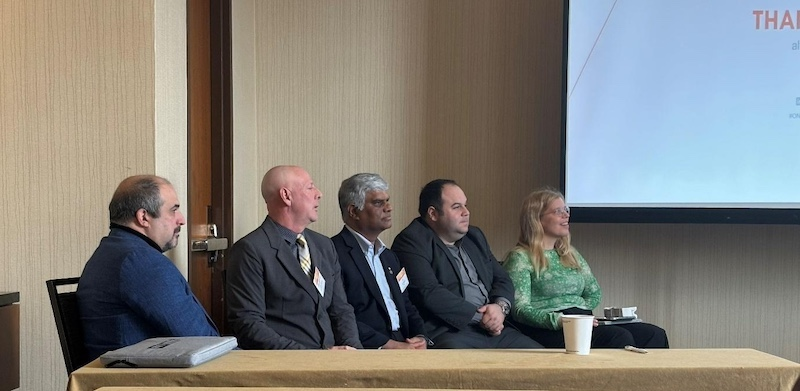
RFID panel members (left to right) Nuno Borges Carvalho, John McVay, C.J. Reddy, Eduardo Rojas, and Jasmin Grosinger discussed the potential for RFID to be used in digital twins and discussed a range of applications from infrastructure monitoring to predictive maintenance. Image from All About Circuits’ attendance of IEEE RWW
RFID is not a perfect solution, however, with many concerned about the logistics of implementing digital twins at a large scale. While RFID can afford to be inefficient in one-off cases, the move toward dense deployments requires major improvements in sensor and transceiver efficiency.
That was highlighted by Nuno Borges Carvalho, Director of DETI and Universidade de Aveiro, who said “I believe that to have a massive deployment of these sensors we need to increase the efficiency of all of our systems.”
Pushing Moore’s Law Back
Moving to another topic, the RWW plenary sessions included highly topical discussions on industry trends. Specifically, Madhavan Swaminathan, Professor at Georgia Tech, discussed how advanced RF packaging will be critical to sustaining continued growth. As we begin to see the sun set on Moore’s Law, new techniques and technologies are needed to replace Moore’s Law and continue the performance increases we’ve come to expect.
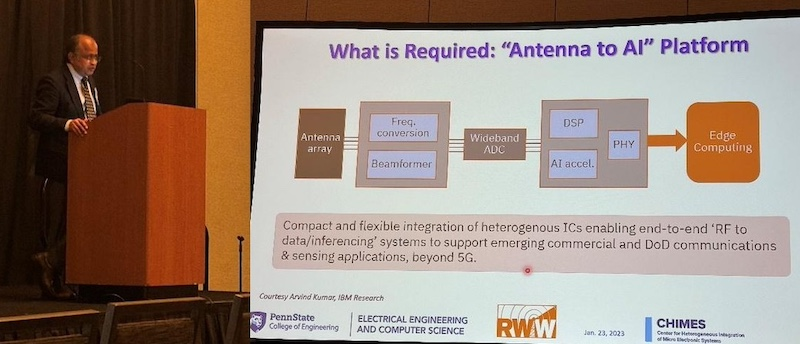
In order to sustain the semiconductor growth we’ve come to expect, Swaminathan believes that an “Antenna to AI” platform is necessary to minimize package losses and densely integrate sensors and processing power. Image from All About Circuits’ attendance of IEEE RWW
This is not to say that semiconductors are dying; actually, quite the contrary, with Swaminathan saying “They’re projecting that the semiconductor industry will become a trillion dollar industry very soon.” In spite of this, we’ve reached an inflection point where transistors of all kinds are no longer becoming cheaper to manufacture over time.”
“Look around 2022, you see an inflection point. So, the cost of that transistor is beginning to rise. And there is a reason for it, because as you begin to scale the size of these transistors, you want a certain technology node, the capital cost becomes prohibitively high.”

In the coming years, engineers will need to work together to solve the problems present from both a microwave communication and a systems engineering perspective. Image from All About Circuits’ attendance of IEEE RWW. (Click image to enlarge)
Hope is not lost, however, as advanced packaging techniques may yield new techniques for continued integration. In addition, heterogeneous integration of RF and processing architectures together could yield a new method which Swaminathan calls “Antenna to AI”, where all the signal processing, from RF to inferencing, can be performed in more efficient chips and packages.
Plenty of Work to Be Done
Although many engineers may be worried about obsolescence as a result of new and exciting innovations such as ChatGPT and LLMs, a key fact to remember is that, although we may no longer have the same problems to solve, problems will always exist.
And whether those problems are security and efficiency concerns for RFID digital twins, or advanced semiconductor architectures for Antenna to AI platforms, engineers will always be needed to push the boundary of knowledge further and further.
This holds true in any engineering field, from microwave circuits to software design. As a result, in order to continue innovation for innovation’s sake, we should look to the future to find the hardest problems that will give the most exciting solutions.
