
Intel’s debut into automotive discrete GPUs marks a pivotal shift in vehicle computing by bringing high-performance graphics and AI acceleration to next-gen cars. The Intel Arc A760-A discrete GPU delivers 229 TOPS of AI compute power, enabling real-time 3D rendering, advanced driver monitoring, and local AI model processing—all while meeting stringent automotive reliability standards 56.
How Does Intel’s Automotive Discrete GPU Compare to Existing Solutions?
Intel’s automotive discrete GPU stands apart through its unique fusion of PC-grade graphics and automotive hardening:
Performance Comparison:
-
AI Compute: 229 TOPS (vs. 30-40 TOPS in typical automotive SoCs)
-
Memory: 16GB GDDR6 (vs. shared memory in integrated solutions)
-
Thermal Design: -40°C to +110°C operating range
-
Safety: ASIL-B certified
Key Differentiators:
-
Local execution of 14B+ parameter AI models
-
PC-quality gaming experiences in vehicles
-
Simultaneous multi-OS support (Linux/Android/Windows)
-
Chiplet-based future-proof architecture
What Technical Innovations Power Intel’s Automotive GPU?
The Intel Arc A760-A automotive discrete GPU incorporates several breakthrough technologies:
Architectural Highlights:
-
Xe-Cores with ray tracing acceleration
-
AI acceleration through XMX matrix engines
-
Hardware-accelerated AV1 encoding
-
DirectX 12 Ultimate and Vulkan support
-
7nm process technology with automotive hardening
Software Ecosystem:
-
OneAPI for cross-architecture development
-
OpenVINO toolkit for AI optimization
-
Automotive-grade Linux and Android support
-
OTA update capabilities
Which Automotive Applications Benefit Most From Discrete GPUs?
Intel’s automotive discrete GPU unlocks new possibilities across multiple vehicle domains:
Immersive Cockpits:
-
3D digital instrument clusters
-
Augmented reality HUDs
-
Photorealistic navigation maps
-
Console-quality in-car gaming
AI Acceleration:
-
Local LLM processing (6B-7B parameter models)
-
Multi-modal driver monitoring
-
Natural language interfaces
-
Real-time cabin personalization
Advanced Visualization:
-
Virtual prototyping
-
Digital twin simulations
-
Autonomous driving visualization
-
Marketing configurators
How Does Intel’s GPU Strategy Differ From NVIDIA and Qualcomm?
Intel takes a distinct approach in the automotive GPU space:
Strategic Differentiation:
-
Focus on open ecosystems vs. proprietary stacks
-
PC-to-car technology transfer
-
Chiplet-based customization
-
Emphasis on local AI processing
Performance Benchmarks:
-
0.058s first-token latency for 6B models
-
88 tokens/second generation speed
-
4K 120fps rendering capability
-
Support for multiple concurrent displays
What Challenges Does Intel Face in Automotive GPU Adoption?
While promising, Intel’s automotive discrete GPU faces several hurdles:
Market Challenges:
-
Late entry against established players
-
Limited automotive software ecosystem
-
High power consumption concerns
-
Cost sensitivity in mass-market vehicles
Technical Hurdles:
-
Thermal management in confined spaces
-
Electromagnetic interference mitigation
-
Long-term reliability validation
-
Safety certification complexity
Buying Tips
For automakers considering Intel’s automotive discrete GPU:
-
Evaluate thermal design requirements early
-
Assess AI workload requirements (TOPS needs)
-
Verify software compatibility with existing stacks
-
Consider chiplet customization opportunities
-
Plan for OTA update infrastructure
-
Budget for development toolchain adoption
-
Evaluate total cost of ownership vs. performance
-
Engage with Intel’s automotive support teams
Fly-Wing Technology (HK) Co., Limited can facilitate access to Intel’s automotive GPU evaluation kits and provide technical consultation for integration challenges. Their global supply chain expertise ensures reliable access to these cutting-edge components throughout product lifecycles.
Electronic Components Expert Views
“Intel’s automotive discrete GPU represents the most significant challenge to NVIDIA’s dominance in vehicle graphics since AMD’s exit. What makes it truly disruptive isn’t just the raw performance, but how it bridges the PC and automotive worlds – bringing proven gaming architectures into cars while meeting stringent automotive requirements. The local AI capabilities could redefine what’s possible in next-gen cockpits.” – Automotive Semiconductor Analyst
FAQ
Q: What makes Intel’s automotive discrete GPU unique?
A: Its combination of PC-derived graphics architecture, massive local AI processing (229 TOPS), and automotive-grade reliability sets it apart from integrated alternatives.
Q: Can Intel’s GPU run current automotive software?
A: Yes, it supports Android Automotive, Linux, and Windows Automotive with compatibility layers for existing middleware.
Q: When will vehicles with Intel GPUs launch?
A: First production vehicles are expected in 2025, with demo units available now for development.
Q: How does power consumption compare to alternatives?
A: At 75-100W TDP, it consumes more than integrated solutions but enables capabilities impossible on lower-power chips.
Automakers can now choose an Intel SDV SoC and later add a discrete GPU to handle larger compute workloads.
At this year’s AI Cockpit Innovation Experience, Intel announced its entry into the automotive, discrete GPU (dGPU) market for vehicle cockpits.
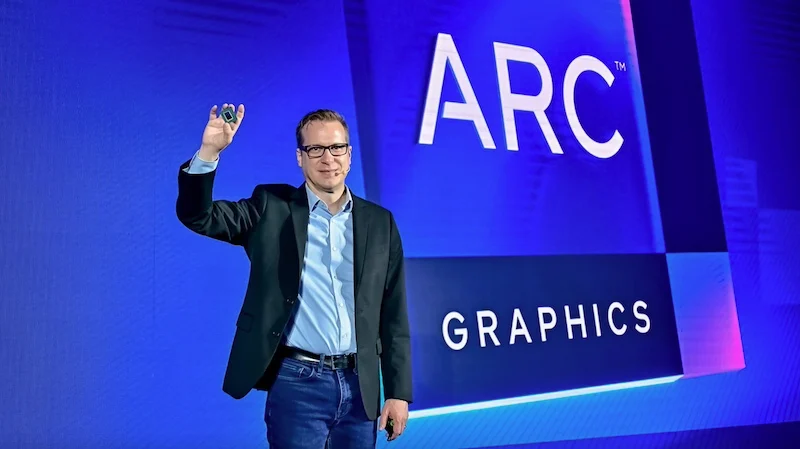
VP and general manager of Intel Automotive Jack Weast presents Intel Arc Graphics for Automotive.
With the Intel Arc A760A at the core of this solution, Intel Arc Graphics for Automotive supports up to four 4K displays and includes features such as single root input/output virtualization (SR-IOV), which enhances performance by up to 40% in virtualized environments.
Introducing Intel Arc Graphics
Intel engineered the Intel Arc A760A with 28 Xe cores and an equal number of Ray Tracing Units, which deliver advanced real-time ray tracing capabilities essential for rendering highly realistic 3D environments. Additionally, the GPU integrates 448 matrix engines for AI computations, enabling complex tasks such as deep learning inference directly within the vehicle and 448 vector engines for parallel processing to enhance the overall computational throughput.
Intel also designed the system with scalability in mind, integrating Intel’s AI-enabled SoCs to create a synergistic environment where computational power and AI capabilities are multiplied.
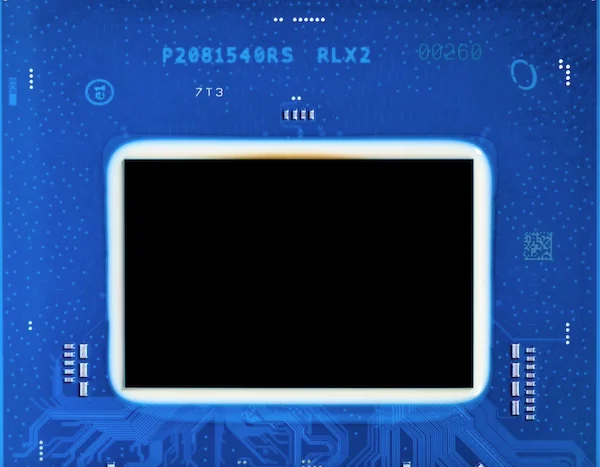
Intel Arc Graphics discrete GPU.
To enable substantial bandwidth for data transfer between the GPU and other system components, the A760A is equipped with 16 GB of GDDR6 memory on a 256-bit interface and operates on a PCI Express Gen4 x16 configuration. The system supports a peak performance of up to 14 TFLOPS FP32 and up to 229 TOPS for AI operations.
It offers support for OpenGL, Vulkan, and advanced media codecs like AVC, HEVC, VP9, and AV1.
Intel’s Vision for the AI Cockpit
Powered by this new hardware, Intel also discussed its vision for future AI Cockpit Experiences, designed to provide an immersive and interactive environment within the automotive sector.
Intel’s AI Cockpit leverages a combination of hardware and software optimizations. It includes support for 4K high-refresh-rate displays, fully 3D user interfaces, and multimodal interaction, which incorporates voice, gesture, touch, and eye movement recognition. Intel believes the multimodal approach will enable more accurate and intuitive interaction by processing and fusing data from different inputs.
The Intel AI Cockpit supports large language models (LLMs) that enable cognitive functionalities within the vehicle. This includes features such as voice dialogues, precise intent recognition, and on-device data processing that ensures privacy by keeping sensitive information within the vehicle. The system also supports complex AI applications like the Zhipu AI Car Assistant and the Baichuan NPC AI Companion, which deliver nuanced vehicle control, interactive manuals, and lifelike conversational experiences.
Aligning with Intel’s Strategic Objectives
Intel’s move into the automotive discrete GPU market aligns with its broader strategic goals of expanding its footprint in high-growth, data-centric industries. By entering this space, Intel hopes to diversify its portfolio and remain at the forefront of all things compute.
All images used courtesy of Intel.
