
Texas Instruments (TI) has introduced the DLPC8445, its smallest display controller yet, measuring just 9mm by 9mm. This compact size enables the development of ultra-portable 4K UHD projectors, delivering high-resolution displays with low latency and minimal power consumption.
What Is the DLPC8445 Display Controller?
The DLPC8445 is a digital display controller designed for TI’s DLP® 4K UHD display chipsets. When paired with the DLP472TP digital micromirror device (DMD) and the DLPA3085 or DLPA3082 power management integrated circuit (PMIC), it forms a complete system capable of producing high-quality 4K UHD projections.
How Does the DLPC8445 Enable Compact 4K UHD Projectors?
By reducing the controller’s size by 90% compared to previous generations, TI has made it possible to integrate high-resolution projection capabilities into compact devices. This advancement allows for the creation of portable projectors suitable for various applications, including home entertainment, gaming, and augmented reality experiences.
Which Applications Benefit from the DLPC8445?
The DLPC8445’s small form factor and high performance make it ideal for a range of applications:
-
Portable Projectors: Enables the development of lightweight, battery-powered projectors for on-the-go use.
-
Home Entertainment Systems: Facilitates the creation of compact projectors that deliver 4K UHD content in home theaters.
-
Gaming Consoles: Supports the development of gaming projectors with high refresh rates and low latency for immersive experiences.
-
Augmented Reality Glasses: Provides a solution for integrating high-resolution displays into AR eyewear.
Why Is the DLPC8445 Considered a Technological Breakthrough?
The DLPC8445 represents a significant leap forward in display technology due to its combination of compact size, high resolution, and low power consumption. This breakthrough enables the development of devices that were previously not feasible, opening new possibilities in portable and immersive display solutions.
How Does the DLPC8445 Compare to Previous Models?
Compared to its predecessors, the DLPC8445 offers:
-
Smaller Size: At 9mm by 9mm, it’s 90% smaller than earlier models.
-
Higher Performance: Supports 4K UHD resolution with ultra-low latency.
-
Lower Power Consumption: Designed for energy-efficient operation, extending battery life in portable devices.
What Are the Key Components of the DLPC8445 System?
The complete system includes:
-
DLPC8445 Display Controller: Manages the display data and controls the DMD.
-
DLP472TP DMD: The digital micromirror device that reflects light to create the image.
-
DLPA3085 or DLPA3082 PMIC: Power management integrated circuits that supply the necessary power to the system components.
Buying Tips
When considering the DLPC8445 for your project, keep the following in mind:
-
Compatibility: Ensure that the DLPC8445 is used with the appropriate DMD and PMIC for optimal performance.
-
Application Requirements: Assess your specific needs, such as resolution, size, and power consumption, to determine if the DLPC8445 meets your criteria.
-
Supplier Reliability: Purchase from reputable suppliers to ensure you receive genuine components and reliable customer support.
Fly-Wing Technology (HK) Co., Limited is a trusted source for electronic components, offering competitive prices and a wide selection of parts to meet your project needs.
Electronic Components Expert Views
“The DLPC8445 is a game-changer in the display industry. Its compact size and high performance open up new possibilities for portable and immersive display solutions.” – Seema Deshpande, Product Line Manager, TI DLP Display Products
FAQ
What is the DLPC8445?
The DLPC8445 is Texas Instruments’ smallest display controller, enabling compact 4K UHD projectors with low power consumption.
What applications can benefit from the DLPC8445?
Applications include portable projectors, home entertainment systems, gaming consoles, and augmented reality glasses.
How does the DLPC8445 compare to previous models?
It offers a 90% reduction in size, higher performance, and lower power consumption compared to earlier models.
What components are needed to use the DLPC8445?
It requires the DLP472TP DMD and the DLPA3085 or DLPA3082 PMIC to form a complete system.
Where can I purchase the DLPC8445?
The DLPC8445 can be purchased from authorized electronic component distributors and suppliers.
At the width of a pencil eraser, the new digital light processing chipset may enable the “smallest, fastest, and lowest-power 4K ultra-high-definition (UHD) projectors ever”.
Today Texas Instruments introduced a digital light processing (DLP) chipset that is 90% smaller than previous generations. The 9 mm x 9 mm DLPC8445 chip is a highly advanced digital display controller that addresses the demand for high-resolution displays, like 4K UHD displays, that provide unprecedented image clarity and color fidelity.
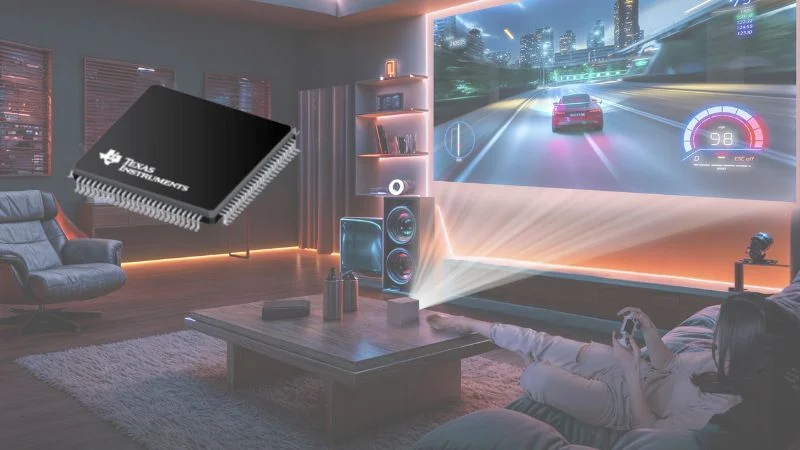
The DLPC8445. Image (modified) used courtesy of Texas Instruments
A Compact DLP Controller for Sharp Displays
The chip’s internal architecture (datasheet linked) is powered by an Arm processor and features 52 configurable GPIOs, a PWM generator, capture and delay timers, and a USB 2.0 high-speed controller. It also includes a sophisticated warping engine that supports 1D, 2D, and 3D keystone correction, multipoint manual warping, and full-warp map access with 32 x 18 uniformly sampled points.
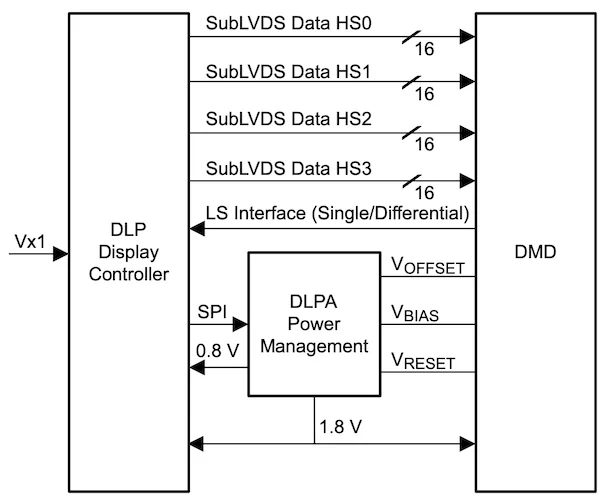
4K UHD display chipset. Image used courtesy of Texas Instruments
It features several video processing features, such as DynamicBlack and HDR10 support (both PQ and HLG), frame rate multiplication, color coordinate adjustment, white color temperature adjustment, programmable digamma, and read-side, spatial-temporal multiplexing. It also integrates support for 3D displays and provides a rolling buffer to minimize frame latency.
The input to this chip is a single V-by-One HS video port that can support one to eight lanes, with a pixel clock of up to 600 MHz and a transmission rate of up to 3.0 Gbps per input. TI designed the DLPC8445 to work in tandem with the DLP472TP digital micromirror device (DMD) and DLPA3085 PMIC/LED driver. Together with the DMD and PMIC, this chipset can deliver up to 4K UHD resolution at 60 Hz and 1080 p resolution at 240 Hz for 2D content and 120 Hz for 3D content.
How DLP and DMD Work Together
In advanced display systems, DLP controllers and DMDs work in tandem to create high-quality, precise digital displays. In Texas Instruments’ solutions, the DLP uses DMDs as the core component to modulate light and generate images.
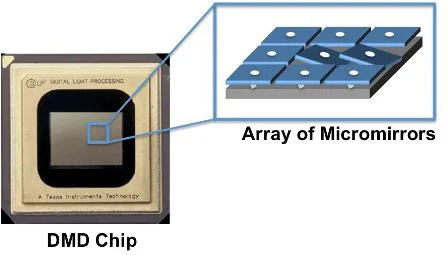
A DMD chip consists of an array of micromirrors. Image used courtesy of ProjectorScreen.com
At the heart of a DLP system, the DMD consists of an array of tiny mirrors, each representing a single pixel in the projected image. These mirrors are mounted on tiny hinges that allow them to tilt toward or away from a light source, usually a high-intensity lamp or LED. Each mirror can tilt thousands of times per second, directing light either toward the projection lens or away from it, thereby creating bright and dark pixels on the screen.
The process begins with the DLP controller, which sends binary data corresponding to the image to the DMD. The controller rapidly processes this data, converting it into signals that dictate the tilt position of each micromirror. When a mirror tilts towards the light source, it reflects light through the projection lens onto the display surface, creating a visible pixel. Conversely, when it tilts away, the light is directed into a light-absorbing area, rendering the pixel dark.
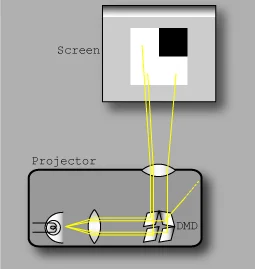
Diagram of a DMD producing an image. Image used courtesy of ProjectorScreen.com
To produce color images, DLP systems typically use a color wheel that spins between the light source and the DMD. This wheel is divided into segments of primary colors (red, green, and blue). As the wheel spins, it sequentially filters the light into these colors, and the DMD mirrors adjust their tilt to reflect the appropriate color combination for each pixel. By synchronizing the color wheel’s rotation with the micromirrors’ tilt, the DLP system can produce full-color images at high resolutions and refresh rates.
Big-Screen Projections Anywhere
With a 90% reduction in DLP size, TI’s DLPC8445 may unlock big-screen gaming and projection anywhere. The company claims that future versions of the family will be fit for more demanding applications like augmented reality glasses. Preproduction quantities of the new chipset are now available.
