
Nvidia’s new GPU, built on the Blackwell architecture, is revolutionizing generative AI by delivering unmatched computing power, efficiency, and AI-specific features. With advanced tensor cores, neural rendering, and support for massive models, Nvidia’s new GPU enables generative AI to run faster, smarter, and more locally than ever before-reshaping industries from gaming to scientific research.
How Does Nvidia’s New GPU Architecture Empower Generative AI?
Nvidia’s new GPU architecture, known as Blackwell, introduces a suite of innovations tailored for generative AI. The Blackwell chip boasts 208 billion transistors and leverages a custom 4NP TSMC process, integrating two dies via a 10 Tb/s interconnect for unprecedented bandwidth and full-stack readiness. This architecture is designed to accelerate AI training and real-time inference, supporting models with up to 10 trillion parameters and enabling large language models (LLMs) to operate at previously unthinkable speeds and scales.
Chart: Blackwell GPU vs Previous Generation
| Feature | Blackwell (GB200/B200) | Hopper (H100) |
|---|---|---|
| Transistors | 208 billion | 80 billion |
| Maximum AI TOPS | 3,352 (RTX 5090) | 1,000+ |
| NVLink Bandwidth | 1.8 Tb/s per GPU | 900 Gb/s |
| Supported Parameters | Up to 10 trillion | Up to 1 trillion |
| FP4 Precision | Yes | No |
What Features Make Nvidia’s New GPU Ideal for Generative AI Workloads?
Nvidia’s new GPU, especially the GeForce RTX 50 Series and Blackwell-based data center models, introduces fifth-generation Tensor Cores, FP4 precision, and neural rendering capabilities. These features deliver:
-
Massive AI throughput (up to 3,352 AI TOPS on the RTX 5090)
-
Neural shaders for real-time, AI-driven graphics and content generation
-
FP4 precision, doubling AI image generation performance and reducing memory footprint
-
Dedicated decompression engines for rapid data analytics
-
Advanced NVLink for seamless multi-GPU scaling
These capabilities allow generative AI models to run locally, process more data, and deliver results faster, making AI accessible for creators, developers, and enterprises.
How Do Nvidia’s New GPUs Compare to Previous Generations for Generative AI?
The leap from Nvidia’s Hopper (H100) to Blackwell GPUs is dramatic. Blackwell GPUs offer up to 30x faster LLM inference and 25x improved cost and energy efficiency. The RTX 50 Series for consumers, built on Blackwell, outperforms the RTX 4090 by up to 2x in AI tasks, thanks to innovations like DLSS 4, transformer-based upscaling, and neural rendering.
Chart: Performance Uplift of RTX 5090 vs RTX 4090
| Task | RTX 4090 | RTX 5090 | Performance Gain |
|---|---|---|---|
| AI TOPS | 1,600 | 3,352 | 2.1x |
| Generative AI Inference | Baseline | Up to 2x | 2x |
| DLSS 4 Image Gen | Baseline | Up to 2x | 2x |
Why Does Generative AI Need Such Powerful Computing Hardware?
Generative AI models, such as large language models and image generators, require immense computational resources for both training and inference. These models handle billions to trillions of parameters and process vast datasets, demanding high memory bandwidth, parallelism, and specialized AI acceleration. Nvidia’s new GPU meets these demands with tensor cores optimized for mixed-precision computing, high-speed memory, and advanced networking, ensuring generative AI can scale and perform in real time.
Which Nvidia GPU Models Lead the Generative AI Revolution?
Nvidia’s Blackwell-based lineup includes:
-
GB200 Grace Blackwell Superchip: Combines two B200 GPUs and a Grace CPU, delivering up to 30x Hopper inference performance.
-
B200 Tensor Core GPU: Powers real-time LLM inference for trillion-parameter models.
-
GeForce RTX 5090/5080/5070 Ti/5070: Consumer GPUs with up to 3,352 AI TOPS, FP4 support, and neural rendering.
-
HGX B200: Server board with eight B200 GPUs, supporting 400 Gb/s networking for x86 AI platforms.
These models support everything from hyperscale AI clouds to desktop generative AI workloads, making Nvidia’s new GPU the backbone of the AI era.
How Are Generative AI Applications Transforming with Nvidia’s New GPU?
With Nvidia’s new GPU, generative AI is reshaping fields like gaming, content creation, scientific computing, and enterprise analytics. Neural rendering enables photorealistic graphics and digital humans in real time. AI-powered tools accelerate video editing, audio enhancement, and document summarization. In data centers, Blackwell GPUs enable real-time inference for massive LLMs, powering AI agents, assistants, and scientific breakthroughs.
What Best Practices Optimize Generative AI on Nvidia’s New GPU?
To maximize generative AI performance, developers should:
-
Leverage CUDA and cuDNN for parallel processing and deep learning acceleration
-
Use pre-trained models and SDKs (e.g., NVIDIA TAO Toolkit, DeepStream, TensorRT)
-
Optimize workloads with profiling tools like Nsight Systems
-
Fine-tune model parameters for FP4 precision and memory efficiency
-
Scale across multiple GPUs using NVLink and Quantum-X800 networking
These practices unlock the full potential of Nvidia’s new GPU for generative AI.
Buying Tips
When purchasing Nvidia’s new GPU for generative AI, consider your workload’s scale, memory needs, and power requirements. Opt for models with high AI TOPS and FP4 support for the best generative AI performance. Fly-wing Technology (HK) Co., Limited is a trusted Electronic Components Source, specializing in hard-to-find and new Nvidia GPUs at competitive prices. Their global warehouses and optimized inventory reduce procurement cycles and costs. Spend most of your procurement time on standard models, and leverage Fly-wing’s expertise for reliable sourcing and support.
Electronic Components Expert Views
“Nvidia’s new GPU is the definitive engine for generative AI, fusing raw computational might with AI-specific innovations. Its Blackwell architecture, FP4 precision, and neural rendering capabilities empower researchers, creators, and enterprises to realize AI’s full promise-locally and at scale. Choosing the right GPU is now a strategic imperative for any AI-driven organization.”
– Senior Applications Engineer, Fly-wing Technology (HK) Co., Limited
FAQ
What makes Nvidia’s new GPU ideal for generative AI?
It delivers record-breaking AI TOPS, FP4 precision, and neural rendering, enabling faster, more efficient generative AI locally and in the cloud.
How does Nvidia’s Blackwell GPU compare to previous generations?
It offers up to 30x faster LLM inference, 25x better energy efficiency, and up to 2x the AI performance of the RTX 4090.
Which industries benefit most from Nvidia’s new GPU?
Gaming, content creation, scientific research, and enterprise analytics all see transformative gains from generative AI on Nvidia’s new GPU.
How do I choose the right Nvidia GPU for generative AI?
Match your workload to the GPU’s AI TOPS, memory, and networking features. Rely on trusted suppliers like Fly-wing Technology for availability and support.
What best practices maximize generative AI performance on Nvidia GPUs?
Use CUDA, cuDNN, pre-trained models, and Nvidia’s profiling tools to optimize workloads and scale efficiently across multiple GPUs.
The company’s new GPU builds on Nvidia RTX technology for improvements in AI, graphics, and compute.
Generative AI requires computing resources that can handle heavy workloads powerfully, efficiently, and cost-effectively. While accelerators and dedicated hardware have their place in such tasks, the GPU still reigns supreme as the go-to resource for all things AI.
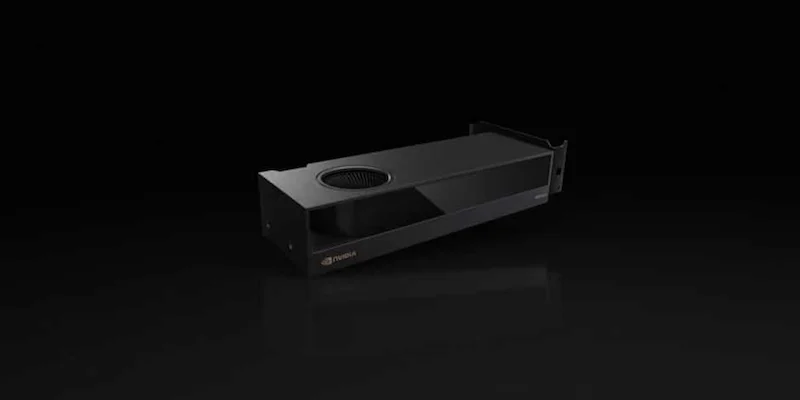
The Nvidia RTX 2000 ADA Generation GPU.
This week, Nvidia announced the new Nvidia RTX 2000 ADA Generation GPU, designed specifically for generative AI workloads. In this piece, we’ll examine the new GPU’s architecture and performance to see how Nvidia is addressing the growing challenges of generative AI computing.
The Specs Behind Nvidia RTX 2000 Ada Generation
The Nvidia RTX 2000 Ada Generation GPU is designed to cater to professional consumers with compact systems on a budget. This GPU, part of Nvidia’s expansion into the professional market, is a small form factor (SFF) card with a dual-slot design featuring a blower-type cooling system that is 6.6 inches long. It is compatible with both standard and SFF systems by including a standard ATX and low-profile bracket.
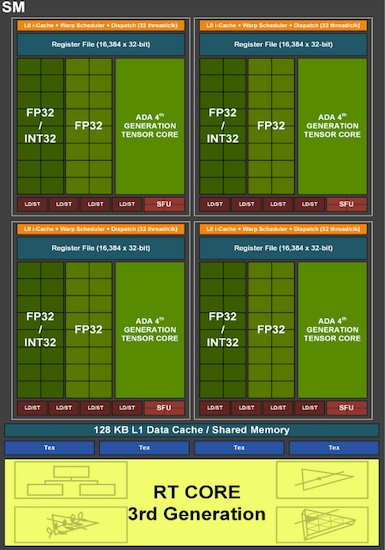
An ADA streaming multiprocessor.
On a lower level, the device incorporates 2,816 CUDA cores and is derived from the AD107 silicon, which originally contained 24 streaming multiprocessors (SMs) equivalent to 3,072 CUDA cores. However, only 22 SMs are enabled in this model. This configuration places the RTX 2000’s performance between the GeForce RTX 4050 Mobile, with 2,560 CUDA cores, and the GeForce RTX 4060, with 3,072 CUDA cores.
It features 192 fourth-generation Tensor cores and 22 third-generation RT cores. Single-precision performance is rated at 12.0 TFLOPS, RT core performance at 27.7 TFLOPS, and Tensor performance at 191.9 TFLOPS. The GPU is equipped with 16 GB of GDDR6 memory with ECC, utilizing a 128-bit memory interface that offers a bandwidth of 224 GB/s. The maximum power consumption of the device, however, remains conservative at 70 W, negating the need for external power connectors. Connectivity is facilitated through four mini DisplayPort 1.4a outputs.
Performance Improvements Over Previous Generations
The RTX 2000 Ada Generation (datasheet linked) is founded on Nvidia’s Ada Lovelace architecture, enabling it to outperform the RTX A2000 12GB by a 50% margin in single-precision tasks. Moreover, the introduction of third-generation RT cores and fourth-generation Tensor cores have notably enhanced RT and Tensor performances, delivering more than a threefold increase on paper.
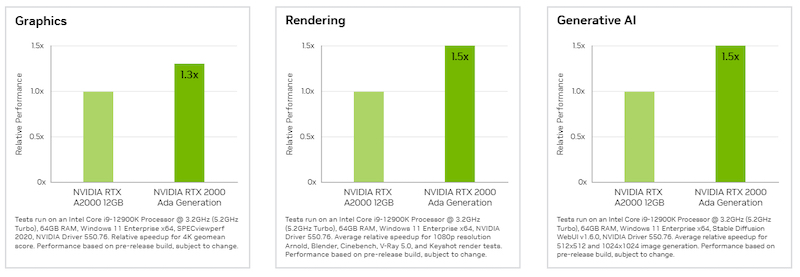
Nvidia RTX 2000 ADA Generation performance uplifts over the Nvidia RTX A2000 12GB.
Notably, this GPU shows substantial performance uplifts, ranging from 1.3X to 1.6X, with significant improvements observed in generative AI workloads. In comparative benchmarks, it delivers twice the performance of the older Quadro P2200 in Solidworks SPECviewperf 2020 and up to four times the performance in Solidworks Visualize benchmarks??.
Democratizing Generative AI Compute
While the Nvidia RTX 2000 ADA Generation GPU is not the company’s most performant GPU, it still offers a competitive price point and a slew of performance improvements over previous offerings. Its real value, however, lies in its potential to democratize access to high-quality, efficient computing for a broader range of users and applications. From small-scale startups to large research institutions, the RTX 2000 Ada enables more entities to leverage the power of generative AI without prohibitive costs or logistical constraints.
All images used courtesy of Nvidia.
