Introduction: Why Choosing the Right Voltage Regulator Matters
Almost every electronic system requires some form of power conversion, and the trend towards lower-power, portable equipment has driven the technology to convert power more efficiently. Voltage regulators are devices that convert high voltage into a steady, lower voltage.
A linear voltage regulator is a circuit that takes in a variable input voltage and provides a continuously controlled, steady, low-noise DC output voltage. Generally, linear voltage regulators require a large voltage drop between the input and the output to function correctly.
Generally, linear voltage regulators require a large voltage drop between the input and output to function properly, whereas low-dropout (LDO) regulators work well even when the output voltage is close to the input voltage. This results in higher efficiency compared to linear voltage regulators. Another type of voltage regulator is a switching voltage regulators that offer higher efficiency compared to linear regulators. These are also called DC-DC converters and use inductors, capacitors, and a power switch to convert the input voltage. However, the standard linear regulators and LDOs use only passive components such as resistors and capacitors to convert the higher voltage into a lower voltage.
Modern electronic devices are voltage sensitive, and even a small fluctuation of voltage can cause the circuit to fail. Many electronic design fails not due to the regulator failure, but due to choosing the incorrect regulator for the application. This is mainly because the designers often only consider output voltage and current rating and overlook key design parameters such as dropout voltage, efficiency, and thermal dissipation. The voltage regulators are often classified into two broad categories: Linear and switching regulators.

Therefore, choosing the right voltage regulator for your application is essential, and this technical guide will help you choose the right regulator for your application.
What Is a Linear Voltage Regulator?
In modern electronics, a clean and noise-free constant voltage is essential for powering sensors, microcontrollers, op-amp circuits, relay modules, communication modules, motor controllers, audio circuits, and various analog/digital loads.
A linear voltage regulator is an electronic device that provides a constant output voltage at its output by dissipating excess input voltage as heat. Every electronic device requires a specific voltage for its proper operation, and voltage regulators provide that constant DC voltage.
The Linear voltage regulators are the simplest type of regulators that use resistors to dissipate the excess heat and therefore are not as efficient as LDO and switching regulators. So, the most commonly used linear voltage regulators are the IC 7812 and IC 7805 regulators. The IC 7812 provides a constant 12V at its output, and the IC 7805 provides a constant 5V.
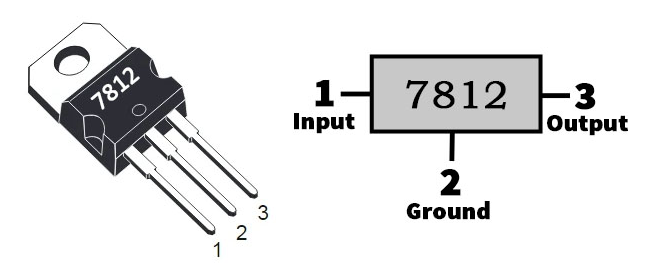
Linear voltage regulators are also known as the three-pin regulators because these regulators have mostly only three pins, i.e., input, output, and GND pin. The higher voltage is applied at the input terminal with a decoupling capacitor to filter the noise, and the constant output is taken across the output terminal. The pin diagram of IC 7812 is shown below.
Key Characteristics of Linear Voltage Regulators
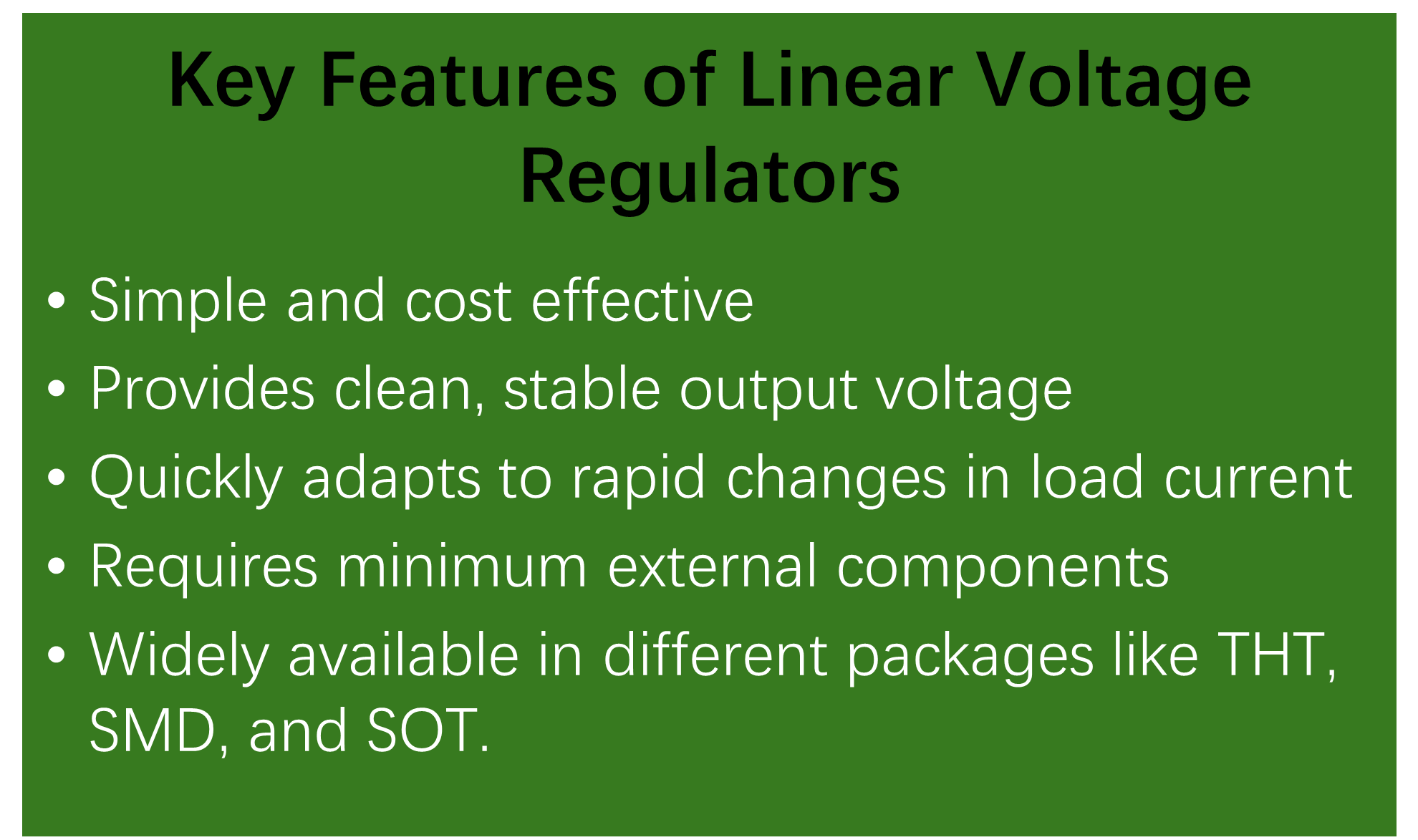
The linear voltage regulators are the simplest type of regulators that use minimum external components for their operation and consist of only three pins. However, because they use resistor elements to dissipate the excess voltage, their efficiency is lower compared to other regulators. Therefore, these regulators are often used for reference voltage generation, power supplies, and for MCU rails.
If your application requires the following features offered by linear regulators, then a linear voltage regulator is the right choice for your design.
Limitations of Linear Voltage Regulators
When choosing the voltage regulator for your application must consider these limitations. If your design requires any of the following features, do not go with the linear regulators. Generally, when the following characteristics are required in an application, designers often prefer LDOs and switching voltage regulators.
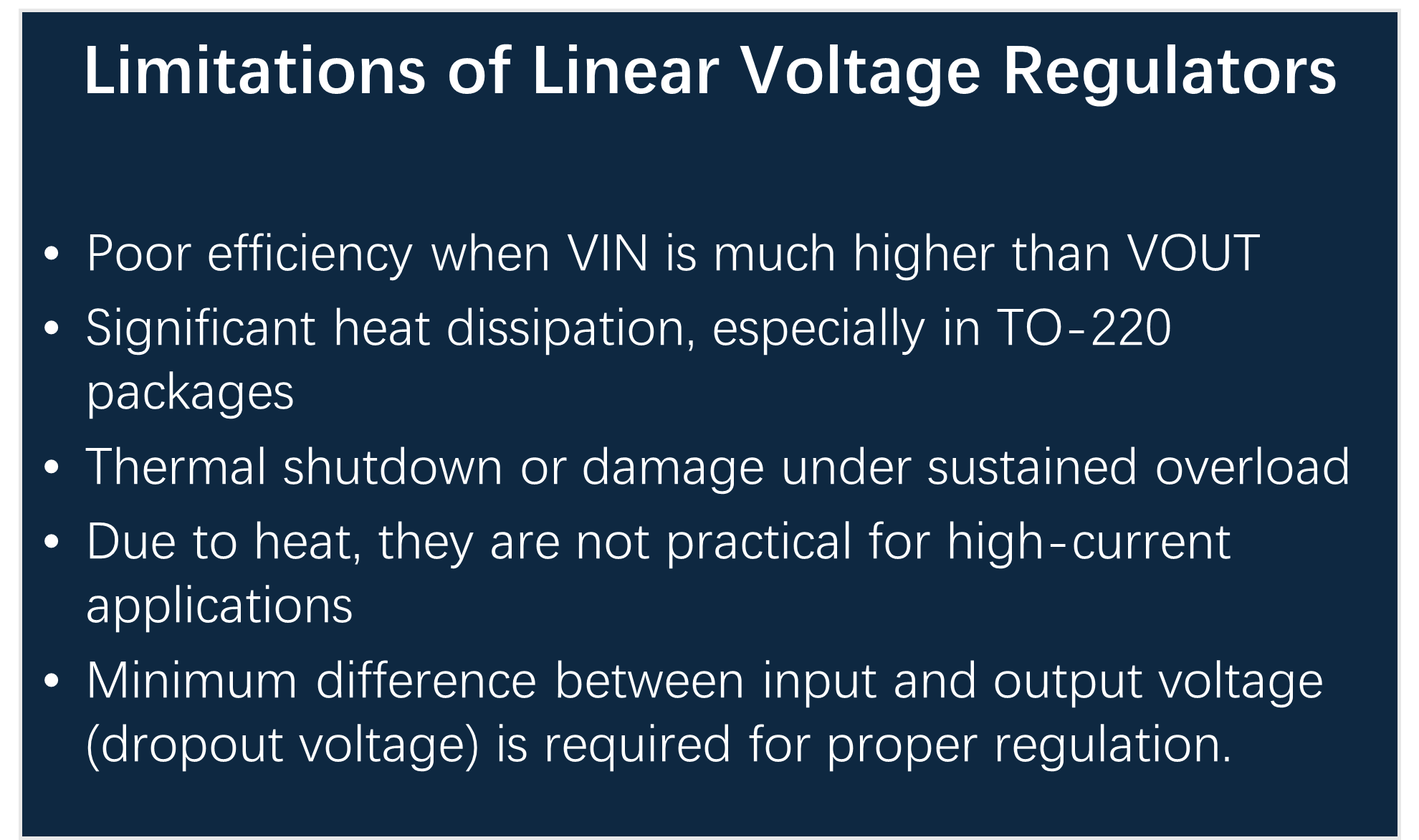
For example, running an IC 7805 from 12 V at 500 mA results in over 3.5 W of heat, requiring a heatsink or improved PCB thermal design.
Linear Voltage Regulators: Typical Technical Specifications
Typical Technical Specifications of Linear Voltage Regulators
Traditional linear regulators such as LM7805, LM7812, and LM317 exhibit these technical specifications.

What Is an LDO (Low Dropout) Regulator?
An Low Dropout is the type of linear voltage regulator that is designed to operate with a very small difference between input and output voltage. This voltage is known as the dropout voltage, and the regulator is known as LDO regulator.
Unlike linear regulators such as IC 7805 and LM7812 voltage regulators, LDOs can operate even when the difference between input and output voltage is a few hundred millivolts. LDOs are very common in modern electronic devices, especially in wearable and consumer electronics such as LM1117, AMS1117, MCP1700, TLV700, and TPS7A.
Traditional linear voltage regulators have a higher voltage drop between input and output voltage, which is typically as low as 2V. This is acceptable for many applications, but in some applications, it is not desirable. For example, in applications that require a 5V constant DC output from a 7V input, the linear voltage regulator, such as IC 7805, will work for such applications. However, in applications where it is required to generate the 3.3V from a 3.6V Li-ion battery, LDO works well, but a linear voltage regulator will fail. Therefore, choosing between LDO and a linear voltage regulator is dependent on the application type and specific requirements.
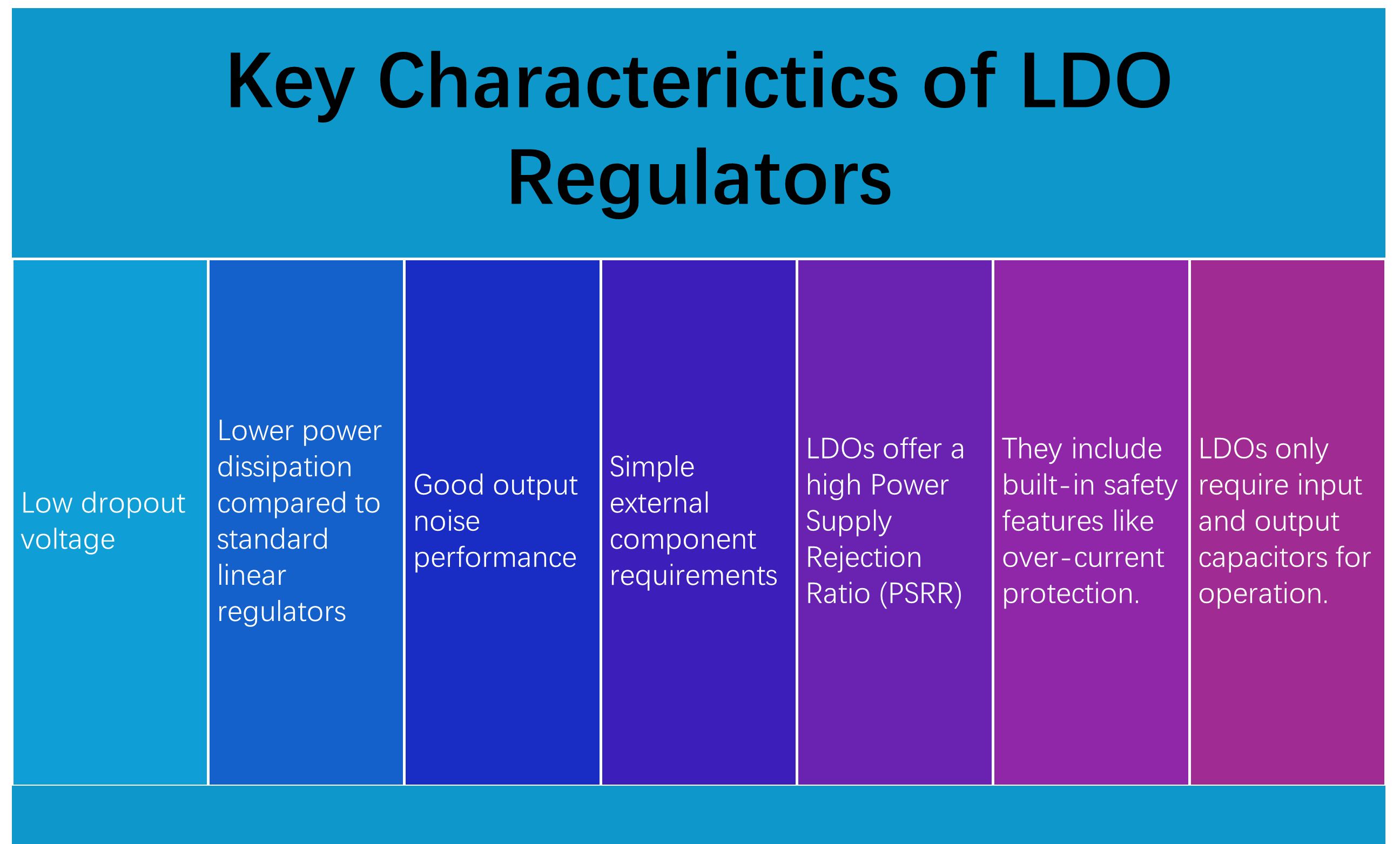
Key Characteristics of LDO Regulators
LDOs offer many more advantages compared to linear voltage regulators. Therefore, they are commonly used in MCU power rails using TLV700, MCP1700, RF, and analog sections requiring low noise (TPS7A series), Battery-powered systems with tight voltage headroom, and post-regulation after switching converters for ripple suppression. Their key features are;
Typical Technical Specifications of LDOs
Typical Technical Specifications of LDO Voltage Regulators
Modern LDO regulators such as LM1117, AMS1117, MCP1700, TLV700, and TPS7A series devices are optimized for low-voltage systems and battery-powered designs.
What Is a Switching Voltage Regulator?
A switching regulator is an electronic device that is widely used in modern electronic systems. The switching regulators differ from the traditional linear regulators because they uses switching element to convert the input voltage to either high or low voltage regardless of the changes at the input side. Because these regulators use switching elements to convert the input voltage, capacitors and inductors are used to smooth the output voltage.
Types of Switching Regulators/DC-DC converters
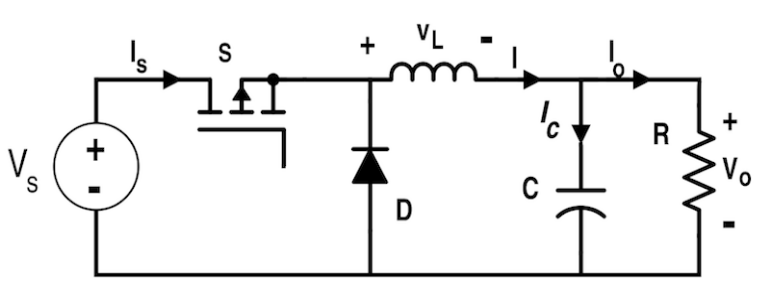
The switching regulators are categorized based on the output voltage. If the output voltage of a switching regulator is lower than the input voltage, it is known as a Buck converter. On the other hand, if the output voltage of a switching regulator is higher than the input voltage, it is known as a boost converter. However, if the switching regulator can either convert the input voltage to a higher or lower voltage, it is known as a buck-boost converter.

Unlike traditional regulators, switching regulators do not dissipate the excess voltage as heat. Instead, they store and release the energy efficiently using inductors and capacitors. Therefore, switching regulators are the preferred choice for high-current and wide input-voltage applications. The typical circuit of a buck converter is shown below.
Due to higher performance, better thermal management, and higher efficiency, these regulators are extensively used in embedded, industrial, and power electronic designs. Some of the most widely used regulators ICs are LM2576, MP1584, TPS5430 (buck), MT3608 (boost), and TPS63070 or TPS629210 (buck-boost).
Switching Regulators: Typical Technical Specifications
Typical Technical Specifications of Switching Voltage Regulators
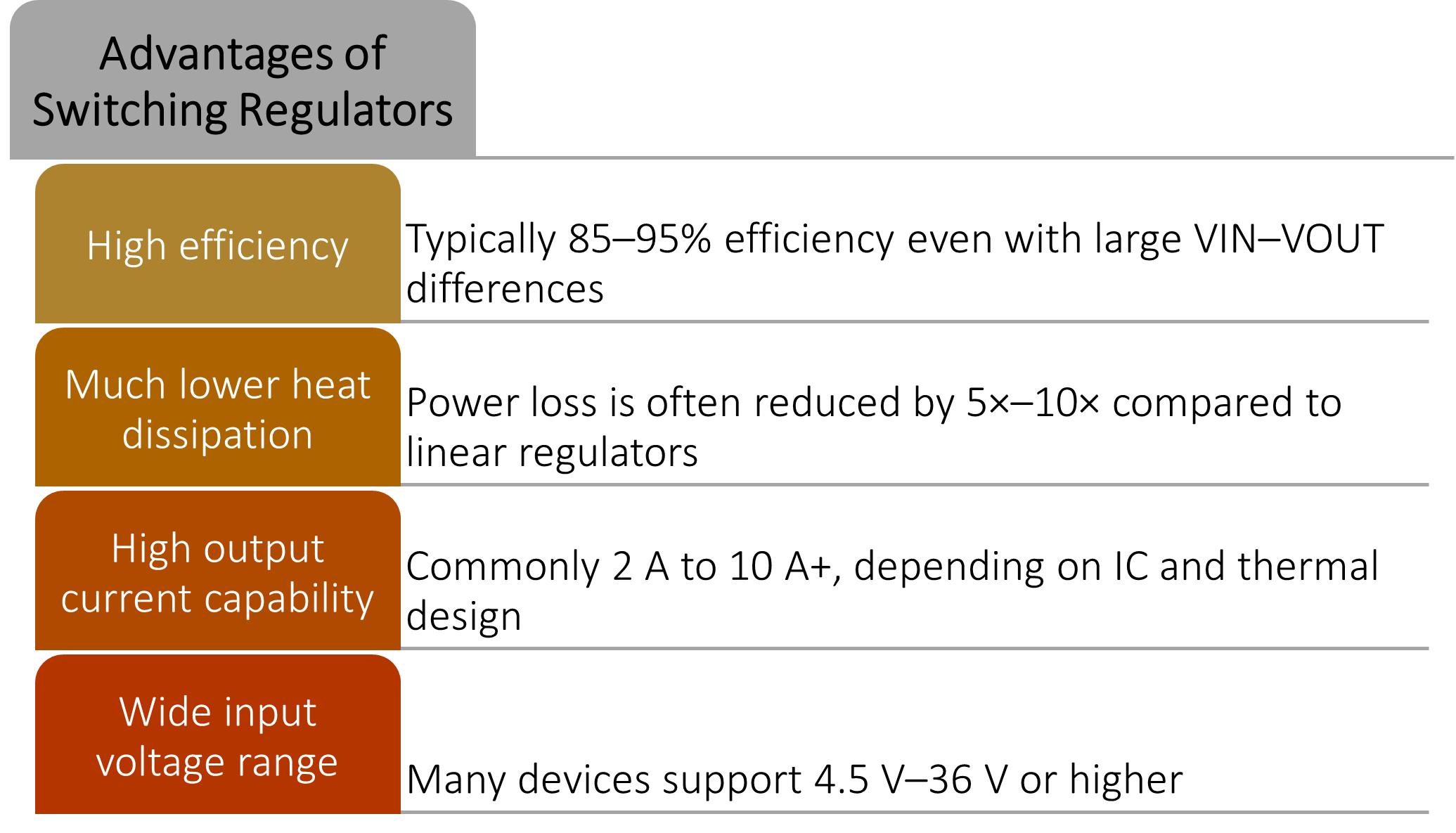
Advantages of Switching Regulators
Unlike traditional linear voltage regulators, switching regulators are far superior in terms of thermal management, efficiency, performance, and reliability. When choosing the voltage regulator for your application, must take into account the following advantages of switching regulators over linear regulators.
Typical Applications of Switching Regulators
Due to their higher efficiency, less heat dissipation, better thermal management, and higher performance, switching regulators are used in vast fields. Some of the applications where switching regulators are used;
- Battery-powered devices
- High-current MCU, CPU, and FPGA rails
- Industrial and automotive electronics
- IoT and embedded systems
- Power distribution networks
Efficiency vs Noise
One of the most important design decisions in power electronics is balancing power efficiency against output noise performance. This trade-off largely determines whether a linear, LDO, or switching regulator is the right choice for a given application.
Efficiency should be prioritized over noise performance when power loss, heat generation, or battery life directly affect system reliability or usability. So, in high-current designs, even a small efficiency improvement can prevent thermal shutdown, reduce PCB size, and eliminate the need for heatsinks.
For example, supplying 5 V at 2 A from a 12 V source using a linear regulator would dissipate 14 W, making the design impractical, while a 90% efficient switching regulator dissipates close to 1 W. Therefore, in such cases—motor drivers, CPUs, FPGAs, LED drivers, battery-powered devices, and compact enclosures—switching regulators are mandatory, and moderate output ripple is acceptable or easily filtered. Therefore, in such a case, choosing efficiency is not an optimization—it is a design requirement.
Thermal Considerations When Choosing a Regulator
Thermal management is one of the most critical factors in selecting a voltage regulator. Even a perfectly functioning regulator can fail prematurely or trigger thermal shutdown if the power dissipation exceeds the PCB’s ability to remove heat.
Power dissipation in a voltage regulator depends mainly on the voltage drop across the regulator and the load current. Generally, Linear/LDO regulators dissipate all excess voltage as heat. However, switching regulators dissipate only a fraction of the power due to higher efficiency. The power loss can be calculated using;
Ploss = (VIN − VOUT) × IOUT + IQUIESCENT × VOUT
VIN = Input voltage
VOUT = Output voltage
IOUT = Load current
IQUIESCENT = Regulator quiescent current
To check the thermal design suitability for your application, check junction-to-ambient thermal resistance (θJA) in the datasheet. Once junction-to-ambient is determined, calculate the expected junction temperature using ;
TJ = TAMBIENT + PLOSS × θJA
TJ = Junction temperature of the device
TAMBIENT = Ambient temperature
PLOSS = Power dissipated by the regulator
θJA = Thermal resistance junction-to-ambient (°C/W)
Consider heatsinks or airflow if power dissipation exceeds 1–2 W for small packages.
Linear vs LDO vs Switching Regulators: Key Differences
Voltage Regulator Comparison
How to Choose a Voltage Regulator for Your Application
At this point, we know what voltage regulators are, their types, and the strengths and limitations of different voltage regulators. The flow chart below helps the designer to choose the right voltage regulator for their applications.
How to Choose the Right Voltage Regulator: Flow Diagram
1️⃣ Assess Output Current
Determine whether the required output current exceeds 1 A.
✅ If it exceeds 1 A, follow the High-Power Path (Step 2).
❌ If it is 1 A or below, follow the Low/Medium-Power Path (Step 5).
2️⃣ High-Power Path (IOUT > 1 A)
Evaluate if efficiency is critical for your design, such as in battery-powered or thermally constrained circuits.
✅ High efficiency required → Use a Switching Regulator.
❌ If efficiency is not critical, check expected power dissipation:
Power dissipation can be calculated as:
Ploss = (VIN − VOUT) × IOUT
✅ If Ploss > 2 W → Switching Regulator is recommended.
❌ If Ploss ≤ 2 W → Linear regulator may be used with proper heatsinking.
3️⃣ Select Switching Regulator Type
Choose the switching topology based on the relationship between input and output voltages:
- VIN > VOUT → Buck Regulator
- VIN < VOUT → Boost Regulator
- VIN varies above and below VOUT → Buck-Boost Regulator
Buck: LM2596, TPS5430
Boost: MT3608
Buck-Boost: TPS63070, TPS629210
4️⃣ Check Noise Sensitivity
Consider whether the load is noise-sensitive (e.g., RF circuits, ADCs, audio, PLLs, sensors).
✅ If sensitive → Add an LDO after the switching regulator for post-regulation.
❌ If not sensitive → The switching regulator alone is sufficient.
5️⃣ Low / Medium-Power Path (IOUT ≤ 1 A)
Check whether the input voltage is close to the desired output voltage (dropout ≤ 500 mV).
✅ If yes → Proceed to the LDO path (Step 6).
❌ If no → Compare Linear and Switching options based on efficiency and thermal considerations.
6️⃣ LDO Regulator Path
Determine if a low dropout voltage is required (≤ 300 mV).
✅ Yes → Modern LDOs (e.g., MCP1700, TLV700) are suitable.
❌ No → Standard LDOs (e.g., LM1117, AMS1117) can be used.
Check thermal dissipation: Ploss = (VIN − VOUT) × IOUT
✅ If Ploss < 1 W → LDO is safe.
❌ If Ploss ≥ 1 W → Switching regulator is recommended.
7️⃣ Linear vs Switching (Low Current)
Consider noise performance for the load.
✅ Critical → Choose Linear or LDO.
❌ Not critical → Evaluate simplicity and BOM cost.
Simplicity prioritized → Linear regulators (LM7805, LM317) are suitable.
Efficiency prioritized → Switching regulator is preferred.
8️⃣ Input Voltage Stability
Assess whether the input voltage is wide or unstable (common in automotive, battery, or industrial systems).
✅ Wide/unstable input → Use Switching Regulator.
❌ Stable input → Linear or LDO regulators are acceptable.
Popular Voltage Regulator ICs and Typical Applications
Choosing the right voltage regulator often depends on both the type of regulator and the specific IC available. Therefore, to help designers make quick decisions, the table below lists some commonly used linear, LDO, and switching regulators, along with their typical applications. This allows engineers to select a suitable IC for their project without getting into a hassle.
Voltage Regulator Examples
Conclusion
To sum up, voltage regulators are critical design components, and their incorrect selection can lead to design failure. This article covered the basics of different types of voltage regulators, such as linear, LDO, and switching voltage regulators. Designers often confuse when choosing the regulator for their design application, and the incorrect selection of voltage regulators leads to design failure. This article covers the guide for the designers to help them choose the right voltage regulator for their application.
Therefore, understanding voltage regulators’ differences, their efficiency, noise, thermal management, and stability helps the designers to make timely decisions. This ensures that engineers can design reliable power systems and avoid common risks such as thermal stress, oscillations, or ripple-induced malfunctions.
Frequently Asked Questions(FAQ)
Linear and LDO regulators are ideal for low-current, noise-sensitive applications like sensors and ADCs, while switching regulators excel in high-current, high-efficiency applications such as motors and CPUs. For battery-powered designs requiring both efficiency and low noise, a switching regulator followed by an LDO is often the best solution.
Keep VIN–VOUT small enough to avoid excessive heat. For example, a 12 V → 5 V linear regulator at 1 A dissipates 7 W—too much without proper heatsinking. If the voltage drop is large, a switching regulator is recommended.
Yes. This hybrid approach combines high efficiency from the switching stage and low noise from the LDO, making it ideal for MCUs, ADCs, and RF circuits.
To quickly choose a suitable regulator IC, first define the load current and voltage, efficiency versus noise requirements, thermal limits, and input voltage range. Then, select the appropriate regulator type—Linear, LDO, or Switching—and consult popular IC options, such as LM7805, TLV700, or TPS5430, to find a match for your application.