
Introduction to the LM2576 Switching Regulator IC
LM2576 is an ultra-efficient monolithic integrated circuit specifically designed to accomplish step-down (buck) DC-DC conversion. And therefore becomes a popular choice in power supply designs within various electronic applications. Manufactured by Texas Instruments, the switching regulator integrated circuit supports the construction of stable, regulated output voltages. From high input voltages and demonstrates significant advantage over the traditional linear regulators like the LM7805. With its ability to produce up to 3A of output current and support an extensive input voltage range (usually 4V to 40V), LM2576 is suited to applications where compactness, cost-effectiveness, and energy efficiency are required by the power solution.
The LM2576 is characterized by its high efficiency which often tops 80%. Thus reducing heat dissipation and eliminating the need for large heatsinks on most applications. It is available in fixed output voltage versions (3.3V, 5V, 12V, 15V) and an adjustable output version, thus offering flexibility where applicable. Some common applications include battery-powered applications, automotive supplies, LED driver supplies, and solar supplies. Its on-board features such as thermal shutdown and current limiting enhance reliability, making it a reliable component not only among hobbyists but also among professional engineers who deal with the development of rugged power management circuits.

What is the LM2576 Switching Regulator?
LM2576 Overview and Basic Functionality
LM2576 is a monolithic integrated circuit uniquely designed for step-down (buck) DC-DC conversion, efficiently managing voltage by reducing a higher input voltage to a lower and regulated output. It is used as a switching regulator through pulse-width modulation (PWM), thus realizing increased efficiency compared to linear regulators. With the capability to provide up to 3A output current, it offers fixed output voltage versions of 3.3V, 5V, 12V, and 15V, or an adjustable output through external components, thus making it especially ideal for compact and economical power supply solutions.
History and Manufacturer Details of LM2576 IC
LM2576 has been designed by Texas Instruments, the leading semiconductor company famous for its large portfolio of power management integrated circuits (ICs). Released within the SIMPLE SWITCHER® family portfolio, the LM2576 has been extensively put to use since the nineteen nineties due to its dependable and easy-to-use nature within the field of DC-DC converter applications. LM2576 is provided within different packages, including TO-220 and TO-263 to cater to through-hole along surface-mount applications. Texas Instruments also supports the LM2576 through complete datasheets and application notes. And hence continues its relevance to modern-day electronics beyond the availability of new replacements.
Key Features of LM2576 Voltage Regulator
Efficiency and Output Current Capabilities
The LM2576 switching regulator has high efficiency, usually exceeding 80% and reaching rates of up to 90% in ideal circumstances, thus remarkably reducing power loss relative to linear regulators. High efficiency is due to its pulse-width modulation (PWM) switching action that remarkably reduces heat dissipation. The switching regulator has an integrated circuit capable of delivering up to 3A of continuous output current and is thus safe to power an extremely variable range of items ranging from microcontrollers to motors without the need to deploy bulky heat sinks.
Input Voltage Range and Output Voltage Options
LM2576 can accept a high input voltage range between 4V and 40V (up to 60V on the HV version), and it can be powered by various supplies such as batteries, solar cells, or automobile supplies. Fixed output voltage versions exist (3.3V, 5V, 12V, 15V), and an adjustable version also exists. With the latter version, output voltages settable by the user with external resistors can be provided. Its diversity makes it applicable to various distinct applications where precise voltage regulation is also an issue.
Built-in Protection Features in LM2576
The LM2576 also incorporates good internal protection features for reliability. It has cycle-by-cycle current limiting to protect against output overcurrent conditions and a thermal shutdown feature that activates at higher junction temperature (approximately 150°C). These internal protections allow for safe operation under fault conditions, making the LM2576 a reliable distribution device for mission critical systems.
Thermal Shutdown and Current Limiting
The thermal shutdown function of the LM2576 stops operation when the internal temperature of the IC gets too high to prevent damage to the regulator and the circuit connected to it. Its current-limiting feature also limits the output current in overload conditions to prevent damage to the IC and other external components. Together, these features help increase the reliability of the LM2576 and make it a suitable option for harsh conditions in automotive and industrial applications.
LM2576 Pinout Diagram and Configuration
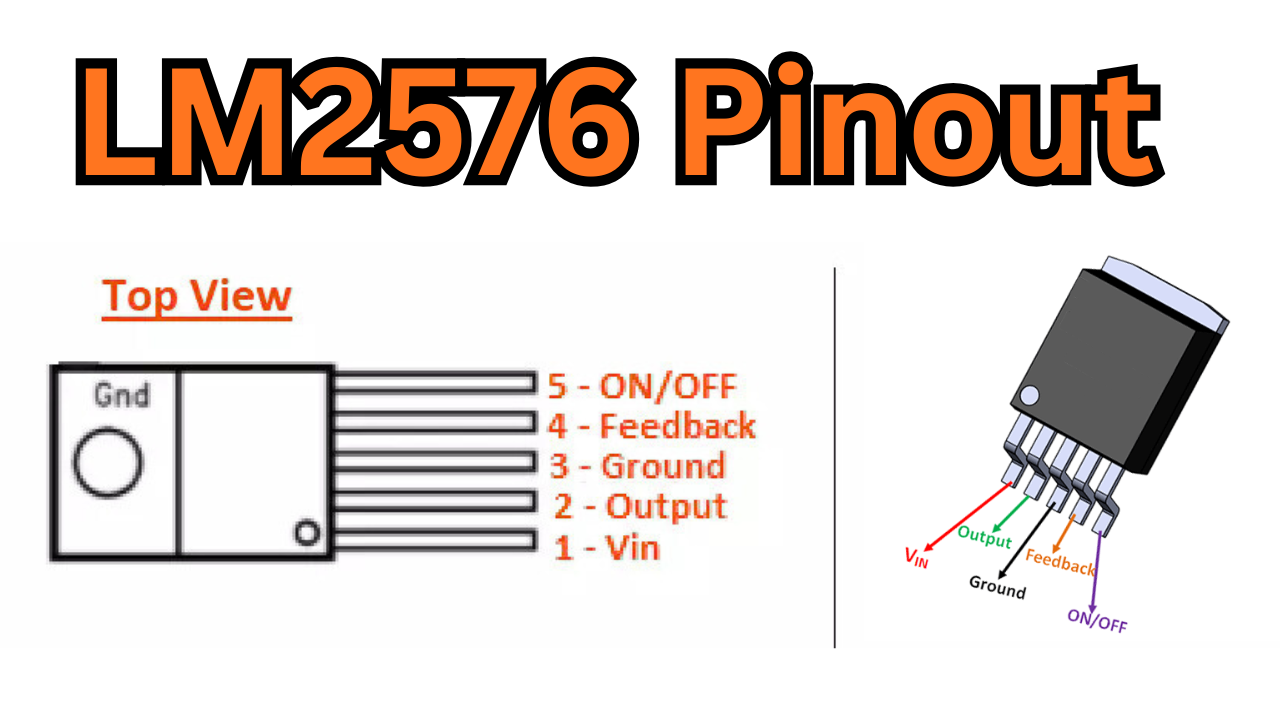
Detailed LM2576 Pin Descriptions
LM2576 switching regulator is available in various packages with five primary pins: VIN (input voltage), VOUT (output voltage), GND (ground), Feedback (to regulate voltage), and ON/OFF (enable/disable control) pins. It is powered by input voltages between 4V and 40V (up to 60V on HV versions) and has an output with regulated voltage. Adjustable versions determine the output voltage via Feedback pin, and the ON/OFF pin also supports power-saving control.
LM2576 TO-220 Package Pinout
The LM2576 packaged in the TO-220 package is the through-hole version often used in designs where reliable heat dissipation is required. Its five-pin layout consists of the following: Pin 1 (VIN), Pin 2 (VOUT), Pin 3 (GND), Pin 4 (Feedback), and Pin 5 (ON/OFF). The TO-220 package’s metal tab bonded to the ground increases thermal management. By being soldered to the heat sink and thus is especially ideal for high-power applications.
LM2576 TO-263 Package Pinout
The TO-263 (D2PAK) package is a surface-mount variant of the LM2576, designed for compact designs with good thermal performance. Its pinout mirrors the TO-220: Pin 1 (VIN), Pin 2 (VOUT), Pin 3 (GND), Pin 4 (Feedback), and Pin 5 (ON/OFF). The large ground pad on the bottom enhances heat dissipation, suitable for space-constrained applications like automotive or portable electronics.
Typical Connection Diagram for LM2576 Buck Converter
A typical LM2576 buck converter circuit needs few external components: an input capacitor, output capacitor, inductor (about 100 µH), diode, and resistors for adjustable versions. The VIN pin connects to the power source, VOUT to the load, and GND to common ground. The Feedback pin sets the output voltage through a resistor divider. While, the ON/OFF pin can connect to VIN or be externally controlled. A Schottky diode completes the efficient step-down operation.
How the LM2576 DC-DC Converter Works
Internal Block Diagram of LM2576 Regulator
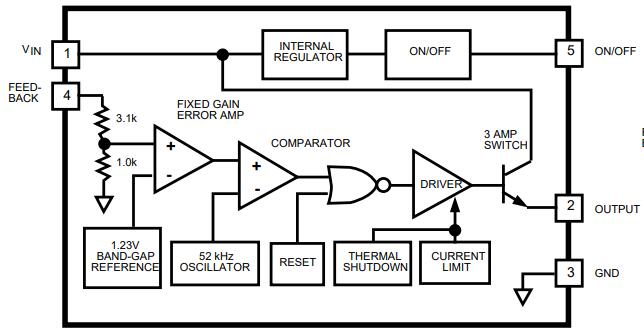
The LM2576 switching regulator IC incorporates several important elements to achieve a highly efficient DC-DC buck (step-down) converter. The block diagram consists of an internal fixed-frequency oscillator (52 kHz), a pulse-width modulation (PWM) comparator, a power switch (typically a BJT). A feedback voltage reference (1.23V for the adjustable versions), and the protection circuits (thermal shutdown and current limiting). The VIN pin powers the internal switch, which is constantly switching power to the inductor and the Feedback pin ensures that the output voltage is monitored to remain regulated. This architecture, being compact, allows for high efficiency and a small number of external components.
Switching Operation and PWM Control
LM2576 operates by fixed-frequency PWM control circuitry, which is used to control the output voltage. The oscillator turns the power switch on and off alternately at a rate of 52 kHz to control the energy stored by an external inductor. During the “on” state, the current is through the inductor to allow energy to be stored, but during the “off” state the energy is released by the inductor through the Schottky diode to the output capacitor and load. The duty cycle is adjusted by the PWM comparator to the output voltage feedback to allow the regulation to be stable despite changes in input voltage or load.
Component Selection for LM2576 Circuits
Circuit construction with an LM2576 is somewhat stringent with component choices. Some key components are a 100 µH inductor to support 3A output, a low voltage dropout Schottky diode like the 1N5822, an input capacitor between 100 µF and 470 µF, and an output between 330 µF and 1000 µF. Adjustable versions must be set by means of a resistor divider to the output voltage where VOUT = 1.23V × (1 + R1/R2). Component values must be chosen to conform to the datasheet to provide the best efficiency and stability.
Efficiency Calculations for LM2576 Applications
The LM2576 achieves high efficiency (80–90%) due to its switching topology, which minimizes power loss compared to linear regulators. Efficiency (η) is calculated as η = (POUT / PIN) × 100, where
\[POUT = VOUT × IOUT and PIN = VIN × IIN. \]
For example, a 5V/2A output from a 12V input with 85% efficiency implies an input current of approximately 0.784A (PIN = POUT / η = 10W / 0.85 ≈ 11.76W). Factors like inductor quality, diode forward voltage, and load conditions impact efficiency, and the datasheet provides graphs to estimate performance.
LM2576 Datasheet Specifications and Parameters
Electrical Characteristics of LM2576 IC
The datasheet for the LM2576 provides thorough electrical characteristics that are the key to design requirements. Under standard operating conditions (VIN = 12V, IOUT = 3A, VOUT = 5V), the output voltage tolerance is held to ±4% over line and load conditions. Quiescent current is about 5 mA, and standby current with the ON/OFF pin low is about 50 µA. The oscillator frequency is always 52 kHz and thus ensures smooth switching performance. Efficiency is between 80% and 90%, depending on the input/output voltage and load. Specifications thus provide dependable performance through an array of uses.
Absolute Maximum Ratings
The absolute maximum ratings of the LM2576 determine the working range to avoid damage. Maximum input voltage is 45V on standard versions and 63V on HV versions. The ON/OFF pin is tolerable to +7V. Max power dissipation is internally limited but package dependent (TO-220 and TO-263). It also depends on the thermal management. Junction temperature is not to exceed 150°C and the storage temperature is between -65°C and +150°C. Operating beyond these specifications can cause permanent damage to the IC.
Recommended Operating Conditions
For optimal performance, the LM2576 should operate within recommended conditions. The input voltage should be between 4V and 40V (or 60V for HV versions). The output current should not exceed 3A, and the operating junction temperature should stay between -40°C and +125°C. The output voltage for fixed versions is set (3.3V, 5V, 12V, or 15V), while adjustable versions allow customization via external resistors. Adhering to these conditions ensures stability, efficiency, and longevity in applications like power supplies or LED drivers.
Practical LM2576 Switching Regulator DC-DC Converter Applications
LM2576 in Battery-Powered Devices
The LM2576 is widely used in battery-driven applications due to its high efficiency and ability to step down battery voltages, i.e., 12V or 24V. To reduced voltages, i.e., 3.3V or 5V, that are appropriate for microcontrollers, sensors, and displays. Its quiescent current and standby state of 5 mA and 50 µA respectively help to increase battery life within portable applications, i.e., handheld devices, IoT applications, and medical applications. Also, the adjustable variant allows voltage to be accurately tuned to match the requirement of individual components.
Automotive Power Supply Applications Using LM2576
For automotive applications, the LM2576’s high input voltage range (4V to 40V, 60V versions available for HV) is perfect to accommodate variable voltages from automobile batteries (12V to 14.4V). Infotainment modules, GPS modules, and sensors are powered by the LM2576 to provide output voltages that are stable and constant, i.e., 5V or 12V. Over-heating and impulse currents are prevented by the thermal shutdown and current limiting capabilities of the IC.
LM2576 for LED Driver Circuits
The LM2576 is a great option for LED driver applications, where constant voltage is required for either series or parallel arrays of LEDs. For example, it can take a 12V input down to 3.3V to drive low power LEDs, or you can use the adjustable version to set a custom voltage for different LEDs. The LM2576 operates at a high efficiency, which lowers heat generation, and it can deliver up to 3A of current to drive high brightness LEDs for lighting, including streetlights or headlights for automobiles.
Solar Power Systems with LM2576 Switching Regulator
In solar power systems, the LM2576 step down varies the variable input voltage from commonly used solar panels (most commonly operating from 12V to 40V) down to regulated outputs for battery charging or powering devices. With efficiencies of >80 to 90%, and an adjustable version to match battery inputs. For specific chemistry (e.g., Lead-acid or lithium-ion), the LM2576 allows for maximum energy harvesting and use. The built in protection features help ensure the IC has a long lifetime of use in solar outdoor applications.
Adjustable Voltage Regulator Designs with LM2576
The LM2576’s adjustable version enables custom output voltages using a resistor divider, calculated as VOUT = 1.23V × (1 + R1/R2). This flexibility suits applications requiring non-standard voltages, such as 7V for specific microcontrollers or 9V for audio equipment. Designers can tailor the output for unique project needs, making the LM2576 a versatile choice for prototyping and specialized electronics.

LM2576 Switching Regulator Circuit Design Examples and Tutorials
Simple 5V Buck Converter Circuit with LM2576
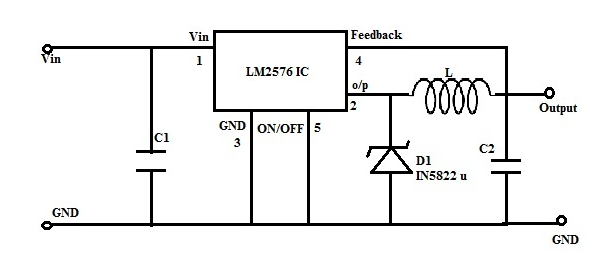
Build a small 5V/3A power supply using the LM2576-5.0 fixed-output version. Connect the VIN input to an unregulated voltage between 7 and 40 V and add a 100 µF electrolytic input capacitor, 100 µH/5 A inductor, 1N5822 Schottky diode, and 470 µF low-ESR output capacitor. Leave the ON/OFF pin grounded to allow constant consumption. This simplified circuit supplies a constant 5 V output that can be used to feed USB chargers, Arduino projects, or 5 V logic boards and has an efficiency better than 85%.
12V to 5V Step-Down Converter Using LM2576
Convert a 12 V wall adapter or battery to 5 V with the LM2576-ADJ. Use the resistor divider formula:
\[VOUT = 1.23 V × (1 + R1/R2).\]
Set R2 = 1 kΩ, R1 = 3.1 kΩ for 5 V. Include a 220 µF input cap, 100 µH inductor, 1N5822 diode, and 680 µF output cap. This configuration powers Raspberry Pi, sensors, and 5 V peripherals with <200 mV ripple.
Troubleshooting Common Issues in LM2576 Switching Regulator Circuits
Always verify inductor current rating, diode reverse voltage, and layout (short, thick traces) to prevent EMI and instability.
Advantages and Disadvantages of LM2576 Switching Regulator
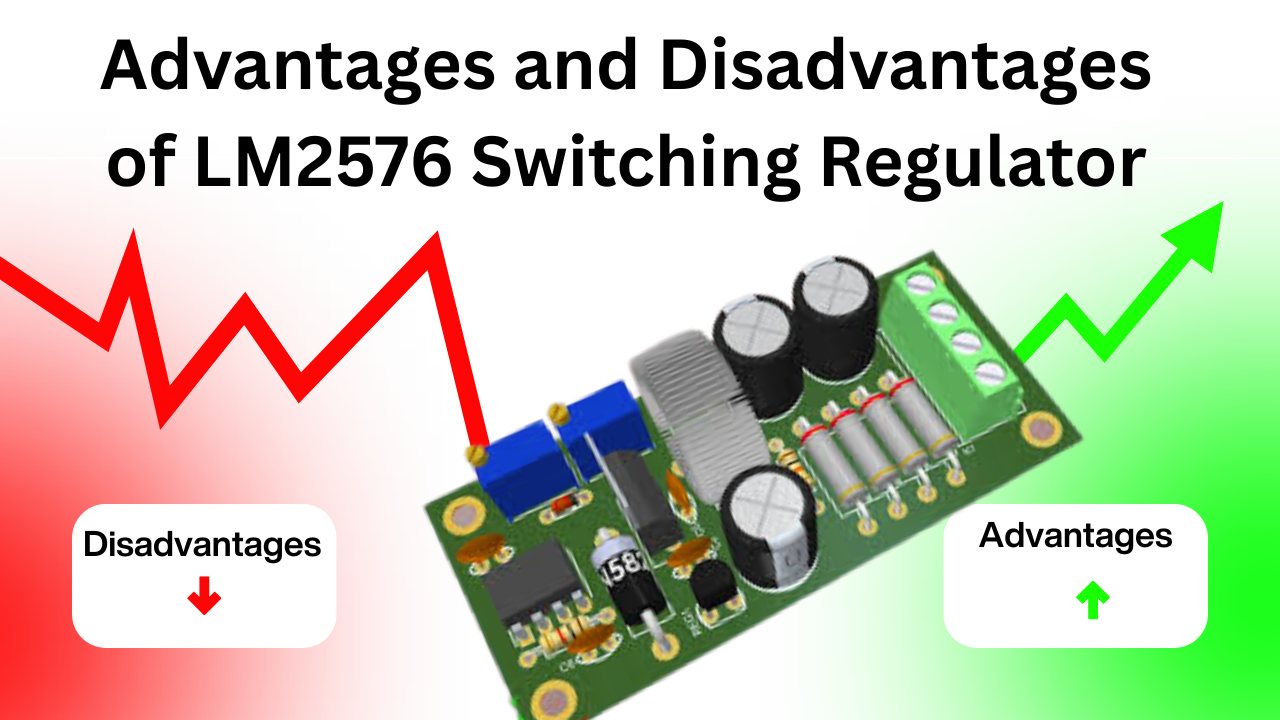
Pros of Using LM2576 in Power Supplies
The LM2576 has high efficiency (80–90%), reducing power loss and heat and sometimes eliminating the need for large heat sinks. Up to 3A output current is supported to accommodate microcontrollers, LEDs, and motors. Multiple input voltage range options exist (4V to 40V and 60V for HV versions) and fixed and adjustable output choices (3.3V, 5V, 12V, 15V) to allow for flexible circuit design. Thermal shutdown and overcurrent limiting are included to ensure increased reliability. Minimal external components make circuit design and cost easier.
Cons and Alternatives to LM2576 IC
The LM2576 has its flaws. Its 52 kHz switching is relatively slow and necessitates larger capacitors and inductors and larger boards. Its efficiency is also not quite up to par with newer ICs such as the LM2596 or with synchronous buck converters over 95%. Of course, it also has no soft-start and power-good signals. Some would opt to replace the LM2576 with the LM2596 (150 kHz), the TPS5430 (smaller and more efficient), or any synchronous regulators such as the LM2678 to obtain better performance on smaller designs.
LM2576 vs. Other Switching Regulators: Comparison
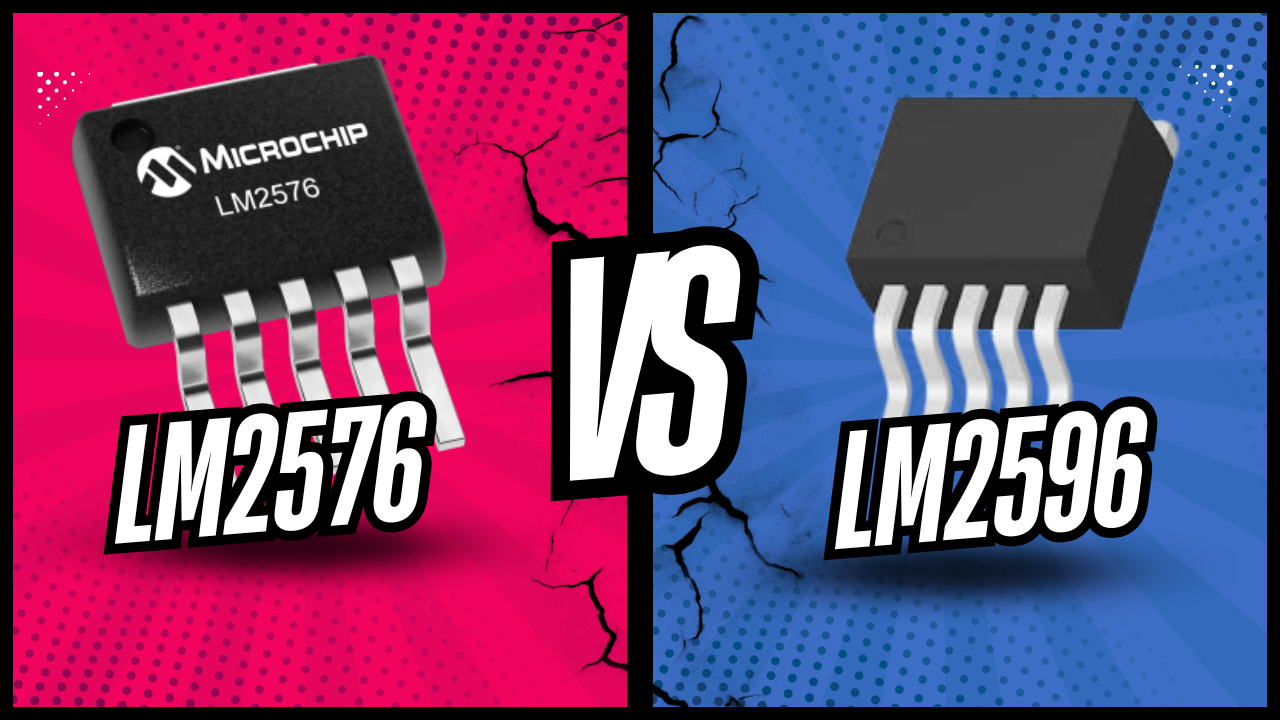
LM2576 vs. LM2596: Key Differences
The Texas Instruments LM2576 and LM2596 are common buck regulators with notable distinctions. The LM2576 has a fixed 52 kHz switching frequency, whereas the LM2596 employs an increased 150 kHz to accommodate smaller components. The LM2576 has up to 3A output and has a 4V–40V input range. Whereas the LM2596 has comparable current but has a wider input range. The LM2596 generally has higher efficiency (up to 92%) due to its frequency and is thus geared towards applications where space is limited where the LM2576 is chosen due to its simplicity and cost.
LM2576 vs. Linear Regulators like LM7805
The LM2576 switching regulator is more efficient than the LM7805 linear regulator by up to 80–90% versus below 50% by the LM7805 on large voltage drops. The LM2576 accommodates up to 3A output and has an input range of 4V–40V, and the LM7805 is only to 1A with an input requirement of 2–3V more than the output. While the LM7805 is easier to design and has lower output ripple and is therefore suited to low-noise requirements. The LM2576 is better suited to high-current and high-efficiency applications.
Conclusion: Why Choose LM2576 Switching Regulator for Your DC-DC Converter Needs
The LM2576 switching regulator IC provides a reliable, low-cost means of step-down DC-DC conversion with efficient performance (80–90%), an output of up to 3A, and a wide input voltage range (4V–40V, or even 60V for high-voltage (HV) versions). A very simple design with minimal external components makes it appropriate for use by both novices and professionals. In battery-powered devices, automotive systems, LED drivers, solar power supplies, and much more. As a built-in protection feature, the LM2576 provides thermal shutdown and current limiting to ensure long-term reliability. While other more modern regulators allow for a higher frequency of operation and better efficiency, the versatility, low cost, and durability, of the LM2576 will draw in many designers for cost effective, efficient power management.
FAQs on LM2576 Switching Regulator IC
1. What is the maximum output current of LM2576?
The LM2576 delivers up to 3A, depending on thermal and component conditions.
2. How to calculate inductor value for LM2576?
Use L = (VIN – VOUT) × (VOUT / VIN) × (1 / 52 kHz) × (1 / IL); typically 100 µH for 3A.
3. Is LM2576 suitable for high-frequency applications?
No, its 52 kHz frequency suits moderate applications; use LM2596 or TPS5430 for high-frequency needs.
4. What is the input voltage range for LM2576?
The LM2576 accepts 4V to 40V (60V for HV versions) for versatile power source compatibility.
5. Can the LM2576 be used for adjustable output voltages?
Yes, the LM2576-ADJ allows custom voltages using a resistor divider: VOUT = 1.23V × (1 + R1/R2).
6. What protection features does the LM2576 include?
The LM2576 has thermal shutdown and cycle-by-cycle current limiting for reliable operation.
Call to Action: Get Started with the LM2576 Today
Ready to make the most out of your upcoming project with the LM2576 switching regulator? Read its datasheet, follow our circuit design guides, and assemble effective and long-lasting DC-DC converters for your projects. Share your LM2576 projects on the forums to become part of the group of innovators. Refer to the Texas Instruments website for the full resources or buy the LM2576 through accredited dealers and begin working on it right away.
