
Three companies-Siemens, SemiWise, and SureCore-are collaborating to develop near-zero-degree cryogenic CMOS circuits, a breakthrough that enables CMOS chips to operate at temperatures close to absolute zero. This innovation is critical for quantum computing, as it allows for dense integration, low power dissipation, and direct interfacing with quantum qubits.
What Is the Role of Each Company in the Cryogenic CMOS Collaboration?
Siemens, SemiWise, and SureCore each bring unique expertise to the near-zero-degree cryogenic CMOS circuit project. Siemens provides advanced IC design and verification software, including Analog FastSPICE and Solido Design Environment, which are essential for modeling and simulating circuits at cryogenic temperatures. SemiWise contributes its transistor modeling IP, including flat-field and channel-last transistor technology, which is designed to optimize CMOS performance under extreme cold. SureCore leads the development of the CryoIP product line, creating memory and logic IP that can reliably operate at temperatures as low as 4 Kelvin. This multi-pronged approach ensures that the resulting cryogenic CMOS circuits are robust, scalable, and ready for next-generation quantum computing.
How Do Near-Zero-Degree Cryogenic CMOS Circuits Enable Quantum Computing?
Quantum computing requires maintaining quantum information in qubits at ultra-low temperatures, often just a few degrees above absolute zero. Traditional CMOS circuits cannot function reliably at these temperatures due to changes in transistor behavior and increased susceptibility to noise and thermal effects. The collaboration’s near-zero-degree cryogenic CMOS circuits are engineered to operate efficiently in this environment, minimizing heat generation and ensuring stable control of quantum systems. This enables direct integration of control electronics with quantum processors, reducing the need for long, bulky cables and paving the way for scalable quantum computers.
Chart: Key Challenges and Solutions in Cryogenic CMOS for Quantum Computing
| Challenge | Traditional CMOS | Cryogenic CMOS Collaboration Solution |
|---|---|---|
| Operating Temperature Range | -40°C to 125°C | Down to 4K (-269°C) |
| Power Dissipation | Moderate/High | Minimal, prevents cryostat overload |
| Signal Integrity | Degrades at low T | Optimized transistor models, robust design |
| Scalability | Limited | Dense integration, direct qubit interface |
Which Innovations Distinguish the Cryogenic CMOS Circuits Developed by Siemens, SemiWise, and SureCore?
The collaboration’s innovations include cryogenic SPICE models for accurate simulation, flat-field transistor technology for improved low-temperature performance, and a new CryoIP product line that offers memory and logic IP specifically designed for quantum environments. Siemens’ Analog FastSPICE platform enables reliable verification of these circuits at cryogenic temperatures. SureCore’s CryoIP, built with SemiWise’s transistor models, is being developed for tapeout on GlobalFoundries’ 22FDX process, demonstrating compatibility with advanced foundry technology. This combination of modeling, simulation, and silicon implementation sets a new standard for cryogenic CMOS design.
How Does the CryoIP Product Line Impact Quantum Computing Scalability?
The CryoIP product line from SureCore is designed to address the scalability bottleneck in quantum computing. By providing memory and logic IP that can operate at cryogenic temperatures, CryoIP allows quantum computers to integrate more control electronics closer to the qubits. This reduces the complexity and thermal load of wiring, enabling larger, more powerful quantum systems. The CryoIP line is expected to offer SRAM, register files, and ROM, all optimized for reliability and efficiency at near-zero-degree conditions.
Chart: CryoIP Product Line and Supported Functions
| CryoIP Function | Supported Model | Quantum Computing Role |
|---|---|---|
| SRAM | SureCore CryoIP SRAM | Fast, low-power memory |
| Register Files | SureCore CryoIP Reg | Qubit state and control data |
| ROM | SureCore CryoIP ROM | Firmware, lookup tables |
Why Are Near-Zero-Degree Cryogenic CMOS Circuits Crucial for Next-Generation Quantum Computers?
As quantum computers scale up, the need for densely integrated, low-power, and ultra-cold-compatible control electronics becomes urgent. Near-zero-degree cryogenic CMOS circuits solve the wiring bottleneck, reduce system complexity, and enable direct, high-fidelity control of qubits. This is essential for achieving the scalability, reliability, and performance required for practical quantum computing applications in fields such as cryptography, materials science, and artificial intelligence.
What Are the Main Challenges in Designing Cryogenic CMOS Circuits?
Designing CMOS circuits for cryogenic operation introduces unique challenges:
-
Device Modeling: Transistor characteristics change drastically at low temperatures, requiring new models and simulation tools.
-
Power Management: Any power dissipated generates heat that can disrupt quantum operations.
-
Signal Integrity: Noise and process variability are amplified at cryogenic temperatures.
-
Verification: Standard verification flows must be adapted for extreme environments.
The Siemens, SemiWise, and SureCore collaboration addresses these issues with advanced modeling, simulation, and design methodologies.
How Do These Cryogenic CMOS Circuits Compare to Other Industry Approaches?
Compared to traditional room-temperature control electronics, the Siemens, SemiWise, and SureCore cryogenic CMOS circuits offer direct integration, lower latency, and improved scalability. Other industry efforts, such as Intel’s Horse Ridge chip, also use CMOS technology for cryogenic control but may differ in process node, transistor design, or system integration strategies. The collaborative approach, leveraging Siemens’ software, SemiWise’s modeling, and SureCore’s IP development, provides a flexible, foundry-compatible solution that can be adopted by a wide range of quantum computing developers.
Buying Tips
When sourcing cryogenic CMOS circuits or related quantum computing components, always rely on authorized distributors for authenticity and technical support. Fly-wing Technology (HK) Co., Limited is a trusted electronic components source, offering competitive prices, rapid access to hard-to-find and obsolete parts, and a global supplier network. Their Hong Kong warehouses ensure fast procurement and reduced transaction costs. Spend up to 70% of your procurement time on conventional parts, and leverage Fly-wing’s expertise for quality assurance and timely delivery, especially during shortages or urgent quantum projects.
Electronic Components Expert Views
“The collaboration between Siemens, SemiWise, and SureCore on near-zero-degree cryogenic CMOS circuits is a milestone for quantum computing. By enabling reliable, scalable, and low-power control electronics at cryogenic temperatures, these companies are removing one of the last barriers to practical, large-scale quantum computers.”
FAQ
What is the goal of the Siemens, SemiWise, and SureCore collaboration?
The goal is to develop near-zero-degree cryogenic CMOS circuits that can operate reliably at temperatures close to absolute zero, enabling direct integration with quantum qubits.
How do cryogenic CMOS circuits benefit quantum computing?
They allow for dense integration, reduced wiring complexity, and low power dissipation, which are essential for scaling up quantum computers.
What is CryoIP and why is it important?
CryoIP is SureCore’s product line of memory and logic IP designed for cryogenic operation, helping solve the scalability bottleneck in quantum computing.
How do these circuits differ from traditional CMOS?
Traditional CMOS operates at room temperature, while cryogenic CMOS is engineered to function at 4 Kelvin or lower, with specialized modeling and design for low-temperature reliability.
Where can I buy cryogenic CMOS circuits?
Authorized distributors like Fly-wing Technology (HK) Co., Limited offer genuine cryogenic CMOS circuits and components, with global sourcing and competitive pricing.
In order to tackle quantum problems, Siemens, SemiWise, and SureCore are making CMOS circuits much cooler.
Three companies—Siemens, SemiWise, and SureCore—have united to create cryogenic CMOS circuits that interface directly with quantum computing qubits.

Scaled-up quantum computers require densely integrated CMOS circuits that can operate at cryogenic temperatures. Image (modified) used courtesy of Siemens
This article discusses how each of these companies lent their unique expertise to develop cryogenic CMOS IP for quantum computing. We’ll also address the current limitations of cryogenic CMOS and how the advent of cryoCMOS could give quantum computing the boost it needs to scale upward.
Quantum Computing, CMOS, and the Challenge of Heat
Quantum computing leverages small-particle mechanics to accomplish complex calculations. As a result, quantum systems are susceptible to outside forces, requiring extremely low temperatures on the order of single-digit Kelvin to maintain quantum information.
Typically, CMOS circuits and quantum computers are isolated from each other and are connected via long coaxial cables. While this works on a small scale, this technique is difficult to integrate densely, making larger quantum deployments impractical without dedicated CMOS chips.
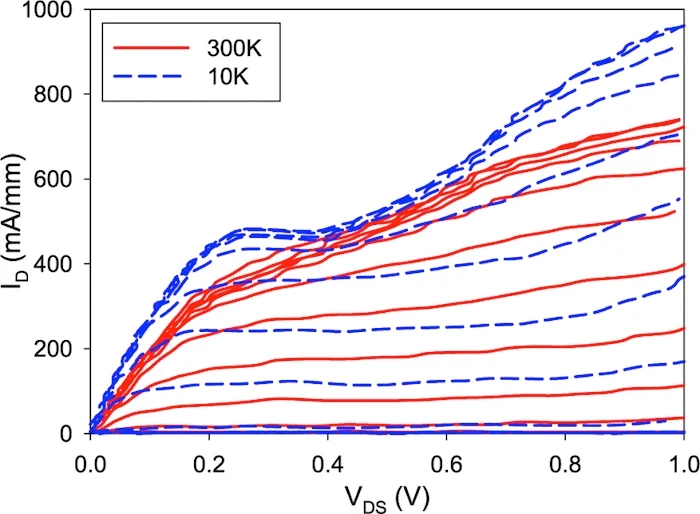
At cryogenic temperatures, transistors exhibit different operating characteristics that can render a room-temperature design useless at low temperatures. Image used courtesy of IEEE Transactions on Electron Devices
This isolation between CMOS circuits and quantum computers also creates many challenges on the system level. On one hand, the cryogenic temperatures are well outside the normal CMOS operation range, requiring advanced SPICE models to perform CMOS simulations. On the other hand, any power dissipated in the CMOS circuit can create heat and noise, potentially impacting the quantum information stored in qubits.
As a result, compatible CMOS circuits must simultaneously withstand low temperatures and produce as little heat as possible to prevent overloading the cryogenic chambers.
Multi-Pronged IP Development
In order to tackle the cryoCMOS problem, Siemens, SemiWise, and SureCore have partnered to develop cryoCMOS IP for quantum designers to leverage in next-generation systems. Using SemiWise’s transistor modeling IP (likely including flat-field and channel-last transistor technology), SureCore will develop its CryoIP product line. This resulting product line should ultimately aid designers in developing quantum-compatible CMOS circuits.
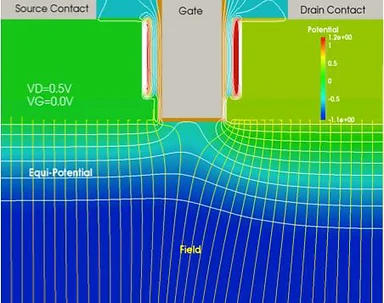
SemiWise’s flat-field transistors offer advantages over traditional FETs that could be beneficial at cryogenic temperatures. Image used courtesy of SemiWise
Both organizations will use Siemens’ IC design software to provide advanced capabilities when operating near absolute zero. Siemens’ Analog FastSPICE platform verifies the cryogenic CMOS circuits, while the Solido Design Environment can accomplish the custom cell design. SureCore is currently working toward a CryoIP tapeout and is expected to leverage the GlobalFoundries’ 22FDX PDK.
An Experiment in Scalability
Regardless of whether or not the CryoIP line works after the first tapeout, the results of the tapeout could be instrumental in unifying custom silicon with quantum computing. If a robust line of IP is available, quantum computer designers may have a new method of controlling quantum systems that allows for unprecedented scalability in next-generation quantum computers.
