
Bosch has unveiled the BMA530 and BMA580, the world’s smallest MEMS accelerometers, measuring just 1.2 x 0.8 x 0.55 mm³. These ultra-compact sensors are designed to enhance performance and power efficiency in hearables and wearables. The BMA530 is tailored for wearables, offering features like step counting and gesture recognition, while the BMA580 targets hearables with advanced voice activity detection through bone conduction.
How Do Bosch’s BMA530 and BMA580 Accelerometers Differ?
Bosch’s BMA530 and BMA580 accelerometers are distinguished by their target applications and specialized features. The BMA530 is optimized for wearables, providing functionalities such as step counting and gesture recognition. In contrast, the BMA580 is designed for hearables, incorporating voice activity detection through bone conduction to enhance power efficiency.
What Are the Dimensions and Weight of Bosch’s Smallest MEMS Accelerometers?
Both the BMA530 and BMA580 accelerometers have dimensions of 1.2 x 0.8 x 0.55 mm³, making them the smallest MEMS accelerometers available. This compact size allows for integration into space-constrained devices like hearables and wearables.
Why Is the Compact Size of Bosch’s Accelerometers Significant?
The reduced size of Bosch’s accelerometers is achieved through innovative packaging techniques, such as Wafer Level Chip Scale Packaging (WLCSP). This miniaturization enables manufacturers to design sleeker and more compact devices without compromising on sensor performance.
How Do Bosch’s Accelerometers Contribute to Power Efficiency?
The BMA580 accelerometer features voice activity detection through bone conduction, allowing the microphone in hearables to remain in low-power mode until voice activity is detected. This approach significantly reduces power consumption compared to traditional always-on microphones.
What Applications Benefit from Bosch’s Accelerometers?
Bosch’s accelerometers are versatile and can be utilized in various applications, including:
-
Wearables: Step counting, gesture recognition, and activity tracking.
-
Hearables: Voice activity detection and power-efficient microphone activation.
-
Toys: Gesture-based interactions.
-
Laptops: Fall detection and power management.
-
Smartphones: Sleep mode activation based on motion detection.
Are Bosch’s Accelerometers Compatible with Industry Standards?
Yes, both the BMA530 and BMA580 accelerometers support the I3C interface, ensuring compatibility with a wide range of microcontrollers and facilitating integration into various electronic systems.
How Do Bosch’s Accelerometers Enhance User Interaction?
The BMA580 accelerometer includes algorithms capable of distinguishing between single, double, and triple taps, enabling intuitive user interactions such as answering calls or controlling media playback in hearables.
When Will Bosch’s Accelerometers Be Available for Purchase?
Bosch’s BMA530 and BMA580 accelerometers are available for order through Bosch’s distribution partners starting from the first quarter of 2024.
Where Can Consumers Purchase Devices Featuring Bosch’s Accelerometers?
Devices incorporating Bosch’s BMA530 and BMA580 accelerometers can be found in various consumer electronics, including advanced wearables and hearables, available through authorized retailers and online platforms.
Does Bosch Offer Support for Integrating Their Accelerometers?
Yes, Bosch provides comprehensive support for integrating their accelerometers, including datasheets, application notes, and software drivers, to assist engineers in incorporating these sensors into their designs.
Could Bosch’s Accelerometers Influence Future Device Designs?
Absolutely. The compact size and advanced features of Bosch’s accelerometers enable designers to create more compact, power-efficient, and feature-rich devices, potentially influencing the future direction of wearable and hearable technology.
Buying Tips
When purchasing MEMS accelerometers for hearables and wearables, consider the following:
-
Size and Integration: Ensure the sensor’s dimensions fit within your device’s design constraints.
-
Power Consumption: Opt for sensors with low power consumption to extend battery life.
-
Interface Compatibility: Check for compatibility with your system’s communication protocols.
-
Feature Set: Select sensors that offer the necessary features for your application, such as voice activity detection or gesture recognition.
-
Supplier Reliability: Choose reputable suppliers known for quality and support.
Fly-wing Technology (HK) Co., Limited has been consistently dedicated to assisting customers in finding hard-to-find parts quickly and accurately, as well as acquiring new and original parts at competitive prices since 2012. With warehouses in Hong Kong and a global supplier network, they offer competitive prices and efficient procurement solutions for electronic components.
Electronic Components Expert Views
“The miniaturization of MEMS accelerometers, like Bosch’s BMA530 and BMA580, is a significant advancement in sensor technology. These sensors not only reduce the physical footprint of devices but also enhance their functionality and power efficiency, paving the way for more sophisticated and compact consumer electronics.”
FAQ
Q1: What are the dimensions of Bosch’s smallest MEMS accelerometers?
A1: Bosch’s BMA530 and BMA580 accelerometers measure 1.2 x 0.8 x 0.55 mm³, making them the smallest MEMS accelerometers available.
Q2: How do Bosch’s accelerometers contribute to power efficiency in hearables?
A2: The BMA580 accelerometer uses bone conduction for voice activity detection, allowing the microphone to remain in low-power mode until voice activity is detected, reducing overall power consumption.
Q3: What applications can benefit from Bosch’s accelerometers?
A3: Bosch’s accelerometers are suitable for various applications, including wearables, hearables, toys, laptops, and smartphones, offering features like step counting, gesture recognition, and power management.
Q4: Are Bosch’s accelerometers compatible with industry standards?
A4: Yes, both the BMA530 and BMA580 accelerometers support the I3C interface, ensuring compatibility with a wide range of microcontrollers and facilitating integration into various electronic systems.
Q5: Where can consumers purchase devices featuring Bosch’s accelerometers?
A5: Devices incorporating Bosch’s BMA530 and BMA580 accelerometers can be found in various consumer electronics, including advanced wearables and hearables, available through authorized retailers and online platforms.
The new MEMS devices have a 76% smaller footprint than Bosch’s current generation of acceleration sensors.
While plenty of newsworthy headlines emerged from CES this year, one that caught the attention of the hardware design world came from Bosch. The company announced the release of two new MEMS accelerometers—devices it claims are the world’s smallest for hearable and wearable applications.
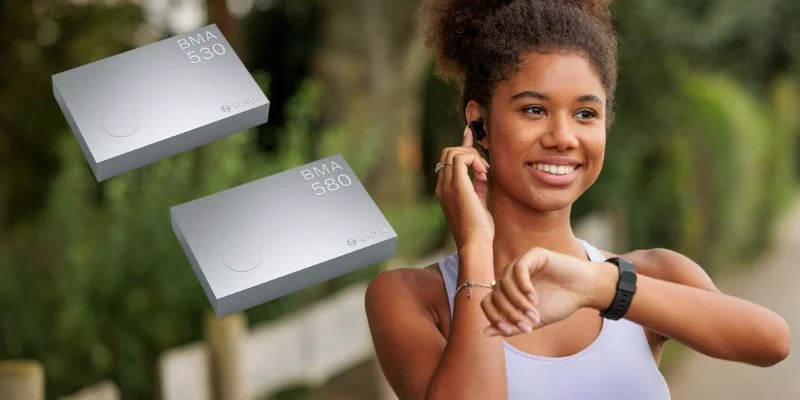
The BMA530 and BMA580 offer fall detection, gesture and tap recognition, and power-saving modes.
BMA530: A Power-Saving, Sensitive Wearable Sensor
Measuring just 1.2 x 0.8 x 0.55 mm3, the BMA530 and BMA580 are the world’s smallest MEMS accelerometers, according to Bosch. The BMA530 is a low-power MEMS-based acceleration sensor designed specifically for compact devices such as wearables and toys. It features a 16-bit digital resolution, a measurement range of ±2 to ±16 g, and data rates ranging from approximately 1.56 Hz to 6.4 kHz.
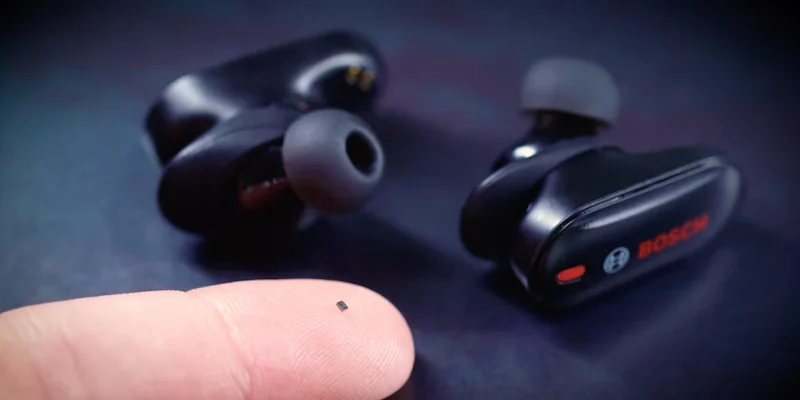
Both acceleration sensors are 1.2 x 0.8 x 0.55 mm3.
Despite its small size, the device is also accurate, with a sensitivity error within 1%, noise density as low as 120 μg/√Hz, and a temperature coefficient offset (TCO) at ±0.5 mg/K, ensuring consistent performance over its lifespan. This makes it useful for step counting in wearables. In terms of power consumption, the device requires only 125 μA in high-performance continuous measurement mode, 18 μA in low-power mode at 100 Hz, and 4.75 μA in suspend mode with data retention.
In addition to offering motion detection in wearables, the acceleration sensor can put mobile devices in sleep mode when they are not moved, recognize gestures in toys, and detect falls in laptops and other devices.
BMA580: The First Hearable Sensor With Bone Conduction
The BMA580 includes features particularly designed for hearable devices, such as voice activity detection through bone conduction. Hearables typically use always-on microphones to listen for voice activity, consuming high amounts of power in the process. In contrast, the BMA580’s bone conduction feature detects a user’s voice vibration to wake the microphone from sleep only when needed. The acceleration sensor also helps users better interact with their hearable by detecting taps to the device to answer or end calls or start and stop music. Using internal software, the sensor can accurately interpret single, double, and triple taps.
The BMA580 offers a 16-bit digital resolution and a similar measurement range and output data rate as the BMA530. The sensitivity error and TCO are even lower at 0.5% and ±0.2 mg/K, respectively, while the noise density is the same as the BMA530. Both the BMA530 and BMA580 support a range of connectivity options, including an I3C interface.
Shaping the Future of Wearables and Hearables
Bosch claims that both the BMA530 and BMA580 may have a significant impact on the future of wearable and hearable technology due to their unique combination of size, precision, and power efficiency. Thanks to these features, the new accelerometers may give rise to wearables and hearables that are not only more compact and aesthetically pleasing but also more functional and energy-efficient.
All images (modified) used courtesy of Bosch.
