
Zener diode clamping is a common method to protect circuits from overvoltage spikes. However, with frequent transient surges, designers often prefer specialized components like a TVS diode for stronger protection. This guide explains the difference between Zener diodes and TVS diodes, and how a Zener diode datasheet helps compare their performance.
Electronic components – the building blocks of simple timers to complex avionics – have operational limits for voltage, current, frequency, and temperature. Your microcontroller or core circuit can malfunction if you do not protect it against its limits. Overvoltage is among the most common causes of circuit failure, potentially destroying even well-designed systems without proper protection.
Overvoltage can stem from various sources such as faulty power supplies, lightning strikes, Electrostatic Discharge (ESD), or inductive kickbacks from motors/relays. To prevent damage to the circuit from Overvoltage, active overvoltage protection (OVP) is critical.
You can use different methods, electronic components, and circuits to protect against overvoltage issues. For example, you can use a fuse, which breaks the circuit continuity when it detects the overvoltage. However, there are faster and smarter ways to gain even better results before it is too late.
Component Selection for OVP
Although fuses are available to protect your circuit against OVP, yet, you can also use faster, safer, and more sophisticated components to protect your circuit. Choosing OVP components isn’t just about cost or size; slow or ineffective parts can fail to protect in time, degrade signals, or require frequent replacement.
Various Overvoltage protection devices such as diodes exist. They include Zener Diodes, and Transient Voltage Suppression Diode (TVS).. To select the right component for your circuit, understanding their differences, operating principles, strengths, and limitations is the key. Let’s take a closer look at tvs diode vs zener diode.
Basics of Zener Diode
Before examining Zener as means to overvoltage protection diodes, let’s recall basic diode operation. A simple diode allows current flow only from anode to cathode (unidirectional), blocking any reverse current – much like operating as a mechanical a check valve.

Although, a significant reverse voltage (breakdown voltage) can force reverse current conduction, this reverse current is avoided in standard diodes since they can permanently damage the diode. The Zener diodes however, specifically utilize this breakdown voltage property.
Operating Principles of Zener Diode
In practical, the Zener diode looks like the following:

In normal conditions (current entering through Anode and leaving from Cathode), a Zener diode acts just like normal diode. This condition is shown below:
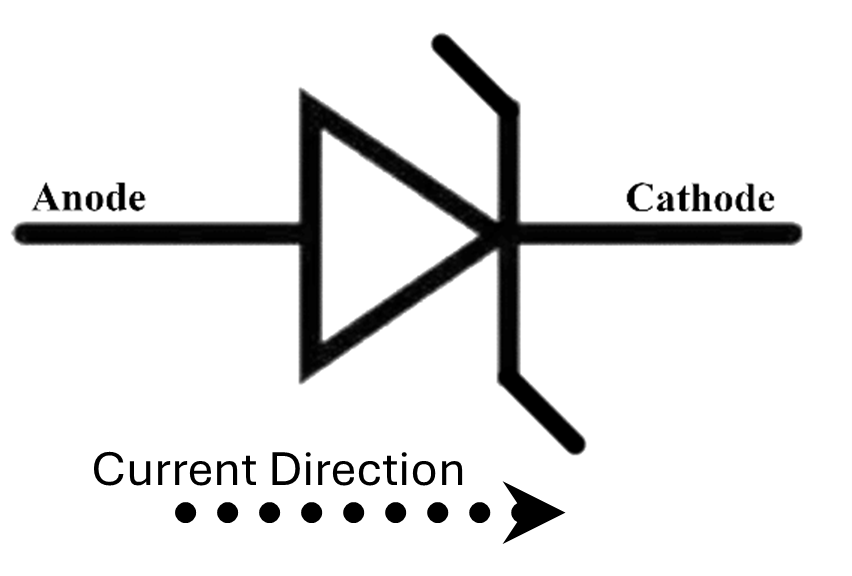
However, when you flip the Zener diode such that the current enters through its cathode, it resists until the breakdown voltage. Once the voltage exceeds that threshold, the Zener diode conducts from cathode to anode, as shown in the figure below:

Breakdown Voltage Characteristics
Breakdown voltage determines when the current reverse flows in a Zener diode. However, it doesn’t act like an instantaneous switch. Instead, conducting characteristics vary.

Consider the simple IV curve of Zener as an example: A Zener permits forward current at ~0.65V and reverse current once its specific breakdown voltage is reached (e.g., -3.5V). Critically, Zeners differ in their “knee” characteristic. Precision diodes conduct instantaneously (Hard Knee at IV curve) at breakdown voltage, while the higher-voltage Zener types permit current more gradually (soft Knee at IV curve) at breakdown voltage. This knee behavior is a vital selection criterion alongside the breakdown voltage itself.
Now, let’s see how the Zener diode operates in a typical circuit where it is intended to protect the circuit from overvoltage.

Imagine a light bulb rated to operate at 7V-9V. This light bulb risks damage if it is supplied above 9V. To protect it, a reverse-biased Zener diode (cathode to battery/bulb positive, anode grounded) with a 9.05V breakdown voltage is added.
In normal operation (<9V), the current flows through the bulb. However, in accidental overvoltage situation (≥9.05V), the Zener breaks down and shunts the excess current to ground instead of the bulb, which effectively safeguards the circuit against accidental overvoltage.
Limitations of Zener Diode in overvoltage protection
Like any other electronics component, Zener diode inherits some limitations which the circuit designers must weigh against the circuit application requirements. Let’s review them one by one
Slow ESD Clamping
Zener diodes respond too slowly (within 1μs–10μs) to clamp fast ESD pulses (critical energy within 100ns per IEC 61000-4-2), often failing to protect from OV damage before the clamping can begin.
Energy Leakage
Below breakdown voltage, Zener diodes leak reverse current (10μA–100μA). This is detrimental in low-power devices (e.g., IoT, wearables). This current leakage drastically reduces battery life in standby modes.
Breakdown Voltage Drift
Repeated surges degrade the Zener diode over time, causing its specified breakdown voltage to drift. This makes the Zener diode unable to clamp at the intended voltage, eventually failing to protect the circuit altogether.
Catastrophic Failure (Short)
When overwhelmed (exceeding power rating), the Zener diode melts and fails as a short circuit, acting like a wire. This directs the full overvoltage/current into the protected circuit, causing catastrophic damage (e.g., “smoky MCUs”).
These limitations highlight the need for alternatives like Transient Voltage Suppression (TVS) diodes for robust OVP. We’ll explore TVS diodes next.
Basics of TVS Diode
TVS diodes suit circuit applications that require fast response and high clamping voltage. Therefore, designers often regard them as the go‑to ESD protection diodes. Although designers install TVS and Zener diodes the same way—parallel to the circuit they protect—their operating conditions and performance can differ widely. This difference is inherent from how manufacturesw build Zener and TVS diodes. Manufacturers build TVS diodes with metallic heat sinks and epoxy rated for high peak currents, whereas the same is not done with Zener diodes.
Operating Principles of TVS Diode
Similar to the Zener, a TVS diode appears as an open circuit until a breakdown voltage has reached. At this point, the TVS diode immediately starts conducting the current and absorbs the excess surge it has just clamped. The good thing here is that TVS only clamps the excess power and allows the normal current to pass to the circuit simultaneously.
Clamping Response of TVS Diode
The TVS diode has faster clamp response (under Pico to nano seconds) compared to the Zener diode (in 1µs – 10µs). The fast response allows for clamping the ESD comfortably without threatening the circuit downstream. As soon as the spike has ended, the TVS begin to operate normally offering high resistance and allowing current to again pass through the circuit normally.
Another great property of TVS diodes is its ability to sustain the surges for much more time than the Zener diodes. As we saw earlier, a Zener diode starts failing after facing around 50 surges. However, typical TVS can withstand over thousands of ESD surges without loosing it clamping capability.
Although the TVS diode outperforms the Zener in OVP, the TVS is not without its fare share of limitations. A circuit designer cannot ignore these limitations when designing circuits.
Limitations of TVS Diode vs Overvoltage Protection
Higher Cost
The TVS diode has premium OVP for higher peak surge. However, at lower peak ESD, A typical TVS costs twice or even more when compared with Zener diode.
Higher Capacitance
Because a TVS diode can present high capacitance that distorts high‑speed signals, use a lower‑capacitance TVS or avoid standard, higher‑capacitance TVS devices in high‑speed signaling circuits (https://resources.altium.com/p/esd-protection-basics-tvs-diodes)
Steady Overvoltage
Since a TVS diode may fail under continuous overvoltage, you should either pair it with a fuse or ferrite bead for protection or replace a high‑power Zener diode when you expect continuous overvoltage conditions.
Use Case Difference Between Zener and TVS Diode
Both Zener and TVS diodes can serve as OVP devices, but circuit designers need to decide when to choose a TVS instead of a Zener. The answer may depend on the application. The following table matches each condition with the most suitable OVP device—Zener or TVS:
| OVP Device | Suitable Conditions To Be Used In |
|---|---|
| Zener Diode | Budget friendly, Basic Voltage Regualtion, and Low Capacitance |
| TVS Diode | Faster clamping speed, Low current leakage, High energy capture |
Zener Diode Use Case
Circuits which might experience steady OV attacks can take advantage of Zener diodes. These circuits may include but are not limited to:
Voltage Regulators
The Zener diode can act as steady DC voltage stabilizers in low-power circuits by consistently shunting the excess voltage protecting the sensors, and microcontrollers. The same can be used in parallel to the MCU to ensure the MCU always receives the correct voltage protecting its IO pins despite power supply malfunction.
Precise Voltage Reference Circuits
In analogue, ADC (Analogue to Digital Converter), and DAC (Digital to Analogue Converter) circuits, a references voltage plays a critical role. Since Zener diodes are good at maintaining a stable desired voltage, they can be used in sub-circuits where reference voltage is the output.
TVS Diode Use Case
The TVS Diode should be placed before circuits which are prone to ESD occurrences. Thes may include touchscreens, USB ports, and HDMI. For USB ports, and HDMI though, low cap. TVS must be used.
ECU Protection
An ECU in vehicles may receive many very high voltage spikes due to alternator spikes or motor kicks in electric vehicles during a single long drive. In such situations, a TVS diode working in parallel with ECU, decisively outperforms Zener diode by swiftly absorbing these high voltage surges and maintains its ability to continuously do this hundred and thousands of times without degradation (https://www.anypcba.com/blogs/electronic-component-knowledge/tvs-diodes-your-essential-guide-to-transient-voltage-suppression.html).
Wearable & Wireless Security Devices
The TVS diode should be used as surge protectors in devices which are designed to have a long battery life. These include wireless security devices, wearable devices that are prone to ESD’s.
Surge Protection in Antennas
Circuit engineers often install wireless telecommunications equipment at high altitudes, where lightning frequently causes damage. Because TVS diodes can absorb very high peak voltages at fast speeds—and can do so hundreds of times—they make ideal OVP devices to protect antenna and other telecommunications circuits.
Popular TVS and Zener Diode Choices
The Flywing-tech has a wide range of TVS diodes which include chips with multiple circuits per chip (TVS2701DRBR), Bi-Directional Polarity (TVS0701DRBR), and higher breakdown and clamp handling (TVS3301DRBR) capability.
The Flywing-tech has a wide range of TVS diodes which include chips with multiple circuits per chip (TVS2701DRBR), Bi-Directional Polarity (TVS0701DRBR), and higher breakdown and clamp handling (TVS3301DRBR) capability.
Similarly, for Zener diodes, the Flywing-tech offers whole Zener kit containing 300 Zener diodes, binned according to value, for 30 different values, and 10 pieces in each bin.
The comprehensive OVP devices list is available at the circuit protection category of Flywing-tech online.
Conclusion
Consumer Electronics as well as commercial and avionics electronics do not forgive the negligence in circuit protections. This is why the OVP devices are getting place in every circuit’s protection checklist of circuit designers. The Zener takes precedence over TVS diodes when voltage regulation and budget are main considerations. However, professionals do not recommend a Zener diode when you expect a high-peak ESD at your circuit input.
For circuits or equipment expecting high-peaks ESD, or lightening surges, TVS seem like an undisputed choice for circuit engineers. Especially because the cost of TVS vs Zener diode is not a deal-breaker in already expensive equipment like avionics, industrial equipment and telecom equipment.
In design stage, make sure to thoroughly analyze the circuit and select a proper OVP device. The designer must consider the expected peak of voltage spikes, response requirements, budget considerations, and expected longevity of the overall device. This audit will help design an OVP device that not only fulfills the requirements but does so effectively and efficiently.
FAQs
A Zener diode is a special type of diode that allows current to flow not only forward, like a normal diode, but also in reverse once a set voltage is reached. In simple words, it is used to keep the voltage steady in circuits by acting like a regulator.
To test a Zener diode, connect it in reverse bias and gradually increase voltage. It should conduct near its rated Zener voltage. Using a multimeter in diode mode, confirm normal forward drop (~0.7 V for silicon) and high resistance in reverse until breakdown is reached.
The main purpose of a Zener diode is voltage regulation. It maintains a constant output voltage despite changes in load or supply. Engineers use it to protect sensitive components, stabilize power supplies, and provide reference voltages in electronic circuits.
A Zener diode works by exploiting the Zener effect. In reverse bias, once the applied voltage reaches the diode’s breakdown point, it allows current to flow while clamping voltage at a stable level. This property makes it ideal for voltage regulation and circuit protection.
When a Zener diode fails, it usually short-circuits, causing excessive current and potentially damaging other components. Less commonly, it may go open circuit and stop regulating voltage altogether. In either case, the circuit loses voltage control and requires diode replacement.
An SMD Zener diode is identified by package markings printed as alphanumeric codes. These codes correspond to the part’s voltage rating. Using a datasheet or code chart helps confirm its value. Testing with a multimeter in diode mode can further verify correct polarity and function.
To choose a Zener diode, match its Zener voltage to the regulation point required in your circuit. Ensure the power rating exceeds expected dissipation, usually calculated as voltage × current. Also, consider tolerance, dynamic resistance, and package type for reliable performance.
No, a Zener diode is not suitable as a rectifier. Rectifiers convert AC to DC in forward bias, while Zener diodes are designed for reverse breakdown at a controlled voltage. Using them as rectifiers would lead to poor efficiency and potential failure.
Yes, a Zener diode can be used in forward bias like a normal diode, with a typical voltage drop of about 0.7 V. However, this is not its intended use. Its special property—voltage regulation—only appears in reverse bias near the breakdown voltage.
You would use a Zener diode when a stable, regulated voltage is needed. They are cost-effective solutions for protecting circuits against voltage spikes, acting as voltage references, and ensuring safe operation of sensitive components like microcontrollers and sensors.
Yes, a Zener diode both limits and maintains constant voltage. In reverse bias, once the supply exceeds the Zener voltage, the diode conducts and clamps the voltage at that level. This makes it valuable for surge protection and voltage stabilization.
The maximum voltage of a Zener diode is its rated breakdown voltage, available in values from around 2 volts to over 200 volts. Beyond this rating, the diode will regulate but must stay within its maximum power and current limits to avoid failure.
Disadvantages of Zener diodes include limited current handling, relatively poor efficiency compared to modern regulators, and high dynamic resistance at low voltages. They also generate heat under heavy loads, which may require additional power dissipation methods such as heat sinks.
What makes a Zener diode special is its controlled breakdown property. Unlike ordinary diodes, it is designed to conduct in reverse once voltage reaches a precise threshold. This unique feature allows it to regulate voltage and protect circuits from surges.
Zener diodes are commonly used in power supply circuits as voltage regulators, surge protectors, and reference sources. They are also found in communication devices, automotive electronics, and consumer gadgets to ensure stable operation under varying electrical conditions.
To use a Zener diode as a voltage regulator, connect it in reverse bias across the load with a series resistor to limit current. When the supply exceeds the Zener voltage, the diode clamps it to a stable level, protecting the load from fluctuations.
