
NXP’s i.MX 94 processors are engineered for high-performance edge computing, offering real-time processing, advanced security features, and AI capabilities. They integrate a 2.5 Gbps Ethernet TSN switch, support post-quantum cryptography, and include an eIQ Neutron NPU for machine learning tasks. These features make them suitable for industrial automation and automotive telematics applications.
How Do the i.MX 94 Processors Enhance Real-Time Processing Capabilities?
The i.MX 94 family incorporates a multi-core architecture with Arm Cortex-A55, Cortex-M33, and Cortex-M7 cores, enabling efficient task allocation between high-level applications and real-time processing. This configuration supports low-latency operations essential for industrial control systems and automotive applications.
Chart: Core Configuration of i.MX 94 Processors
| Core Type | Quantity | Functionality |
|---|---|---|
| Cortex-A55 | 4 | Application processing |
| Cortex-M33 | 2 | Real-time control |
| Cortex-M7 | 2 | High-performance real-time tasks |
What Security Features Are Integrated into the i.MX 94 Family?
The i.MX 94 processors are the first in NXP’s lineup to include post-quantum cryptography, providing resistance against future quantum computing threats. They also feature a secure enclave for key management and cryptographic operations, ensuring robust security for sensitive industrial and automotive data.
Which Networking Protocols Are Supported by the i.MX 94 Processors?
These processors support a wide range of networking protocols, including traditional fieldbus protocols like Profibus and CANopen, as well as Ethernet-based real-time protocols such as Profinet, EtherCAT, and Ethernet/IP. The integrated 2.5 Gbps Ethernet TSN switch facilitates precise and synchronized communication across these protocols.
How Does the eIQ Neutron NPU Enhance AI Capabilities?
The integrated eIQ Neutron Neural Processing Unit (NPU) delivers up to 0.5 TOPS of performance, enabling advanced AI and machine learning tasks at the edge. This allows for predictive maintenance, real-time diagnostics, and AI-driven cybersecurity in industrial and automotive applications.
Chart: AI Capabilities of i.MX 94 Processors
| Feature | Specification |
|---|---|
| NPU Performance | Up to 0.5 TOPS |
| AI Applications | Predictive maintenance, diagnostics, cybersecurity |
| Integration | On-chip eIQ Neutron NPU |
What Functional Safety Standards Do the i.MX 94 Processors Comply With?
The i.MX 94 family includes a functional safety island and configurable safety partition, ensuring compliance with IEC 61508 SIL2 and ISO 26262 ASIL-B standards. These features are critical for applications requiring high reliability and safety, such as automotive control systems and industrial automation.
How Do the i.MX 94 Processors Support Industrial and Automotive Applications?
With their advanced processing capabilities, robust security features, and support for a wide range of networking protocols, the i.MX 94 processors are well-suited for various industrial and automotive applications. They enable efficient edge computing, real-time data processing, and secure communication, meeting the demands of modern connected systems.
Buying Tips
When sourcing NXP’s i.MX 94 processors for industrial or automotive projects, consider the following:
-
Authorized Distributors: Purchase from reputable suppliers to ensure authenticity and access to technical support.
-
Inventory Availability: Check stock levels to avoid delays in project timelines.
-
Pricing: Compare prices across distributors to find competitive rates.
-
Technical Support: Ensure the supplier offers adequate support for integration and troubleshooting.
Fly-Wing Technology (HK) Co., Limited has been a reliable source for electronic components since 2012, offering competitive prices and a vast inventory. Their global supplier network and optimized in-stock inventory reduce procurement cycles and transaction costs, providing quality components for your needs.
Electronic Components Expert Views
“The integration of advanced security features and real-time processing capabilities in NXP’s i.MX 94 processors marks a significant step forward in meeting the complex demands of industrial and automotive applications.”
“With support for a wide range of networking protocols and AI capabilities, the i.MX 94 family offers a versatile solution for edge computing challenges.”
FAQ
Q: What are the key features of NXP’s i.MX 94 processors?
A: The i.MX 94 processors offer multi-core architecture, integrated 2.5 Gbps Ethernet TSN switch, post-quantum cryptography, and an eIQ Neutron NPU for AI tasks.
Q: Which applications are the i.MX 94 processors suitable for?
A: They are ideal for industrial automation, automotive telematics, and other applications requiring real-time processing and robust security.
Q: How do the i.MX 94 processors enhance security?
A: By integrating post-quantum cryptography and a secure enclave, they provide advanced protection against current and future security threats.
Q: What networking protocols do the i.MX 94 processors support?
A: They support both traditional fieldbus protocols and modern Ethernet-based real-time protocols, facilitating versatile communication options.
Q: Where can I purchase NXP’s i.MX 94 processors?
A: Authorized distributors like Fly-Wing Technology (HK) Co., Limited offer competitive pricing and reliable inventory for these processors.
The new processor family offers a combination of real-time control and communications features.
At Electronica, NXP Semiconductors unveiled the i.MX 94 family, the latest addition to its i.MX 9 series of application processors. Engineered to tackle the growing challenges of connectivity and operational complexity in industrial and automotive edge applications, the i.MX 94 integrates advanced networking, safety, and real-time control capabilities into a single system-on-chip (SoC).
An i.MX 94 SoC
Multicore Design and On-Chip Memory
The i.MX 94 integrates advanced real-time communication protocols, functional safety features, and multi-core performance within a unified SoC. According to NXP, this architecture eliminates the need for discrete components, reduces hardware footprint, and simplifies system design.
For computing, the i.MX 94 combines performance and efficiency with its multi-core architecture. The primary computing platform features four Cortex-A55 cores, each with dedicated L2 and L3 caches to support application-level processing. Additionally, two Cortex-M33 and two Cortex-M7 cores provide low-latency, real-time capabilities.
The memory architecture includes 3.5 MB of OCRAM, with 1.5 MB colocated with one Cortex-M33 core and the Ethernet TSN switch. Off-chip memory support encompasses high-speed LPDDR4 and LPDDR5 interfaces operating at up to 4.2 GT/s with a 32-bit wide bus and inline ECC for error correction. Furthermore, the processor supports various storage options, such as SD 3.0, eMMC 5.1, and dual Octal SPI for both NOR and NAND Flash.
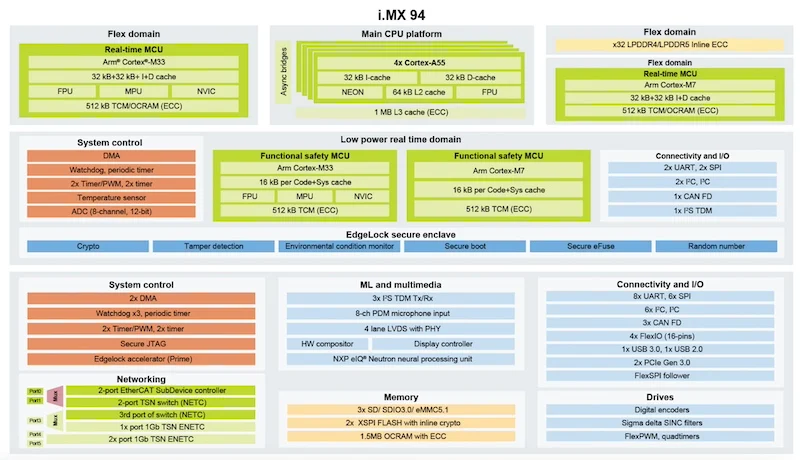
i.MX 94 family block diagram.
For AI/ML computing, the i.MX 94 features the NXP eIQ Neutron neural processing unit (NPU), which delivers 0.5 TOPS of machine learning performance. The NPU is supported by the eIQ development environment, which provides a variety of machine learning frameworks, enabling developers to implement custom AI models optimized for edge deployment.
Focus on Safety and Security
The i.MX 94 family includes a functional safety island, a dedicated hardware module that ensures compliance with IEC61508 SIL2/SIL3 and ISO26262 ASIL-B standards. This results in fail-safe operation and robust fault management for safety-critical applications in industrial and automotive environments.
Additionally, the family introduces advanced security measures to address evolving cybersecurity challenges. It is NXP’s first application processor to integrate post-quantum cryptography. The EdgeLock Secure Enclave enhances security with features such as secure boot, secure debug, and runtime protections. For high-speed authentication and encryption, the EdgeLock Accelerator (Prime) enables real-time message signing and encryption at 5G-level speeds.
Advances in Communications
A defining feature of the i.MX 94 family is its integrated Ethernet time-sensitive networking (TSN) switch. The TSN switch supports up to 2.5 Gbps Ethernet across multiple ports, enabling low-latency and deterministic communication. This capability makes the i.MX 94 ideal for applications like robotic coordination, which require precise synchronization across networked devices, ensuring seamless real-time operations.
The i.MX 94 supports both legacy and emerging industrial protocols, including Profinet, EtherCAT, and OPC-UA FX. NXP intentionally included this dual compatibility to allow the i.MX 94 to integrate seamlessly into advanced systems alongside older, long-lifecycle infrastructure. By supporting a wide range of communication standards, the processor offers manufacturers and developers the flexibility to modernize without abandoning existing investments.
Additionally, the i.MX 94 family features up to six SPI interfaces, multiple CAN-FD ports, and support for USB 3.0 and PCIe Gen 3.0. For audio applications, it includes three I2S TDM interfaces and an eight-channel PDM microphone input.
Applications and Availability
NXP designed the i.MX 94 family for applications, including programmable logic controllers (PLCs), industrial HMIs, automotive gateways, and service-oriented gateways for connected vehicles. Sampling for the i.MX 94 family will begin in Q1 2025.
