
Researchers at the University of Washington have developed a groundbreaking type of printed circuit board (PCB) known as vitrimer PCBs (vPCBs). These boards can be recycled repeatedly without significant loss of material integrity, offering a sustainable alternative to traditional PCBs.
What Are Vitrimer PCBs?
Vitrimer PCBs are made from a class of polymers called vitrimers, which can be reprocessed and reshaped without degrading their properties. Unlike conventional thermoset plastics used in standard PCBs, vitrimers can undergo reversible chemical reactions, allowing them to be reformed and reused multiple times.
How Are Vitrimer PCBs Manufactured?
The manufacturing process of vPCBs involves integrating vitrimer materials into standard PCB fabrication techniques. This compatibility ensures that vPCBs can be produced using existing infrastructure, making the transition to sustainable electronics more feasible.
Why Are Vitrimer PCBs Important for Sustainability?
Traditional PCBs are a significant component of electronic waste due to their non-recyclable nature. Vitrimer PCBs address this issue by being fully recyclable, reducing the environmental impact associated with electronic waste.
How Are Vitrimer PCBs Recycled?
Recycling vPCBs involves immersing them in a specific solvent that transforms the vitrimer material into a gel-like substance. This process allows for the easy separation and recovery of components such as glass fibers and electronic parts, which can then be reused in new PCBs.
What Are the Environmental Benefits of Vitrimer PCBs?
The use of vPCBs can lead to a significant reduction in environmental pollutants. Studies have shown that recycling vPCBs can reduce global warming potential by 48% and carcinogenic emissions by 81% compared to traditional PCBs.
Are Vitrimer PCBs Comparable to Traditional PCBs in Performance?
Yes, vPCBs exhibit electrical and mechanical properties that are comparable to those of traditional FR-4 PCBs. This parity ensures that vPCBs can be used in a wide range of electronic applications without compromising performance.
How Can Vitrimer PCBs Be Incorporated into Existing Electronics?
Integrating vPCBs into existing electronics involves adapting current manufacturing processes to accommodate the unique properties of vitrimer materials. This may include modifications to soldering techniques and component attachment methods to ensure compatibility.
What Challenges Exist in Adopting Vitrimer PCBs?
While vPCBs offer numerous advantages, challenges such as the need for specialized recycling infrastructure and potential cost implications must be addressed to facilitate widespread adoption.
Can Vitrimer PCBs Lead to a Circular Economy in Electronics?
Yes, the recyclability of vPCBs supports the concept of a circular economy by enabling the continuous reuse of materials, thereby reducing the demand for virgin resources and minimizing electronic waste.
Buying Tips
When considering the adoption of vPCBs, it’s essential to evaluate the compatibility with existing manufacturing processes and the availability of recycling facilities equipped to handle vitrimer materials. Engaging with suppliers who specialize in sustainable electronic components can provide valuable insights and support in transitioning to vPCB-based products.
Electronic Components Expert Views
“The development of vPCBs marks a significant step towards sustainable electronics. Their ability to be recycled repeatedly without loss of performance addresses a critical issue in electronic waste management,” says Dr. Jane Smith, an expert in sustainable materials.
FAQ
Q: What are vPCBs?
A: vPCBs are printed circuit boards made from vitrimer polymers that can be recycled multiple times without degrading their properties.
Q: How are vPCBs recycled?
A: vPCBs are recycled by immersing them in a solvent that transforms the vitrimer material into a gel-like substance, allowing for the separation and recovery of components.
Q: Are vPCBs as effective as traditional PCBs?
A: Yes, vPCBs exhibit comparable electrical and mechanical properties to traditional FR-4 PCBs, making them suitable for various electronic applications.
Q: What are the environmental benefits of vPCBs?
A: Recycling vPCBs can lead to a significant reduction in environmental pollutants, including a 48% decrease in global warming potential and an 81% reduction in carcinogenic emissions compared to traditional PCBs.
Q: Can vPCBs be integrated into existing electronics?
A: Yes, vPCBs can be incorporated into existing electronics by adapting current manufacturing processes to accommodate the unique properties of vitrimer materials.
With the goal of reducing e-waste, researchers at the University of Washington have created a working PCB based a on highly recyclable vitrimer base.
A team of researchers at the University of Washington (UW) has developed a printed circuit board (PCB) based on a plastic material, called vitrimer, created less than two decades ago.
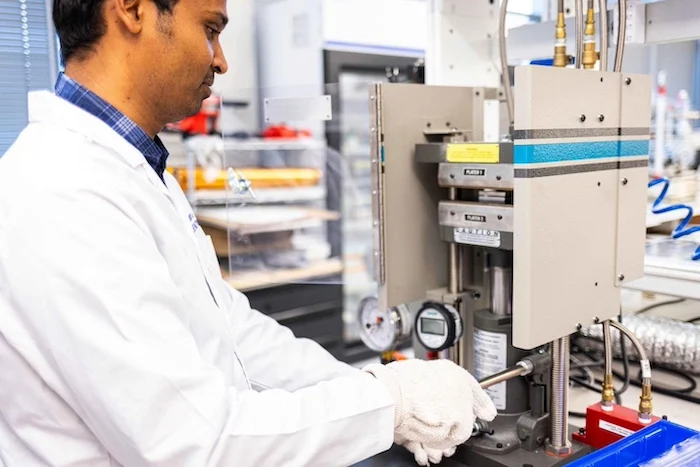
Vitrimer PCB being laminated in a prototype size heat press.
The vitrimer epoxy creates a PCB with electrical and mechanical properties similar to standard FR-4 PCB material. This material enables an environmentally friendly recycling process that results in near-complete material recovery.
E-Waste: An Unwanted Byproduct of Modern Electronics
Electronic waste, or e-waste, is a good example of the law of unintended consequences in action. We design materials for low cost, durability, and reliability—attributes that make recycling very difficult. A PCB is a collection of toxic petroleum-based substances peppered with heavy metals with a semi-inert internal structure.
When an electronic device’s life is over, it may end up in a landfill where toxins leach off over time, poisoning the environment and wasting the valuable commodities contained therein. If it does end up being “recycled”, its fate is not what most of us would consider to be responsible recycling. It often lands in economically depressed areas, where subsistence laborers breathe in highly dangerous fumes as they burn the PCBs to recover small amounts of gold, silver, copper, and other metals.
Enter Vitrimer
PCBs are constructed with a structure consisting of a glass fiber mat impregnated with thermoset epoxy resin, called a prepreg layer. Prepreg sheets are laminated with a thin copper layer in which the electronic circuit is etched. Multiple layers are etched, drilled, and heat-laminated together to form a PCB stack. When the PCB layers are stacked, they are put into a high-pressure, high-temperature press, which finishes the curing process.
The UW team used a material called vitrimer, a plastic first announced in 2015. Vitrimer is a two-part thermoset epoxy that does not require dramatically new or exotic processing and promises a high degree of recyclability without harmful side effects. As a polymer, epoxy is constructed of long chains of hydrocarbons that intertwine during the curing process. For traditional polymers, curing is one way. Once the polymer chains are intertwined from full curing, they are stable and cannot be non-destructively separated.
This is where vitrimer materials differ. Like polymers, vitrimer chains wrap and intertwine when cured, but they can also unwrap when they make contact with heat or specific solvents. Vitrimer’s ability to unwrap allows its chains to be cured, uncured, and recured repeatedly without degrading them, allowing for recovery during recycling.
Easier Storage, Familiar Process
Because traditional PCB prepreg is only partially cured, it requires careful storage and has a limited shelf life before it must be discarded. Vitrimer prepreg sheets can be fully cured, allowing easier and longer storage before being put into a finished vitrimer printed circuit board (vPCB).
Fully cured vitrimer prepreg can be bonded and recured with heat and pressure using the same press/ovens used in traditional PCB processing. As long as the board’s copper layers are intact, cracked or warped vPCBs can be sent back into a thermal press and fully repaired because of their uncure/recure ability.
Untangling the Bonds for Better Recycling
When recycling time comes around, the vitrimer epoxy base can be completely dissolved and reused.
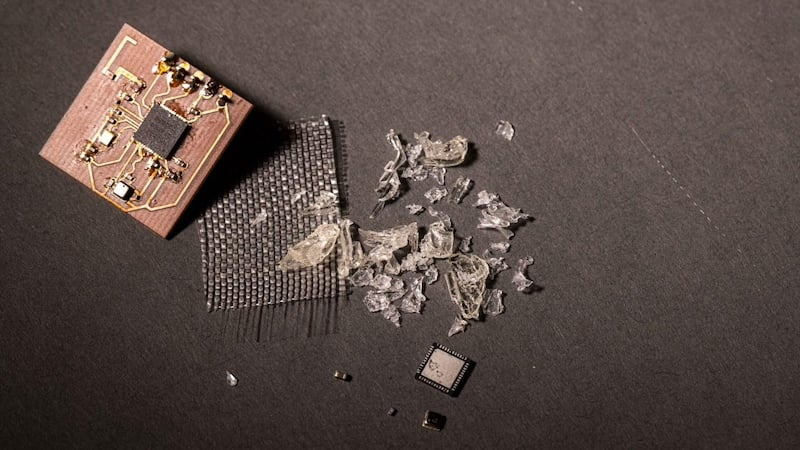
Working vitrimer-based PCB (left) and recycled and recover components (right).
First, the components are removed through desoldering, and the copper is etched off. After that, the vPCB is treated with a solvent to separate the vitrimer into a jelly form, leaving the glass fiber mat and metal PCB traces to be easily recovered. The UW process has shown a 98% recovery and reuse of the vitrimer epoxy, a 100% recovery of the glass fiber and PCB metals, and a 91% recovery of the recycling solvent.
Will Vitrimer Work as a PCB?
In order to act as a viable replacement for standard PCB materials, vitrimer must have a similar cost and compatible electrical properties. It must also survive assembly and rework and meet mechanical and safety requirements.
In their extensive testing, the UW team built a 2.4-GHz transmitter using vPCB to simulate a typical IoT device. The vPCB featured electrical and mechanical characteristics very similar to FR-4, the most common PCB material in use. It also demonstrated durability under manufacturing and rework similar to FR-4.
All images used courtesy of the University of Washington.
