
SMT adapter modules are essential tools for transitioning between different IC package types without redesigning PCBs. They facilitate the integration of advanced IC packages into existing designs, ensuring compatibility and maintaining performance standards.
What Are SMT Adapter Modules?
SMT (Surface-Mount Technology) adapter modules are printed circuit boards (PCBs) that allow surface-mount devices (SMDs) to be connected to through-hole pins or other package types. They serve as intermediaries, enabling engineers to test and prototype with various IC packages without the need for a complete PCB redesign.
Why Are SMT Adapter Modules Important?
These modules are crucial for several reasons:
-
Design Flexibility: They allow the use of different IC packages in a single design, accommodating various component types.
-
Cost Efficiency: By eliminating the need for new PCB designs, they reduce development costs.
-
Rapid Prototyping: Engineers can quickly test and evaluate different ICs, speeding up the development process.
How Do SMT Adapter Modules Work?
SMT adapter modules function by providing a compatible interface between the SMD and the desired package type. For instance, a module can convert a QFN (Quad Flat No-lead) package to a DIP (Dual In-line Package) footprint, allowing the SMD to be inserted into a standard through-hole socket.
Which IC Packages Can Be Adapted Using SMT Modules?
SMT adapter modules support a wide range of IC packages, including:
-
QFN to DIP: For converting QFN packages to DIP sockets.
-
SSOP to DIP: For adapting SSOP packages to DIP configurations.
-
TSSOP to DIP: For transitioning TSSOP packages to DIP layouts.
-
BGA to DIP: For converting BGA (Ball Grid Array) packages to DIP formats.
When Should You Use SMT Adapter Modules?
SMT adapter modules are particularly useful during the following scenarios:
-
Prototyping: When testing new ICs in existing designs.
-
Component Substitution: When replacing obsolete or unavailable components with newer alternatives.
-
Design Evaluation: When assessing the performance of different IC packages before finalizing a design.
Where Can You Source SMT Adapter Modules?
SMT adapter modules are available from various suppliers, including:
-
Digi-Key: Offers a wide selection of SMT adapter kits for different IC packages.
-
Texas Instruments: Provides evaluation modules for testing new IC packages without redesigning PCBs.
-
Advanced Interconnections: Specializes in customized interconnect solutions for semiconductor development.
Does Using SMT Adapter Modules Affect Signal Integrity?
Yes, using SMT adapter modules can impact signal integrity due to factors like trace length, impedance mismatch, and parasitic inductance. It’s essential to consider these factors during the design phase to minimize any adverse effects on performance.
Are There Limitations to Using SMT Adapter Modules?
While SMT adapter modules offer significant benefits, they also have limitations:
-
Size Constraints: The additional space required for the adapter can be a limiting factor in compact designs.
-
Cost: High-quality adapters may increase the overall cost of the project.
-
Complexity: Integrating adapters into a design can introduce additional complexity, requiring careful planning and testing.
Can SMT Adapter Modules Be Used in High-Speed Applications?
SMT adapter modules can be used in high-speed applications; however, careful consideration must be given to factors like trace routing, signal integrity, and grounding. In high-speed designs, even minor imperfections introduced by adapters can affect performance.
Buying Tips
When purchasing SMT adapter modules, consider the following:
-
Compatibility: Ensure the adapter matches the IC package and the target footprint.
-
Quality: Opt for modules from reputable manufacturers to ensure reliability and performance.
-
Specifications: Check the adapter’s specifications, including pitch, dimensions, and material quality, to ensure they meet your design requirements.
As a reliable Electronic Components Source, Fly-Wing Technology (HK) Co., Limited has been consistently dedicated to assisting customers in finding hard-to-find parts quickly and accurately, as well as acquiring new and original parts at competitive prices since 2012. Historically, shortages and time-critical demands have been associated with high-service sales and exceptionally high prices. Our website offers consistently competitive prices that are in line with or lower than those of other leading online distributors or superstores. We have our own warehouses in Hong Kong, which allows us to purchase electronic components from all over the world and offer powerful competitive prices. We acknowledge the difficulty of sourcing obsolete electronic components and strive to provide the best solutions for our customers. Our company confidently recommends that buyers spend up to 70% of their procurement time finding conventional parts. We have optimized our in-stock inventory and global supplier network to reduce procurement cycles, lower transaction costs, and provide quality electronic components at competitive prices. We believe that this approach will lead to the best results for our clients.
Electronic Components Expert Views
“SMT adapter modules are invaluable tools for engineers looking to integrate new IC packages into existing designs without the need for a complete PCB redesign.”
— Dr. Emily Zhang, Semiconductor Packaging Specialist
“While SMT adapters offer flexibility, it’s crucial to consider their impact on signal integrity, especially in high-speed applications.”
— Prof. John Lee, Electronics Design Engineer
“The use of SMT adapter modules can significantly reduce development time and costs, making them a preferred choice in prototyping and testing phases.”
— Dr. Michael Chen, PCB Design Expert
FAQ
Q1: What are SMT adapter modules used for?
SMT adapter modules are used to transition between different IC package types, allowing engineers to test and integrate various components without redesigning PCBs.
Q2: Can SMT adapter modules be used in high-speed designs?
Yes, but careful consideration must be given to factors like trace routing and signal integrity to ensure optimal performance.
Q3: Where can I purchase SMT adapter modules?
SMT adapter modules can be purchased from suppliers like Digi-Key, Texas Instruments, and Advanced Interconnections.
Q4: Do SMT adapter modules affect signal integrity?
Yes, they can impact signal integrity due to factors like trace length and impedance mismatch.
Q5: Are there limitations to using SMT adapter modules?
Yes, limitations include size constraints, potential cost increases, and added complexity in design.
Learn how surface-mount adapter evaluation modules (EVMs) help ease the transition to analog ICs with advanced package types.
For decades, semiconductor manufacturers have developed integrated circuits (ICs) as surface-mount device (SMD) packages. The most common surface-mount technology (SMT) package types for DC-DC converters, op amps, and many other circuits include small-outline integrated circuit (SOIC), thin-shrink small outline package (TSSOP) and small-outline transistor (SOT).
Newer processes and manufacturing technologies such as 300mm wafers have enabled higher-performing devices with more parts per wafer. These advances have led to the production of ICs at higher volumes than legacy ICs.
Along with increased volumes, Texas Instruments (TI) manufactures and assembles many newer devices at multiple sites, which is known as “dual sourced.” Dual-source manufacturing and assembly make it easier to move existing system designs to newer devices, since there’s more throughput, flexibility and reliability in the supply chain.
Performance and Longevity
Perhaps the most straightforward method for increasing the longevity of a product is to increase its performance by updating the ICs with newer, better-performing devices. This method helps accelerate the development cycle at the design and verification level because the designer already knows that the majority of the system works and will make relatively minor changes, thus simplifying the product’s recharacterization or recertification.
Or you might be motivated to move to a new device generation because of improved performance. In 2004, TI released the LMC7211-N push-pull output comparator. But with the recent release of the company’s TLV1811 comparator, it is possible to improve overall system performance by evaluating the newer device in place.
For example, the TLV1811 has improved specifications that make it a potential replacement for the LMC7211-N. The TLV1811 employs a more advanced IC process and has a rail-to-rail input/output, a 40 V supply range and a lower offset voltage. Its operating temperature range extends to 125°C, as opposed to 85°C for the LMV7211-N.
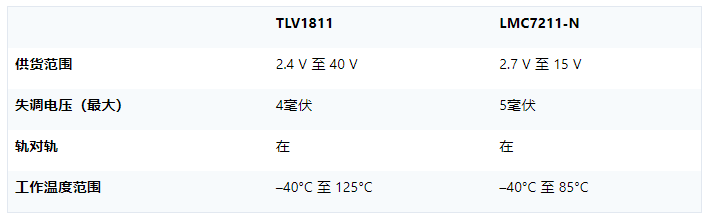
Table 1. TLV1811 vs. LMC7211-N specification comparison
Saving Time and Cost
In applications where there’s a limited amount of board space, cost sensitivity or both, it might be necessary to transition to a smaller and more economical device throughout a system’s lifetime. An example of this would be transitioning from the OPA171 operational amplifier in an SOIC package to the OPA991 operational amplifier in the SC-70 package. As Figure 1 shows, the SC-70 body size is more than six times smaller than the SOIC, resulting in instant space savings.
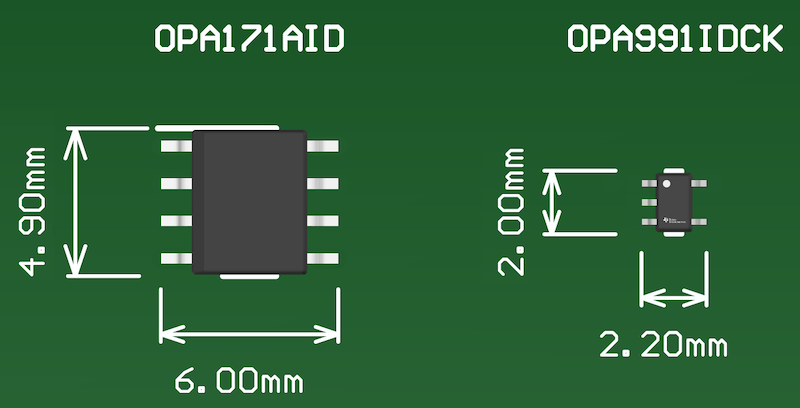
Figure 1. OPA171 SOIC package vs. the OPA991 SC-70 package
Newer manufacturing capabilities and process improvements have enabled drastic die-size reductions of semiconductor devices that enable manufacturers to offer them in smaller packages previously unavailable.
Transitioning to Newer Packages Without a Redesign
Whether the reason to move to a different device is to take advantage of an updated process technology, performance, size or cost, one common obstacle when updating devices is the lack of drop-in replacements. For operational amplifiers, for example, this challenge arises in packages with additional pins for shutdown, such as a 16-pin SOIC package and a 16-pin TSSOP.
For example, the TI TLV2775 is a quad-channel operational amplifier with shutdown functionality available in both 16-pin SOIC and TSSOP. While newer devices continue to support the no-shutdown 14-pin SOIC and TSSOP, they rarely offer the shutdown variants in SOIC and TSSOP, which makes it harder for engineers to move to newer devices.
TI’s TLV9054S is a great choice for an upgrade. However, this quad-channel shutdown operational amplifier is only available in the very thin quad flat no-lead (16-pin WQFN) package.
Three Difficult Options
Until recently, if you wanted to replace the TLV2775 with the TLV9054S, you had three options:
- Option #1: Spin a new board to evaluate a part that you haven’t tested yet.
- Option #2: Build a simplified circuit on an evaluation module to evaluate.
- Option #3: “Dead bug” or “blue wire”-solder your device to your board.
TI’s surface-mount adapter evaluation modules (EVMs) offer an alternative for designers. These adapter EVMs provide savings in both engineering time and cost by enabling the evaluation of a replacement device in a system. Option #1, listed above, is expensive and time-consuming, option #2 may not give you a complete picture of device performance, and option #3 introduces parasitic losses and can be almost impossible with smaller devices.
As Figure 2 shows, the surface-mount adapter EVM goes directly on the existing printed circuit board and adapts the 16-pin SOIC to the 16-pin WQFN device under evaluation. The surface-mount adapter EVMs provide a distinct advantage to evaluating another device by minimizing resources spent to evaluate that the device will work in your product before transitioning over.
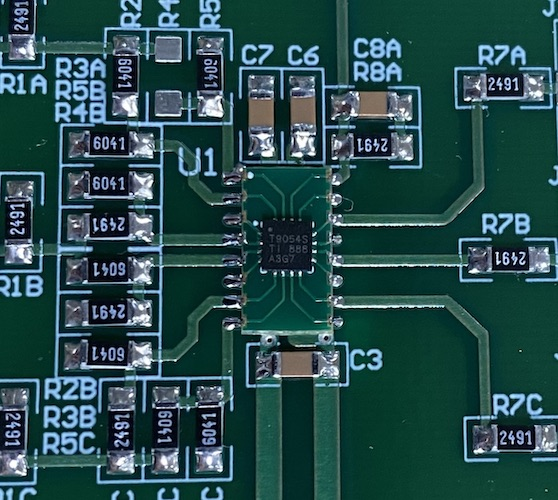
Figure 2. Converting the 16-pin SOIC to a WQFN package
Like the 16-pin SOIC package and 16-pin TSSOP, single-channel SOIC packages in older devices such as the LMC7211-N and OPA171 are not available in the next-generation versions of these devices (the TLV1811 and OPA991, respectively). There are many newer packages not available in previous-generation devices that provide a very compact solution, but wouldn’t be easy to evaluate simply.
Four Surface-Mount Adapter EVM Choices
New surface-mount adapter EVMs are available in four package variations:
- The eight-pin SOIC adapter EVM (Figure 3)
- The eight-pin very thin shrink small-outline package (VSSOP) and TSSOP adapter EVM (Figure 4)
- The quad (14-/16-pin) TSSOP adapter EVM (Figure 5)
- The quad (14-/16-pin) SOIC adapter EVM (Figure 6)
TI designed each variation to convert footprints of larger legacy packages into their next-generation successors.
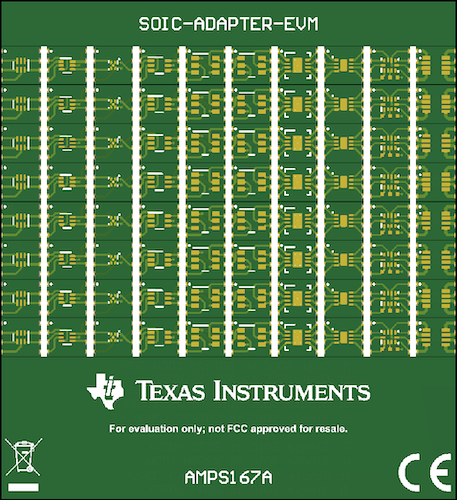
Figure 3. SOIC adapter EVM
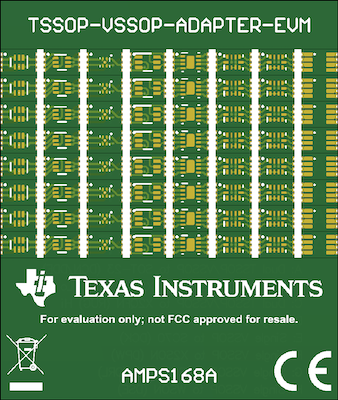
Figure 4. VSSOP TSSOP adapter EVM
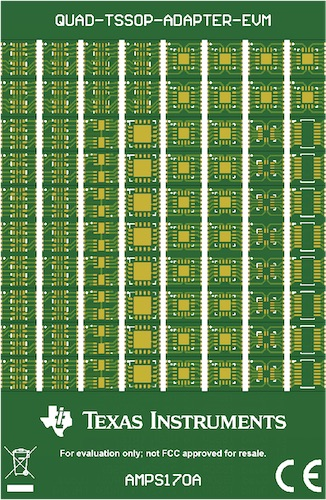
Figure 5. Quad TSSOP adapter EVM
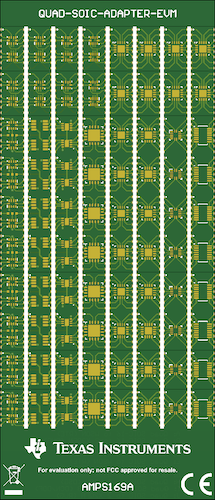
Figure 6. Quad SOIC adapter EVM. (Click image to enlarge)
Ease Your Engineering Efforts
Updating and upgrading devices used to be a daunting challenge. Previous methods of either spinning a new board before testing the new device, building out a simplified circuit on an EVM, or blue wiring the device all come at the expense of time and money. Surface-mount adapter EVMs can help you minimize engineering effort and save costs by giving you the option to evaluate new devices in existing designs.
If interested in learning how to use and ordering one or more of these surface mount adapter boards in your system, they can be ordered from TI’s Surface Mount Adapter EVM page.
All images used courtesy of Texas Instruments
Industry Articles are a form of content that allows industry partners to share useful news, messages, and technology with All About Circuits readers in a way editorial content is not well suited to. All Industry Articles are subject to strict editorial guidelines with the intention of offering readers useful news, technical expertise, or stories. The viewpoints and opinions expressed in Industry Articles are those of the partner and not necessarily those of All About Circuits or its writers.
