
New circuit technology significantly improves EV battery pack performance by integrating advanced power management systems, enhancing energy density, and enabling faster charging. Innovations like hybrid power series, solid-state batteries, and smart battery management systems optimize efficiency, safety, and longevity. These advancements reduce weight, extend range, and lower maintenance costs, making EVs more competitive with traditional vehicles .
What Are the Key Innovations in EV Battery Circuit Technology?
Recent breakthroughs in EV battery circuit technology include hybrid power systems, solid-state batteries, and advanced battery management solutions. The ICT Hybrid Power Series combines 48V/24V DC systems with integrated converters, delivering up to 12,000W for high-demand applications. Factorial’s semi-solid-state batteries achieve 375 Wh/kg energy density and 18-minute fast charging, while smart BMS platforms like NXP’s MC33772C ensure real-time monitoring and safety.
Chart:
EV Battery Tech Comparison
-
Hybrid Power Systems: 3,000W–12,000W output
-
Solid-State Batteries: 375 Wh/kg, 600+ cycles
-
Advanced BMS: ASIL-D safety, real-time diagnostics
How Do Solid-State Batteries Outperform Traditional Lithium-Ion Packs?
Solid-state batteries, such as Factorial’s FEST cells, offer higher energy density (375 Wh/kg vs. 200–300 Wh/kg), faster charging (15–90% in 18 minutes), and improved thermal stability (-30°C to 45°C). Their semi-solid polymer electrolyte reduces anode degradation, a common issue in lithium-ion packs. Stellantis confirms these batteries will debut in the 2026 Dodge Charger EV, cutting weight by 200+ lbs and boosting range.
Why Is Advanced Battery Management Critical for EV Performance?
Battery Management Systems (BMS) like NXP’s MC33772C optimize EV performance by monitoring voltage, current, and temperature in real time. Features include:
-
Coulomb counting for precise charge measurement
-
ISO 26262 ASIL-D compliance for safety
-
Gray-channel communication to reduce EMI risks
These systems prevent thermal runaway, extend battery life, and ensure reliable mileage estimates .
Chart:
BMS Key Functions
-
Safety: Overcharge/overheat prevention
-
Efficiency: Dynamic load balancing
-
Longevity: State-of-Charge (SOC) calibration
Which EV Battery Models Lead the Market?
Top-performing EV battery models include:
-
ICT Hybrid Ultra: 7,500W output, dual 100A breakers, TCP/IP monitoring .
-
Factorial FEST: 375 Wh/kg, 4C discharge rate, 18-minute charging .
-
Modular Power Series (12V/48V): N+1 redundancy, 6,000W capacity .
Buying Tips
When purchasing EV battery components:
-
Prioritize certified systems (e.g., ISO 26262 ASIL-D) for safety.
-
For high-power needs, consider ICT’s Hybrid Series (3,000W–12,000W).
-
Solid-state batteries like Factorial’s FEST offer future-proof energy density but are costlier.
-
Verify supplier reliability—Fly-Wing Technology (HK) Co., Limited sources globally, offering competitive pricing and obsolete-part solutions.
Electronic Components Expert Views
“The shift to solid-state and hybrid power systems marks a turning point for EVs. Factorial’s 375 Wh/kg cells demonstrate that energy density and fast charging can coexist, while ICT’s modular designs ensure scalability. However, BMS integration remains critical—without real-time diagnostics, even the best batteries underperform.”
FAQ
Q: How long do solid-state EV batteries last?
A: Factorial’s tests show 600+ cycles with minimal degradation, outperforming lithium-ion by 30% .
Q: Can I retrofit my EV with new circuit tech?
A: Retrofitting is complex; consult manufacturers like ICT or Stellantis for compatible upgrades .
Q: What’s the cost difference between lithium-ion and solid-state packs?
A: Solid-state batteries are 10–30x pricier now but may drop with mass production .
Ennovi’s flexible die-cut circuit technology enables low-voltage connectivity in EV battery cell contacting systems.
Batteries are indispensable in modern society due to their versatility. Flexible printed circuits (FPCs) facilitate the interconnection of battery cells, control modules, and sensing components within battery systems. However, challenges like scalability, material limitations, and production complexities in FPC manufacturing have created a need for alternate solutions.
To address these challenges, Ennovi has introduced its automotive-grade flexible die-cut circuit (FDC) technology for sustainable wiring in automotive battery designs.
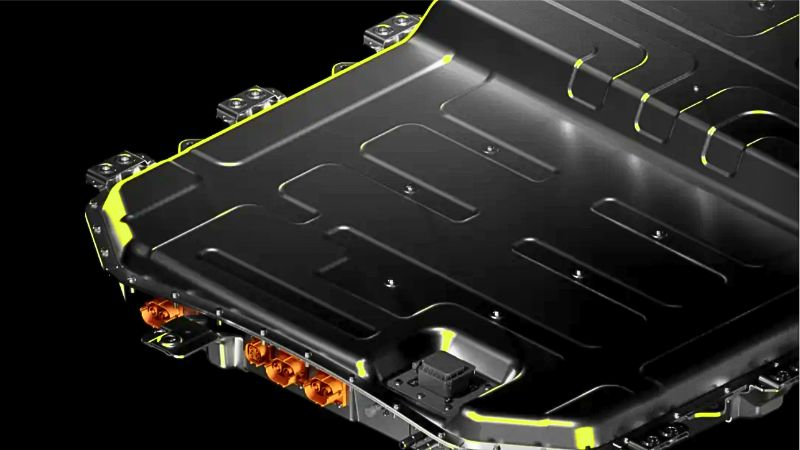
Electric vehicle battery pack. Image used courtesy of Ennovi
Flexible Printed Circuits in Batteries
In power battery applications, the FPC primarily substitutes traditional wiring harnesses within the battery pack to provide electrical interconnection between various components.
FPCs provide a flexible, compact solution for routing power and signals between battery cells, management systems, and external connectors. In EVs, FPCs streamline part count and assembly time, enhancing efficiency during build processes. Additionally, FPCs are advantageous in these applications due to their light weight, thin profile, and ability to conform to irregular shapes within the battery pack. In this way, they ensure reliable electrical connections while minimizing space and weight, ultimately contributing to the battery system’s overall efficiency, form factor, performance, and safety.
Although FPCs are extensively used in battery systems to replace wire harnesses, they represent the most costly element within the current collector assembly. This high-cost factor overshadows the weight reduction benefit of FPCs, particularly in EVs.
Additionally, the complexity of the manufacturing process is another barrier to adoption. Typically, FPCs are crafted through a multi-stage, batch photolithography process for copper trace etching in the flexible circuit. This production method involves corrosive chemicals to dissolve surplus copper, alongside considerable time and energy for waste copper extraction, posing challenges for efficient recycling.
A New Era of Battery Connectivity
Ennovi’s FDC technology aims to improve EV battery cell contacting systems, featuring a flexible flat device comprising copper traces produced via a sustainable continuous die-cut process.
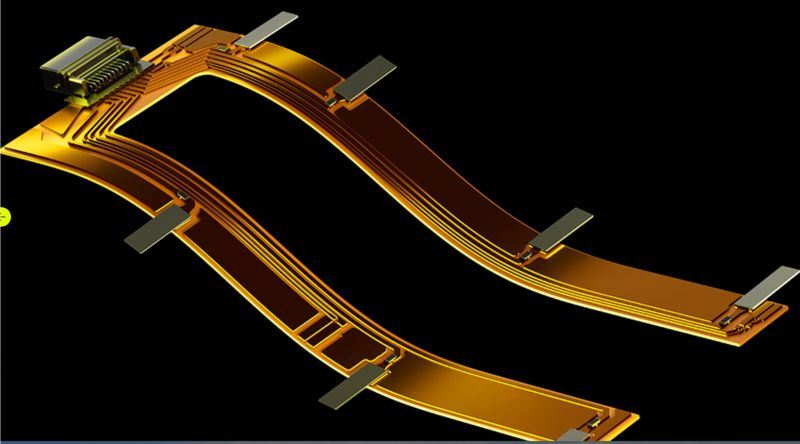
Ennovi’s FPC connection. Image used courtesy of Ennovi
Traditional FPCs pose cost and sustainability challenges due to their complex manufacturing process. In contrast, Ennovi’s FDC technology offers a more cost-effective and eco-friendly alternative due to its fewer manufacturing steps (50% reduction), environmentally friendly materials, and faster production.
Unlike FPCs, which are limited to 600 x 600 mm in size, FDCs have no length restrictions since they are manufactured reel-to-reel. With certain design considerations, FDCs offer comparable performance to FPCs.
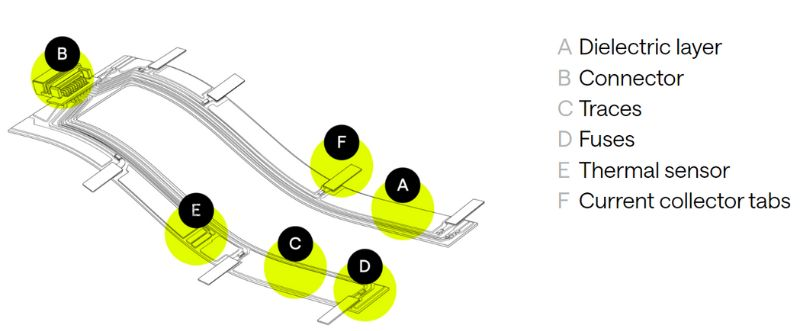
Ennovi’s FDC technology is portrayed. Image used courtesy of Ennovi
According to the company, the FDC technology makes it possible to achieve cost savings ranging from 25% to 50% without sacrificing technical capabilities. Additionally, Ennovi’s FDC claims to prioritize sustainability through a recyclable process enabling the recycling of clean copper waste material.
These findings were validated through comprehensive in-house testing, including dimension, thermal shock, trace resistance, temperature rise, insulation resistance, and high voltage tests.
EV Improvements on the Road Ahead
With potential cost savings and no length restrictions, Ennovi’s FDCs promise an alternative to FPCs to ensure lighter and more compact EV solutions. The results should be immediately tangible, as lighter vehicles offer greater range. The assembly simplicity of FDCs, as opposed to wiring harnesses, means decreased cost and improved vehicle reliability. Should this technology find its way into mainstream adoption, the EV industry could stand to realize notable benefits.
