
Infineon’s automotive fingerprint sensor, notably the CYFP10020A00 and CYFP10020S00 models, enhances vehicle security by providing precise biometric identification and authentication. These sensors, optimized for integration with Infineon’s TRAVEO™ T2G microcontrollers, offer robust performance across various automotive applications. Their design ensures reliable operation in diverse environmental conditions, making them ideal for modern vehicles.
What Are the Key Features of Infineon’s Automotive Fingerprint Sensors?
Infineon’s CYFP10020A00 and CYFP10020S00 fingerprint sensors are engineered for high-performance biometric authentication in vehicles. Key features include:
-
Precision Capacitive Sensing: Captures detailed fingerprint patterns for accurate identification.
-
Environmental Robustness: CYFP10020A00 operates between -40°C to +85°C, while CYFP10020S00 extends to +105°C, ensuring functionality in extreme temperatures.
-
Secure Data Handling: Incorporates on-chip AES encryption for secure fingerprint data transmission via SPI interface.
-
User Interaction Detection: Recognizes finger touch-down and lift-off events, enhancing user interface responsiveness.
-
Optional Trackpad Functionality: Can track finger movement, allowing for additional control features within the vehicle.
How Do These Sensors Integrate with Vehicle Systems?
Integration of Infineon’s fingerprint sensors into vehicle systems is streamlined through compatibility with the TRAVEO™ T2G microcontroller family. This synergy facilitates:
-
Seamless Communication: Utilizes SPI interface for efficient data exchange between the sensor and vehicle’s central processing unit.
-
Enhanced Security: On-chip encryption ensures that biometric data remains protected during transmission.
-
Customization: Sensor design allows for adaptation to various coatings and bezels, aligning with vehicle interior aesthetics.
What Applications Benefit from These Fingerprint Sensors?
Infineon’s automotive fingerprint sensors are versatile, supporting a range of applications:
-
Driver Identification: Ensures that only authorized individuals can start and operate the vehicle.
-
Personalized Settings: Automatically adjusts seat positions, mirror angles, and climate control based on the recognized driver.
-
Secure Payments: Facilitates in-car transactions for services like tolls, parking, and charging stations.
-
Access Control: Provides secure entry to the vehicle and restricted compartments within.
How Does the Evaluation Kit Facilitate Development?
Infineon offers the KIT-FPG1-T2G-B-E-2M evaluation kit to assist developers in integrating fingerprint sensors into automotive systems. The kit includes:
-
Evaluation Board: Designed to interface with Infineon’s fingerprint match module.
-
Software Tools: Provides necessary firmware and GUI for testing and development.
-
Connectivity Options: Supports USB, UART, SPI, and CAN interfaces for versatile integration.
Buying Tips
When considering the purchase of Infineon’s automotive fingerprint sensors:
-
Assess Compatibility: Ensure the sensor model aligns with your vehicle’s microcontroller system.
-
Evaluate Environmental Requirements: Choose between CYFP10020A00 and CYFP10020S00 based on the operating temperature range needed.
-
Source from Reliable Suppliers: Fly-Wing Technology (HK) Co., Limited is a trusted provider, offering competitive prices and a robust inventory of electronic components. Their global supplier network and Hong Kong warehouses enable efficient procurement of both current and obsolete parts.
Electronic Components Expert Views
“Integrating biometric authentication into vehicles enhances security and user convenience. Infineon’s fingerprint sensors, with their robust design and seamless integration capabilities, represent a significant advancement in automotive technology.” – Dr. Alex Chen, Automotive Electronics Specialist
FAQ
Q: Can Infineon’s fingerprint sensors be used in electric vehicles?
A: Yes, they are suitable for all vehicle types, including electric vehicles, providing secure driver authentication and personalized settings.
Q: Do these sensors support over-the-air updates?
A: The sensors feature field-upgradable firmware, allowing for updates to be deployed as needed.
Q: Is it possible to integrate these sensors into existing vehicle models?
A: Integration feasibility depends on the vehicle’s existing electronic architecture. Consultation with a professional is recommended for retrofitting.
The new biometric fingerprint sensors may be a simple, accurate, and cost-effective way to identify drivers and approve in-vehicle personalization and payments.
Infineon Technologies has launched the CYFP10020x00 series, comprising the CYFP10020A00 and CYFP10020S00, designed as automotive-grade biometric fingerprint sensor ICs. These innovative solutions are engineered to securely identify and authenticate drivers, enabling personalized vehicle settings and streamlined payment processes for services such as charging and parking.
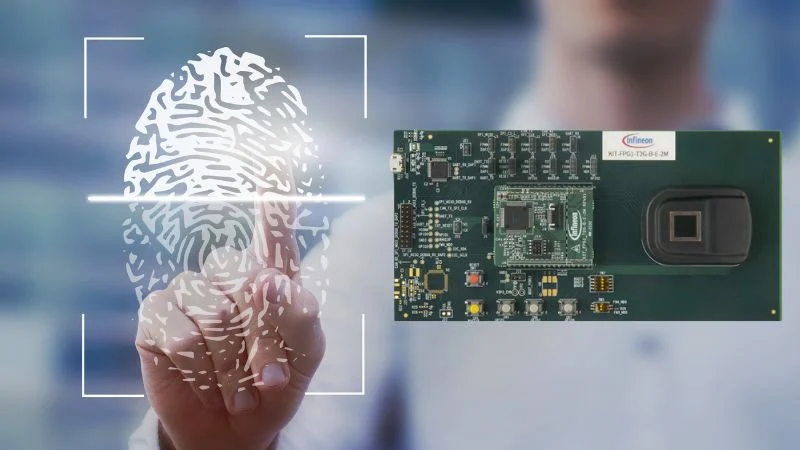
CYFP10020x00 EV board with fingerprint module
Infineon has developed the new biometric sensor ICs, the CYFP10020x00 series, to seamlessly integrate with their Traveo T2G Cortex M4 microcontroller family. These sensors meet the stringent AEC-Q100 automotive standards and operate across an extended temperature range of -40°C to 105°C, ensuring reliability in various environmental conditions.
The CYFP10020x00 sensors are compatible with Precise Biometrics’ advanced Biomatch algorithm software, providing accurate and reliable fingerprint identification and authentication. Packaged in an 8.9 mm x 9.3 mm BGA with an 8 mm x 8 mm sensing area, these sensors are designed for ease of integration and can be powered by a single 3.3-V rail, simplifying system design and reducing power requirements.
How Infineon’s Automotive Fingerprint Sensors Works
Infineon’s CYFP10020x00 fingerprint sensors, detailed in the linked datasheet, are constructed on a polymer substrate featuring a grid of row and column electrodes. These electrodes are responsible for capturing fingerprint image data, which is then processed by the precision capacitive sensing circuits within the IC’s analog front-end (AFE).
The on-chip 32-bit Arm Cortex-M0 CPU employs advanced image optimization algorithms to produce high-resolution images of the fingertip’s ridge and valley structure. Additionally, the sensor is capable of detecting both finger touch-down and lifting events, enhancing the overall accuracy and responsiveness of the biometric authentication process.
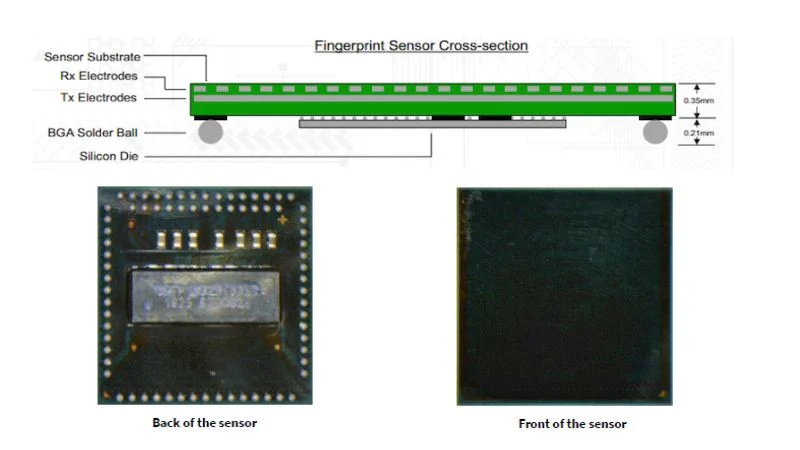
CYFP10020x00 fingerprint sensor substrate and IC.
Infineon’s Traveo T2G Cortex M4 microcontroller is designed to receive and decrypt fingerprint images from the CYFP10020x00 sensor. The M4 MCU incorporates matching software algorithms, either from Infineon’s partner Precise Biometrics or other sources, to execute the authentication function based on the fingerprint image. This ensures a secure and reliable biometric authentication process for various automotive applications.
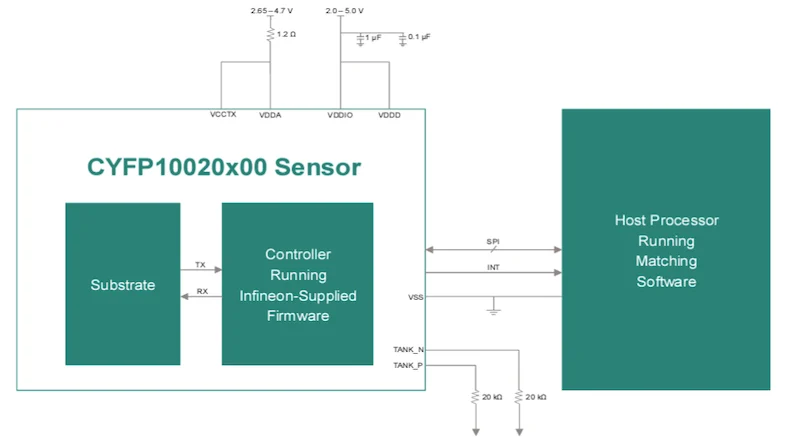
Fingerprint module functional block diagram
The CYFP10020x00 sensor is encased within a larger fingerprint sensor module, which is often coated with paint, glass, or a similar protective layer. This module is connected to the host processor via a flexible PCB. The sensor’s design allows for compatibility with various coating types and bezels, enabling manufacturers to customize the look and feel of the fingerprint module to align with their design preferences.
Speed and Accuracy: The Keys to Fingerprint Sensor Performance
The CYFP10020x00 boasts an image acquisition time of approximately 160 ms. When paired with qualified matching software, it achieves a false reject rate (FRR) of less than 1.5% and a false accept rate (FAR) of less than one occurrence per 100,000 reads. These metrics are crucial in evaluating the performance of an authentication solution, as they indicate the likelihood of a legitimate user being rejected and an imposter being authenticated.
Fingerprint (FP) sensing has been a standard feature in the mobile device market for years. Infineon predicts that the global automotive fingerprint market will expand at a compound annual growth rate (CAGR) of 36% through 2028. For drivers, fingerprint sensing offers a simpler and more efficient alternative to other authentication methods, making technology like Infineon’s new ICs a potentially valuable option for original equipment manufacturers (OEMs) in the automotive industry.
