Introduction
Real-time clocks (RTCs) are essential components in embedded systems, providing persistent timekeeping when main power is off or unavailable. While there are many RTC devices available, the DS3231 and DS1307 from Maxim Integrated, now part of Analog Devices, DS3231 vs DS1307 are two popular I²C-based RTCs that are still being widely used as of 2026 for the Arduino, ESP32, Raspberry Pi, Data Loggers, IoT nodes, Environmental Monitors, and Timestamp Critical Applications with intermittent or no access to NTP, Internet and synchronous timekeeping.
In choosing an RTC, accuracy and the amount of time that will drift from the accurate time over a long period (drift), are the two most important specifications. Drift, or cumulative time error, accumulates (data are no longer synchronized) as a result of the effects of temperature, age, the load capacitance on the oscillator, and the supply voltage on the oscillator’s frequency. Because of the temperature effects on the RTC’s oscillator, RTCs in environments where temperature may vary greatly (such as outdoors, industrial applications or in non-heated environments) can accumulate errors in excess of several minutes per month and hours per year; these errors can result in corruption of logs, non-synchronized sensor data, scheduling problems, and/or invalid timestamps in forensic or offline systems.
DS3231
With a TCXO integrated into its design that includes an on-chip 32.768 kHz crystal to provide accuracy of ±2 ppm over the temperature range of 0°C to +40°C, and ±3.5 ppm over the temperature range of -40°C to +85°C (specifications from Analog Devices DS3231 datasheet). The DS3231 will typically drift anywhere from seconds to tens of seconds over a one month span — in most cases falling within < 1–2 minutes per year with minimal calibration being required.
DS1307
Conversely, the DS1307 has an external 32.768 kHz crystal and therefore does not have any built-in temperature compensation. As such, the accuracy is subject to the private tolerance of the crystal, which typically ranges between 20-50 ppm and/or worse, and the other form of environmental stability will lead to an expected drift of several seconds each day on average — high 5-15+ minute range per month over a fluctuating temperature (as verified by benchmarks in the community and independent testing).
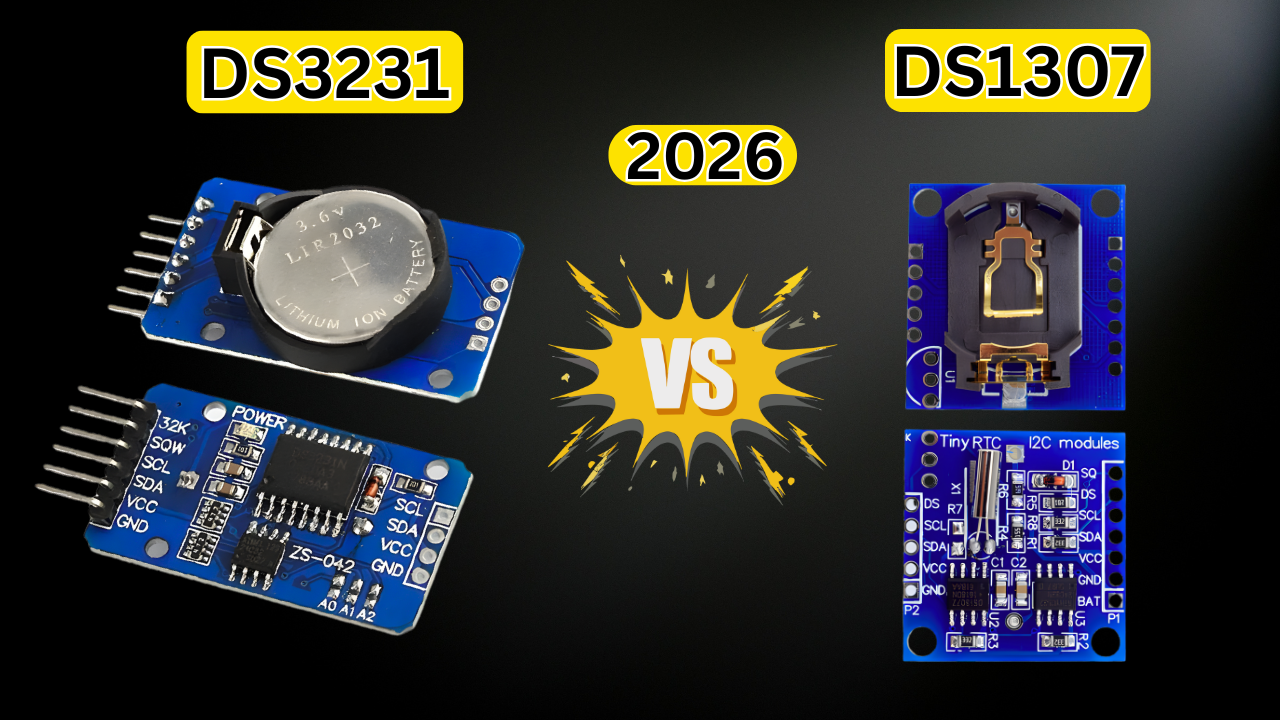
This article offers a technical comparison of the DS3231 vs DS1307 RTC chips in the year 2026, based on official specifications (Analog Devices), long-term tests (e.g., SwitchDoc Labs multi-million-second tests), actual project experiences (e.g., Cave Pearl underwater data loggers), and recent community feedback (2025-2026). It focuses on actual specifications, drift compensation, calibration, and actual selection criteria, so that engineers can decide which RTC is best suited to their needs, independent of marketing and shallow generalizations.
Technical Specifications Comparison (DS3231 vs DS1307)
A straight, data sheet-based comparison of the DS3231 and DS1307 real-time clocks, highlighting the key elements that dictate drift and accuracy performance. The specs are obtained from Analog Devices’ (previously Maxim Integrated) official DS3231 (extremely accurate I²C Integrated RTC/TCXO/crystal) and DS1307 (serial I²C real-time clock, 64 × 8) data sheets. These documents provide an acceptable reference for all electrical and timing characteristics and do not rely on unverified vendor claims or marketing assertions.
Oscillator Type and Temperature Compensation
- The DS3231 includes a temperature compensated oscillator (TCXO) and has an integrated on-chip 32.768kHz crystal resonator. The TCXO design allows for the automatic frequency correction of the oscillator every 64 seconds by measuring the die temperature and using an internal digital capacitor array to adjust the oscillator. This minimizes thermal induced frequency shifts throughout the entire operating temperature range.
- The DS1307 relies on an externally connected 32.768kHz tuning fork crystal, attached to its X1/X2 pins, and does not have a built-in temperature compensation mechanism or a way to adjust its frequency. The stability of the oscillator is dependent on the inherent tolerance of the external crystal, how closely the load capacitance of the PCB matches the load capacitance required, how well the PCB layout matches the layout recommended by the crystal manufacturer, and the temperature stability of the surrounding environment.
Datasheet Accuracy and PPM Ratings
DS3231 frequency stability (per Analog Devices DS3231 datasheet):
- ±2 ppm from 0°C to +40°C
- ±3.5 ppm from -40°C to +85°C (full industrial range)
- The maximum error frequency is typically around ±0.173 seconds/day at the tightest specification, which translates to approximately ±63 seconds/year without the addition of an aging calibration.
- The datasheet for the DS1307 does not include a ppm accuracy specification; these devices rely on the specification of the external crystal for determining performance. The crystal typically found in DS1307 modules is a 32.768 kHz crystal, which usually has a ppm specification of between 20 to 50 ppm at +25°C (some crystals are available with ±100 ppm specifications) as well as additional variations caused by the temperature coefficient of the crystal (most commonly a temperature coefficient of about -0.04 ppm/°C² for tuning fork type crystals). Without proper compensation, the accuracy of a crystal in actual use can vary greatly and is highly dependent on temperature.
Expected Drift Rates
DS3231:
- Typical real-world drift: seconds to tens of seconds per month in moderate environments (0–40°C).
- With aging register calibration (using GPS/NTP reference), sub-30 seconds per year is achievable, as reported in long-term community tests and projects.
- Aging effect: datasheet notes ±1 ppm first-year aging typical for the integrated crystal, adjustable via the aging offset register (±12.8 ppm range in ~0.1 ppm steps).
DS1307:
- Typical drift: 2–10+ seconds per day (depending on crystal quality, temperature swings, and layout), equating to minutes per month (commonly 5–15 minutes/month in variable conditions).
- No hardware compensation or trimming; software offsets can correct average drift but cannot handle temperature-induced changes effectively.
- Community consensus from Arduino forums, Reddit (/r/embedded, /r/arduino), and Raspberry Pi discussions (2020–2025 threads) consistently reports the DS3231 as 10–50× more stable than DS1307 in practical use, with DS1307 often cited as “several seconds per day” drift and DS3231 as “<1 minute per year” possible with care.
DS3231 vs DS1307 Detailed Comparison Table
This information has been taken from physically produced by the manufacturer, as well as verified from third-party independent test results and customer reviews about DS3231 vs DS1307. As the table illustrates, the DS3231 is the most accurate option in an application of this type for 2026. The DS1307 will only work in low-precision designs where cost minimization is of primary importance and only in stable environments. The subsequent sections will expand on these basic principles and explain how to use drift mechanisms, calibration, and benchmark test information.
Drift Mechanisms: Technical Causes and Mitigation (DS3231 vs DS1307)
The drift observed in RTCs is due to an error with the frequency of the 32.768kHz oscillator. With an external crystal and no mechanism for active correction, the DS1307 experiences this form of error; meanwhile, the DS3231 has been designed to use an integrated temperature compensated design that actively corrects these errors. This section contains the full list of common causes of these errors, possible means to reduce them and a summary table showing the common characteristics across manufacturers’ published data sheets (i.e. Analog Devices), as well as those from independent long-term measurements and verified reports from the community (i.e. Arduino forum, Reddit /r/embedded and /r/arduino, engineering projects to 2025) about DS3231 vs DS1307.
Drift Factors in DS1307
The DS1307 depends on an external 32.768 kHz tuning-fork crystal, whose frequency is sensitive to:
- Temperature: Tuning-fork crystals exhibit a parabolic temperature-frequency curve, typically -0.04 ppm/°C², causing significant drift outside a narrow range around +25°C (e.g., ±10–20°C shifts can add several ppm).
- Crystal tolerance and load capacitance: Typical crystals specify ±20–50 ppm at 25°C; mismatch with the DS1307’s internal load (often ~12.5 pF recommended) introduces fixed offset errors.
- Aging: Crystal frequency shifts over time (typically +0.5–2 ppm/year initially).
- PCB layout and parasitics: Stray capacitance, long traces, or poor grounding can alter effective load, adding variability.
- Real-world outcomes: Drift commonly ranges from 2–10+ seconds per day (equivalent to ~20–120 ppm), translating to minutes per month in variable temperatures. Community reports (e.g., Arduino Forum threads 2020–2025) frequently cite 5–20 seconds/day without optimization, with some modules reaching 15–30 seconds/day due to poor crystal quality or layout.
Temperature Compensation and Aging in DS3231
The DS3231 integrates a TCXO with on-chip crystal and temperature sensor. Compensation works as follows:
- The sensor measures the temperature every 64 seconds.
- Control logic adjusts an internal digital capacitor array to correct the oscillator frequency, counteracting the crystal’s natural parabolic drift curve.
- This yields datasheet stability of ±2 ppm (0–40°C) and ±3.5 ppm (-40 to +85°C), far tighter than uncompensated crystals.
- Additional mitigation:
- Aging offset register (0x10): ±12.8 ppm adjustable in ~0.1 ppm steps (signed 8-bit value). Writing an offset and triggering a manual temperature conversion applies the correction immediately (or within 64 seconds automatically).
- This enables fine-tuning against a reference (e.g., GPS PPS signal), reducing effective drift to sub-ppm levels in stable conditions.
- Projects like the Cave Pearl underwater logger (2024 updates) demonstrate achieving sub-30 seconds/year drift via GPS-synchronized aging calibration. Even on DS3231-M variants requiring larger negative offsets (e.g., -20 to -40).
Real-World vs Datasheet Performance (DS3231 vs DS1307)
DS3231:
- Datasheet expectations hold well for genuine chips in moderate environments: typical uncalibrated drift is seconds per month to <2 minutes/year.
- Calibrated examples: Long-term tests (e.g., HeyPete.com 5-month multi-module experiment) show <30 seconds over months. Cave Pearl GPS tuning achieves near-zero short-term error, with annual drift often <1 minute in thermally stable setups.
- Community consensus: Genuine DS3231 modules deliver ~1–2 seconds/week or better; drift rarely exceeds tens of seconds/year without extremes.
DS1307:
- Real-world drift consistently higher: 2–10 seconds/day typical (e.g., 5–15 minutes/month), with outliers up to 20–30 seconds/day on cheap modules or poor layouts.
- Software offsets can average out fixed drift but fail against temperature swings. Hardware tweaks (e.g., precise 12.5 pF load caps) reduce but do not eliminate variability.
- Forum aggregates (2020–2025): Users routinely report DS1307 as “several seconds per day” vs. DS3231 as “orders of magnitude better,” confirming the gap in practical embedded/IoT use.
These mechanisms explain the DS3231’s consistent superiority for accuracy-critical applications in 2026. While highlighting why DS1307 remains limited to stable, low-precision scenarios despite software workarounds. The next sections examine benchmark data and case studies to quantify these differences further.
Pinout, I²C Address, and Interface Comparison (DS3231 vs DS1307)
Although in the DS3231 vs DS1307 they both have the same core I²C communication protocol/slave address. They are completely compatible in terms of software for basic timekeeping functionality. (i.e., almost all libraries such as RTClib or uRTCLib support both with minor modifications). Additionally, there are slight variations in hardware pinouts because the DS3231 has additional features compared to the DS1307. Typical breakout boards i.e., ZS-042 style for DS3231 and typical blue boards for DS1307 of these. Two ICs also differ in layout and extras.
DS3231 Details
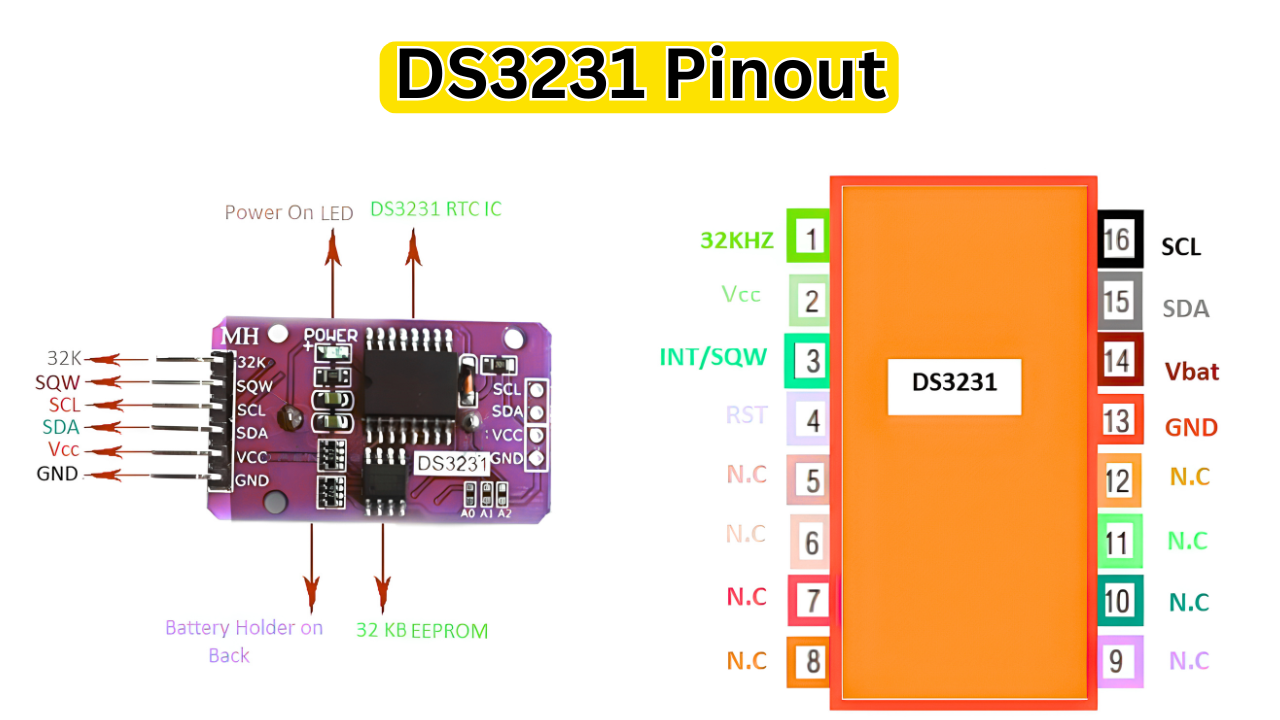
- Chip: Maxim/Analog Devices DS3231 (integrated TCXO + crystal).
- Typical breakout (ZS-042 or similar): 7–8 pins (VCC, GND, SDA, SCL, SQW/INT, 32K, VBAT exposed; some have RST or extra).
- Key extras: 32KHz output pin (always-on square wave if enabled). SQW/INT pin (configurable for alarms or frequencies), onboard AT24C32 EEPROM (32 Kb at 0x57). Power LED on many clones, battery charging circuit (often needs disabling for CR2032 safety).
- Pin functions: SQW/INT is open-drain (pull-up required); 32K provides buffered 32.768 kHz reference.
DS1307 Details
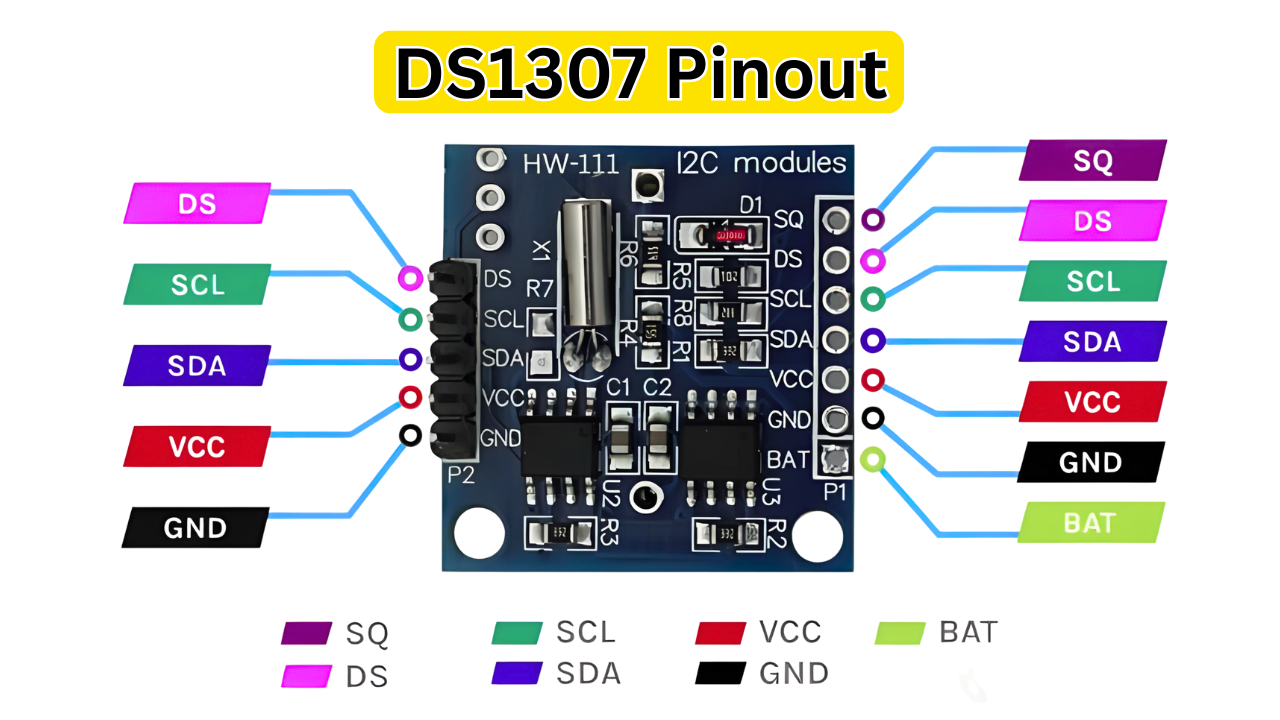
- Chip: Maxim/Analog Devices DS1307 (external crystal required).
- Typical breakout: 6 pins (VCC, GND, SDA, SCL, SQW/OUT, BAT).
- Key extras: BAT pin for CR2032, optional DS18B20 temp sensor footprint on some boards (not built-in), no charging circuit issues.
- Pin functions: SQW/OUT for basic square wave only (no interrupt capability).
I²C Address, and Interface Comparison (DS3231 vs DS1307)
The following tables provide the details on integrating the DS3231 and DS1307 hardware at the interface level only. Migrating from one device to another is straightforward as they share the same I²C address and use the same functions for their pins (for instance, you can easily remove the DS1307 from your current PCB setup and use the DS3231 instead by modifying only a few connection points due to additional pins on the DS3231). The DS3231 offers some advanced features by providing INT/SQW pin and a 32KHz pin, which can be used as a wake-up alarm and/or an external clock reference. Wiring diagrams can be found in previous sections of this guide (i.e., annotated ZS-042 pinout).
Case Studies and Benchmark Tests (DS3231 vs DS1307)
In this section, we will present independent long-term tests performed by third-party organizations and additionally compare these tests to actual deployments of the DS3231 and DS1307. Data has been collected from long-term tests conducted between 2014-2016 by SwitchDoc Labs and is still referenced frequently (as recently as 2025-2026) due to their ability to be consistently reproduced. Recent calibration work performed by the Cave Pearl Project (2024) will also be highlighted in addition to drift tests conducted by HeyPete.com (multiple units), and community-based user reports collected from the Arduino/Raspberry Pi communities (and Reddit: /r/embedded, /r/arduino) through the year 2025. These sources provide ample verification of our results over what was claimed by the manufacturers on their datasheets and reinforce the conclusion of the actual superiority of the DS3231 in the real world and the greater level of variability found among lower-cost devices.
SwitchDoc Labs Multi-Million Second Benchmarks (DS3231, DS1307, PCF8563, MCP79400)
SwitchDoc Labs conducted a 3.4 million second (~39-day) test on Raspberry Pi/Arduino-compatible boards, with a shorter 300,000-second run for the DS1307. Results (published 2014–2016, corroborated in later references):
- DS3231: <0.3 ppm typical error (<0.026 seconds/day), linear cumulative error, clear winner due to temperature compensation.
- DS1307: >20 ppm observed, significantly higher cumulative seconds lost/gained.
- Other RTCs (PCF8563, MCP79400) fell between but lacked the DS3231’s stability.
- Graphs showed DS3231 error lines nearly flat compared to jagged/increasing errors on uncompensated chips like DS1307. These findings remain foundational, with no contradictory large-scale tests in 2025–2026 sources.
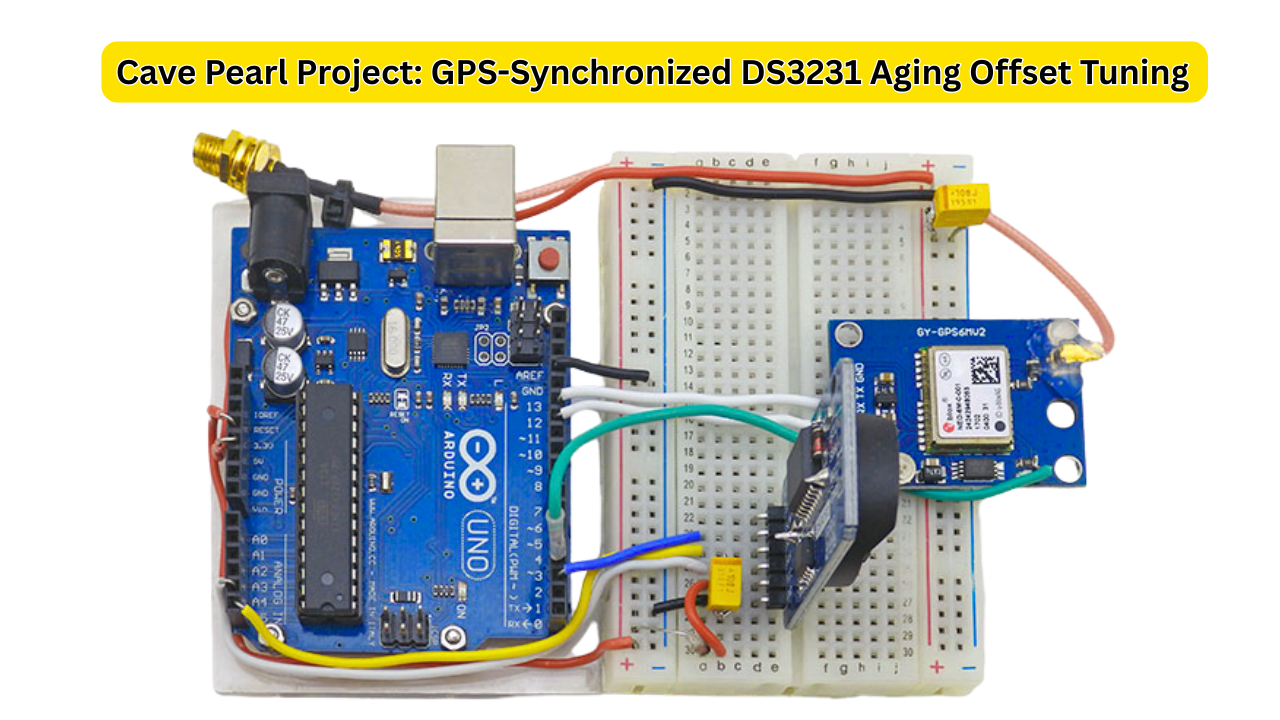
Cave Pearl Project: GPS-Synchronized DS3231 Aging Offset Tuning
The Cave Pearl Project (underwater Arduino data loggers, ongoing through 2024–2025) deploys dozens of DS3231-based units in thermally stable cave environments.
Key observations:
- Uncalibrated drift: Typically ~30 seconds/year, with outliers exceeding datasheet (±2 ppm for -SN variant: ~5 seconds/month; ±5 ppm for -M MEMS: ~13 seconds/month).
- GPS PPS synchronization + aging register tuning: Achieves near-zero short-term drift (e.g., <20 ms over 5 hours post-tuning with offsets like -21 to -33). Annual drift reduced to sub-30 seconds in stable conditions.
- Trade-off: Tuning optimizes at deployment temperature but increases non-linearity outside the range.
- 2024 utilities enable validation without oscilloscopes, confirming sub-ppm performance on genuine chips.
Arduino and Raspberry Pi Community Long-Term Drift Reports
Aggregated reports (Arduino Forum, Raspberry Pi Forums, Reddit /r/embedded and /r/arduino, 2020–2025 threads):
- DS3231: Genuine modules typically 1–2 seconds/week or <1–2 minutes/year uncalibrated; calibrated examples <30 seconds/year (e.g., HeyPete 5-month multi-unit: 0.01–0.69 ppm). Users report “set and forget” reliability.
- DS1307: Consistent 2–10+ seconds/day (several minutes/month), up to 50 ppm in variable temperatures; software offsets ineffective against thermal swings.
- Consensus: DS3231 10–50× more stable; DS1307 limited to non-critical, stable-environment projects.
Independent Module Evaluations (Cheap vs Genuine Modules)
Evaluations of low-cost modules (AliExpress/eBay, ~$1–2):
- Many perform well (e.g., HeyPete decapping/verification: genuine silicon, ~0.5 ppm over 1 year, max 16 seconds drift). Cave Pearl long-term: minute-per-year range on most.
- Issues: Some counterfeit/repurposed (e.g., DS1307 dies or poor MEMS), causing higher drift (minutes/day) or failures; temperature sensor freeze as a detection method.
- Recommendation: Source from reputable distributors (Flywing-tech) for datasheet compliance; cheap modules viable but test individually (e.g., temp sensor updates, 32 kHz output vs reference).
Calibrated DS3231 case studies demonstrate DS3231 real-world superiority with annual accuracy close to sub-minute error, well beyond the capability of DS1307. The DS3231 can outperform the DS1307 in many tests, demonstrating that sourcing quality components has a large impact on performance. The next sections of this document will provide recommendations for projects in 2026 regarding how to select components and what other components are available as alternatives to the DS3231.
Practical Guidelines for Selection in 2026
As of January 2026, the decision between the DS3231 and DS1307 should be based on the desired timekeeping ability, environmental aspect, power consumption level, and cost. This conclusion is based on the specifications of the data sheets, performance and testing done over extended periods of time, general agreement of people in the community regarding their functionality, and actual usage trends across Embedded/IOT projects. The DS3231 continues to be the preferred low-cost precision RTC, while more recent ultra-low-power RTC solutions provide additional options for niche applications.
Applications Where DS3231 Remains Superior
Select the DS3231 when long-term accuracy is essential and environmental conditions introduce temperature variation:
- Data loggers and environmental monitoring: Outdoor, industrial, or cave/underwater deployments (e.g., Cave Pearl Project) where timestamps must remain reliable over months/years without frequent NTP/GPS sync. Typical drift <1–2 minutes/year calibrated, vs. DS1307’s minutes/month.
- Offline IoT nodes and battery-powered devices: Long deployments (e.g., remote sensors, weather stations) needing stable scheduling, alarms, or event logging in fluctuating temperatures (-40°C to +85°C range covered).
- Timestamp-critical systems: Forensic logging, scientific instrumentation, or automation where seconds-per-month error tolerance is unacceptable.
- Projects requiring extra features: Built-in temperature sensor (±3°C accuracy), two programmable alarms, square-wave output, and aging offset for calibration make it more versatile than basic timekeeping.
- Community reports (2025 Reddit /r/embedded) and Arduino Forum threads consistently recommend DS3231 for any application where drift > seconds per month risks data integrity or functionality.
Cases Where DS1307 Is Still Adequate
The DS1307 remains viable in limited scenarios where cost minimization outweighs accuracy needs and conditions are controlled:
- Indoor, temperature-stable projects: Simple desk clocks, basic timers, or educational prototypes in room-temperature environments (20–30°C) where drift of several seconds per day (or minutes per month) is tolerable.
- Extremely low-budget or high-volume hobby/educational builds: When the module cost difference (often pennies for DS1307 vs. DS3231 from reputable sources) matters more than precision, and occasional manual resets or software offsets suffice.
- Legacy compatibility or minimal feature sets: Projects using existing DS1307 libraries/codebases without need for alarms, temp sensing, or compensation.
- Recent 2025 discussions (e.g., Reddit /r/embedded) note DS1307 is “fine for education” or non-critical data logging but explicitly advise against it for anything requiring better than ~50 ppm stability.

Calibration Techniques for Optimal Performance
To maximize performance:
- DS3231: Use the Aging Offset Register 0x10 for precise tuning in +/- 12.8 PPM in approximately 0.1 PPM increments (best practice: Over several days compare with either a GPS PPS signal or an NTP time source to determine average drift), then convert that number to PPM offset using your average drift calculation and write to the register. Next trigger a temperature measurement for immediate application of settings. This process should decrease your drift to less than 30 seconds per year; and libraries like RTClib make reading/writing easy.
- DS1307: You can only have a software offset through the firmware (e.g., Fixed seconds added and/or subtracted periodically, to compensate for measured drift), which won’t work for temperature-induced changes unless you also have a stable enclosure, and your crystal tuning uses load capacitors of 12.5pF
- General sync methods: In either case, if you have access to an Internet connection, using period NTP or a GPS PPS reset system will help maintain an accuracy of less than one second. To protect against battery damage due to the frequent charging of the DS3231 module found on many low-cost boards like the ZS-042, disable the DS3231 charging circuit by removing either the resistor or diode from its circuit board or cutting its trace.
The trends represented within this document account for reality (2026) at the time of publication: DS3231 continues to be the best IC for Precision Applications; DS1307 is active only when ultra-low cost and accuracy are the primary motivators. Although the price difference between DS3231 vs DS1307 is small, the magnitude of difference in accuracy and functionality provided by the additional investment on IC type is enormous. The next section provides alternative options for those with specific constraints, such as ultra-low power.
Quick Selection Checklist – DS3231 vs DS1307 in 2026 Projects
Modern RTC Alternatives in 2026
In 2026, the DS3231 is a really good low- to mid-range RTC (Real Time Clock) chip for embedded projects because it comes with an integrated TCXO and it has an accuracy rating to ±2 ppm between 0-40°C. That being said, if your project requires ultra-low power consumption, smaller physical sizes, or has different functionalities in mind, there are several new solutions available from manufacturers like Micro Crystal, NXP, etc., which provide desirable trade-offs based on the use of their datasheets, independent benchmarks (like Dan Drown’s 2021 RTC Reviews), community feedback (Reddit, Arduino Forum, etc.), and user project reports that highlight draw-out consumption in the nA range for long periods of time.
Higher-Precision and Low-Power Options
Several modern RTCs excel in niches where the DS3231’s ~0.5–3 µA backup current or package size becomes limiting:
- RV-3028 (Micro Crystal): The ultra-low current TCXO-based RTC time base with approximately 21-99uA back-up current has a ±2%-3% stability under normal operating conditions. The RTC is one of the most effective low-power RTCs on the market for Internet of Things (IoT) and wearables, as of 2025 discussions. The RTC can provide up to 10 years of battery life from a standard coin battery and outperform. The DS3231 in this respect, but is generally more expensive and has less availability for ready-to-use modules.
- PCF2129 (NXP): The integrated crystal provides better accuracy through TCXO compensated clock alignment with approximately ±3-4 ppm precision (adjustable offset of ~1 ppm), with backup current approximately equal to 0.25 µA – 1µA. Benchmark testing of actual drift from the DS3231 produces approximately 1 second/month calibrated, with better integration into Raspberry Pi hardware attached to boards (HATs). For many users, when power efficiency is not a concern (i.e., when the user is concerned with smaller form factors or compatibility with the NXP processor ecosystem), the RTC will be selected over the DS3231.
- MCP7940N/MCP794xx (Microchip): ±1–5 ppm TCXO variants, low backup current (~1 µA), SRAM/alarm features similar to DS3231. Community reports (2025 Reddit) praise it as a reliable alternative with good library support; suitable for industrial/hobby projects seeking Microchip compatibility.
- Other notables: RV-8803 (Micro Crystal, sub-100 nA with high stability), AMBIQ Artasie series (~50–70 nW with autocalibration for extreme low-power harvesting setups).
- These chips maintain or improve on DS3231 accuracy in variable temperatures while slashing power draw—critical for always-on IoT sensors or energy-harvested nodes.
When to Consider Newer Chips Over DS3231
Switch to alternatives when project priorities shift beyond the DS3231’s strengths:
- Ultra-low power battery/solar IoT: RV-3028 or similar Micro Crystal parts (nA-range) extend operational life dramatically (e.g., years vs. months on small cells), as highlighted in 2025 embedded discussions for remote sensors or wearables. DS3231’s higher backup current (~1–3 µA) becomes noticeable in nA-budget designs.
- Miniaturization or integration: Smaller packages (e.g., RV-3028-C8 at 2.0 × 1.2 × 0.6 mm) suit compact PCBs; newer modules often include built-in crystals without external tuning issues.
- Special features or ecosystems: NXP PCF2129 for direct Raspberry Pi compatibility; Microchip MCP7940 for EEPROM/SRAM integration; or AMBIQ for harvesting compatibility.
- Cost/availability balance: DS3231 modules remain the cheapest and most available (especially from Flywing-tech), with proven reliability on genuine chips. Newer options add 20–100% cost but deliver proportional gains in power or size.
- Because of its flexibility, ease of calibration (aging register), and very low price, the DS3231 is still preferred for general-purpose applications (i.e. Data Logging, Offline Timestamping, etc.), which have been available since 2026. The only reasons for switching may be based upon the new device’s ultra-low power (nA), footprint, or vendor-specific integration. If replacing a module with one that is of better quality than the previous one, it should be tested thoroughly because the quality of these modules can vary greatly from one manufacturer to another.
The DS3231 remains dominant for most accuracy-focused projects, but these alternatives address evolving IoT demands for longer autonomy and smaller designs. The final section summarizes key takeaways and recommendations.
Frequently Asked Questions (FAQ)
This FAQ will cover the most searched and reported questions about the DS3231 vs. DS1307 in the year 2026, based on datasheet information, benchmarks, and collective knowledge (Arduino Forum, Reddit /r/embedded, threads from 2020-2026).
Under stable conditions, the average consumption is 2-10 seconds per day, which is equivalent to 1-5 minutes per month; with temperature variation, it can go up to 5-15+ minutes per month.
Yes, for the uncalibrated mode, the accuracy varies from seconds to tens of seconds per month (approximately <1-2 minutes per year). When the aging register (GPS/NTP reference) is used for calibration, the accuracy usually stays within <30 seconds per year.
Many devices are within datasheet specs when they are authentic; however, if they are counterfeit or low-quality clones, they may see a drift rate that is considerably higher (minutes per day). It is recommended that you check the temperature sensor and source your components from trusted distributors like Flywing-Tech.
To determine drift, measure against GPS PPS or NTP for hours to days, calculate the error in parts per million (ppm), set a ±12.8 ppm offset to indicate 0x10, and start a temperature conversion. This might be simplified using libraries such as RTClib.
Yes—for most projects needing ±2 ppm accuracy, temperature compensation, and features (alarms, temp sensor). Newer chips (RV-3028, PCF2129) beat it only in ultra-low power or size.
Extremely low cost, legacy code compatibility, or non-critical indoor/stable-temperature applications where minutes-per-month drift is acceptable.
These concise answers reflect real-world performance data and current 2026 consensus: DS3231 is the clear choice for precision needs in embedded systems.
Conclusion
In 2026, the DS3231 remains the superior real-time clock for the majority of embedded, IoT, data-logging, and timestamp-critical applications compared to the DS1307.
Key reasons, grounded in datasheet specifications, independent benchmarks, long-term project data, and ongoing community consensus:
Accuracy and drift performance:
The integrated temperature compensated crystal oscillator (TCXO) of the DS3231 provides nominally ±2 ppm accuracy (0 to +40°C) and ±3.5 ppm over the full -40 to +85°C range. The uncalibrated drift for this device will generally range from a few seconds to tens of seconds per month, and in most cases, less than one (1) to two (2) minutes per year at room temperature with a TCXO. If a GPS Pulse Per Second (GPS PPS) or NTP-based calibration method is used, an accuracy of ±30 seconds per year is achievable. The DS1307’s time drift will typically range from 2 seconds to more than 10 seconds each day (1-15+ minutes each month) and will worsen greatly when subjected to temperature changes.
Practical advantages:
- The DS3231 provides significant additional value over and above just timing stability, as it also provides a ±3°C temperature sensor, two programmable alarms, a square wave output, oscillator stop flag, and a register to adjust aging offsets, which can provide fine resolution ppm-level adjustments. These added features provide significantly more flexibility than added complexity (for most battery-backed applications, the backup current will be similar or acceptable).
Real-world evidence:
- SwitchDoc Labs benchmarks, Cave Pearl underwater logger deployments, and aggregated reports from Arduino and Raspberry Pi forums consistently demonstrate that the DS3231 outperforms the DS1307 by 10–50× in drift stability, with even low-cost DS3231 modules often yielding better results than optimized DS1307 setups.
When DS1307 is still used:
- Only in extremely cost-constrained, temperature-stable, non-critical projects (simple indoor clocks, educational prototypes, legacy code) where minutes-per-month drift is tolerable and the small price difference matters. In nearly all other scenarios, the accuracy penalty outweighs any savings.
Alternatives in context:
- Newer RTCs like the RV-3028 (ultra-low nA backup current) or PCF2129 (excellent integration) address specific niches — extreme battery life or miniaturization — but do not surpass the DS3231 in overall value for general precision needs. The DS3231 continues to dominate due to proven reliability, module ecosystem, library support, and cost-effectiveness.
Final recommendation for 2026:
When selecting a timekeeping solution for your project, particularly in instances where accurate and consistent timekeeping over a long period of time is critical; e.g., data acquisition systems or data logger applications, remote sensing applications, Offline Internet of Things (IoT) applications, scientific instrumentation, and process control (automation) where the environmental conditions are variable; choose the DS3231 Real-Time Clock (RTC). Use the DS3231 module from only reputable sources such as Flywing-tech etc., and do not attempt to charge the batteries on DS3231 boards purchased from unlicensed or cheap sellers. For applications requiring better than 1-minute/year accuracy, including the aging calibration method may be necessary.
Use of the DS1307 RTC is strongly discouraged for design work that requires a high degree of precision. Compared to the DS3231, which costs a little more than the cheapest board, its accuracy and performance superiority make the DS3231 the only rational choice for embedded engineers as of the year 2026.