
Arm’s latest Neoverse technology marks a significant leap in infrastructure computing, introducing advanced features like chiplet support, enhanced security, and improved performance per watt. These innovations aim to meet the growing demands of AI, cloud, and edge computing workloads.
How Does Arm’s Neoverse Technology Enhance Performance?
Arm’s Neoverse technology introduces several key enhancements to boost performance:
-
Chiplet Support: Enables modular designs for customized solutions.
-
Advanced Coherent Mesh Network (CMN): Improves memory access and scalability.
-
Scalable Vector Extensions (SVE2): Enhances processing capabilities for AI and HPC tasks.
These features contribute to significant performance improvements, making Neoverse a compelling choice for modern infrastructure needs.
What Are the Key Components of the Neoverse V3 and N3 Platforms?
The Neoverse V3 and N3 platforms include:
-
Neoverse V3: Designed for high-performance computing tasks.
-
Neoverse N3: Optimized for scalable cloud and edge applications.
-
Compute Subsystems (CSS): Integrate CPUs, memory, and interconnects for efficient data processing.
These components work together to deliver robust performance across various workloads.
Which Industries Benefit Most from Neoverse Technology?
Neoverse technology is particularly beneficial for industries such as:
-
Cloud Service Providers: Offering scalable and efficient infrastructure.
-
Telecommunications: Supporting 5G networks with high throughput requirements.
-
High-Performance Computing (HPC): Enabling complex simulations and data analysis.
These sectors leverage Neoverse’s capabilities to enhance their operations and services.
Why Is Security a Focus in Neoverse’s Design?
Security is a critical aspect of Neoverse’s architecture:
-
Confidential Compute: Utilizes Arm’s RME technology to protect data during processing.
-
Isolation Features: Ensures secure execution environments within shared infrastructures.
These security measures help safeguard sensitive information in multi-tenant environments.
How Does Neoverse Compare to x86 Architectures?
Neoverse offers several advantages over traditional x86 architectures:
-
Performance per Watt: Delivers higher efficiency, reducing operational costs.
-
Scalability: Easily adapts to varying workload demands.
-
Flexibility: Supports diverse applications from AI to networking.
These benefits make Neoverse a competitive alternative in the infrastructure market.
When Can We Expect Widespread Adoption of Neoverse Technology?
Adoption of Neoverse technology is accelerating:
-
2025 Projections: Nearly 50% of compute shipped to top hyperscalers is expected to be Arm-based.
-
Industry Momentum: Major players like AWS, Google Cloud, and Microsoft Azure are integrating Arm-based solutions.
This trend indicates a growing acceptance of Arm’s architecture in the industry.
Where Is Neoverse Technology Being Deployed?
Neoverse technology is being deployed in various regions:
-
Global Data Centers: Enhancing infrastructure capabilities.
-
Edge Computing Sites: Supporting localized data processing.
-
Telecom Networks: Facilitating 5G rollouts and services.
These deployments demonstrate Neoverse’s versatility across different environments.
Does Neoverse Support AI Workloads Effectively?
Yes, Neoverse is well-suited for AI workloads:
-
AI Optimization: SVE2 and chiplet designs enhance AI processing capabilities.
-
Throughput Improvements: Achieves significant performance gains in AI tasks.
These features make Neoverse a strong candidate for AI infrastructure needs.
Are There Any Limitations to Neoverse Technology?
While Neoverse offers many advantages, some considerations include:
-
Ecosystem Compatibility: Ensuring software and hardware support across platforms.
-
Transition Challenges: Migrating from existing architectures may require adjustments.
Addressing these factors can help maximize Neoverse’s potential.
Buying Tips
When considering Neoverse-based solutions:
-
Evaluate Workload Requirements: Determine if Neoverse’s performance aligns with your needs.
-
Consider Ecosystem Support: Ensure compatibility with existing systems and software.
-
Assess Vendor Offerings: Compare different vendors’ implementations of Neoverse technology.
Fly-wing Technology (HK) Co., Limited offers a range of Arm-based components, providing access to Neoverse technology with competitive pricing and global sourcing capabilities.
Electronic Components Expert Views
“Arm’s Neoverse technology represents a significant advancement in infrastructure computing, offering enhanced performance, scalability, and security features that are crucial for modern workloads.”
FAQ
Q: What is Arm’s Neoverse technology?
A: Neoverse is Arm’s infrastructure platform designed for scalable, high-performance computing, optimized for cloud, AI, and edge workloads.
Q: How does Neoverse improve performance?
A: Through features like chiplet support, advanced mesh networks, and scalable vector extensions, Neoverse enhances processing efficiency and throughput.
Q: Is Neoverse suitable for AI applications?
A: Yes, Neoverse’s design includes optimizations for AI workloads, offering improved performance per watt and scalability.
Q: Where is Neoverse technology deployed?
A: It’s deployed in data centers, edge computing sites, and telecom networks globally, supporting various infrastructure needs.
Q: What are the benefits of Neoverse over x86?
A: Neoverse offers better performance per watt, scalability, and flexibility, making it a competitive alternative to x86 architectures.
Arm’s third generation of its Neoverse IP is designed to maximize TCO for intensive workloads and support new technologies like chiplets.
Arm has announced two new Arm Neoverse Compute Subsystems (CSS) built on “the best generation of Neoverse technology yet.” What makes these new offerings stand out in the crowded landscape of computing technologies?
Arm’s two new Arm Neoverse Compute Subsystems (CSS) include the Arm Neoverse CSS V3 and the Arm Neoverse CSS N3.
Arm Introduces the Neoverse CSS N3 and V3
The Arm Neoverse CSS V3 and Neoverse CSS N3 represent the latest advancements in Arm’s compute subsystem portfolio.
The Neoverse CSS V3 is the inaugural product for the high-performance V-series portfolio, engineered to deliver a 50% improvement in performance per socket over its predecessor, the Neoverse CSS N2. This enhancement is crucial for applications requiring high computational throughput, such as advanced analytics, machine learning, and high-performance computing tasks. The V3 subsystem supports leading memory and IO standards to provide a robust platform for building high-performance SoCs.
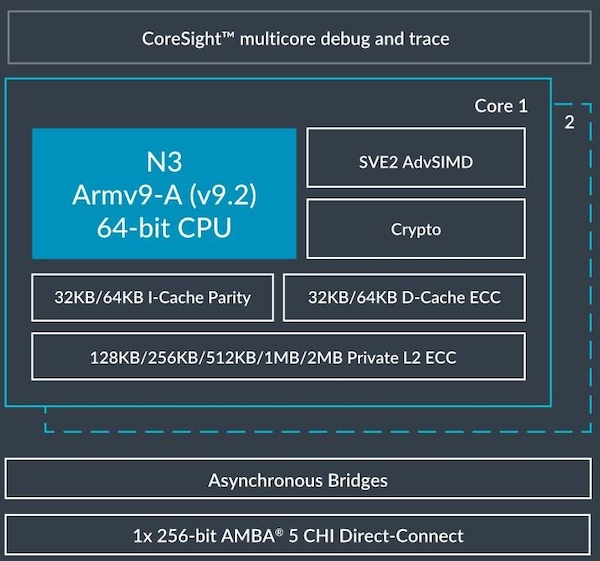
The Arm Neoverse N3 CPU.
The Neoverse CSS N3 extends Arm’s N-series CSS roadmap and focuses on maximizing performance per watt, a critical metric for energy-sensitive environments like edge computing and data centers. The N3 offers a 20% increase in performance per watt compared to the CSS N2, enabling more efficient processing and lower total cost of ownership (TCO) for infrastructure deployments. Architectural enhancements and optimizations reduce power consumption while boosting performance.
Both the CSS V3 and N3 are pivotal in Arm’s ecosystem, enabling partners to leverage pre-configured, pre-validated subsystems to accelerate the development of custom silicon solutions. This approach significantly reduces design complexity and time to market, allowing partners to focus on differentiating their products.
Arm Neoverse CSS S3 for Confidential Compute and Chiplets
As part of this launch, Arm also unveiled the Arm Neoverse CSS S3, an advancement in the infrastructure-specific system IP landscape.
This third-generation system IP is engineered to meet the diverse needs of applications spanning from high-performance computing (HPC) and machine learning to edge computing and data processing units (DPUs). The Neoverse S3 chassis is distinguished by its focus on delivering key innovations such as chiplets, confidential computing, and support for leading industry standards like UCIe, DDR5, CXL 3.1, and PCIe Gen5/Gen6.
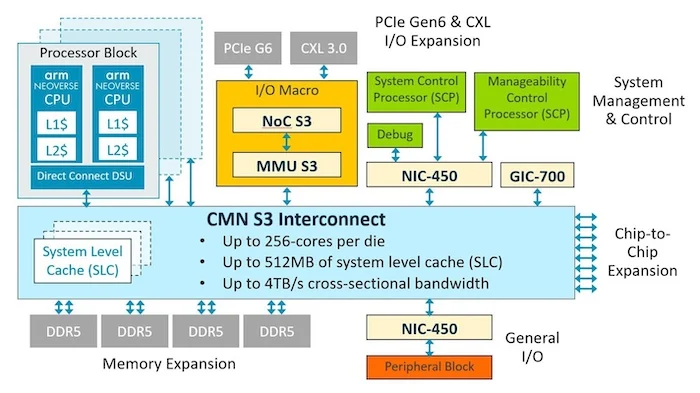
The Arm Neoverse system diagram showing the S3 chassis.
At its core, the Neoverse CSS S3 is designed to enhance composability, increase IO throughput, and bolster security. It achieves this through a suite of system IPs, including Arm RME for confidential computing. Arm RME aligns with the industry-standard DPE for “in use” data protection, ensuring that data remains secure not only when stored or in transit but also when actively being processed in memory.
Furthermore, the Neoverse S3 introduces upgraded IO and memory systems that can support the latest standards, including PCIe Gen6 and CXL 3.1, thereby ensuring high-speed data transfer and efficient memory access. This is complemented by standardized chiplet interfaces with AMBA CHI C2C over UCIe, facilitating the development of modular and efficient SoCs.
Strides for Computing
In a time where digital transformation is accelerating at an unprecedented pace, the demand for more powerful, efficient, and scalable computing infrastructure has never been higher. Enterprises are constantly on the lookout for advancements that can provide a competitive edge, improve performance, and reduce operational costs.
Arm’s Neoverse CSS V3, N3, and the S3 system IP are a significant stride forward in the company’s technology. The enhanced performance and efficiency of the Neoverse CSS V3 and N3, coupled with the composability and security features of the S3, have the potential to accelerate the pace of digital transformation across various sectors. According to Arm, Neoverse CSS is already being deployed by many large industry players, including Microsoft Cobalt.
All images used courtesy of Arm.
