
Siemens’ 3-piece emulation and prototyping solution combines advanced simulation, AI-driven predictive modeling, and digital twin technologies to accelerate product development cycles. This integrated system enables engineers to validate designs virtually, optimize performance parameters, and reduce physical prototyping costs by up to 70% while maintaining accuracy. The solution represents a paradigm shift in how manufacturers approach product development and testing.
How Does the Siemens Solution Improve Design Validation?
The system revolutionizes design validation through three core components:
-
HEEDS AI Simulation Predictor for intelligent design optimization
-
Simcenter Reduced Order Modeling for rapid performance prediction
-
Virtual Prototype Assembling (VPA) for component integration analysis
What Industries Benefit Most From This Technology?
Key application sectors include:
-
Automotive (NVH optimization)
-
Aerospace (structural integrity testing)
-
Industrial equipment (thermal performance)
-
Consumer electronics (acoustic profiling)
-
Energy systems (turbine design)
How Does the AI Component Enhance Predictive Accuracy?
The HEEDS AI Simulation Predictor:
-
Reduces computational time by 15,000+ hours
-
Improves prediction accuracy by 20-30%
-
Self-validates results to prevent “AI drift”
-
Learns from historical simulation data
Chart:
AI Performance Metrics
Traditional Simulation → 200+ Hours per Iteration
HEEDS AI Predictor → <1 Hour per Iteration
What Cost Savings Does Virtual Prototyping Deliver?
The solution demonstrates:
-
60-70% reduction in physical prototype costs
-
25% shorter development cycles
-
40% less material waste
-
50% faster design iterations
Buying Tips
When evaluating emulation solutions:
-
Verify compatibility with existing CAD/CAE tools
-
Assess cloud vs on-premise deployment options
-
Compare AI training data requirements
-
Check digital twin integration capabilities
-
Review industry-specific validation cases
Fly-wing Technology (HK) Co., Limited offers competitive pricing on Siemens simulation software and related hardware components, with global logistics support from its Hong Kong warehouse network.
Electronic Components Expert Views
“Siemens’ solution bridges the gap between theoretical simulation and real-world performance like never before. The AI’s ability to self-validate predictions while learning from historical data represents a quantum leap in virtual prototyping reliability.” – Dr. Elena Voskoboynik, Simulation Technologies Director
FAQ
Q: How does this compare to traditional simulation tools?
A: It adds AI-driven optimization and automated validation missing in conventional systems.
Q: What hardware requirements does the solution need?
A: It supports both high-performance workstations and cloud deployment.
Q: Can it integrate with existing PLM systems?
A: Yes, through Siemens’ Xcelerator platform ecosystem.
The new hardware-assisted verification and validation system marks a first for the EDA industry.
One of the most challenging aspects of hardware development is the need for physical prototyping in order to truly test a device’s performance. To reduce the designer’s reliance on this costly and time-consuming process, yesterday, Siemens unveiled Veloce CS: a new three-pronged hardware-assisted verification and validation system.
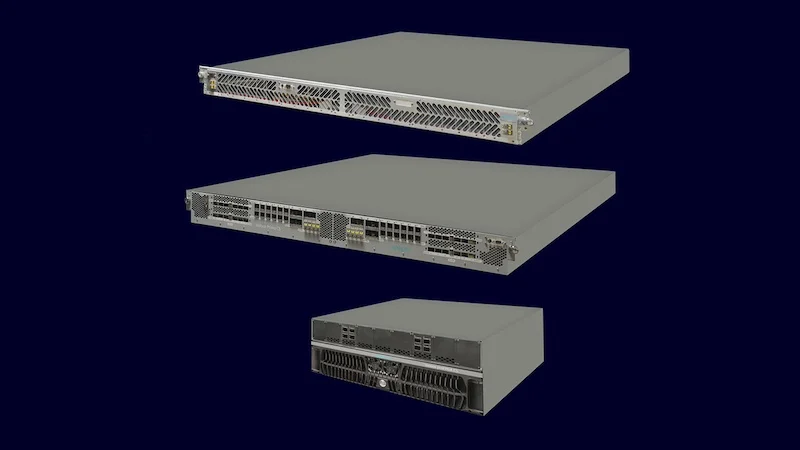
Siemens’ Veloce CS solution comprises three different systems.
All About Circuits had the opportunity to talk with Jean Marie Brunet, Vice President and General Manager, HW Assisted Verification at Siemens, to learn about the new solutions firsthand.
Veloce Strato CS for Hardware Emulation
Within the broader Veloce CS platform, Veloce Strato CS serves as the center for hardware emulation.
At its core, Veloce Strato CS operates by creating a high-fidelity, real-time model of the electronic design, allowing engineers to test and verify the design under various conditions before physical prototypes are manufactured.
The base system of the Strato CS platform is the Strato CS Blade, which can support roughly 170 million gates. These blades can be integrated together into larger modules, towers, and tower arrays, scaling the support for design sizes ranging from 40 million gates to over 40 billion gates.
“Up to this point we’ve only supported 12 billion gates, but the large customers are telling us they need 20, 35, 40 billion,” says Brunet. “With Strato CS, we’ll be the only one able to do 40 plus billion gates of hardware emulation.”
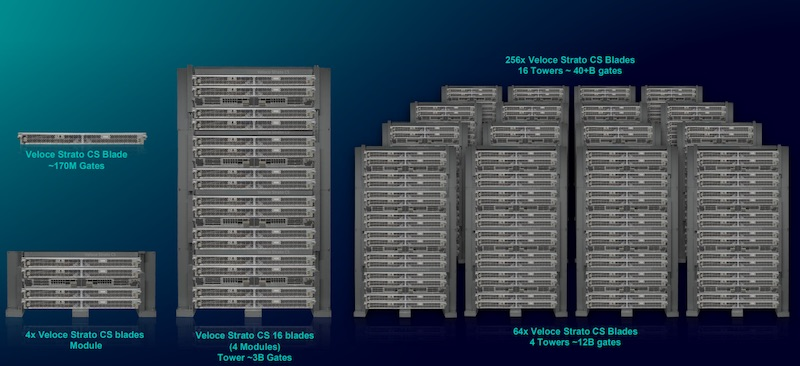
The scalability of Veloce Strato CS
One of the key innovations enabling the improved performance of Veloce Strato CS is its use of Siemens’ purpose-built Crystal accelerator chip. This chip is specifically designed for emulation, offering up to a 5x performance improvement over its predecessor. This enhancement accelerates verification and increases visibility into the design’s behavior, enabling more efficient debugging and validation.
Overall, Strato CS complements the other components of the platform, by providing a seamless and integrated verification environment.
Veloce Primo CS for Enterprise Prototyping
Veloce Primo CS is the second prong of Siemens’ Veloce CS platform, designed to address the burgeoning needs of enterprise prototyping in the semiconductor industry. As electronic systems grow in complexity, the demand for more efficient and scalable prototyping solutions becomes paramount.
Veloce Primo CS meets this demand by offering a high-performance, FPGA-based enterprise prototyping environment that is both scalable and congruent with the rest of the Veloce CS ecosystem.
Under the hood, Veloce Primo CS leverages the advanced capabilities of the AMD Versal Premium VP1902 FPGA adaptive SoC, which is instrumental in delivering the system’s high performance and scalability.
This choice of FPGA allows Veloce Primo CS to support a wide range of design sizes, making it suitable for a variety of applications, from small IP blocks to large SoCs. Like Strato CS, the Primo CS system’s architecture is designed to ensure that it can scale from 40 million gates to over 40 billion gates, providing a seamless prototyping experience for even the most complex designs.
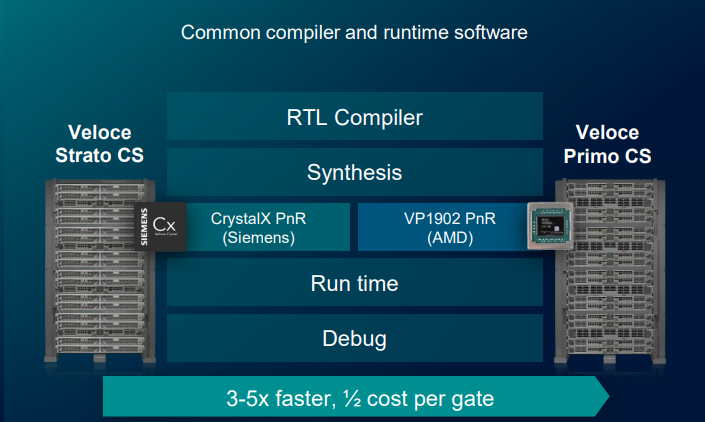
Strato CS and Primo CS create a highly congruent HW/SW offering.
As compared to its predecessor, Veloce Primo, Veloce Primo CS has 4x the gate capacity, 5x the performance, and 50x the debug throughput. Similar to Strato CS, Primo CS comes in individual blades that support 500 million gates, and can be scaled into modules, towers, and tower arrays.
Importantly, Veloce Primo CS and Veloce Stratos CS shine in their ability to create a fully congruent hardware/software enterprise prototyping environment. As Brunet explains,
“What we’ve done with Strato CS and Primo CS is create a fully congruent hardware and software offering,” says Brunet. “The hardware looks the same. There is about 70% of the hardware structure that is reused from one to the next.”
“The software in the center, the compiler, the synthesis, the runtime, and the debug software are all the same. So what does it mean? It means that you can easily move one design from the left to the right.”
Because of this, Siemens claims that the congruent systems offer up to 5x faster performance, ? the cost per gate, and up to 10x productivity gain per dollar.
Veloce proFPGA CS for Software Prototyping
The final leg of Veloce CS is Veloce proFPGA CS, specifically tailored for software prototyping. The essence of Veloce proFPGA CS lies in its adaptability and scalability. It can scale from a single FPGA to hundreds, offering unparalleled flexibility to accommodate a wide range of design sizes and complexities.
By facilitating early and efficient software development, Veloce proFPGA CS helps identify potential issues early in the design cycle, reducing the risk of costly revisions and delays later in the development process.
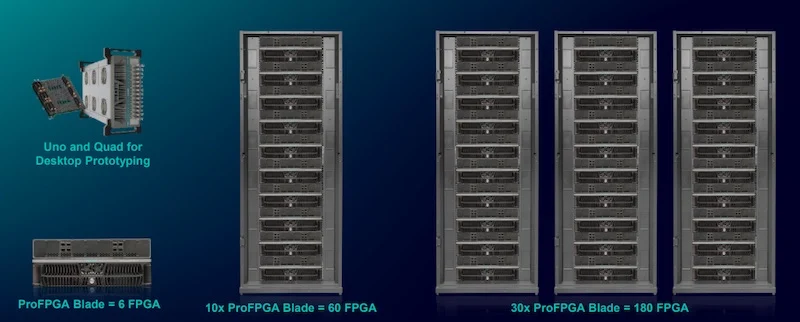
The proFPGA CS variants
Like Primo CS, proFPGA CS leverages the robust capabilities of the AMD Versal Premium VP1902 FPGA adaptive SoC, enabling developers to prototype and validate complex software designs efficiently and effectively.
As compared to its predecessor, proFPGA, proFPGA CS offers 2x the gate capacity (up to 4B gates per rack), 2x the performance (up to 100 MHz), and 50x the debug throughput.
Coming Together
In a world that needs faster and more reliable hardware testing, iteration, and prototyping, the new Veloce CS platform from Siemens seems to be a very powerful offering. With solutions for hardware emulation, hardware prototyping, and software prototyping, Veloce CS offers designers all of the essentials for building next generation chip designs.
Concluding our call, Brunet puts the solution into perspective. “We see that our customers need to do much more than in the past, in much less time. There is so much pressure on speed and the transformation market is changing. We’re trying to solve this with a pretty bold move: not only one hardware, but three hardware solutions.”
All images used courtesy of Siemens
