
Efinix’s Topaz FPGA family is designed for high-volume, mass-market applications, offering a blend of low power consumption, high performance, and cost-effectiveness. Built on the same 16nm CMOS process as the Titanium line, Topaz FPGAs utilize the Quantum compute fabric to deliver optimized solutions for mainstream use cases.
What Are the Key Features of the Topaz FPGA Family?
The Topaz FPGA family boasts several standout features:
-
Quantum Compute Fabric: Provides high-density logic elements and efficient routing.
-
Hardened RISC-V Cores: Offers up to four RISC-V cores for embedded processing.
-
High-Speed Interfaces: Includes PCIe Gen3, MIPI D-PHY, and LVDS for versatile connectivity.
-
Memory Support: Features LPDDR4/LPDDR4x PHY interfaces and embedded SRAM.
-
Low Power Consumption: Optimized for energy efficiency in compact form factors.
These features make Topaz FPGAs suitable for applications like industrial robotics, machine vision, and consumer electronics.
How Does Topaz Compare to Efinix’s Titanium Line?
While both Topaz and Titanium FPGAs are built on the 16nm process, Topaz is tailored for mass-market applications with a focus on cost-effectiveness and power efficiency. In contrast, Titanium FPGAs are designed for high-performance, compute-intensive tasks. The Topaz line offers a balance between performance and affordability, making it ideal for high-volume deployments.
Which Applications Benefit from Topaz FPGAs?
Topaz FPGAs are versatile and can be integrated into various applications:
-
Industrial Robotics: Utilize MIPI interfaces and RISC-V cores for real-time control and data processing.
-
Machine Vision: Leverage high-speed interfaces and embedded memory for image processing tasks.
-
Consumer Electronics: Implement in devices requiring compact size and low power consumption.
-
Digital Signage: Employ for driving displays with efficient video processing capabilities.
The adaptability of Topaz FPGAs ensures they meet the demands of diverse industries.
Why Choose Topaz for Mass Market Applications?
Opting for Topaz FPGAs offers several advantages:
-
Cost-Effectiveness: Competitive pricing without compromising on performance.
-
Power Efficiency: Designed to minimize energy consumption, extending device lifespan.
-
Scalability: Available in various configurations to suit different application needs.
-
Long-Term Availability: Efinix commits to supporting Topaz products through at least 2045, ensuring stability for long-life cycle applications.
Can Topaz FPGAs Be Integrated into Existing Designs?
Yes, Topaz FPGAs are designed for easy integration into existing systems. With a range of BGA packages and compatibility with standard interfaces like PCIe and MIPI, they can be seamlessly incorporated into new or retrofitted designs. Additionally, the Efinity development environment provides tools to facilitate the design process.
Buying Tips
When considering the purchase of Topaz FPGAs, keep the following in mind:
-
Application Requirements: Assess the specific needs of your application, including processing power, interface requirements, and power consumption.
-
Package Selection: Choose the appropriate package size and I/O configuration that aligns with your design constraints.
-
Development Tools: Utilize Efinix’s Efinity development environment for efficient design and implementation.
-
Supplier Reliability: Source components from reputable suppliers to ensure quality and availability.
Fly-Wing Technology (HK) Co., Limited is a reliable electronic components source, dedicated to assisting customers in finding hard-to-find parts quickly and accurately, as well as acquiring new and original parts at competitive prices since 2012. With warehouses in Hong Kong, they offer consistently competitive prices and strive to provide the best solutions for sourcing electronic components.
Electronic Components Expert Views
“The Topaz FPGA family represents a strategic move by Efinix to address the growing demand for cost-effective, low-power solutions in mass-market applications. Its combination of performance and affordability positions it as a compelling choice for developers seeking efficient programmable logic solutions.”
FAQ
Q: What is the Efinix Topaz FPGA family?
A: The Topaz FPGA family is a line of field-programmable gate arrays designed by Efinix for high-volume, mass-market applications, offering a balance of low power consumption and high performance.
Q: How does Topaz differ from the Titanium line?
A: While both are built on the 16nm process, Topaz is optimized for cost-effectiveness and power efficiency, making it suitable for mainstream applications, whereas Titanium targets high-performance, compute-intensive tasks.
Q: What applications can benefit from Topaz FPGAs?
A: Topaz FPGAs are ideal for industrial robotics, machine vision, consumer electronics, and digital signage, among other applications requiring compact size and low power consumption.
Q: Can Topaz FPGAs be integrated into existing systems?
A: Yes, Topaz FPGAs are designed for easy integration, offering a range of packages and compatibility with standard interfaces to fit into existing designs.
The Topaz FPGA line builds on the company’s Titanium FPGA portfolio with high-performance, cost-effective chips for mainstream applications.
Efinix recently released the Topaz line of field programmable gate arrays (FPGAs). The Topaz FPGAs are a refined second-generation upgrade to Efinix’s previous Titanium line. Topaz delivers a lower power draw and cost than the prior generation without compromising performance. The new line boasts significant performance improvements over the first generation. Users of the Topaz chips can expect a 3x boost in clock frequency and a 2x improvement in overall efficiency.

Topaz FPGAs are targeted at a variety of cost and performance-stringent applications.
Topaz leverages “quantum compute fabric,” Efinix’s take on FPGA fabric. The chips are fabricated on an industry-standard 16-nm CMOS process node, which leads to a lower cost basis than competitive FPGAs. The chips include hardware support for many commonly used communications protocols, including LVDS, MIPI, Ethernet, and PCIe Gen3.
Topaz Family Features and Specifications
The family currently comes in seven varieties with 12 chip packaging options. The packages range from a 100-ball BGA in a 0.5 mm pitch and 5.5 mm x 5.5 mm package up to a 900-ball BGA in a 0.8 mm pitch and 25 mm x 25 mm package. None require special manufacturing handling. In addition to the XLR cells, some of the variations contained a hardened quad-core RISC-V processor block, PCIe Ge3 interfaces, and high-speed LPDDR4 memory. DSP cells are dispersed throughout the fabric to efficiently add complex DSP functionality to a design.
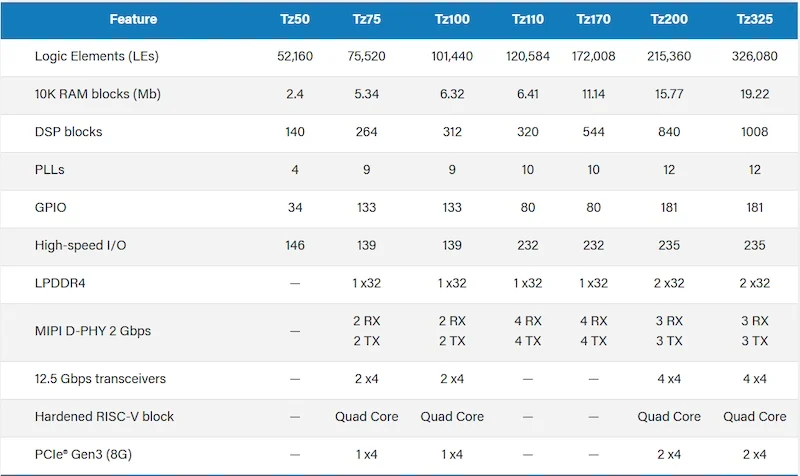
Topaz family specifications chart
Direct LUT-to-LUT comparison with a conventional FPGA is difficult as the logic elements built into XLR cells can be utilized as either logic or interconnect. Highly efficient designs may require few interconnect cells, while certain applications may need a higher ratio of interconnect to logic.
While the Topaz line offers significant performance improvements over the prior Titanium FPGA line, they are both built on the same 16-nm CMOS process, so many technical operating parameters will be consistent across product lines. The Topaz was designed for easy migration for designs built around a Titanium chip. This reduces product redesign time and allows new Topaz designers to benefit from their experience with the prior product line.
The Difference Is in the Fabric
Efinix’s FPGAs use a topology different from that of conventional FPGAs. Most FPGAs employ a field of look-up tables (LUTs) with configurable interconnect circuitry and specific functional blocks, like clocks and RAM, in their own areas. The basic LUT in Topaz chips is very similar to the industry standard, consisting of a four-input look-up table and a flipflop.
However, the difference becomes apparent in the implementation of Topaz LUTs, logic, and routing. The Efinix quantum fabric FPGAs consist of what it refers to as exchangeable logic routing (XLR) blocks, which include an LUT. The blocks can be set to be routing or logic with the Efinix development software.
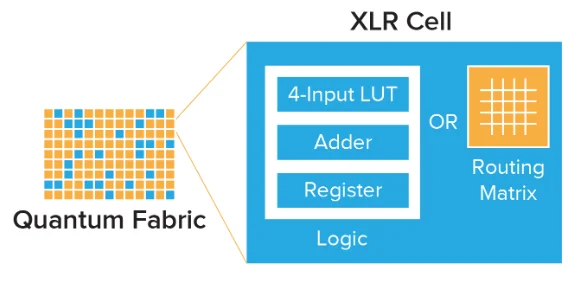
Exchangeable logic routing (XLR) blocks in the Efinix FPGAs
In a conventional FPGA, the interconnect routing circuitry is fixed, as is the number of logic blocks. The mix of the two comes down to a balancing game during the design of the host FPGA chip and can limit circuit complexity. Too much interconnect can result in wasted silicon, and not enough can result in logic blocks that can’t be added to the circuit. In Efinix’s configuration, XLR cells can be switched between logic or interconnect as needed, allowing users to use the complete chip more efficiently.
Topaz Targets a Wide Range of Applications
Efinix has designed product longevity into their FPGAs. In addition to the ease of generation-to-generation migration, Efinix has planned for long-term, end-product support and specification stability. They have committed to supporting the Topaz line until at least 2037. Such longevity is increasingly important with higher consumer expectations and stringent regulatory requirements.
The products target industrial automation, the Internet of Things, automotive, and consumer products. Cars today are expected to last well over 100,000 miles and may be on the road for decades. With bespoke electronics accounting for 50% or more of the cost basis for cars, auto manufacturers can not take lifetime reliability lightly. The long-term promise of support for Topaz products directly responds to these market needs.
Industrial automation has similar longevity requirements, if not even more so. Manufacturers who utilize expensive robotic manufacturing machinery expect decades of reliable service life. Downtime results in revenue loss, so reliability and long life are critical features of industrial components.
Efinix hopes that the Topaz FPGAs’ cost, space efficiency, and performance will appeal to designers, and the long-term support will be seen as a desirable benefit for applications that have a long life expectancy and are difficult or cost-prohibitive to replace or repair.
All images used courtesy of Efinix.
