
SiFive’s Performance P870-D processor is engineered to handle demanding AI workloads in data centers. With its high compute density and scalability, it offers a power-efficient solution for parallelizable tasks like video streaming, storage, and web appliances. This processor is poised to enhance AI-driven applications in various sectors.
What Makes the SiFive P870-D Suitable for AI Workloads?
The SiFive P870-D is designed to address the specific needs of AI workloads. Its architecture supports high levels of parallelism, making it ideal for tasks that require simultaneous processing of multiple operations. This capability ensures efficient handling of AI computations, leading to improved performance in data centers.
How Does the P870-D’s Scalability Benefit Data Centers?
Scalability is a critical factor for data centers managing large-scale AI tasks. The P870-D offers enhanced scalability, allowing data centers to expand their processing capabilities as demand grows. This flexibility ensures that infrastructure can adapt to increasing workloads without compromising performance.
Why Is Power Efficiency Important in AI Processing?
Power efficiency is crucial in AI processing to reduce operational costs and environmental impact. The P870-D’s design emphasizes power efficiency, enabling data centers to manage AI workloads effectively while minimizing energy consumption. This approach aligns with the industry’s push towards sustainable computing solutions.
Which Applications Benefit Most from the P870-D Processor?
Applications that require intensive data processing, such as video streaming, storage management, and web appliances, benefit significantly from the P870-D processor. Its architecture is tailored to handle the demands of these applications, ensuring smooth and efficient operation in data center environments.
Are There Other Processors Comparable to the P870-D?
While there are other processors designed for AI workloads, the P870-D stands out due to its combination of high compute density, scalability, and power efficiency. These features make it a compelling choice for data centers seeking to optimize their AI processing capabilities.
Buying Tips
When considering processors for AI workloads, it’s essential to evaluate factors such as compute density, scalability, power efficiency, and compatibility with existing infrastructure. SiFive’s P870-D processor offers a balanced solution that addresses these needs, making it a valuable addition to data center operations.
Electronic Components Expert Views
“The SiFive P870-D processor represents a significant advancement in AI processing for data centers. Its design focuses on parallelism and efficiency, aligning with the growing demands of AI applications.”
FAQ
Q: What is the SiFive P870-D processor?
A high-performance RISC-V processor designed for AI workloads in data centers.
Q: What applications can benefit from the P870-D?
Video streaming, storage management, and web appliances.
Q: Why is power efficiency important in AI processing?
To reduce operational costs and environmental impact.
Announced today, the new RISC-V processor is SiFive’s first foray into mainstream data center and infrastructure use cases.
Few companies have made a larger impact in the RISC-V world than SiFive. Today, the company is building its momentum with the announcement of the SiFive Performance P870-D data center processor.
The new P870-D processor complements SiFive’s Intelligence Processor family.
All About Circuits spoke to Ian Ferguson, a senior director at SiFive, to learn more about the new processor firsthand.
Architectural Innovations for Data Centers and AI
Unlike processors designed for high-end, single-threaded performance, the SiFive P870-D targets the mainstream data center market. SiFive designed the P870-D specifically for workloads that benefit from high levels of parallelism over raw single-thread performance. These workloads include video streaming, web hosting, storage, and AI inference tasks—areas that require efficiency, scalability, and cost-effectiveness.
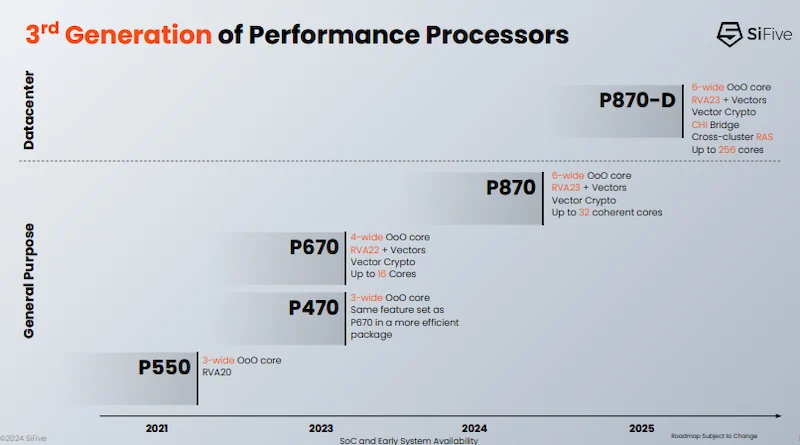
SiFive processor roadmap
“When we looked at the marketplace, people were doing whatever they could to get single-thread performance up,” Ferguson said. “But as soon as you start to do that, you get to a place where performance is going up a little, and power is going up a lot. When we looked at our decision points, it was around that volume, mainstream area of data centers where we can do a better job of optimizing power and performance.”
Key Features of the P870-D Data Center Processor
Several architectural features set the P870-D apart from other processors in the market.
First, SiFive designed the device to scale up to 256 coherent cores, a feature that aids in handling parallel processing tasks common in data centers. A distributed input-output memory management unit (IOMMU) architecture complements this scalability, enhancing the processor’s ability to manage virtualized device I/O. The distributed IOMMU allows the P870-D to eliminate bottlenecks and enhance performance to process large datasets quickly and efficiently.
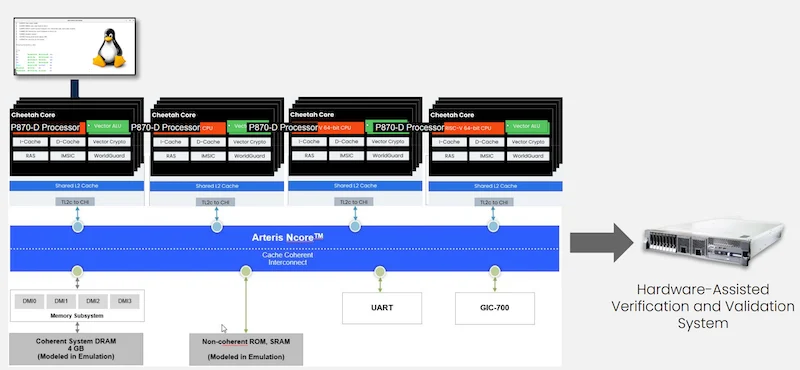
Building on a partnership with Arteris, SiFive will use the P870-D to lead RISC-V-based emulation systems with Arteris Ncore compliance.
Another major feature of the P870-D is its support for the RISC-V Sv57 extension, which provides 57-bit virtual address space support. This extension allows the processor to manage large memory spaces, making handling large-scale AI training models and other memory-intensive tasks significantly more feasible.
In addition to its memory management capabilities, the P870-D integrates advanced reliability, availability, and serviceability (RAS) features. These features detect and correct errors before they can impact system performance, allowing data centers to operate continuously without downtime.
“We’ve taken a core that we announced last year called the P870, and we’ve added RAS functionality to do error detection and correction on registers,” Ferguson said. “We’ve also increased the capability to scale to more CPU cores, so you can go up to 256 coherent cores.“
Moreover, the P870-D is designed with power efficiency in mind. SiFive has implemented various power management features, including dynamic voltage and frequency scaling (DVFS) and idle power modes, to minimize power consumption without sacrificing performance.
Advanced Protocol Support
One of the P870-D’s defining features is its comprehensive support for advanced protocols, including AMBA Coherent Hub Interface (CHI) and Compute Express Link (CXL), both of which enhance the processor’s scalability and interoperability within complex system architectures.
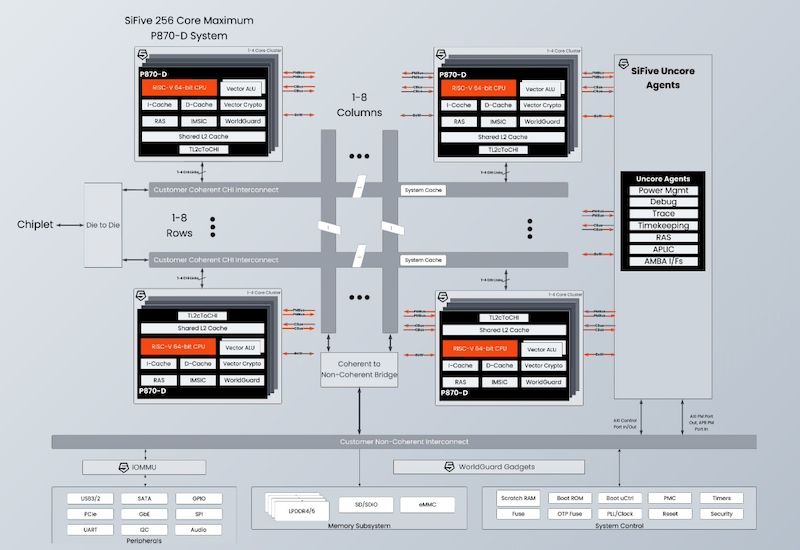
Scalable subsystems using the P870-D.
AMBA CHI is an open protocol that enables cohesive scaling of the number of clusters within a system. By supporting AMBA CHI, the P870-D enables data center architects to scale their systems up to 256 coherent cores while maintaining high data integrity and performance. This scalability handles the parallel processing demands of modern data centers, where multiple tasks must be executed simultaneously without bottlenecks. Using a standard CHI bus also means that the P870-D can easily integrate with existing systems, reducing the time and cost of developing custom interconnects.
Conversely, CXL is a protocol that facilitates coherent memory access between CPUs, accelerators, and other devices. The P870-D’s support for CXL allows users to create heterogeneous systems where different processing elements can share memory resources efficiently. This is particularly important for AI workloads, where accelerators and general-purpose CPUs must work cohesively.
A Boon for Data Centers
With the P870-D, SiFive balances performance and power over raw performance alone. The company plans to continue this path, optimizing the less glamorous but equally important corners of the market.
“I think it’s going to be a long time before you see us at the absolute leading edge of performance,” Ferguson said. “We’ll be more focused on creating innovation in segments that we feel are underserved.”
All images used courtesy of SiFive.
