
A temperature sensor is a fundamental component in modern electronics, used to measure heat and convert it into an electrical signal for monitoring and control.
It is widely used across automotive systems, industrial equipment, HVAC, IoT devices, and consumer electronics.
Temperature sensing plays a critical role in system performance and safety. From an engine coolant temperature sensor regulating engine operation to digital sensors in smart systems managing environmental conditions, accurate measurement directly impacts how systems behave.
In practice, engineers do not choose between “good” and “bad” parts. They choose between different temperature sensors based on range, accuracy, packaging, interface, and installation conditions.
However, there are multiple temperature sensor types, each with different working principles, accuracy levels, and use cases. The right one depends on the application, environment, and integration requirements.
In this guide, we’ll briefly explain how temperature sensors work, compare key types, and provide practical guidance on selecting the right sensor for your system.
What Is a Temperature Sensor?
A temperature sensor is a device that detects temperature and converts it into an electrical signal such as resistance, voltage, current, or digital data.
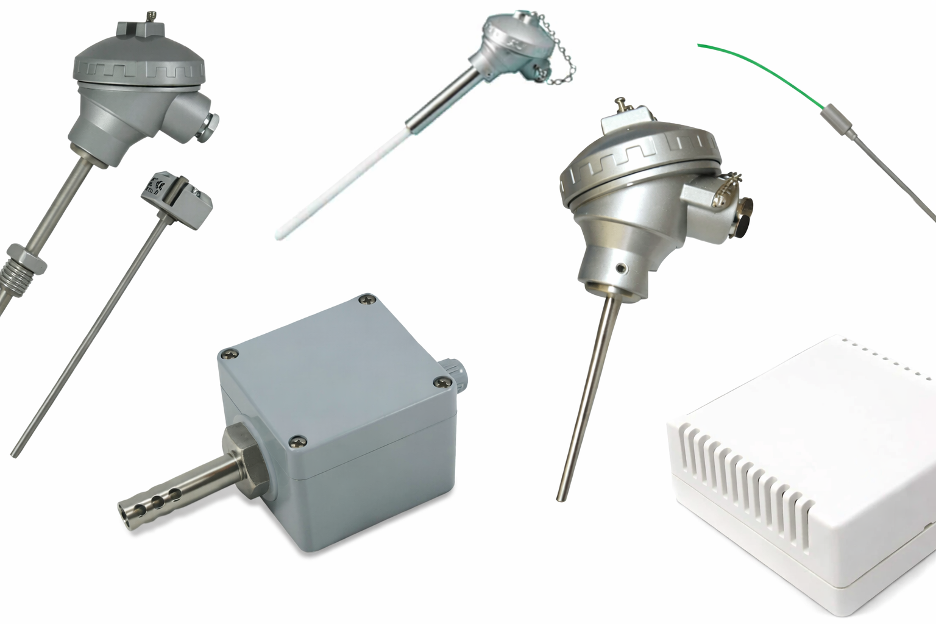
That output is then interpreted by a control system, ADC, microcontroller, PLC, or software platform.
In simple circuits, this may be a direct reading. In more advanced systems, it becomes part of a larger decision loop used for automation, alarms, efficiency control, or thermal protection.
That is why two designs using the same sensor can still perform very differently. A high-quality sensor paired with poor wiring, weak thermal contact, or noisy analog circuitry can still produce bad results.
Temperature sensors are commonly grouped into contact and non-contact types. Contact sensors must touch the measured medium or surface, while non-contact sensors estimate temperature by detecting emitted infrared energy.
Both approaches are valid, but each serves different applications and carries different trade-offs.
That is why temperature sensors must be evaluated not only by datasheet values, but also by how they behave in the actual system.
How Does a Temperature Sensor Work?
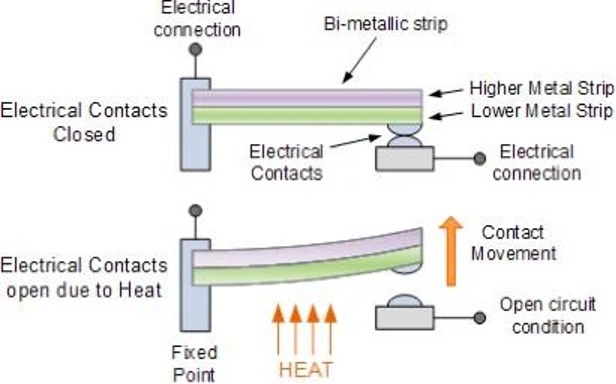
The simplest answer to how does a temperature sensor work is that temperature changes a physical property, and the sensor converts that change into a readable electrical output.
Different sensor families rely on different physical effects, but the end goal is always the same: convert heat into useful data.
Resistance Change
Thermistors and Resistance Temperature Detectors (RTDs) work by changing resistance as temperature changes. In thermistors, the resistance shift is relatively large, which makes them highly sensitive.
In RTDs, especially platinum RTDs, the resistance changes in a more stable and repeatable way over a broad range. This is why engineers favour RTDs for higher-accuracy industrial measurement.
Voltage Generation
Thermocouples use the Seebeck effect. When two dissimilar metals form a junction and experience a temperature difference, they generate a small voltage.
That voltage can be converted into temperature, which makes thermocouples especially useful in wide-range and high-temperature environments.
Their big strength is range and toughness rather than top-end precision in moderate conditions.
Semiconductor-Based Sensing
Semiconductor sensors use predictable changes in junction behavior to produce either analog or digital temperature data.
Devices like the DS18B20 integrate sensing, conversion, and communication in one package.
For instance, the DS18B20 measures from -55°C to +125°C, provides ±0.5°C accuracy from -10°C to +85°C, and communicates over 1-Wire, which allows multiple sensors to share one bus.
Infrared Radiation Detection
Infrared sensors estimate temperature without touching the target. The MLX90614, for example, is an infrared thermometer device for non-contact measurement.
This is useful when the object is moving, inaccessible, sterile, or too hot for physical contact. The trade-off is that emissivity, target size, alignment, and surface characteristics can all affect the reading.
Sensor → Signal → ADC → System
A good sensing element can still give poor results if the reference, ADC, filtering, or thermal mounting is weak.
A useful temperature measurement system does more than sense heat. It follows a chain: sensor → signal → ADC → system.
A thermistor usually needs a measurement circuit and ADC. An RTD needs excitation and error control.
A thermocouple often needs amplification and compensation. A digital temperature sensor handles much of that internally and sends processed data directly to the controller.
This is why sensor choice and signal-chain design should treat together, not as separate decisions.

Temperature Sensor Types
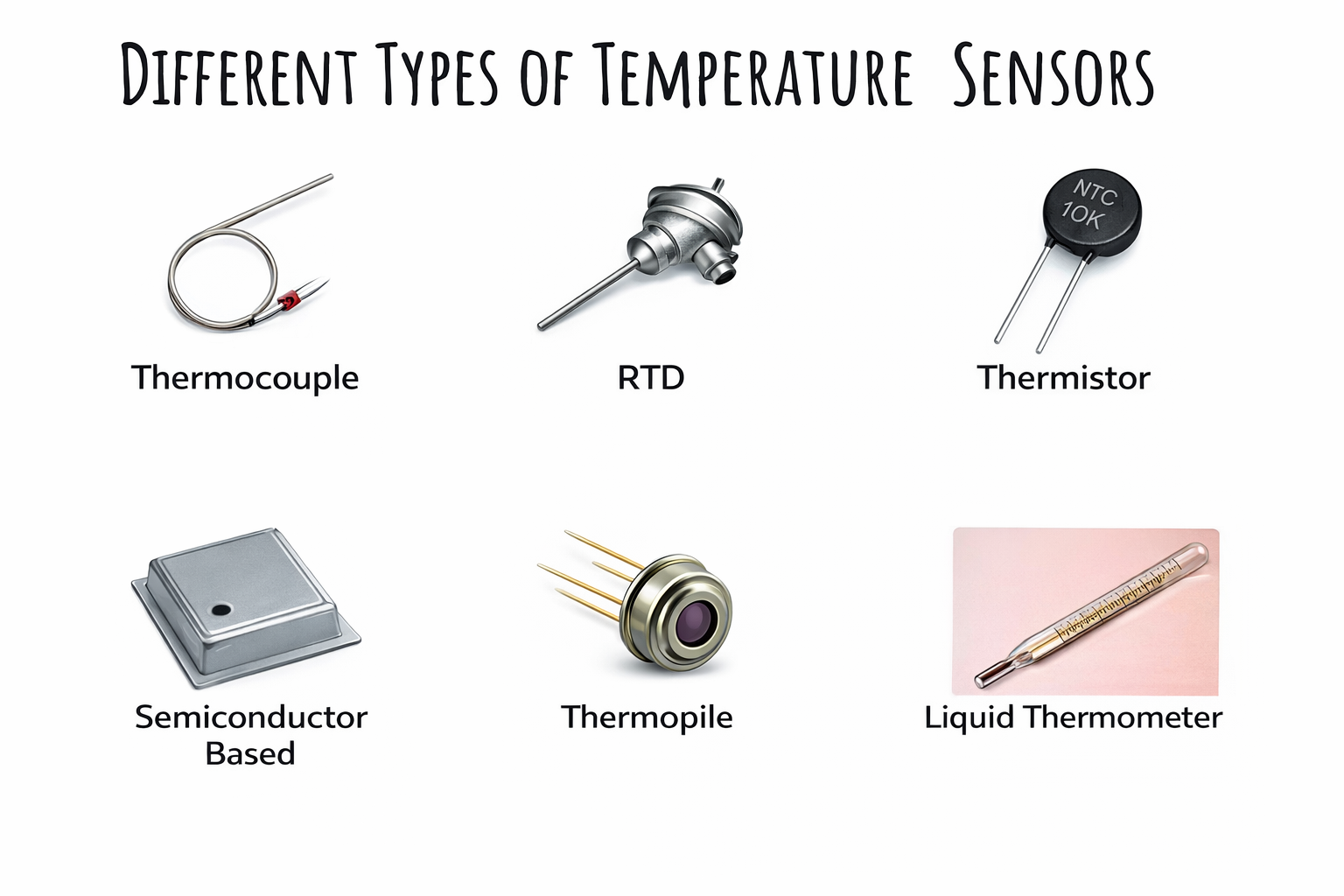
Understanding temperature sensor types is essential because no single type is best for every design.
Thermistors
Thermistors are among the most common contact temperature sensors. They are inexpensive, compact, and very sensitive to temperature change.
The most widely used measurement type is the NTC thermistor, where resistance falls as temperature rises.
PTC thermistors behave the opposite way and we use it for protection or switching-related functions rather than mainstream temperature measurement.
Flywing Tech’s catalog reflects this split with NTC and PTC product listings in separate families.
One reason thermistors are so popular is packaging flexibility. That matters because packaging influences thermal response, mechanical fit, environmental exposure, and assembly method.
Thermistors are widely used in battery systems, HVAC controls, chargers, consumer electronics, and thermal protection circuits because they offer strong sensitivity and low cost.
Their main limitation is nonlinearity, so they often need calibration tables or software compensation when we required high accuracy over a broader span.
RTD Sensors
RTDs are often the better fit when accuracy must remain stable over time, not just at initial calibration.
RTD sensors, especially platinum RTDs are widely used where accuracy, repeatability, and long-term stability matter more than minimum cost.
The trade-off is that RTDs demand more careful circuit design. Lead resistance, excitation method, reference stability, ADC resolution, and self-heating all influence the final result.
That is why 3-wire and 4-wire RTD configurations are common in industrial measurement systems.
RTDs are a strong fit for industrial control, lab systems, HVAC monitoring, environmental chambers, and any application where stable temperature data matters over time.
Thermocouples
Thermocouples are usually chosen when the expected temperature would push thermistors, RTDs, or many digital IC sensors outside their comfortable operating range.
They are common in furnaces, kilns, exhaust systems, and industrial heating processes.
Their output is small, so readout circuitry has to handle low-level voltages and reference-junction compensation carefully.
They are not usually the first choice for highest moderate-range accuracy, but they are often the most practical option when the application would exceed the comfort zone of thermistors, RTDs, or most digital IC sensors.
Digital Temperature Sensors
A digital temperature sensor is often the easiest choice for Arduino, ESP32, and IoT projects because it reduces analog design complexity.
A digital temperature sensor combines the sensing element with internal conversion and an interface such as 1-Wire, I²C, or SPI.
This reduces analog design effort and simplifies integration with microcontrollers, especially in IoT and embedded systems.
Infrared Temperature Sensors
Infrared temperature sensors measure emitted radiation instead of relying on contact. They are useful for surface measurement, moving targets, sterile environments, or any design where contact is impractical.
Their biggest design challenge is not the sensor itself but the measurement context. Surface emissivity, reflections, target size, angle, and field of view all shape accuracy.
In practice, IR sensors work best when we know surface emissivity, distance, and target size.
Temperature Sensor Comparison Table
This table shows why there is no single best temperature sensor for every application. The right choice depends on temperature sensor range, required accuracy, installation style, and system constraints.
| Sensor Type | Typical Accuracy | Typical Range | Cost Level | Best Fit |
| NTC thermistor | High in a narrow band | Low to medium | Low | Batteries, HVAC, consumer electronics |
| PTC thermistor | Lower as a precision sensor; often used for protection | Narrow to moderate | Low | Protection, compensation, switching-related use |
| RTD | Very high | Medium to wide | Higher | Industrial control, lab systems, precise monitoring |
| Thermocouple | Moderate | Very wide | Medium | Furnaces, exhaust, high-heat processes |
| Digital temperature sensor | Medium to high | Low to medium | Low to medium | Arduino, ESP32, IoT, distributed sensing |
| Infrared sensor | Moderate, setup-dependent | Surface-dependent | Medium | Non-contact surface temperature measurement |
This comparison is directional rather than absolute. Exact performance depends on part number, package, calibration method, wiring, and installation.
But as a buying framework, it helps show why the “best” sensor is always application-specific.
Key Performance Factors
Choosing a sensor only by category is not enough. The better decision comes from understanding the performance factors that actually shape system behavior.
Accuracy
Temperature sensor accuracy means how close the reading is to the true temperature.
RTDs are often favored where high accuracy matters, while precision digital ICs can also perform very well in moderate ranges.
Thermistors can be highly accurate over a limited span, but often require calibration or compensation. Thermocouples are generally for range and ruggedness than for top-end moderate-range precision.
Response Time
Response time describes how quickly a sensor reacts to a change. Smaller thermistors can respond quickly because they have low thermal mass.
Probe housings, encapsulation, airflow, mounting pressure, immersion depth, and thermal interface all influence real response. A good sensor in a poor package can still react slowly.
Stability
Stability matters in long-term monitoring. RTDs are valued for long-term repeatability, while digital sensors benefit from internal calibration and consistent digital output.
Thermistors may drift more in harsher environments or if material stress becomes an issue over time.
Sensitivity
Sensitivity is the amount of output change produced by a temperature change. Thermistors are very sensitive, which helps detect small local changes.
RTDs are more linear and predictable. Thermocouples cover wider temperature spans, but their small output voltages demand careful signal handling.
Evaluating temperature sensor accuracy, response time, stability, and sensitivity together gives a more realistic picture of temperature sensor range and overall system suitability.
In practice, a sensor that looks ideal on paper may still underperform if wiring, shielding, mounting, or thermal contact are weak.
How to Choose the Right Temperature Sensor
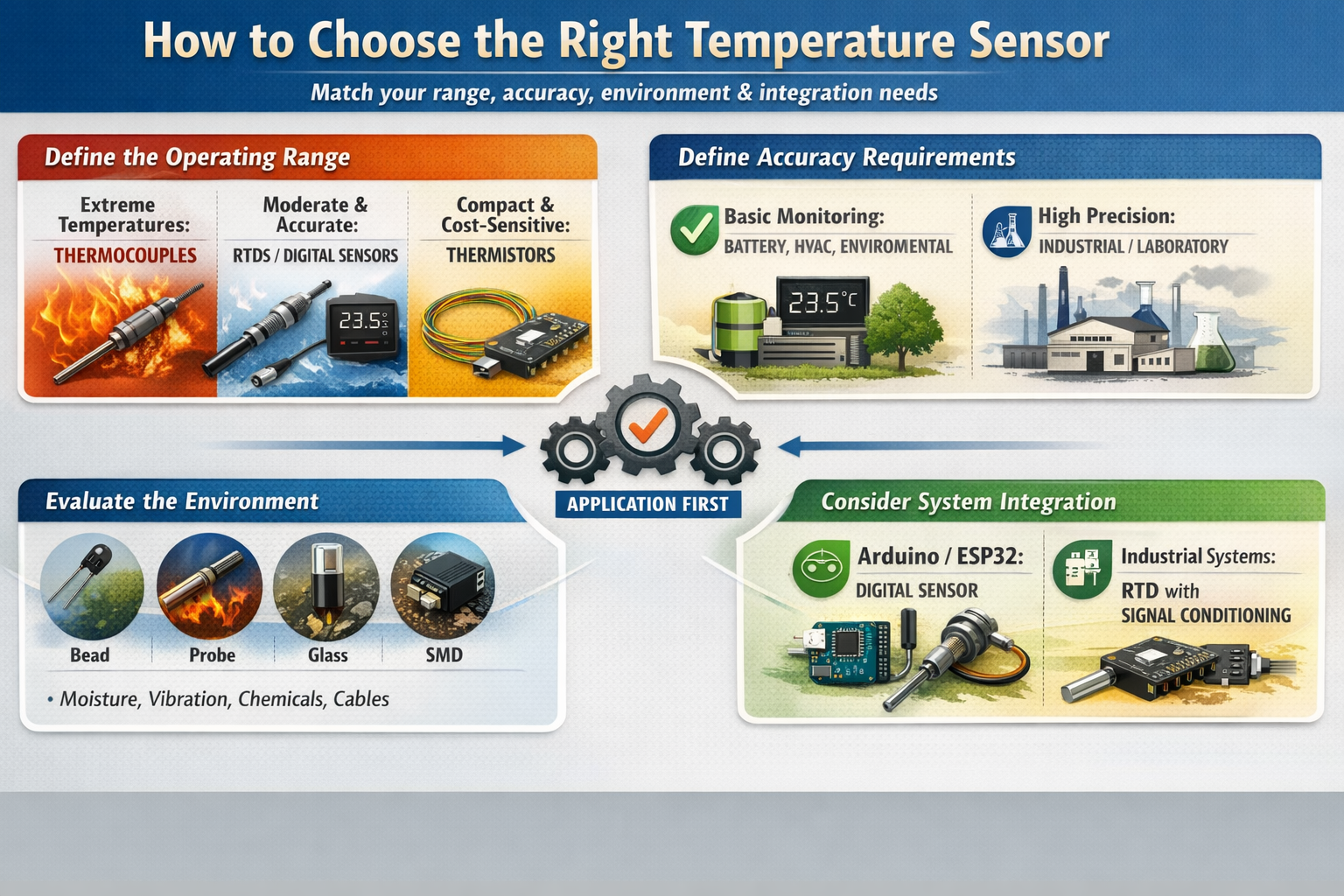
The best temperature sensor is the one that matches your range, accuracy needs, environment, and integration method without adding unnecessary complexity.
If you are asking which temperature sensor should you use, start with the application rather than the part number.
Define the Operating Range
Begin by identifying the temperature range your system must handle.
- If temperatures are extreme, thermocouples are usually the most practical choice
- If the range is moderate and accuracy matters, use RTDs or high-quality digital sensors
- If the design is compact and cost-sensitive, thermistors often make the most sense
The operating range immediately narrows down your options and prevents overcomplicating the design.
Define Accuracy Requirements
Next, determine how much accuracy your application actually needs.
A battery pack monitor, HVAC node, or general environmental sensor does not require the same level of precision as industrial process control or laboratory measurement.
- Avoid overdesigning accuracy if it does not add value
- Avoid underdesigning if the measurement affects safety or control decisions
The goal is to balance performance with cost and complexity.
Evaluate the Environment
Environmental conditions have a major impact on sensor performance.
Factors such as moisture, vibration, chemicals, airflow, cable length, and mechanical constraints should be in consideration.
This is where sensor form factor becomes critical.
Consider System Integration
Finally, consider how the sensor will integrate into your system.
- For Arduino or ESP32-based designs, a digital temperature sensor like DS18B20 simplifies integration and reduces analog design effort
- For industrial systems requiring high accuracy, RTDs with proper signal conditioning provide better long-term performance
Integration affects everything from circuit complexity to scalability, so we should consider it early in the design process.
Real-World Selection Examples
- For an engine coolant temperature sensor, thermistor-based designs are common because they balance sensitivity, compactness, and cost.
- For smart thermostats or Nest-style room sensing, sensor placement and stability matter as much as raw specification.
- For Arduino or ESP32 projects, a digital temperature sensor such as DS18B20 often simplifies design and scaling.
Temperature Sensor Applications
Temperature sensors are used across a wide range of industries, each with different requirements for accuracy, durability, response time, and integration.
Understanding where and how these sensors are applied helps in selecting the right type for real-world systems.
Different applications prioritize different things, which is why the same temperature sensor type is not ideal everywhere.
Automotive Systems
Automotive designs rely on temperature sensing for control, protection, and efficiency.
An engine coolant temperature sensor helps regulate engine operation, while an intake air temperature sensor supports air-density-related control decisions.
These sensors must operate reliably under vibration, high temperatures, and exposure to fluids, which makes packaging and connector reliability critical.
Industrial Systems
Industrial applications prioritize repeatability, uptime, and stable measurement systems.
RTDs are commonly used where accuracy and long-term stability are required, while thermocouples dominate higher-temperature processes such as furnaces and manufacturing lines.
In these environments, the sensor is only one part of the system. Reference quality, input circuitry, wiring resistance, and shielding all influence overall measurement accuracy.
Consumer Electronics
In consumer electronics, the focus is on compact size, low cost, and ease of integration.
Thermistors and IC-based temperature sensors are widely used in chargers, power supplies, laptops, smartphones, and battery systems.
These sensors help manage thermal performance, prevent overheating, and improve device reliability.
IoT and Smart Homes
In smart thermostats and Nest-style room-sensing systems, multiple measurement points can matter more than relying on a single sensor mounted at the controller.
IoT applications prioritize scalability, connectivity, and simple integration with microcontrollers.
Digital temperature sensors suit these systems because they provide direct digital output and reduce circuit complexity.
How to Test and Replace a Temperature Sensor
Knowing how to test a temperature sensor and replace it when needed is important for both design validation and real-world troubleshooting.
The goal is to confirm that the sensor responds correctly to temperature changes and that the overall system is functioning as expected.
In general, testing involves applying known temperature variations and observing whether the sensor output changes smoothly, predictably, and within expected limits.
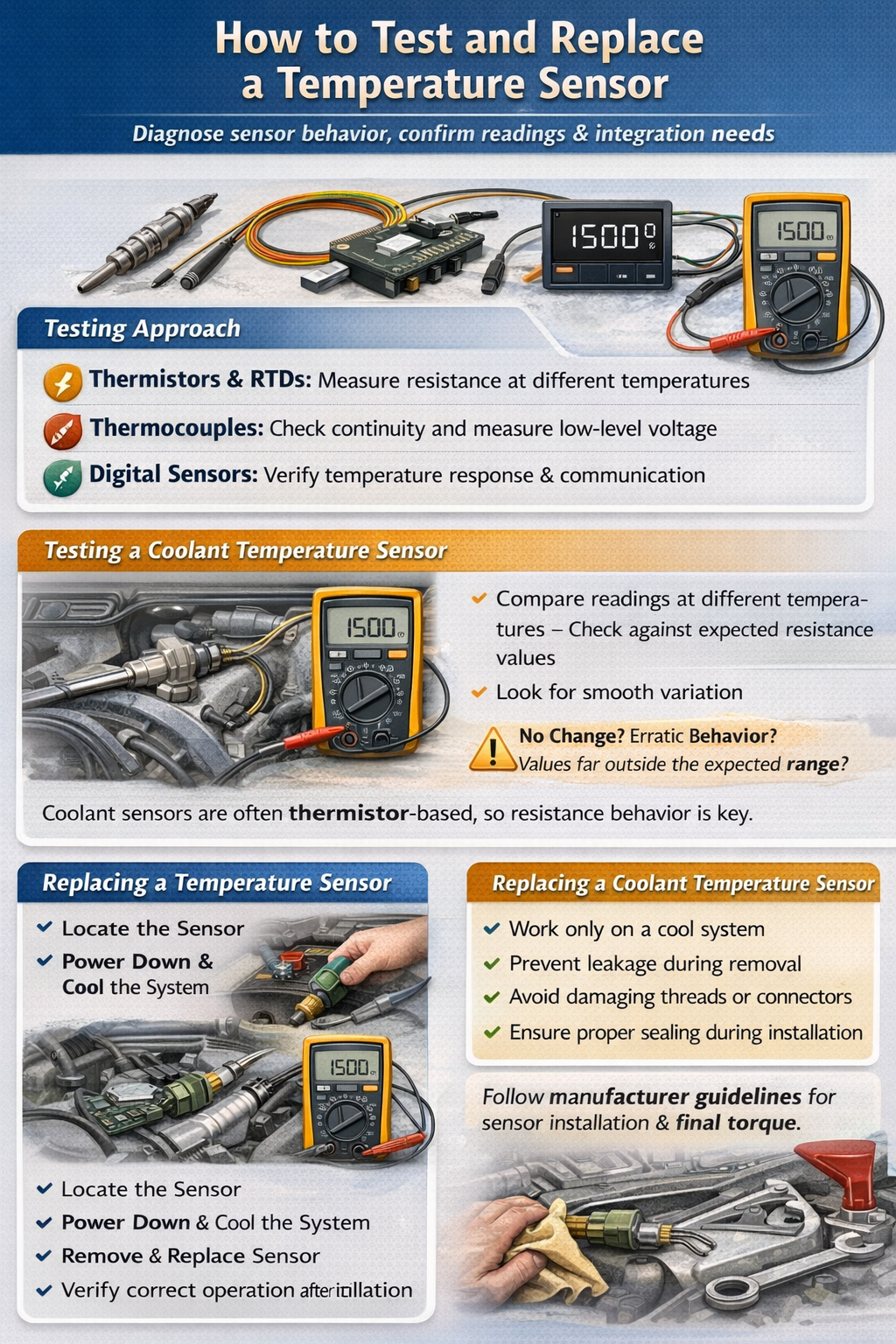
Testing Approach
The testing method depends on the sensor type:
- Thermistors and RTDs: Measure resistance at different temperatures. The change should be continuous and follow expected behavior
- Thermocouples: Check continuity and measure low-level voltage output under temperature differences
- Digital temperature sensors: Verify both temperature response and communication (I²C, SPI, or 1-Wire), since communication faults can appear as sensor issues
Testing a Coolant Temperature Sensor
To test a coolant temperature sensor, disconnect it safely and measure resistance across its terminals.
- Compare readings at different temperatures
- Check against expected resistance values
- Look for smooth variation
If the sensor shows no change, erratic behavior, or values outside the expected range, it is likely faulty. Since most coolant sensors are thermistor-based, resistance behavior is the primary indicator.
Replacing a Temperature Sensor
Understanding how to replace a temperature sensor is especially useful in maintenance and automotive applications.
The general process includes:
- Locate the sensor
- Power down or allow the system to cool
- Remove the sensor carefully
- Install the new sensor securely
- Verify correct operation after installation
Replacing a Coolant Temperature Sensor
For how to replace coolant temperature sensor or how to replace engine coolant temperature sensor, additional care is required:
- Work only on a cool system
- Prevent leakage during removal
- Avoid damaging threads or connectors
- Ensure proper sealing during installation
- Verify readings and check for leaks after replacement
The manufacturer guidelines always guide proper installation because exact procedures may vary depending on the vehicle or system.
Final Thoughts
Temperature sensors are foundational to modern electronic and industrial systems, but selecting the right one requires more than just comparing specifications. It involves understanding how different sensor types behave, how they integrate into a system, and how environmental and design factors influence real-world performance.
Thermistors remain ideal for compact and cost-sensitive applications. Users prefer RTDs where accuracy and long-term stability are critical.
Thermocouples handle extreme temperature ranges, while digital temperature sensors simplify embedded and IoT integration. Infrared sensors extend measurement capabilities to non-contact environments.
More importantly, reliable temperature measurement depends on the complete system—not just the sensing element. Signal conditioning, wiring, connectors, packaging, and mounting all play a role in determining final accuracy and stability.
For engineers and buyers, this is where working with a component supplier becomes valuable.
Flywing Tech offers a broad catalog that includes NTC thermistors, PTC thermistors, and digital temperature sensors such as DS18B20, along with multiple form factors like bead, probe, and SMD devices.
This allows you to select not only the right sensor type but also the right physical configuration for your application.
FAQs
What is a temperature sensor?
A temperature sensor is a device that detects temperature and converts it into an electrical signal such as resistance, voltage, or digital data, which can then be processed by a system for monitoring or control.
How does a temperature sensor work?
A temperature sensor works by using a physical property that changes with temperature. This can include resistance change (thermistors, RTDs), voltage generation (thermocouples), semiconductor behavior (IC sensors), or infrared radiation detection (non-contact sensors).
What is an engine coolant temperature sensor?
An engine coolant temperature sensor is used in automotive systems to monitor engine temperature. It provides data to the engine control unit (ECU) to optimize fuel injection, ignition timing, and cooling system operation.
What are the different types of temperature sensors?
The main types of temperature sensors include thermistors, RTDs, thermocouples, digital temperature sensors, and infrared sensors. Each type differs in accuracy, temperature range, response time, and application suitability.
What is the difference between RTD and thermistor?
RTDs offer higher accuracy and stability over a wide temperature range, while thermistors are more sensitive and cost-effective but work best within a limited range. Thermistors are commonly used in consumer electronics, while RTDs are preferred in industrial applications.
What is the difference between thermocouple and RTD?
Thermocouples are suitable for very high temperatures and harsh environments, while RTDs provide higher accuracy and stability in moderate temperature ranges. Thermocouples generate voltage, whereas RTDs rely on resistance change.
Which temperature sensor is best for Arduino?
A digital temperature sensor like DS18B20 is one of the best options for Arduino because it provides direct digital output, requires minimal external components, and supports multiple sensors on a single data line
Which temperature sensor is best for industrial use?
RTDs and thermocouples are commonly used in industrial environments. RTDs are preferred for high accuracy and stability, while thermocouples are used for high-temperature applications such as furnaces and manufacturing processes.
What is the working range of temperature sensors?
The temperature sensor range depends on the type:
- Thermistors: typically -50°C to 150°C
- RTDs: around -200°C to 600°C
- Thermocouples: up to 1800°C depending on type
- Digital sensors: usually -55°C to 125°C
Can temperature sensors fail?
Yes, temperature sensors can fail due to:
- Electrical damage
- Environmental stress (heat, moisture, vibration)
- Aging and drift
- Wiring or connection issues
Regular testing helps identify problems early.


COMMENTS