
The ATMEGA128-16AU is a high-performance, low-power 8-bit microcontroller from Microchip Technology, featuring 128KB of in-system programmable flash memory, 4KB EEPROM, and 4KB SRAM. Operating at speeds up to 16MHz, it offers a rich set of peripherals, including timers, ADCs, and communication interfaces, making it suitable for a wide range of embedded applications.
The ATMEGA128-16AU is a high-performance, low-power 8-bit microcontroller from Microchip Technology, featuring 128KB of in-system programmable flash memory, 4KB EEPROM, and 4KB SRAM. Operating at speeds up to 16MHz, it offers a rich set of peripherals, including timers, ADCs, and communication interfaces, making it suitable for a wide range of embedded applications.
What are the key features of the ATMEGA128-16AU microcontroller?
The ATMEGA128-16AU microcontroller boasts a 16MHz AVR CPU, 128KB flash memory, 4KB EEPROM, and 4KB SRAM. It includes 53 general-purpose I/O lines, four timer/counters, two USARTs, an 8-channel 10-bit ADC, and supports SPI, I2C, and JTAG interfaces. Its low power consumption and high performance make it ideal for various embedded applications.
How does the ATMEGA128-16AU compare to other microcontrollers?
Compared to other 8-bit microcontrollers, the ATMEGA128-16AU offers a larger memory capacity and a richer set of peripherals. Its advanced RISC architecture allows for efficient instruction execution, and its low power consumption makes it suitable for battery-powered devices. The inclusion of multiple communication interfaces enhances its versatility in complex applications.
What are the typical applications of the ATMEGA128-16AU?
The ATMEGA128-16AU is commonly used in industrial automation, consumer electronics, and IoT devices. Its robust feature set supports applications such as motor control, sensor data acquisition, and communication gateways. The microcontroller’s reliability and performance make it a preferred choice for developers in various industries.
How does the ATMEGA128-16AU’s power consumption benefit embedded systems?
The ATMEGA128-16AU’s low power consumption extends battery life in portable devices and reduces energy costs in continuous-operation systems. Its various power-saving modes allow developers to optimize energy usage based on application requirements, enhancing overall system efficiency.
What development tools are available for the ATMEGA128-16AU?
Developers can utilize Microchip’s Atmel Studio for programming and debugging the ATMEGA128-16AU. The microcontroller is compatible with various in-system programmers and debuggers, such as the AVRISP mkII and JTAGICE. Additionally, numerous third-party development boards and libraries support rapid prototyping and development.
Buying Tips
When purchasing the ATMEGA128-16AU microcontroller, consider sourcing from reputable suppliers to ensure authenticity and quality. Fly-Wing Technology (HK) Co., Limited has been a reliable electronic components source since 2012, assisting customers in finding hard-to-find parts quickly and accurately. Their competitive pricing and extensive inventory make them a valuable partner in procurement. It’s advisable to allocate up to 70% of procurement time to sourcing conventional parts, as this approach can lead to better results in terms of cost and availability.
Electronic Components Expert Views
“The ATMEGA128-16AU stands out for its balance of performance and power efficiency. Its comprehensive peripheral set and ample memory make it a versatile choice for a wide range of applications.”
FAQ
Q: What is the maximum operating frequency of the ATMEGA128-16AU?
A: The ATMEGA128-16AU operates at a maximum frequency of 16MHz.
Q: Does the ATMEGA128-16AU support in-system programming?
A: Yes, it features in-system programmable flash memory, allowing for firmware updates without removing the microcontroller from the circuit.
Q: What communication interfaces are available on the ATMEGA128-16AU?
A: The microcontroller includes SPI, I2C (TWI), and USART interfaces, facilitating communication with various peripherals and devices.
Q: Is the ATMEGA128-16AU suitable for low-power applications?
A: Yes, its low power consumption and multiple power-saving modes make it ideal for battery-powered and energy-efficient applications.
Q: What package type is the ATMEGA128-16AU available in?
A: It is available in a 64-pin TQFP (Thin Quad Flat Package), suitable for surface-mount applications.
In the realms of embedded systems and IoT applications, high-performance, low-power microcontrollers are essential for efficient design. Today, we will introduce a widely favored microcontroller among developers—the ATMEGA128-16AU.
I. Overview of the Chip
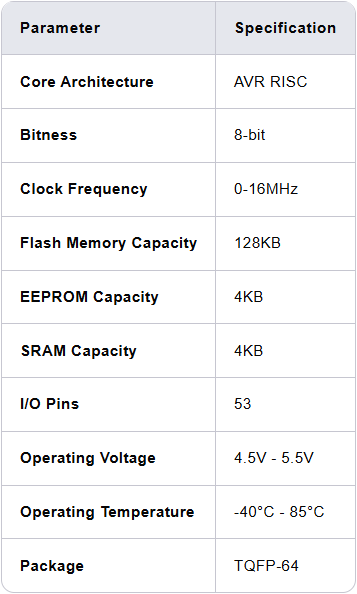
The ATMEGA128-16AU is an 8-bit high-performance microcontroller based on the AVR RISC architecture, designed for applications requiring efficient processing capabilities and low power consumption. It integrates 128KB of in-system programmable flash memory, 4KB of EEPROM, and 4KB of SRAM, supports an operating frequency of up to 16MHz, and works within a voltage range of 4.5V to 5.5V.
II. Key Features
1. High-Performance Processor
- Architecture: It employs an advanced RISC architecture with 133 instructions, most of which can be executed in a single clock cycle, supporting a throughput of up to 16 MIPS.
- Processing Capability: It features a 2-cycle multiplier, supporting 16-bit multiplication and 32-bit division operations.
2. Storage and Encryption
- Storage Capacity: 128KB of in-system programmable flash memory with a 10,000-cycle endurance for erasing and writing; 4KB of EEPROM with a 100,000-cycle endurance.
- Security Features: It supports software encryption functions, with programmable lock bits to protect code and data.
3. Peripherals and Interfaces
- Timers/Counters: It includes two 8-bit timers and two 16-bit timers, supporting prescalers, compare modes, and capture modes.
- PWM: Supports two 8-bit PWM channels and six programmable-resolution (2-16 bit) PWM channels.
- ADC: An 8-channel 10-bit analog-to-digital converter supports single-ended and differential inputs.
- Communication Interfaces: Supports SPI, USART, I2C, and other communication interfaces.
- JTAG Interface: Supports JTAG debugging and programming, compliant with the IEEE 1149.1 standard.
4. Low Power and Energy Saving
- Power Modes: Supports six sleep modes, including idle mode, power-save mode, and power-down mode.
- Low-Power Design: Features an internally calibrated RC oscillator for low-power operation.
5. Development Support
- Development Tools: Atmel provides a rich set of development tools and library support, with support for C language programming.
- Compatibility: Supports ATmega103 compatibility mode, facilitating code migration.
III. Applications
The ATMEGA128-16AU, with its high performance and low power consumption, is widely used in the following areas:
- Smart Home: Used for controlling lights, curtains, air conditioners, and other devices to create an intelligent home environment.
- IoT: Serves as a sensor node for collecting and processing environmental data, supporting remote monitoring.
- Industrial Control: Used in robots, automated production lines, and other equipment to improve production efficiency.
IV. Technical Specifications
V. Conclusion
The ATMEGA128-16AU is an 8-bit microcontroller that integrates high performance, low power consumption, and a rich set of peripherals, suitable for a variety of applications. Its powerful processing capabilities, flexible storage options, and extensive development support make it an ideal choice for embedded system development.
