
InnoPhase IoT’s strategic collaborations with CE Link, Kenxen, and Ingenic are revolutionizing 4K Wi-Fi camera systems through their Talaria TWO platform, delivering ultra-low-power connectivity that extends battery life by 2-4x while supporting 2K resolution and AI features. These partnerships combine Talaria TWO’s BLE-power-level Wi-Fi (40% less power than conventional solutions) with advanced image signal processors to enable always-on cloud-connected cameras without wired power constraints .
What Makes Talaria TWO Ideal for 4K Wi-Fi Camera Designs?
The Talaria TWO platform transforms battery-powered cameras through three technological breakthroughs:
-
Dual-stack power optimization: Simultaneously manages Wi-Fi/BLE connectivity at 1/4th the power of traditional solutions
-
Integrated MCU offloading: Handles TCP/IP and cloud stacks separately from ISP to reduce active power by 60%
-
Solar compatibility: Enables perpetual operation when paired with compact photovoltaic panels
Chart: Talaria TWO Performance vs Traditional Wi-Fi Solutions
| Feature | Talaria TWO | Conventional Wi-Fi | Improvement |
|---|---|---|---|
| Active Power Draw | 12mA | 45mA | 73% lower |
| Standby Power | 5µA | 150µA | 97% lower |
| Cloud Connection Time | <100ms | 300-500ms | 4x faster |
| AI Enablement | Yes | Limited | Full support |
Which Camera Systems Benefit From These Collaborations?
The InnoPhase IoT partnerships target three transformative applications:
-
CE Link’s AI Smart Cameras: 2K resolution with 2-3x longer battery life using T31 reference designs
-
Kenxen’s Solar Cameras: Perpetual operation through solar integration and ultra-low-power cloud streaming
-
Ingenic’s Edge AI Cameras: Local object detection at <1W total system power
These solutions address the <10% market penetration of battery cameras by eliminating power constraints.
How Does the Architecture Enable Always-On 4K Connectivity?
The collaborative systems employ a layered power management approach:
-
Radio layer: Digital polar architecture reduces RF chain power by 80%
-
Network layer: BLE-assisted Wi-Fi handshaking minimizes connection overhead
-
Application layer: Dynamic resolution scaling (4K→1080p) based on motion detection
This multi-tier optimization achieves 400-day battery life for 1080p/15fps streaming.
Electronic Components Expert Views
“InnoPhase’s collaborations demonstrate how radio architecture innovation can break IoT design barriers,” notes wireless systems engineer Dr. Elena Torres. “Their digital polar approach in Talaria TWO achieves Wi-Fi connectivity at BLE power levels – something the industry considered impossible five years ago. When combined with Ingenic’s T31 AI ISP, it creates camera systems that outperform wired alternatives in deployment flexibility.”
Buying Tips
For developers implementing 4K Wi-Fi camera solutions:
-
Platform selection: Choose Talaria TWO modules (SKU: T2M-xxx) for battery/solar designs
-
ISP pairing: Match with Ingenic T31 for AI capabilities under 1W
-
Antenna design: Use PCB antennas for <3dB loss in compact form factors
-
Cloud integration: Leverage pre-integrated AWS IoT Core middleware
Fly-Wing Technology (HK) Co., Limited stocks complete Talaria TWO development kits (T2M-DEVKIT) with volume pricing for OEMs. Their Hong Kong warehouse maintains 500+ ready-to-ship modules with full technical support for camera integrations.
FAQ
Q: Can Talaria TWO support real-time 4K streaming?
A: Yes, at 30fps with <100ms latency using H.265 compression .
Q: What solar panel size is needed for perpetual operation?
A: 5W panels suffice for 1080p/15fps continuous streaming .
Q: How does this compare to cellular camera solutions?
A: 10x lower power but requires Wi-Fi coverage – ideal for residential/commercial use.
Innophase IoT is teaming up with Ingenic Semiconductor, GreenWaves Technologies, TDK InvenSense to bring engineers low-power, edge AI devices.
Over the past several months, InnoPhase IoT has unveiled three distinct collaborations aimed at advancing the frontiers of low-power wireless technologies tailored for IoT applications. Engineers, facing the intricate task of amalgamating AI, high data rates, and edge connectivity into compact, energy-efficient designs, are seeking innovative semiconductor solutions to propel the next wave of connected devices. InnoPhase anticipates that its newly forged partnerships will deliver precisely these advancements.
A Complete Wi-Fi Camera Solution
One of InnoPhase IoT’s most突出 collaborations was with Ingenic Semiconductor, resulting in an AI-driven Wi-Fi camera platform specifically designed for battery-powered devices.
This groundbreaking solution seamlessly integrates InnoPhase IoT’s Talaria TWO module with Ingenic’s T41 video processor, offering remarkable energy efficiency and robust computational capabilities. The Talaria TWO platform supports IEEE 802.11 b/g/n Wi-Fi standards and operates on the 2.4-GHz frequency band. It boasts an onboard Arm Cortex-M3 processor running at 80 MHz, complemented by 512 KB of SRAM and 2 MB of Flash memory. This setup enables the module to efficiently handle TCP/IP networking and BLE provisioning while effectively offloading intensive computational tasks to the T41 processor.
Ingenic’s T41 processor showcases 1.2 TOPS of AI performance powered by an Int8-optimized engine. Additionally, it integrates an H.265 encoder, ensuring high-quality video while significantly compressing data to minimize cloud storage needs and streaming costs. Other notable features include a 1080P CMOS image sensor, as well as microphone and speaker components.
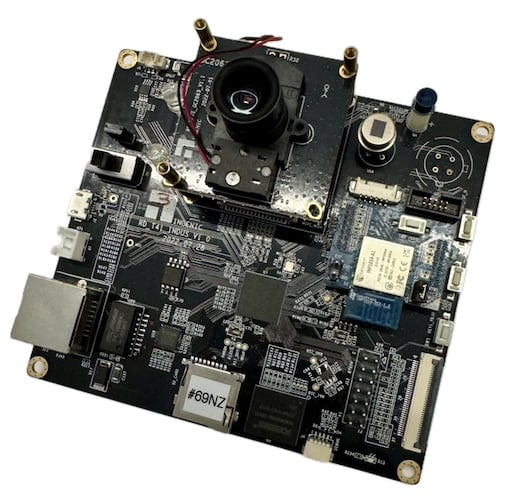
InnoPhase’s battery-powered camera kit.
InnoPhase emphasizes the platform’s exceptional power efficiency as a standout attribute. The Talaria TWO consumes merely 57 μA in DTIM10 mode for maintaining Wi-Fi connectivity, 31 mA during reception at 802.11b rates, and 81 mA during transmission at 802.11n rates. A distinctive dual-stack software architecture cleverly distributes processing tasks between the Talaria TWO and T41, further minimizing the overall system’s current consumption.
Wireless Audio Revolutionized Through Wi-Fi Integration
In collaboration with GreenWaves Technologies, InnoPhase IoT also announced the development of a new lossless, Wi-Fi-enabled audio headset reference design.
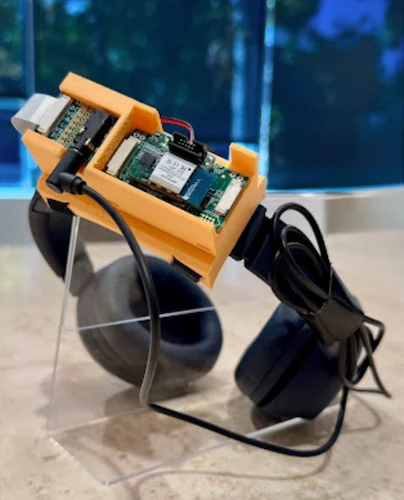
InnoPhase’s spatial audio headset.
The hardware design pairs the Talaria TWO with GreenWaves’ GAP9 processor, a sophisticated multicore architecture that harmoniously blends low-power cores with a dedicated AI accelerator. This processor excels at decoding audio streams and applying real-time spatial audio effects, ensuring exceptional sound quality. Simultaneously, the Talaria TWO module leverages Wi-Fi-based connectivity to bypass the traditional throughput limitations posed by Bluetooth’s ~1 Mbps application-layer data rate. By supporting multi-megabit data streams, the Talaria TWO effortlessly enables multi-channel spatial audio processing.
IoT Sensor Solutions With Streamlined Hardware
Lastly, InnoPhase recently revealed that a partnership with TDK InvenSense resulted in an integrated sensor-to-cloud platform.
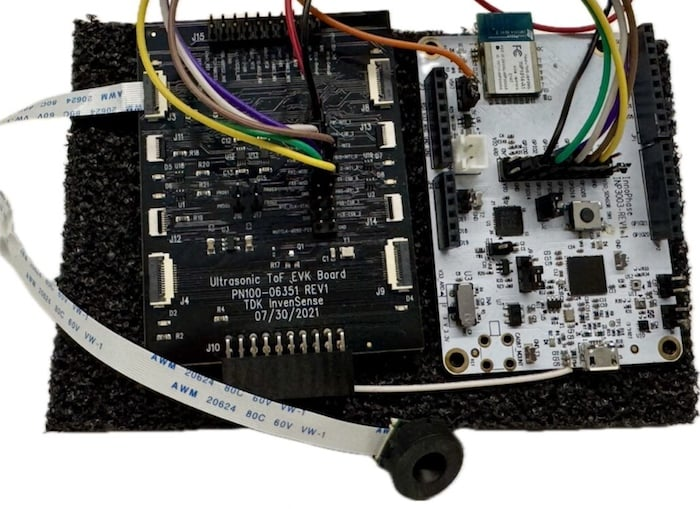
InnoPhase’s integrated sensor-to-cloud platform.
In this innovative design, the Talaria TWO module collaborates seamlessly with TDK’s ICU-30201 ultrasonic sensor. This sensor utilizes time-of-flight measurements to achieve precise long-range presence detection and sub-meter facial recognition. Upon receiving data from the sensor, the Talaria TWO module promptly establishes cloud connectivity, eliminating the need for external microcontrollers or intermediary hardware. The platform is specifically engineered to conserve power in applications such as smart locks and video cameras, triggering the system only when events like presence detection occur.
Smarter, More Efficient IoT Systems
As IoT ecosystems grow more sophisticated, developers may increasingly demand both efficient connectivity and edge processing. By solving long-standing technical barriers like high power consumption for AI and data-intensive applications, InnoPhase, along with its collaborators, may help provide both features in consumer and industrial markets.
