
Open up a car key fob, fitness tracker, or compact medical device, and you’ll likely find a CR1620 battery powering it.
This CR1620 battery may be small, but it has earned a reputation as a preferred choice in electronics that demand long-lasting, dependable energy.
The reason is simple: the CR1620 combines durability, a stable 3-volt output, and compact size, making it ideal for devices where reliability matters and space is limited.
Today, CR1620 coin cells power over 10 billion wearable and remote-control devices worldwide, underscoring their ubiquity in key fobs, fitness trackers, medical sensors, and countless other gadgets.
Backing this growth, the global coin cell battery market was valued at USD 4.89 billion in 2024 and is projected to grow at a 6.3% CAGR through 2034.
In this guide, we’ll explore everything you need to know about the CR1620 battery, including its technical specifications, performance profile, and typical applications.
We’ll also cover the many equivalent models and replacements available and share real-world case studies that highlight why choosing the right supplier makes all the difference.
What Is a CR1620 Battery?
The CR1620 battery is a compact, non-rechargeable lithium coin cell designed to deliver dependable power in small electronic devices.

The name provides a quick breakdown of its dimensions: “CR” stands for lithium manganese dioxide (Li–MnO₂) chemistry, while the numbers indicate its size — 16.0 mm in diameter and 2.0 mm in thickness.
This slim profile makes the CR1620 a go-to choice for applications where space is limited but reliable voltage is critical.
| Model | Diameter | Thickness | Voltage | Capacity | Common Use |
|---|---|---|---|---|---|
| CR1616 | 16 mm | 1.6 mm | 3 V | 55 mAh | Small watches |
| CR1620 | 16 mm | 2.0 mm | 3 V | 75–81 mAh | Key fobs, trackers |
| CR1632 | 16 mm | 3.2 mm | 3 V | 130 mAh | Car remotes |
CR1620 Battery Technical Specifications
The CR1620 battery may look simple on the surface, but every specification is carefully engineered to balance compactness, reliability, and long-term stability.
The following table summarizes key CR1620 battery specifications, including voltage, capacity, chemistry, and size. Engineers and buyers can use these values when selecting or cross-referencing equivalent models.
| Parameter | Typical Range / Value | Notes |
| Chemistry | Lithium Manganese Dioxide (Li–MnO₂) | Proven, stable, primary lithium chemistry (non-rechargeable). |
| Nominal Voltage | 3.0 V | Starts at ~3.2 V open-circuit, stabilizes at 3.0 V under load. |
| Capacity | ~75–81 mAh | Panasonic cells ~75 mAh; Energizer datasheet lists up to 81 mAh. |
| Dimensions | 16.0 mm (diameter) × 2.0 mm (height) | The “1620” designation reflects size: 16 mm × 2.0 mm. |
| Weight | ~1.2–1.3 g | Lightweight, ideal for wearables and compact devices. |
| Internal Resistance | Low (varies with brand and state of charge) | Enables pulse currents for remotes and RF devices. |
| Operating Temperature | –30 °C to +60 °C (some rated up to +70–85 °C) | Reliable across winter and summer extremes. |
| Self-Discharge Rate | ~1–2% per year | Retains >90% charge after 5 years in storage. |
| Shelf Life | 7–10 years | Excellent for long-term stocking or emergency use. |
| ANSI / IEC Designation | 5009LC / CR1620 | Internationally recognized standard. |
| Typical Applications | Key fobs, wearables, medical devices, calculators, memory backup | Low-drain devices with occasional pulse loads. |
Chemistry & Voltage Profile
The CR1620 battery uses lithium manganese dioxide (Li–MnO₂) chemistry — the same proven formulation found in popular coin cells like the CR2032 and CR2450.
This chemistry provides a stable 3.0 V nominal output and excellent long-term reliability across most of the discharge cycle.
When new, the cell typically measures about 3.2 V open-circuit. Once placed under load, it quickly stabilizes near 3.0 V, maintaining that level through nearly all of its service life.
Only near depletion does the voltage drop sharply below 2.5 V, the usual cutoff point for most devices.
This flat discharge plateau ensures dependable voltage regulation in precision electronics such as timekeeping modules, medical sensors, and key fobs.
Capacity, Size & Weight
Depending on the manufacturer, a CR1620 coin cell delivers 75 – 81 mAh of capacity.
-
Panasonic rates its CR1620 at 75 mAh.
-
Energizer lists up to 81 mAh.
While that’s modest compared to larger cells like the CR2450 (~620 mAh), it’s optimized for compact, low-drain devices where space and weight efficiency matter most.
The model number itself describes its size — 16.0 mm diameter × 2.0 mm thickness — and it weighs only 1.2 – 1.3 g.
This ultra-slim form factor enables use in wearables, medical instruments, and miniature remote controls.
Performance, Shelf Life & Operating Conditions
Built for versatility, the CR1620 operates reliably in a wide range of environments: –30 °C to +60 °C, with premium variants rated as high as +70 °C to +85 °C.
At low temperatures, internal resistance rises slightly and effective capacity dips, but brand-name cells (Panasonic, Murata, Energizer) still perform well in automotive key fobs and RF devices during winter.
A major advantage of this chemistry is its ultra-low self-discharge rate which is typically 1–2 % per year.
Even after five years in storage, a CR1620 retains over 90 % of its original capacity, giving it a practical shelf life of 7–10 years.
This makes it ideal for both consumer electronics and industrial applications where long-term reliability is critical.
Internal Resistance & Pulse Performance
Although designed for low-drain use, the CR1620’s low internal resistance allows it to deliver short, high-current pulses, such as the bursts needed by RF transmitters or remote-control key fobs.
For instance, it can supply pulse currents in the 6–10 mA range without significant voltage drop, ensuring consistent signal transmission even after years of use.
However, devices drawing continuous currents above 15 mA will quickly exhaust the cell, so the CR1620 is best suited to intermittent-load applications.

Performance & Discharge Characteristics
The performance of a CR1620 battery depends not only on its compact size and 75–81 mAh capacity but also on how steadily it maintains voltage under different loads and environments.
Below is a breakdown of the main performance factors:
Voltage Behavior Under Load
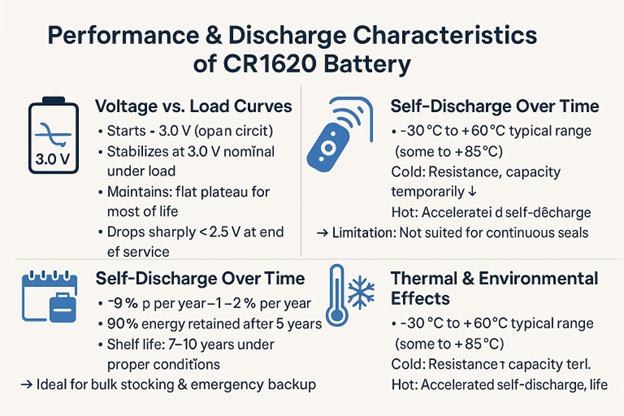
A fresh CR1620 coin cell typically measures ≈ 3.2 V open-circuit. Once placed under load, it stabilizes near 3.0 V and maintains this level for the majority of its life.
This steady output creates the flat discharge plateau visible in manufacturer graphs — a hallmark of lithium-manganese-dioxide chemistry.
Only near the end of its cycle does voltage fall quickly below 2.5 V, signaling depletion and the need for replacement.
Such consistency is why the CR1620 is trusted in timekeeping circuits, medical sensors, and key fobs, where voltage stability is critical.
Pulse Load & Burst Performance
Despite its size, the CR1620 can deliver short high-current bursts when a device transmits a signal — for instance, a car remote, RFID tag, or Bluetooth tracker.
These pulses may draw tens of milliamps for a few milliseconds, yet the cell’s low internal resistance prevents significant voltage sag.
-
Performs reliably for intermittent RF bursts and remote activations
-
Typical pulse current capability: 6–10 mA without major drop
-
Continuous loads above 15 mA will shorten runtime considerably
This pulse behavior is the main reason CR1620 cells remain the standard for remote-control and access-system batteries.
Self-Discharge & Shelf Life
The CR1620 battery offers an exceptionally low self-discharge rate of around 1–2 % per year at room temperature.
Even after five years, it retains over 90 % of its original capacity, supporting a 7–10 year shelf life — ideal for devices that remain unused for long periods or for bulk storage in commercial settings.
Temperature & Environmental Effects
The CR1620 operates reliably across –30 °C to +60 °C, with high-grade variants tested up to +85 °C.
Performance shifts slightly with environment:
| Condition | Effect | Notes |
|---|---|---|
| Cold (< 0 °C) | Higher internal resistance, temporary capacity drop | Still functions in key fobs and sensors |
| Heat (> 60 °C) | Faster self-discharge, shorter life | Avoid prolonged exposure |
| High humidity | Seal degradation risk | Store in dry conditions (5–25 °C) |
When stored properly, the CR1620 maintains its rated performance for nearly a decade, making it dependable for industrial, medical, and consumer applications alike.
Applications and Use Cases
The CR 1620 battery has become a standard choice in modern electronics where small size, stable voltage, and long life are critical. Its balance of compact form and dependable performance makes it suitable for a wide spectrum of applications.

Automobile Key Fobs and Remote Entry Systems
One of the most visible uses of the CR 1620 battery is in automotive keyless-entry fobs.
Car manufacturers such as Honda, Lexus, and Toyota design their remote entry systems around CR1620 cells, leveraging their ability to last several years while still delivering strong bursts of current for RF transmissions.
A typical car key fob remains in standby mode most of the time but requires instant power when unlocking doors or activating alarms.
Therefore, the CR1620’s low self-discharge rate ensures that even if you use your fob only occasionally, the battery won’t run flat prematurely.
A Honda CR-V key fob is rated to function for up to 3–4 years on a single CR1620 battery, even in mixed climates where winter temperatures can drop well below freezing.
Automotive service centers often recommend CR1620 replacements specifically because of their predictable discharge profile and durability in cold conditions.
Watches, Wearable Electronics, and Medical Sensors
Compact gadgets such as digital watches, pedometers, heart-rate monitors, and fitness trackers rely on coin cells that can deliver stable voltage over years of intermittent use.
The CR1620 battery’s slim 2.0 mm height makes it perfect for wearable form factors, while its 70–80 mAh capacity ensures extended runtimes without frequent replacements.
Medical devices such as glucometers, blood-pressure monitors, and electronic thermometers also use CR1620 batteries.
In these contexts, reliability is non-negotiable: a sudden voltage drop could disrupt readings or data storage.
The long shelf life of up to 10 years ensures these devices remain operational even when kept in storage for extended periods.
Memory Backup and RTC (Real-Time Clock) Support
Many electronic devices include a real-time clock (RTC) or small memory modules that require continuous low-current power to preserve settings.
CR1620 batteries are commonly used as backup power sources in motherboards, data loggers, and portable instruments.
Thanks to their stable voltage curve, CR1620s maintain system clocks and memory without interruption, even after years of standby.
Remote Controls, Portable Devices, and LED Gadgets
Beyond automotive use, the CR 1620 battery is also found in TV/DVD remote controls, RFID keycards, handheld calculators, and miniature LED flashlights or toys.
These devices typically draw very little current but must remain reliable on demand.
The CR1620’s ability to handle short pulse loads without significant voltage drop makes it ideal for such applications.
For example, a handheld RFID keycard might draw microamps in standby but requires a sharp current burst to transmit when scanned.
CR1620 batteries meet these demands while keeping the device compact and lightweight.
When substituting or sourcing a CR1620 battery, you’ll often see multiple alternative designations and rechargeable variants.
But not every “equivalent” is truly interchangeable. Let’s dive deeper into what works, what doesn’t, and under what conditions.
Common Equivalent Labels & Cross-References
Many brands and standards bodies use alternate labels for the same 3.0 V, 16 mm × 2.0 mm coin cell. These equivalents are usually safe substitutions, provided you check capacity, performance, and authenticity. Lets talk about each equivalents:
| Label | Who uses it / Context | Chemistry family | Notes |
| CR1620 | Generic IEC designation (used by many brands) | Li-MnO₂ (primary) | The standard name; 3.0 V nominal, 16 × 2.0 mm. |
| DL1620 | Duracell code | Li-MnO₂ (primary) | Duracell’s branding for CR1620; same size/voltage. |
| ECR1620 | Energizer code (also seen as “CR1620”) | Li-MnO₂ (primary) | Energizer’s datasheets often list “ECR1620”; fully cross-compatible. |
| BR1620 | Panasonic “BR” series and some others | Li-(CF)_n (primary) | Same size/voltage; BR chemistry favors long life & heat stability but has lower pulse capability vs CR. Check device requirements. |
| 5009LC (a.k.a. 5009, NEDA/ANSI) | Standards cross-reference | – | Standards code that points to CR1620 form/voltage. |
| GP CR1620 / GPCR1620 | GP Batteries product code | Li-MnO₂ (primary) | Brand-specific SKU for a standard CR1620. |
| KCR1620, 280-208, L08 | Occasional vendor codes | Li-MnO₂ (primary) | Less common labels seen in cross-reference lists; verify datasheet but typically point to CR1620 size/voltage. |
Some part numbers look close but aren’t compatible:
- CR1616: Same diameter, thinner (1.6 mm) → unreliable contact, lower capacity.
- CR1632: Same diameter, thicker (3.2 mm) → usually won’t fit; can stress the holder.
- CR2016 / CR2025 / CR2032: Different diameter (20 mm) → not compatible with 16 mm holders.
- Unbranded “1620” with vague specs: May deviate in chemistry or have high leakage/poor pulse response.
Case Study: Comparing CR2450 vs CR1620 Batteries
Although both the CR2450 and CR1620 are lithium manganese dioxide (Li–MnO₂) coin cells with a 3.0 V nominal voltage, they serve very different applications due to differences in capacity, size, discharge behavior, and internal resistance.
Understanding their strengths helps manufacturers, engineers, and consumers choose the right cell for their devices.
| Feature | CR2450 | CR1620 |
| Nominal Voltage | 3.0 V | 3.0 V |
| Typical Capacity | ~620 mAh | ~81 mAh |
| Dimensions | 24.5 mm diameter × 5.0 mm height | 16.0 mm diameter × 2.0 mm height |
| Weight | ~6.8 g | ~1.3 g |
| Typical Drain (Continuous) | 0.39 mA @ 2.9 V | 0.06 mA @ 2.9 V |
| Pulse Drain | 9.0 mA @ 2.7 V (300 Ω) | 6.5 mA @ 2.6 V (400 Ω) |
| Operating Temp | –30 °C to +60 °C | –30 °C to +60 °C |
| Self-Discharge | ~1% / year | ~1% / year |
| Energy Density | 183 mWh/g | 164 mWh/g |
Discharge Characteristics
CR2450 (High-Capacity Cell)
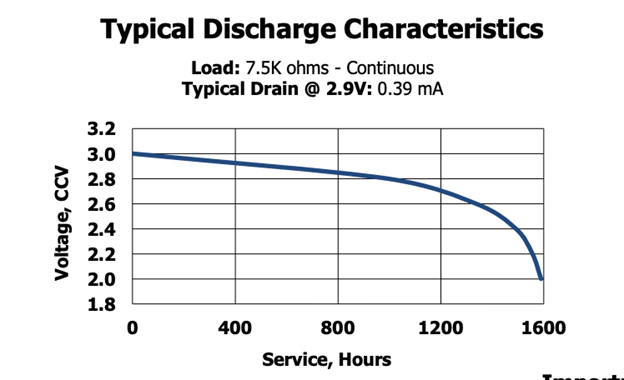
- At a continuous load of 7.5 kΩ (0.39 mA), the CR2450 delivers ~1,590 hours of service before hitting the 2.0 V cutoff.
- Its discharge curve remains very flat around 3.0 V for most of its life, only dipping sharply at the end.
- This makes it ideal for medium-drain devices (e.g., digital cameras, LED beacons, smart sensors) that require long runtimes and larger current bursts.
CR1620 (Compact Cell)
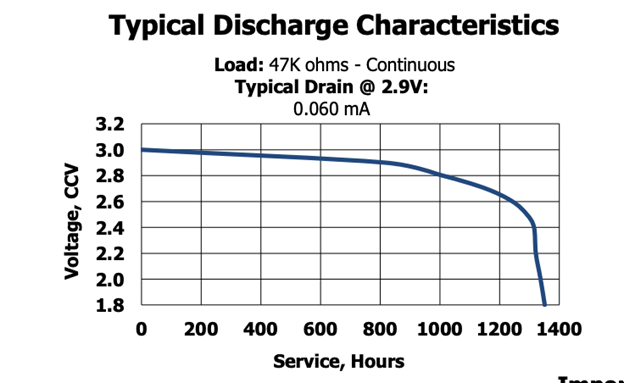
- At a continuous load of 47 kΩ (0.06 mA), the CR1620 delivers ~1,337 hours before cutoff.
- Despite its much lower capacity, the CR1620 exhibits a similar flat discharge plateau, ensuring stable voltage in low-drain devices.
- Best suited for small electronics like watches, key fobs, and medical instruments, where space-saving is critical.
The CR2450 provides nearly 8x the capacity of the CR1620, but the smaller cell matches it in voltage stability within its load range.
Internal Resistance & Pulse Behavior
CR2450
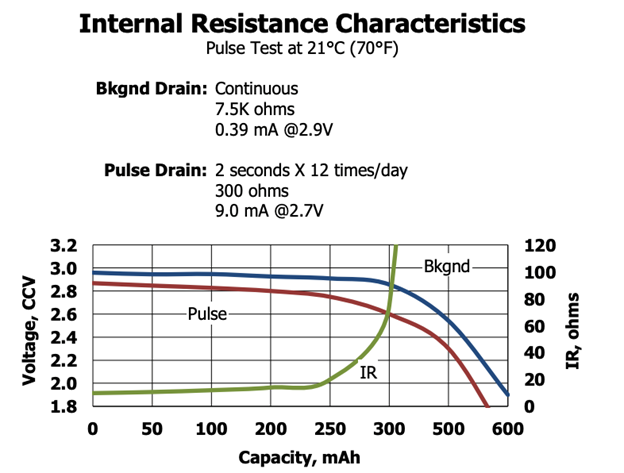
- Maintains lower internal resistance throughout its discharge, meaning it handles higher pulse loads (9 mA) with minimal voltage sag.
- Suitable for devices needing frequent RF bursts or LED flashes.
CR1620
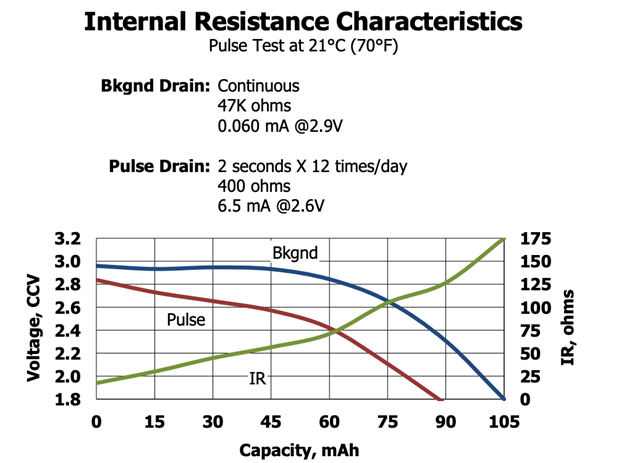
- Internal resistance starts lower but rises faster as capacity depletes (visible in the datasheet graph).
- Can handle pulses of ~6.5 mA briefly, but sustained or frequent pulses shorten its life.
- Well-suited for occasional pulse demands, like unlocking a car fob or logging sensor data.
For pulse-heavy applications, CR2450 outperforms CR1620 significantly. However, CR1620 still handles occasional RF bursts reliably for years in low-drain devices.
Safety, Storage & Best Practices
A CR1620 battery is designed for reliability, but like any lithium coin cell, it must be handled, stored, and disposed of responsibly to ensure both safety and longevity.
Improper handling can shorten its lifespan, cause leaks, or in extreme cases, pose safety hazards.
Below are the key best practices every user or commercial buyer should know.
Safe Handling
CR1620 batteries are stable under normal use, but they should never be subjected to misuse:
- Avoid short circuits: If the positive (+) and negative (–) terminals are bridged by metal objects like keys, coins, or jewelry, the battery may rapidly discharge, heat up, and potentially vent.
- Keep away from heat and flames: Exposing the cell to direct heat, fire, or attempting to incinerate it can cause rupture or leakage.
- Do not puncture, crush, or solder directly: Damaging the casing compromises the seal and can cause electrolyte leakage.
- Never attempt to recharge: CR1620 is a primary (non-rechargeable) lithium coin cell. Charging may cause overheating, leakage, or explosion.
- Child safety: Button cells pose a serious ingestion hazard. If swallowed, they can cause chemical burns within hours. Always store and dispose of them safely and use child-resistant packaging where possible.
Storage Guidelines
Proper storage ensures the CR1620 battery maintains its rated shelf life:
- Ambient conditions: Ideal storage is between 5 °C and 25 °C with low humidity. Avoid prolonged exposure to temperatures above 30 °C.
- Keep in packaging until use: Original blister packs prevent accidental discharge and protect against environmental exposure.
- Shelf life: High-quality CR1620 batteries retain 90–95% of charge after 5 years and can last 7–10 years in storage, thanks to their very low self-discharge rate (<1% per year at room temperature).
- FIFO (First-In, First-Out): For businesses managing large inventories, rotate stock so that older batches are used first.
Disposal & Recycling
Lithium coin cells should not end up in household waste bins. You can:
- Recycle through official programs: Many local councils, electronics stores, or recycling depots accept button batteries.
- Avoid incineration or crushing: Both can cause release of hazardous chemicals or fire.
- Check local regulations: Some regions require partial discharge before disposal; others provide sealed collection containers for spent coin cells.
Counterfeit Risks & How to Spot Fakes
Counterfeit batteries are a growing issue, particularly online. They often look legitimate but fail to meet safety or performance standards. Warning signs include:
- Prices significantly lower than market average.
- Generic or missing branding, poor-quality printing, or misspellings on packaging.
- Batteries sold loose without protective blister packs.
- Unrealistic capacity claims (e.g., 150 mAh for a CR1620 when genuine cells are 75–81 mAh).
- Excessive voltage drop during use — fake cells often can’t handle pulse loads.
To avoid these risks, purchase from authorized distributors like FlywingTech, which guarantees factory-fresh Murata-sourced CR1620 cells with proper packaging and batch traceability.
Final Thoughts
The CR1620 battery continues to prove its value across industries, combining a compact 16 × 2.0 mm form factor, a stable 3.0 V output, and a shelf life of up to 7–10 years.
Its flat discharge plateau and low self-discharge rate make it ideal for devices that must remain dependable—whether that’s a car key fob, a fitness tracker, or a precision medical sensor.
If you’re simply replacing a single cell, confirming a CR1620 battery equivalent (such as DL1620 or ECR1620) ensures compatibility.
For engineering teams and OEMs sourcing at scale, choosing genuine, high-quality cells is critical—generic alternatives often fall short under pulse loads or show higher early failure rates.
At FlywingTech, you’ll find a full range of CR1620 batteries from leading brands, backed by quality assurance and reliable supply chains. For example:
- Murata CR1620 Non-Rechargeable Primary Lithium Battery — trusted by medical and industrial manufacturers for consistency and long-term stability.
- Energizer CR1620VP Primary Lithium Battery — a globally recognized option known for reliability in automotive remotes and consumer electronics.
So, if you’re searching for a CR1620 battery near me for immediate replacement, or planning bulk procurement for commercial projects, FlywingTech ensures you get authentic, factory-fresh stock with competitive pricing and prompt delivery.
Frequently Asked Questions (FAQ)
Q1. What is a CR1620 battery used for?
The CR1620 battery powers a wide range of compact devices such as car key fobs, fitness trackers, watches, medical sensors, calculators, and remote controls. Its slim 2.0 mm profile and stable 3 V output make it ideal for electronics where space is limited but reliability is critical.
Q2. How long does a CR1620 battery last?
Lifespan depends on the device, but in low-drain applications (like watches or key fobs), a CR1620 battery can last 3–4 years in active use. In storage, it retains 90–95% of its energy after 5 years, with a typical shelf life of 7–10 years.
Q3. What batteries are equivalent to CR1620?
Equivalent designations include DL1620 (Duracell), ECR1620 (Energizer), BR1620 (Panasonic), KCR1620 (Kodak/Maxell), and ANSI code 5009LC. These are electrically and dimensionally identical. Always check the datasheet to confirm equivalence.
Q4. Can I use CR1616 or CR1632 instead of CR1620?
No. While they share the same 16 mm diameter, the thickness is different.
- CR1616 is thinner (1.6 mm) and often won’t make reliable contact.
- CR1632 is thicker (3.2 mm) and typically won’t fit in CR1620 slots.
Always replace with the exact CR1620 or its documented equivalents.
Q5. Is the CR1620 rechargeable?
No, the CR1620 is a primary lithium coin cell and should never be recharged. Rechargeable alternatives like ML1620 or LIR1620 exist but have lower capacity, higher self-discharge, and different voltage ranges. They should only be used if your device is designed for rechargeables.
Q6. How can I tell if a CR1620 battery is genuine?
Check for:
- Branded packaging (Energizer, Panasonic, Murata, etc.)
- Clear production/expiry dates
- Sealed blister packs (often child-resistant)
- Consistent specs (75–81 mAh capacity, 3.0 V nominal)
Avoid loose or unbranded coin cells, as they may be counterfeit.
Q7. Where can I buy a CR1620 battery near me?
Search “CR1620 battery near me” and you’ll find options at Home Depot, Walmart, CVS, Walgreens, and Best Buy. For urgent needs, local pickup works well. For bulk or guaranteed fresh OEM stock, ordering online from FlywingTech provides better pricing, traceability, and reliability.
Q8. How should I store CR1620 batteries?
Store in a cool, dry place between 5 °C and 25 °C. Keep them in their original blister packs until use to prevent accidental discharge. Rotate stock using a first-in, first-out (FIFO) method if managing large quantities.
Q9. How do I safely dispose of CR1620 batteries?
Do not throw CR1620 batteries in household trash. Instead, use battery recycling programs at local councils, electronics retailers, or designated drop-off points. Never incinerate or crush the cell, as this can cause leaks or fire.
Q10. Why should I buy CR1620 batteries from FlywingTech?
FlywingTech supplies factory-new Murata CR1620 cells, ensuring genuine components with long shelf life. Customers benefit from:
- Competitive pricing (bulk orders from ~$0.30 per cell)
- Large, always-in-stock inventory
- Fast, reliable shipping worldwide
- Customer-backed reputation for genuine and reliable products
