
When your key fob stops responding, a BLE tag drops offline, or an e-paper label won’t refresh, the problem is often as simple as a weak coin cell. In these cases, the CR2450 3v battery is often the fix.
Larger than the popular CR2032 but with the same diameter, the CR2450 battery offers more than double the capacity and delivers a steady 3-volt output for longer runtimes.
That’s why it has become a go-to choice in devices where reliability matters most. If you’ve ever searched for a CR2450 battery near me, you’ve likely seen how widely it’s used across both consumer and industrial products.
To achieve optimal performance, it’s essential to match the battery to your specific design. A standard CR2450 works for most sockets, while the rimmed CR2450N fits holders with specific geometry.
In this guide, we’ll take a closer look at what makes the CR2450 3v battery unique, how it performs compared to other coin cells, and the practical considerations for choosing, tg, and safely using it in your devices.
What is the CR2450 3v Battery?
The CR2450 3v battery is a 3-volt, non-rechargeable lithium-manganese dioxide (Li-MnO₂) coin cell that measures 24.5 mm in diameter and 5.0 mm in height.
Larger than the popular CR2032 but with the same diameter, it delivers a significantly longer runtime, making it a preferred choice for compact devices that require more power without compromising form factor.

You’ll often find it in key fobs, BLE beacons, electronic shelf labels, bike computers, and a wide range of industrial and medical sensors.
The designation “CR2450” follows a clear logic used across lithium coin cells:
- C indicates lithium-manganese dioxide chemistry,
- R stands for its round shape
- The numbers 24 50 describe its size: 24.5 mm in diameter and 5.0 mm in thickness.
For engineers who want a reliable datasheet-backed option, the FDK CR2450 3v battery from Fujitsu Group is a strong reference design cell. It offers the expected 3 V nominal voltage, flat discharge curve, and robust sealing that make it suitable for long-life consumer, medical, and industrial products.
CR2450 3v Battery Technical Specifications
The CR2450 3v battery technical specifications translate real-world behavior into design numbers you can rely on.
Use this section to set brown-out thresholds, size reservoir capacitors for radio bursts, select the appropriate holder or tabbed variant, and verify performance across your temperature range.
Typical values vary by brand, load profile, and cutoff criteria. Always check the datasheet of the cell you plan to source.
Let’s take a look at the specifications and their details.
| Parameter | Typical / Range | Notes |
| Chemistry | Li-MnO₂ (primary) | “CR” = lithium manganese dioxide coin cell |
| Nominal voltage | 3.0 V | Flat profile aids predictable behavior |
| Nominal capacity | ~600–620 mAh | Varies by brand, load, cutoff |
| Dimensions | Ø 24.5 mm × 5.0 mm | IEC size code “2450” |
| Operating temp. | −30 °C to +60 °C (typ.) | Some lines extend higher; check datasheet |
| Mass | ~6–7 g | Manufacturer dependent |
| Self-discharge | ~1%/year (typ.) | Store cool and dry |
| Codes/variants | CR2450, DL2450, ECR2450, 5029LC; CR2450N | “N” = rimmed top for certain holders |
| Mounting | Coin + holder, or PC-pin/tabbed | Don’t solder bare cells directly |

Electrical Performance
The CR2450 3v battery delivers a stable 3.0 V with a notably flat discharge curve, keeping firmware thresholds and ADC readings predictable through most of life.
Capacity depends on brand, load, and cutoff, but under light loads it typically exceeds 600 mAh.
Expect a long, steady plateau and a sharp end-of-life knee—plan brown-out thresholds accordingly.
- Chemistry: Lithium Manganese Dioxide (Li-MnO₂), primary (non-rechargeable)
- Nominal voltage: 3.0 V (flat mid-life profile)
- Open-circuit voltage (fresh): ~3.1–3.2 V at 20 °C
- Typical capacity: ~600–620 mAh @ 20 °C, 7.5 kΩ to ~2.0 V cutoff
- Recommended continuous current: ≤ 0.2–0.4 mA (application dependent)
- Pulse capability: Short bursts ~6–9 mA for ~2 s with recovery (validate your exact pulse envelope and temperature)
- Internal resistance: Low at beginning-of-life; rises sharply near depletion—the primary driver of pulse sag late in life
- Leakage current (self): Very low; dominated by load rather than cell leakage in most designs
- Cutoff planning: Base decisions on loaded voltage at worst-case temperature + pulse, not open-circuit voltage
For radios (BLE, sub-GHz) or sensors with periodic TX spikes, place a low-ESR reservoir capacitor close to the load (e.g., 10–100 µF) to curb transient droop especially below freezing.
Environmental Behavior (temperature, storage, and drift)
CR2450 battery cells remain reliable across a broad field temperature range. Like all primary lithium coins, cold raises impedance while heat accelerates aging.
Storage conditions strongly influence long-term stability and self-discharge.
- Operating temperature (typ.): –30 °C to +60 °C (verify per product line)
- Storage temperature (recommended): +5 °C to +30 °C, dry, away from heat sources
- Relative humidity (storage): ≤ 75 % RH, non-condensing, original packaging preferred
- Self-discharge: ~1 %/year (typ.) at room temperature
- Cold-weather behavior: Higher internal resistance; budget headroom and consider a larger reservoir cap
- Hot environments: Faster aging; prefer shielded placements and conservative life predictions
Validate at environmental extremes. Run a loaded voltage test at the coldest expected temperature with your real pulse profile to set a truthful low-battery threshold.
Mechanical & Variants (fit, holders, and vibration)
Dimensional consistency and the proper geometry of the holder are critical for maintaining reliable contact over the years of service.
The CR2450 3v battery is available in standard flat-top and rimmed-top variants to accommodate different socket types.
- Dimensions (IEC 2450): Ø 24.5 mm × 5.0 mm
- Mass: ~6–7 g (brand dependent)
- Polarity: Top = positive, case/body = negative
Mounting options
- Serviceable holders for easy field replacement
- Tabbed / PC-pin cells for low contact resistance and better vibration tolerance
Different applications call for different variants of the CR2450. Flywing Tech carries multiple options from Murata Electronics, such as:
- CR2450W for wide-temperature stability,
- CR2450R for enhanced pulse load capability, and
- CR2450X designed for extra-long shelf life.
Each of these retains the 24.5 mm × 5.0 mm geometry but tunes internal chemistry and sealing for different deployment needs.
Safety & Compliance
CR2450 batteries are robust when used correctly. Most incidents stem from misuse, especially attempts to recharge primary cells or inappropriate disposal.
- Rechargeability: Not rechargeable. Never attempt to charge a CR-series primary coin cell
- Leakage resistance: Robust crimp/gasket sealing on datasheeted lines; select reputable manufacturers
- Child safety: Treat all coin cells as ingestion hazards; use secure battery doors per local regulations
- Standards: Prefer lines conforming to IEC 60086 series (primary lithium coin cells) and applicable safety marks
- Transportation: Small primary lithium cells are generally shipped under UN 3090/3091 guidance; follow IATA/IMDG/ADR rules and packaging limits
Design Guidelines
A few simple practices dramatically improve real-world performance, especially as the cell ages or the device faces cold starts and RF bursts.
- Pulse smoothing: Local 10–100 µF low-ESR capacitor near the load; scale with TX current and duty cycle
- Thresholds: Measure low-battery voltage using a loaded voltage at worst-case temperature, not an open-circuit measurement
- Sleep current: Keep quiescent draw well below 100–150 µA to achieve multi-year life targets
- Holder choice: Match CR2450 vs CR2450N geometry; ensure stable contact force and proper polarity keying
- EMC & resets: If the radio browns out the MCU, consider a larger reservoir cap, brief TX-rate limiting, staged-TX ramp, or lower PA level during cold start
- Brown-out reset (BOR): Set BOR above your worst-case loaded knee (e.g., 2.2–2.5 V for many 3.3 V MCUs—tune per silicon)
Capacity Derating & Thresholds (numbers you can start from)
Real devices rarely see “datasheet” capacity. Temperature, pulse current, and cutoff voltage all derate usable energy. Use these starting points then tune with your measurements.
- Room-temp, light load (7.5 kΩ): ~600 mAh to 2.0 V cutoff
- Moderate pulse device (e.g., BLE @ 6–9 mA, 2 s, 12×/day): plan for 10–20 % derating vs light-load capacity
- Cold operation (–10 °C to –20 °C): expect additional 15–30 % effective derating from higher internal resistance
Sourcing & QA (consistency equals predictability)
Battery variability can swamp your nice power budget. Control the variables and you’ll ship predictable products.
- Single qualified line: Lock to one datasheet-backed CR2450 line per product family
- Lot traceability: Capture date/lot codes for field returns and aging analysis
- Incoming inspection: Spot-check OCV, mass, and visual seal integrity on each lot
- Aging curves: Maintain golden sample curves (your own loaded tests at 20 °C and cold) to compare lots
- Do not mix: Avoid mixing brands, ages, or chemistries (CR vs BR vs LiR) within the same product or pack
Testing Of CR2450 3v battery
Testing a CR2450 3v battery is quick and helps you catch weak cells before they cause flaky behavior.
The process combines a simple voltage check, a short loaded measurement, and a read on how your device performs in real-world use. Here are the steps:
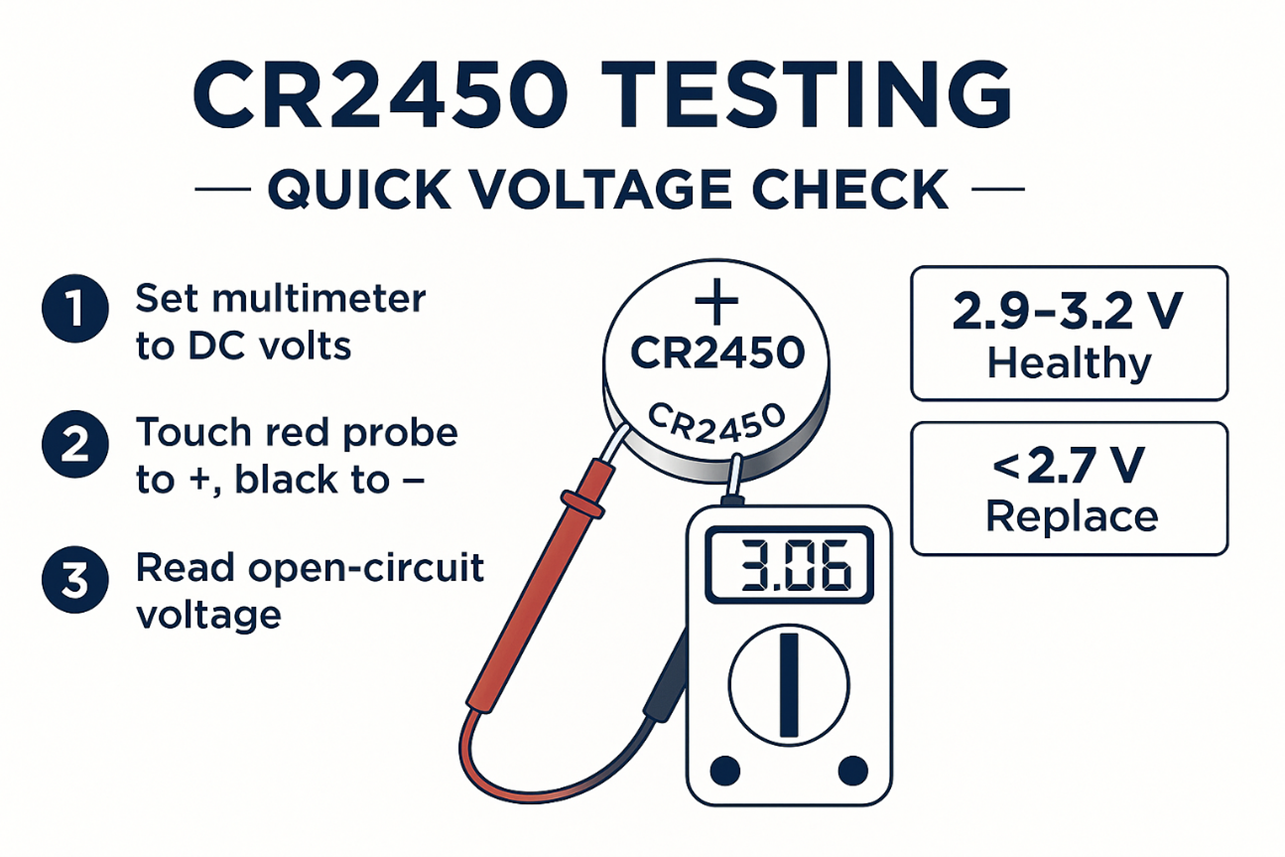
1. Quick Voltage Check
Set your digital multimeter to DC volts, touch the red probe to the “+” side and the black probe to the “–” side, and read the open-circuit voltage.
A healthy CR2450 3v battery typically shows ~2.9–3.2 V. If it’s below ~2.7 V, the cell is near end-of-life, and you should plan a replacement.
2. Realistic Load Test
Voltage alone can look fine even when usable capacity is low. Add a 7.5 kΩ resistor across the terminals and measure the voltage again under load.
If it holds a voltage of≥ ~2.8 V, the battery is generally in good shape. If it drops to < ~2.5 V, internal resistance has likely risen, and real-world capacity is limited.
As a rule of thumb, a cell at ~3.0 V open-circuit that falls to ~2.4 V under load often has < ~30% of its original capacity left.
3. Device-Level Signs
Your product will often tell you what’s happening. Low-battery alerts, dim LEDs, sluggish responses, missed wireless transmissions, or intermittent resets are classic symptoms of a weak CR2450.
Check the device manual if available. Some devices use conservative thresholds to avoid brownouts or data loss.
Avoid shorting the battery; use insulated tools and controlled loads during tests. Do not recharge a CR2450, it’s a primary (non-rechargeable) lithium cell.
Store spares in a cool, dry place (between 5–30 °C) to minimize self-discharge, and recycle spent cells through approved programs rather than disposing of them in regular trash.
Case Study: CR2450 Battery vs CR2032 Battery
The CR2450 and CR2032 are both widely used 3-volt lithium coin cell batteries designed for long-term, low-drain applications.
While they share the same chemistry and steady discharge profile, their differences in size, capacity, and endurance make each better suited for different types of devices. We compared the two using official datasheets listed below:
| Feature | CR2450 | CR2032 |
| Size (Diameter × Height) | 24 mm × 5.0 mm | 20 mm × 3.2 mm |
| Nominal Voltage | 3.0 V | 3.0 V |
| Typical Capacity | ~550–620 mAh | ~220–240 mAh |
| Test Load (Graph) | 7.5 kΩ (0.39 mA) | 15 kΩ (0.19 mA) |
| Service Life (Graph) | ~1,600 hours before cutoff | ~1,200 hours before cutoff |
| Voltage Stability | Flat curve, stable up to ~1,200 h | Stable but starts declining earlier (~1,000 h) |
| Internal Resistance Rise | Later in discharge (~400 mAh onwards) | Earlier in discharge (~150 mAh onwards) |
| Pulse Load Tolerance | Handles higher current pulses (up to 9 mA) with stable voltage | Handles smaller pulses (~6–7 mA), more drop under load |
CR2450 Battery Discharge Characteristics
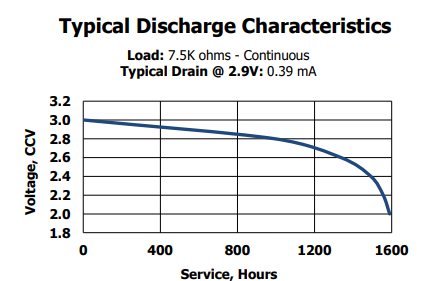
The behavior of CR2450 under a continuous load of 7.5 kΩ, corresponding to approximately 0.39 mA drain at 2.9 V.
The voltage starts at approximately 3.0 V and remains steady for most of the cycle, gradually dropping below 2.8 V after 1,000 hours. A sharper decline begins after 1,200 hours, and the battery reaches cutoff near 1,600 hours.
This long plateau demonstrates the CR2450’s ability to provide stable, reliable power for extended periods, even under moderate drain.
CR2032 Battery Discharge Characteristics
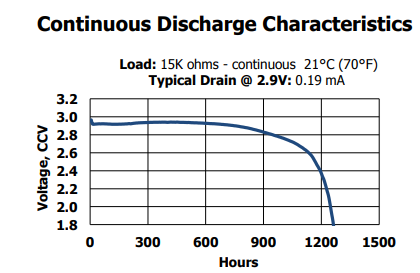
This represents the CR2032, tested at a lighter continuous load of 15 kΩ (around 0.19 mA drain at 2.9 V). Its voltage also stays stable near 3.0 V for the majority of its life, but the decline starts earlier compared to the CR2450.
After about 1,000 hours, the curve drops more sharply, with complete depletion reached by roughly 1,200 hours.
When compared directly, the CR2450 clearly outperforms the CR2032 in terms of service life and load endurance.
Even though the CR2450 is tested under nearly double the current drain, it still lasts longer, approximately 1,600 hours, compared to 1,200 hours for the CR2032.
CR2450 Pulse Discharge Characteristics
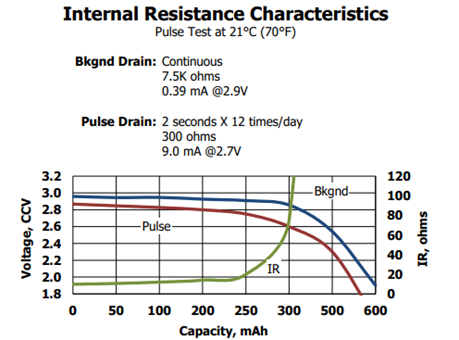
The internal resistance characteristics of the CR2450 show that this larger coin cell maintains stable voltage and low resistance over most of its discharge cycle.
With a background drain of 0.39 mA and pulse drains of 9.0 mA for two seconds, the battery demonstrates strong endurance. The background voltage remains close to 3.0 V until around 400 mAh of capacity is used, after which it gradually declines.
Even under pulse loads, the voltage stays relatively stable for the majority of the cycle, only showing sharper drops towards the end.
Internal resistance remains low and steady through most of the discharge but increases steeply beyond 400 mAh, signaling the onset of cell depletion.
This performance indicates that the CR2450 is well-suited for devices that require steady operation with occasional current spikes, such as IoT sensors, smart locks, and medical devices.
CR2032 Pulse Discharge Characteristics
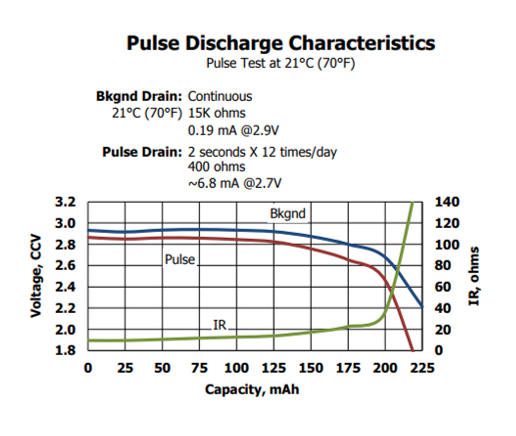
The pulse discharge characteristics of the CR2032 reveal its limitations as a smaller cell.
Tested under a lighter continuous drain (0.19 mA) and pulse loads of approximately 6.8 mA, the CR2032 exhibits a stable voltage profile up to approximately 150 mAh before a faster decline begins.
Under pulse conditions, the voltage drop is more noticeable compared to the background drain, reflecting the cell’s higher sensitivity to bursts of current.
Internal resistance starts to rise much earlier in the discharge cycle than in the CR2450, increasing sharply after 150 mAh and reaching over 120 ohms.
This makes the CR2032 less effective for applications that require sustained or frequent pulse loads.
CR2450 Battery Applications and Devices
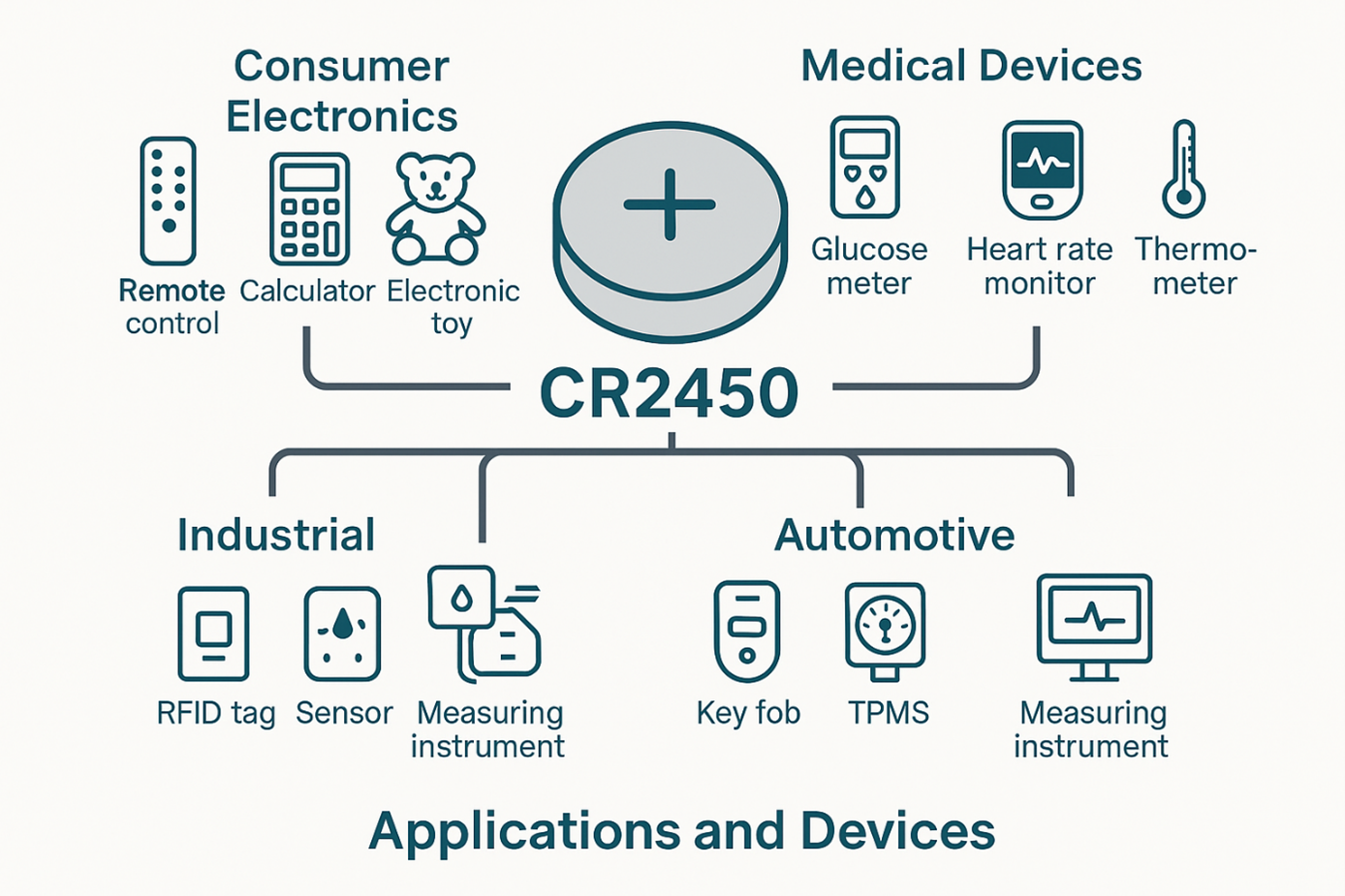
The CR2450 coin cell is a strong choice for applications that require long-lasting power and a steady 3V output in a compact footprint.
Its higher capacity and ability to handle short pulse loads make it reliable across consumer, IoT, medical, automotive, and industrial scenarios.
Consumer Electronics
CR2450 powers small gadgets that must run for years without attention. You’ll commonly see it in remote controls, calculators, electronic thermometers, electronic toys, and LED indicators.
Smart & Connected Devices (IoT)
In low-duty wireless designs, CR2450 provides multi-year service while tolerating brief radio bursts.
It’s frequently used in BLE beacons, RFID sensors and tags, electronic shelf labels, smart locks, and compact wireless sensors.
The cell’s combination of energy density and stable mid-life voltage helps maintain reliable transmissions over long deployments.
Medical Equipment
Portable diagnostics benefit from the CR2450’s predictable output and long shelf life.
Typical devices include glucose meters, heart-rate monitors and straps, digital thermometers, pulse oximeters, and medication reminders.
Consistent 3 V operation supports accurate readings and dependable behavior after periods of storage.
Automotive
CR2450 appears in key fobs, certain TPMS service tools/sensors, gate and garage controllers, and small in-vehicle accessories.
It suits the automotive environment thanks to solid capacity, good pulse tolerance for brief transmissions, and reliable performance across common cabin temperatures and light vibration.
Industrial & Commercial
For equipment that must operate for years with occasional activity, CR2450 is a practical fit.
In data loggers, test gear, compact meters, and warehouse beacons, it reduces maintenance visits while maintaining measurements and signaling over extended service intervals.
Backup Power & RTC/Memory Retention
When the main supply is off, CR2450 3v battery keeps clocks and critical data alive.
It’s widely used for RTC and configuration retention on motherboards and embedded controllers, as well as in meters and security panels.
Low self-discharge and a flat voltage curve help maintain state reliably over extended standby periods.
Depending on your application, different CR2450 variants may give better results.
If you’re looking for a quick replacement and type CR2450 battery near me, you’ll likely find them at electronics retailers, hardware stores, or supermarkets. For instance, Flywing Tech offers Murata’s CR2450R-HO5, which is well-suited for IoT devices that require stable wireless pulses.
Other models like the CR2450R-E3A, CR2450X-HE, and CR2450W-D58 provide additional flexibility for designers who need tailored performance in rugged or long-life environments.
Final Thoughts
The CR2450 3v battery may look like just another coin cell, but its balance of high capacity, flat discharge curve, and long service life makes it one of the most versatile choices in its class.
Compared to smaller cells like the CR2032, it delivers longer runtimes and better tolerance for short pulse loads, which is why it continues to power everything from smart locks and IoT sensors to medical devices and automotive electronics.
For engineers and product designers, the key is to choose the right variant—standard flat-top, rimmed CR2450N, or specialized lines such as wide-temperature, high-pulse, or extended shelf-life versions.
With careful selection and proper circuit design, a CR2450 can keep your product running reliably for years with minimal maintenance.
While searching online for a CR2450 battery near me may solve immediate needs, engineers and product designers often require datasheet-backed lines from trusted suppliers to ensure predictable performance and multi-year reliability.
If you’re selecting a CR2450 3v battery for your next design, Flywing Tech offers a full catalog of options.
These options ensure you can match the right battery to your device’s runtime, environmental, and reliability requirements.
Frequently Asked Questions (FAQs)
What is a CR2450 battery?
What does “CR2450” mean?
How long does a CR2450 battery last?
Is the CR2450 battery rechargeable?
No, the CR2450 is a primary (non-rechargeable) lithium coin cell. Attempting to recharge it can be dangerous. For rechargeable options, look for “LIR2450” or similar lithium-ion coin cells.
