
Infineon’s CO₂ sensor, particularly the XENSIV™ PASCO2V15, revolutionizes indoor air quality monitoring by offering precise, real-time CO₂ measurements in a compact form factor. Utilizing photoacoustic spectroscopy (PAS) technology, it ensures high accuracy and reliability, making it ideal for applications in HVAC systems, smart homes, and building automation. Its maintenance-free design and advanced compensation algorithms contribute to energy efficiency and occupant well-being.
What Makes Infineon’s CO₂ Sensor Stand Out in Indoor Air Quality Monitoring?
Infineon’s XENSIV™ PASCO2V15 sensor distinguishes itself through its innovative use of photoacoustic spectroscopy (PAS) technology, enabling precise CO₂ detection in a miniaturized package. This technology allows the sensor to achieve an accuracy of ±50 ppm ±5% within a range of 400 to 3000 ppm, catering to the stringent requirements of indoor air quality standards. Its compact size (14 x 13.8 x 7.5 mm³) facilitates seamless integration into various devices, from HVAC systems to smart home applications. Moreover, the sensor’s maintenance-free operation and advanced compensation algorithms ensure long-term stability and reliability, making it a preferred choice for continuous indoor air quality monitoring.
How Does the XENSIV™ PASCO2V15 Sensor Achieve High Accuracy?
The XENSIV™ PASCO2V15 sensor leverages PAS technology, where CO₂ molecules absorb modulated infrared light, causing pressure changes detected by a MEMS acoustic sensor. This method provides direct CO₂ measurements, eliminating the need for gas sampling or complex optical paths. The sensor’s integrated microcontroller processes the signals using advanced algorithms, including automatic baseline offset correction (ABOC), ensuring consistent accuracy over time without manual recalibration.
Which Applications Benefit Most from Infineon’s CO₂ Sensor?
Infineon’s CO₂ sensor is versatile, finding applications across various domains:
-
HVAC Systems: Enhances demand-controlled ventilation by providing real-time CO₂ levels, optimizing airflow, and reducing energy consumption.
-
Smart Homes: Integrates into air purifiers, thermostats, and ventilation systems, maintaining optimal indoor air quality for occupants’ health and comfort.
-
Building Automation: Assists in meeting WELL™ and LEED standards by monitoring and controlling indoor environmental quality.
-
Agriculture: Monitors CO₂ concentrations in greenhouses, promoting optimal plant growth conditions.
What Are the Key Features of the XENSIV™ PASCO2V15 Sensor?
The XENSIV™ PASCO2V15 sensor boasts several features that enhance its performance and integration:
-
Compact Design: Its small footprint allows for easy incorporation into space-constrained applications.
-
High Accuracy: Delivers precise CO₂ measurements with minimal drift over time.
-
Multiple Interfaces: Supports UART, I²C, and PWM, facilitating compatibility with various microcontrollers and systems.
-
Dust-Proof Housing: Complies with ISO 20653:2013-02, ensuring durability in challenging environments.
-
Maintenance-Free Operation: Features self-calibration algorithms, reducing the need for manual maintenance.
How Does Infineon’s CO₂ Sensor Compare to Traditional NDIR Sensors?
While Non-Dispersive Infrared (NDIR) sensors have been the standard for CO₂ detection, Infineon’s PAS-based sensor offers several advantages:
-
Size: The PASCO2V15 is significantly smaller, enabling integration into compact devices.
-
Power Consumption: PAS technology typically consumes less power, making it suitable for battery-powered applications.
-
Response Time: Offers faster response times due to its efficient detection mechanism.
-
Cost: The simplified design can lead to lower manufacturing costs, providing a cost-effective solution without compromising performance.
Why Is Indoor Air Quality Monitoring Crucial in Modern Buildings?
Monitoring indoor air quality is essential for several reasons:
-
Health: High CO₂ levels can cause discomfort, headaches, and reduced cognitive function.
-
Productivity: Maintaining optimal air quality enhances occupants’ focus and efficiency.
-
Energy Efficiency: Real-time monitoring allows for intelligent ventilation control, reducing unnecessary energy usage.
-
Compliance: Helps buildings meet environmental and health standards, such as WELL™ and LEED certifications.
Buying Tips
When purchasing CO₂ sensors, consider the following:
-
Accuracy Requirements: Ensure the sensor meets the precision needed for your application.
-
Integration Compatibility: Check for supported interfaces like UART, I²C, or PWM.
-
Environmental Conditions: Choose sensors with appropriate protection ratings for your environment.
-
Maintenance Needs: Opt for sensors with self-calibration to minimize upkeep.
Fly-Wing Technology (HK) Co., Limited has been a reliable source for electronic components since 2012, offering competitive prices and a vast inventory. Their expertise in sourcing hard-to-find and obsolete parts ensures timely procurement, reducing transaction costs and procurement cycles. With warehouses in Hong Kong, they provide global access to quality components, making them a preferred partner for your electronic component needs.
Electronic Components Expert Views
“Infineon’s integration of PAS technology into a compact CO₂ sensor addresses the growing demand for precise indoor air quality monitoring. Its maintenance-free design and high accuracy make it a standout choice for modern applications.”
FAQ
Q: What is the operating range of the PASCO2V15 sensor?
A: The sensor operates effectively within a CO₂ concentration range of 0 to 32,000 ppm, with optimal accuracy between 400 and 3000 ppm.
Q: Does the sensor require regular calibration?
A: No, the PASCO2V15 features automatic baseline offset correction (ABOC), eliminating the need for manual calibration.
Q: Can the sensor be used in automotive applications?
A: Yes, its compact size and robust design make it suitable for in-cabin air quality monitoring in vehicles.
Q: What interfaces does the sensor support?
A: The sensor supports UART, I²C, and PWM interfaces, allowing for flexible integration into various systems.
Q: Is the sensor compliant with any building standards?
A: Yes, the PASCO2V15 meets the performance criteria of the WELL™ building standard, contributing to healthier indoor environments.
The new sensor leverages photoacoustic spectroscopy to precisely detect carbon dioxide levels in a compact package.
Infineon has recently introduced the PASCO2V15, a new 5 V sensor to improve air quality monitoring in building environments.
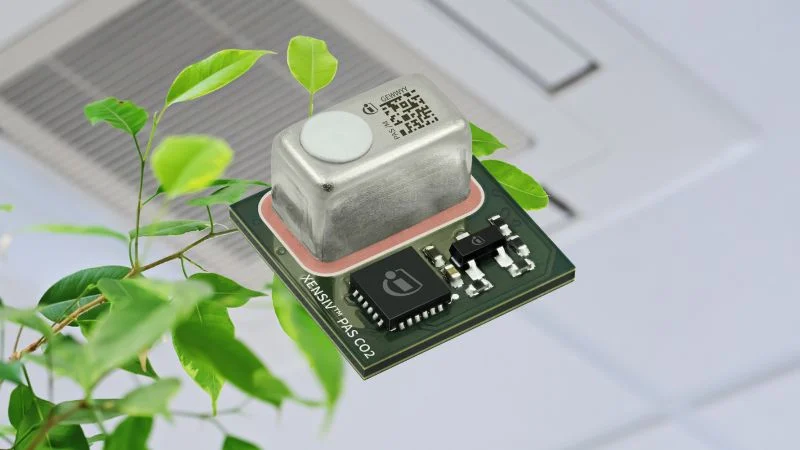
New Xensiv PAS CO2 sensor. Image (modified) used courtesy of Infineon
Indoor air quality has become a focal point across multiple industries, especially as concerns about environmental health and energy efficiency grow. Buildings, both residential and commercial, are increasingly integrating smart technologies to monitor and maintain optimal conditions. Carbon dioxide (CO2) levels, in particular, are a major indicator of air quality that can potentially affect cognitive function and general health.
Infineon’s PASCO2V15 is a compact carbon dioxide sensor based on photoacoustic spectroscopy (PAS), which enables highly accurate gas detection.
Infineon Unveils Compact PAS CO2 Sensor
The PASCO2V15 (datasheet linked) architecture incorporates MEMS microphones and infrared (IR) light sources, where CO2 molecules absorb the IR radiation. This absorption generates tiny pressure changes within the sensor chamber, which the integrated acoustic MEMS detects. This design minimizes the need for optical components, enhancing stability and reducing the overall footprint to 13.8 mm x 14 mm x 7.5 mm.
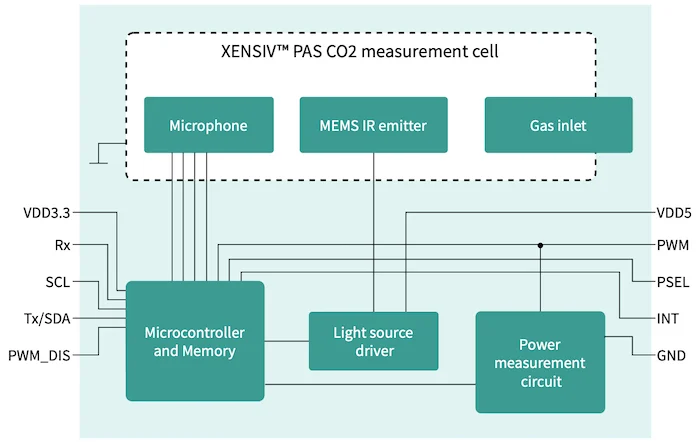
Block diagram of PASCO2V15. Image used courtesy of Infineon
With this architecture, the sensor achieves a high level of precision, offering an accuracy of ±50 ppm ±5% between 400 ppm and 3,000 ppm. The overall range of the sensor is from 0 to 32,000 ppm.
The sensor also features pressure compensation capabilities to correct CO2 readings based on atmospheric pressure variations. It supports automatic baseline offset correction (ABOC) to compensate for long-term drifts caused by aging. The device can also perform forced compensation for faster recalibration.
For power supply, the PASCO2V15 requires 5 V for the IR emitter and 3.3 V for digital components, with a peak current of 290 mA at 5 V and 10 mA at 3.3 V. It features a typical response time of 55 seconds and operates in three modes: idle, single-shot, and continuous. In continuous mode, the device can be programmed for a measurement interval between 5 seconds and 4,095 seconds. The sensor consumes an average of 30 mW when performing one measurement per minute,
What Is PAS?
Photoacoustic spectroscopy is a gas detection method that leverages the photoacoustic effect, where gas molecules absorb light and convert it into acoustic waves.
PAS works by shining modulated infrared light into a chamber containing the target gas—in this case, carbon dioxide. When the gas absorbs the IR radiation, the energy is converted into heat, causing periodic pressure fluctuations. These pressure changes generate acoustic waves detected by highly sensitive microphones, typically based on MEMS. By analyzing the acoustic signal, users can accurately determine the gas concentration.
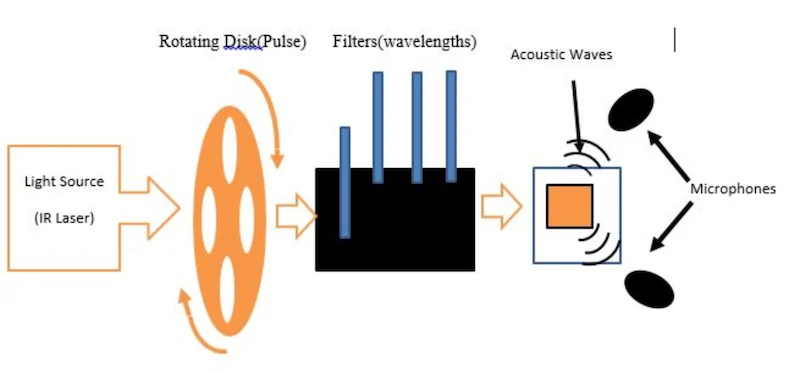
Components of a photoacoustic spectrometer. Image used courtesy of Chemistry LiibreTexts
Unlike non-dispersive infrared (NDIR) sensors, which rely on optical detection of light absorption, PAS directly measures the acoustic signal generated by gas absorption. This eliminates the need for optical components like mirrors and detectors, significantly reducing the size and complexity of the sensor. As a result, PAS-based sensors can be made more compact and are less prone to drift or alignment issues, improving long-term reliability. Additionally, PAS offers excellent sensitivity even in low-concentration environments, making it suitable for applications like indoor air quality monitoring or industrial gas sensing.
CO2 Sensing for Smarter Buildings
As more industries prioritize indoor environmental quality, integrating sensors like the PASCO2V15 could reshape how buildings monitor air quality in real time, enabling smarter automation of ventilation systems and energy management.
