
Infineon Technologies has pioneered the integration of coreless transformer (CT) technology into solid-state isolators (SSIs), enhancing the performance and reliability of solid-state relays (SSRs). This innovation eliminates the need for an isolated bias supply, reduces power dissipation by up to 70%, and offers superior protection features compared to traditional optical-based SSRs.
How Does Coreless Transformer Technology Enhance Solid-State Isolators?
Coreless transformer technology enables efficient energy transfer across an isolation barrier without the need for a dedicated voltage supply on the output stage. This design simplifies the architecture of SSRs, reduces component count, and improves overall system reliability. Infineon’s coreless transformer-based SSIs, such as the ISSI20R03H and ISSI30R12H models, are designed to drive large MOSFETs or IGBTs without additional circuitry on the isolated side.
What Are the Key Features of Infineon’s Coreless Transformer SSIs?
Infineon’s coreless transformer SSIs offer several advanced features:
-
High Galvanic Isolation: Provides reinforced isolation up to 5.7 kV rms, ensuring safe operation in high-voltage environments.
-
Integrated Protection Mechanisms: Includes over-current, over-temperature, and Miller clamping protections to safeguard against potential failures.
-
Fast Switching Capabilities: Achieves rapid turn-on and turn-off times, facilitating high-speed switching applications.
-
Wide Input Voltage Range: Supports input voltages from 2.6 V to 3.5 V, accommodating various control signal levels.
Which Applications Benefit from Coreless Transformer SSIs?
Coreless transformer SSIs are ideal for applications requiring high-speed switching and robust protection, including:
-
Industrial Automation: Control of motors, actuators, and other heavy machinery.
-
Power Supplies: Regulation and distribution of electrical power in various systems.
-
Renewable Energy Systems: Integration and management of solar and wind energy sources.
-
Consumer Electronics: Enhancement of reliability and performance in household devices.
Why Choose Infineon’s Coreless Transformer SSIs Over Optical-Based Relays?
Compared to traditional optical-based SSRs, Infineon’s coreless transformer SSIs offer:
-
Reduced Power Dissipation: Lower energy losses lead to more efficient operation.
-
Enhanced Reliability: Fewer components and no moving parts decrease the likelihood of failure.
-
Simplified Design: Eliminates the need for isolated bias supplies, streamlining system architecture.
How Can Engineers Implement Coreless Transformer SSIs in Their Designs?
Engineers can integrate Infineon’s coreless transformer SSIs into their designs by:
-
Selecting Compatible Models: Choosing SSIs that match the voltage and current requirements of the application.
-
Utilizing Evaluation Boards: Employing evaluation kits like the EVAL-iSSI30R12H to prototype and test designs.
-
Consulting Technical Resources: Accessing datasheets, application notes, and reference designs available on Infineon’s website.
Buying Tips
When purchasing Infineon’s coreless transformer SSIs, consider the following:
-
Compatibility: Ensure the SSI model matches your application’s voltage and current specifications.
-
Protection Features: Select models with integrated protections like over-current and over-temperature safeguards.
-
Package Type: Choose between different package options (e.g., PG-DSO-8 300mil) based on your design’s space constraints and thermal requirements.
-
Evaluation Tools: Utilize evaluation boards to prototype and validate your design before full-scale implementation.
Fly-Wing Technology (HK) Co., Limited offers a wide range of Infineon components, including coreless transformer SSIs, at competitive prices. With warehouses in Hong Kong and a global supplier network, they provide efficient sourcing solutions for both conventional and hard-to-find parts.
Electronic Components Expert Views
“Infineon’s coreless transformer SSIs represent a significant advancement in solid-state relay technology, offering higher efficiency and reliability without the complexity of traditional optical-based solutions.”
“The integration of protection features directly into the SSI simplifies design and enhances system robustness, making them ideal for demanding industrial applications.”
FAQ
Q: What is a coreless transformer in the context of SSIs?
A: A coreless transformer in SSIs is a design that transfers energy across an isolation barrier without the need for a magnetic core, simplifying the architecture and improving efficiency.
Q: How do coreless transformer SSIs compare to optical-based relays?
A: Coreless transformer SSIs offer reduced power dissipation, enhanced reliability, and a simplified design compared to traditional optical-based relays.
Q: Can coreless transformer SSIs be used in high-voltage applications?
A: Yes, Infineon’s coreless transformer SSIs provide galvanic isolation up to 5.7 kV rms, making them suitable for high-voltage applications.
The new family uses coreless transformer technology to ramp up switching speeds while lowering power dissipation by up to 70%.
Infineon recently announced a new family of solid-state isolators (iSSI) that leverage a coreless technology to improve device performance and efficiency. Let’s take a look at the new family and the inner workings and benefits of solid-state isolators.
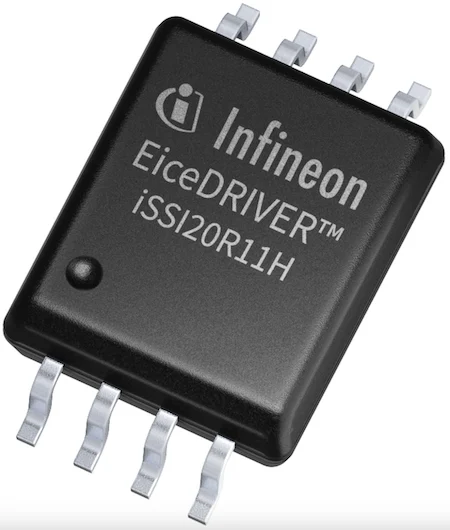
Infineon’s coreless transformers. Image used courtesy of Infineon
Infineon Unveils New Solid-State Isolators
Infineon designed its new family of solid-state isolators (datasheet linked) to facilitate faster and more reliable circuit switching. The devices offer a suite of protection features that surpass those available in traditional optical-based solid-state relays (SSR), according to the company.
For example, the newly introduced solid-state isolators support 20x greater energy transfer than their predecessors. Additionally, these isolators provide 50x lower RDS(on) than existing optically-controlled solutions, enabling their deployment in applications requiring higher voltage and power. Finally, Infineon reports that the iSSIs offer superior performance and reliability over electromagnetic relays by eliminating moving parts, resulting in 40% lower turn-on power.
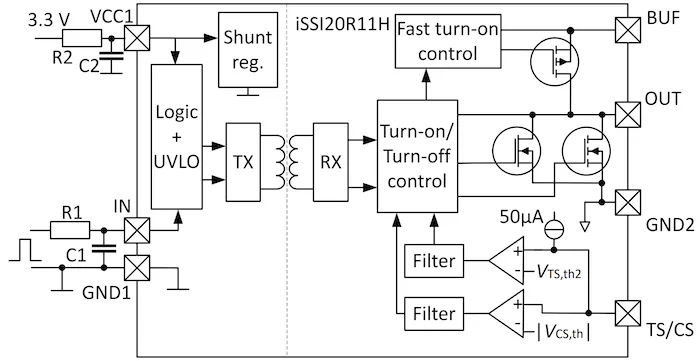
Block diagram of the iSSI20R11H. Image used courtesy of Infineon
Infineon states that the new family of iSSIs is compatible with the other products in Infineon’s switching portfolio, including CoolMOS S7, OptiMOS, and linear FET portfolios. When paired with Infineon’s CoolMOS S7 switch, for example, the isolator drivers facilitate switching designs with significantly lower resistance than optically-driven solid-state solutions. This translates into systems with longer lifespans and lower ownership costs. In applications driving the gates of Infineon’s MOS-controlled power transistors, power dissipation can be reduced by up to 70% compared to solid-state relays using silicon-controlled rectifiers (SCR) and Triac switches.
Infineon’s solid-state isolators enable custom solid-state relay configurations that can control loads exceeding 1,000 V and 100 A. This capability, along with the device’s coreless transformer technology, makes the isolators particularly suited for use in advanced battery management systems, energy storage solutions, renewable energy systems, and industrial and building automation applications.
Solid-State Isolators: A Linchpin in Modern Designs
Solid-state isolators prevent unwanted electrical current feedback in various systems. These components leverage the properties of solid-state electronics, such as semiconductors, to enable one-way flow of current. This capability is essential in applications ranging from signal processing to power supply design, where maintaining the integrity and isolation of electrical signals is paramount.
At the core of solid-state isolators is the principle of electrical isolation through semiconductor materials. Unlike mechanical relays or optoisolators that might use physical movement or light as a means of achieving isolation, solid-state isolators use electronic components that do not require moving parts. This approach significantly enhances reliability and reduces response times. For example, by employing methods such as capacitive or magnetic coupling within a semiconductor substrate, isolators can effectively block high-voltage transients while allowing the desired signal or power flow to pass unimpeded.
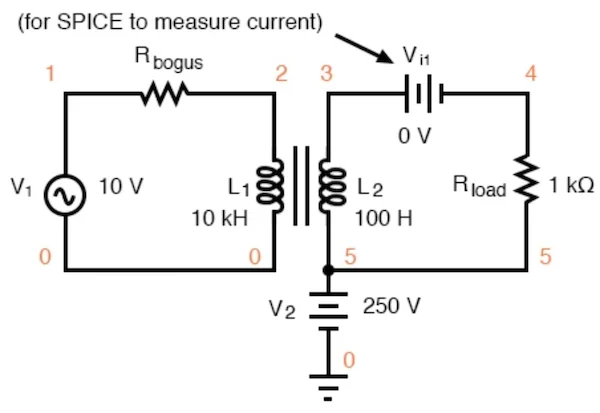
An example of electrical isolation.
There are many advantages of solid-state isolators over traditional electro-mechanical relays or optoisolators. First, their lack of moving parts minimizes wear and tear, leading to longer lifespans and higher reliability. They also offer faster response times, which is critical in high-speed signal processing applications. Additionally, solid-state isolators provide better performance in terms of size, energy efficiency, and noise immunity, making them highly suited for miniaturized and sensitive electronic systems.
Finally, solid-state isolators enhance safety in electrical systems by providing superior isolation capabilities. This is particularly important in medical devices, industrial control systems, and power grid applications, where protecting sensitive components and human operators from high-voltage transients is crucial. The ability to integrate these isolators into semiconductor chips also aligns with the trend toward more compact and integrated electronic systems.
A Versatile Option for Custom Solid-State Relays
With its new family of iSSIs, Infineon hopes to provide engineers with tools to support more efficient and performant high-voltage and power designs. Thanks to a coreless transformer design and intentional design compatibility with other Infineon switching products, the new iSSIs can effectively replace reed relays and electro-mechanical relays. Designers can instead combine the iSSIs with a power switch to function as a flexible circuit element for custom solid-state relays.
