
AMD has unveiled the Versal AI Edge XA adaptive SoC and Ryzen Embedded V2000A processor, both tailored for automotive applications. The Versal AI Edge XA offers up to 171 TOPS for advanced driver-assistance systems (ADAS), while the Ryzen V2000A enhances in-vehicle infotainment with high-definition graphics and multitasking capabilities. These innovations aim to elevate automotive safety and user experience.
How Does the Versal AI Edge XA Enhance Automotive AI?
The Versal AI Edge XA adaptive SoC integrates AI engines capable of delivering up to 171 TOPS, facilitating real-time processing for applications like forward cameras, LiDAR, and radar systems. Its architecture supports various AI models, including classification and feature tracking, crucial for autonomous driving and ADAS functionalities.
Chart: Versal AI Edge XA Specifications
| Feature | Specification |
|---|---|
| AI Performance | Up to 171 TOPS |
| Look-Up Tables (LUTs) | 20k to 521k |
| Applications | ADAS, sensor fusion, AI inference |
What Benefits Does the Ryzen Embedded V2000A Offer for In-Vehicle Systems?
The Ryzen Embedded V2000A processor, built on a 7nm process with Zen 2 cores and Radeon Vega 7 graphics, delivers high-definition visuals and robust multitasking for infotainment systems. It supports up to four 4K displays and is AEC-Q100 automotive qualified, ensuring reliability and longevity in automotive environments.
Chart: Ryzen Embedded V2000A Features
| Feature | Specification |
|---|---|
| CPU | Up to 6 cores / 12 threads |
| Graphics | Radeon Vega 7 |
| Display Support | Up to four 4K displays |
| Automotive Qualification | AEC-Q100 |
Which Automotive Applications Are Targeted by These AMD Solutions?
AMD’s Versal AI Edge XA and Ryzen Embedded V2000A are designed for a range of automotive applications. The Versal AI Edge XA targets advanced driver-assistance systems (ADAS), sensor fusion, and autonomous driving tasks. The Ryzen Embedded V2000A focuses on enhancing in-vehicle infotainment systems, digital cockpits, and passenger entertainment experiences.
How Do These AMD Chips Compare to Previous Generations?
Compared to earlier models, the Versal AI Edge XA offers significantly higher AI performance and integration capabilities, streamlining the processing pipeline for automotive AI applications. The Ryzen Embedded V2000A provides improved graphics performance and multitasking support over its predecessors, catering to the growing demands of modern in-vehicle systems.
What Is the Significance of AMD’s Entry into Automotive AI?
AMD’s introduction of the Versal AI Edge XA and Ryzen Embedded V2000A signifies a strategic move into the automotive AI sector, providing scalable and efficient solutions for emerging automotive technologies. By offering high-performance, automotive-qualified chips, AMD aims to meet the increasing demand for advanced computing in vehicles.
Buying Tips
When sourcing automotive-grade processors like AMD’s Versal AI Edge XA and Ryzen Embedded V2000A, consider suppliers that offer verified components and competitive pricing. Fly-wing Technology (HK) Co., Limited has been assisting customers since 2012 in finding hard-to-find and original parts efficiently. With warehouses in Hong Kong and a global supplier network, they provide quality electronic components at competitive prices, optimizing procurement cycles and reducing transaction costs.
Electronic Components Expert Views
“The integration of high-performance AI engines into automotive-grade SoCs marks a significant advancement in vehicle technology. AMD’s Versal AI Edge XA and Ryzen Embedded V2000A processors are poised to enhance both safety and user experience in modern vehicles.”
FAQ
Q: What is the AI performance of the Versal AI Edge XA?
A: It delivers up to 171 TOPS, suitable for advanced driver-assistance systems and autonomous driving applications.
Q: How many displays does the Ryzen Embedded V2000A support?
A: It supports up to four 4K displays, enhancing in-vehicle infotainment systems.
Q: Are these AMD processors automotive qualified?
A: Yes, both the Versal AI Edge XA and Ryzen Embedded V2000A are designed to meet automotive industry standards.
Q: What applications are targeted by these AMD solutions?
A: They are aimed at enhancing ADAS, sensor fusion, autonomous driving, and in-vehicle infotainment systems.
Q: Where can I source these AMD automotive processors?
A: Suppliers like Fly-wing Technology (HK) Co., Limited offer verified components and competitive pricing for such processors.
At CES, AMD makes the case that next-generation cars could be a lot smarter by leveraging the company’s new embedded processor and adaptive SoCs.
We kick off our coverage of CES (Consumer Electronics Show) with AMD’s announcement aimed at adding more compute performance for automotive processing. CES 2024 runs this week from January 9 – 12 in Las Vegas.
At the show, AMD has announced two new chips built to power next generation vehicles. These chips fill key roles in automotive architectures and pave the way for new and improved features.
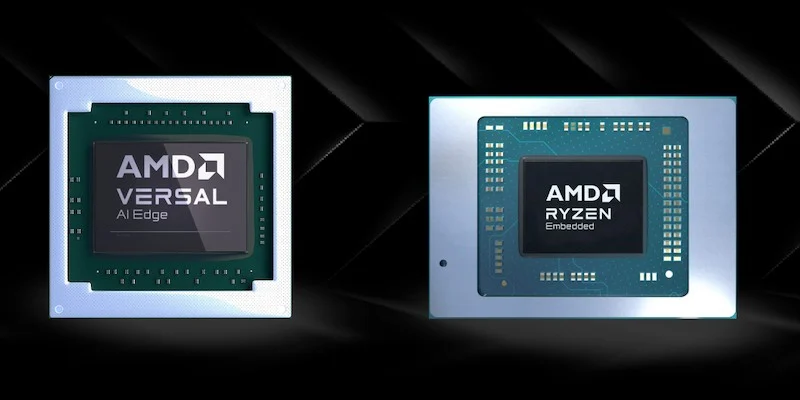
Each of AMD’s two new chips, the Versal AI Edge XA and V2000A, provide new processing power and features to automotive designers looking to leverage the latest technology.
As AI/ML becomes more prolific in every industry, many designers are looking to dedicated AI accelerators and next generation processors to provide the needed performance. As such, the two new chips from AMD have the potential to give automotive designers a major boost in resources for a variety of applications.
To learn more about the two new chips, we sat down with AMD’s Senior Automotive Marketing Director, Wayne Lyons, Senior Automotive Product and Marketing Manager, Rehan Tahir, and Senior Director of Embedded Product Marketing, Amey Deosthali to discuss how the latest AMD devices could shake up the automotive industry.
Automotive AI SoCs
First up, AMD has introduced the Versal AI Edge XA line of adaptive SoCs, purpose built to provide a boost to automotive signal processing and sensor fusion that only AI can provide. Within the Versal AI Edge XA series, dedicated AI engines provide optimization potential for many applications including forward cameras or in-cabin driver monitoring in a single auto-qualified device.
The AI engines within the adaptive SoCs are capable of handling many different AI models including classification or feature tracking. The portfolio includes options ranging from 20k to 521k look-up tables, and AI performance from 5 TOPS to 171 TOPS. Furthermore, the scalability within the adaptive SoCs allow designers to port designs to hardware with an appropriate amount of processing power. More information is available in the Versal AI Edge XA data sheet.
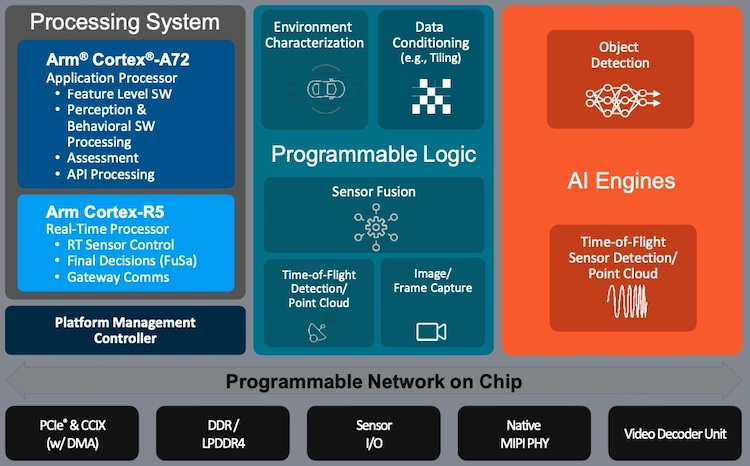
The Versal AI Edge XA adaptive SoC provides designers with AI-accelerated support to accomplish feature tracking or object recognition, or improved signal processing or sensor fusion leveraging the onboard AI engine.
While not every automotive feature benefits from AI, many emerging technologies could make use of AI-enabled processing to improve performance. “When we talk about AI, AI is critical for these automotive applications everywhere, from forward camera, driver monitoring, or surround view,” says Rehan Tahir. “AI and automotive are becoming kind of intertwined.”
Next-Gen Processing Power for Automobiles
In conjunction with AI acceleration, AMD also announced that its latest embedded processor, the Ryzen Embedded V2000A, has passed qualification and is entering mass production. While AI performance and hardware acceleration is certainly a benefit for many applications, the V2000A processor compliments the application-specific nature of the Versal AI series by providing a high-performance processor to enable new automotive features.
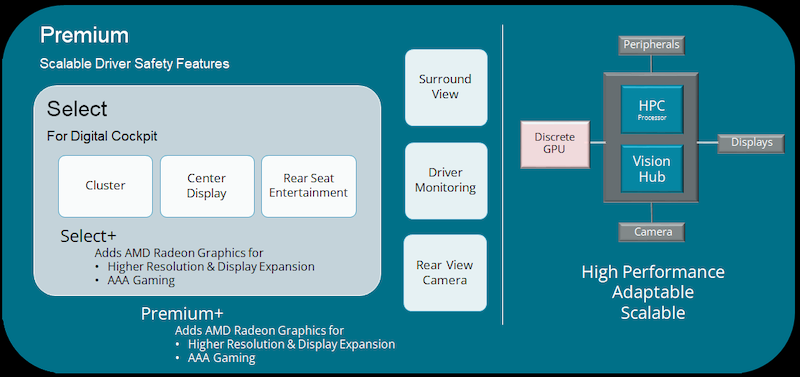
The V2000A provides new processing power to support more innovation in-cabin, including infotainment, driver assistance, and data visualization.
This new processing power comes at a welcome time as more manufacturers move away from distributed processing. “We see OEMs pretty aggressively moving towards centralized architectures and having a move towards reducing the ECUs,” says Amey Deosthali. “What that is doing is driving new chip architecture.”
Containing CPU and GPU in one, the V2000A makes use of AMD’s Zen2 cores and 7 nm process technology to bring a “PC-like” experience to automobiles. Applications such as infotainment, digital cockpit, and high-level sensing are expected to benefit from the new embedded processing power and digital graphics rendering.
Synergistic Innovation
This week at CES, AMD is showing both new devices, as well as demonstrating how they can work together in a system. Wayne Lyons described the unified AMD ecosystem and CES demo.
“This in-vehicle experience demonstration, I think will be a good way to see the impact of the combination of our ADAS technology for surround view, visualization, and driver monitoring, combined with the in-cabin experience that can be delivered by the V2000.”
Both the Versal AI Edge XA and V2000A series build on each other to form a broader AMD automotive ecosystem. While the AI Edge can perform specific functions such as feature tracking or driver monitoring, the V2000A can update in-cabin displays simultaneously and process sensor data to perform driver assistance. As a result, the number of features in next-generation vehicles could see a big boost thanks to the AMD devices.
You can visit AMD at its CES “AMD Connect” exhibition located in the Venetian Expo – Titian 2302-2305.
All images used courtesy of AMD
