
The Siglent SHN900A handheld vector network analyzer (VNA) is a versatile and compact RF testing solution designed for professionals requiring high-performance measurements in the field. With a frequency range up to 26.5 GHz and a dynamic range of 110 dB, it integrates multiple testing functions into a single portable device.
What is the SHN900A Handheld Vector Network Analyzer?
The SHN900A is a portable VNA that combines vector network analysis, time domain analysis, spectrum analysis, and cable and antenna testing into one device. It features a frequency range from 30 kHz to 26.5 GHz, making it suitable for a wide range of RF applications. The analyzer supports both standard and differential S-parameter measurements, providing comprehensive testing capabilities.
How Does the SHN900A Perform in Field Environments?
Designed for portability, the SHN900A weighs less than 3.2 kg and has dimensions of 310 mm × 215 mm × 78.5 mm. Its rugged design ensures durability in various field conditions. The device is powered by a lithium-ion battery, offering up to 4 hours of continuous operation, making it ideal for on-site measurements without the need for external power sources.
What Measurement Capabilities Does the SHN900A Offer?
The SHN900A supports a wide range of measurements, including:
-
S-parameters: Standard and differential measurements
-
Time Domain Analysis (TDA): Time-domain transformation, windowing, and gating
-
Time Domain Reflectometry (TDR): Reflection and transmission analysis, eye diagram simulation
-
Pulse Measurements: Characterization of pulsed signals
-
Spectrum Analysis: Frequency domain analysis
-
Cable and Antenna Testing (CAT): Impedance, VSWR, and fault locationSiglent
These features make the SHN900A suitable for testing components such as filters, amplifiers, and antennas.
Why is the SHN900A Ideal for Portable RF Testing?
The SHN900A combines the performance of benchtop VNAs with the convenience of a portable device. Its comprehensive measurement capabilities, coupled with a rugged design and long battery life, make it an excellent choice for field engineers and researchers requiring reliable RF testing equipment in various environments.
Which Applications Benefit from the SHN900A?
The SHN900A is versatile and can be used in several applications, including:
-
Field Testing: On-site measurements of RF components and systems
-
Research and Development: Characterization of new RF designs
-
Production: Quality control and testing of manufactured components
-
Maintenance: Troubleshooting and repair of RF equipment
-
Communications: Installation and maintenance of antenna systems
How Does the SHN900A Compare to Other Portable VNAs?
When compared to other portable VNAs, the SHN900A offers a competitive frequency range, dynamic range, and measurement capabilities. Its built-in GPS and long battery life provide additional advantages for field use. However, specific requirements such as frequency range and measurement types should be considered when selecting a VNA for particular applications.
Buying Tips
When purchasing a handheld vector network analyzer like the SHN900A, consider the following:
-
Frequency Range: Ensure the device covers the frequencies relevant to your applications.
-
Dynamic Range: A higher dynamic range allows for more accurate measurements of weak signals.
-
Battery Life: Longer battery life is essential for extended field testing sessions.
-
Portability: Consider the device’s weight and size for ease of transport.
-
Measurement Capabilities: Verify that the device supports the specific measurements you require.
Fly-wing Technology (HK) Co., Limited has been a reliable source for electronic components since 2012, offering competitive prices and a wide range of products to meet your RF testing needs.
Electronic Components Expert Views
“The SHN900A’s integration of multiple measurement capabilities into a portable device significantly enhances the efficiency of field testing. Its user-friendly interface and robust design make it a valuable tool for engineers working in diverse environments.“
FAQ
Q: What is the frequency range of the SHN900A?
A: The SHN900A has a frequency range from 30 kHz to 26.5 GHz, covering a wide spectrum for various RF applications.
Q: How long does the battery last on the SHN900A?
A: The SHN900A is equipped with a lithium-ion battery that provides up to 4 hours of continuous operation.
Q: Can the SHN900A perform time domain analysis?
A: Yes, the SHN900A supports Time Domain Analysis (TDA) and Time Domain Reflectometry (TDR) for detailed signal characterization.
Q: Is the SHN900A suitable for field use?
A: Absolutely, the SHN900A is designed for portability with a rugged build and long battery life, making it ideal for field testing.
Q: What calibration methods does the SHN900A support?
A: The SHN900A supports various calibration methods, including SOLT, SOLR, TRL, Response, and Enhanced Response, ensuring accurate measurements.
Siglent designed the new vector network analyzer to bring the performance of a benchtop solution to a portable form factor.
Siglent recently announced a new handheld vector network analyzer (VNA) designed to bring the high performance of a benchtop VNA to a portable form factor. This offering supports sensitive electronics fields, such as high-speed or RF.
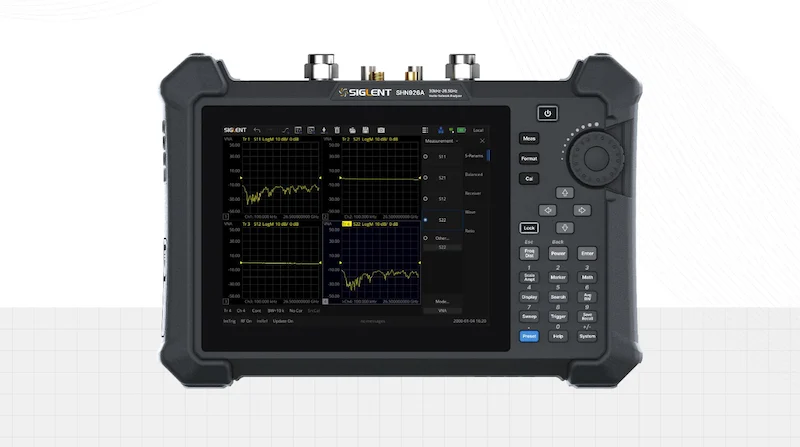
SHN900A. Image used courtesy of Siglent
Where voltage levels are low, timing budgets are tight, and the margin for error is minimal, testing equipment, like the SHN900A Series Handheld VNA, must be accurate and high-resolution to ensure that devices are field-ready before deployment.
Siglent’s New Handheld Vector Network Analyzer
Siglent built the portable SHN900A as a comprehensive RF test solution for a wide range of applications, including field testing, R&D, and production.
The SHN900A VNAs cover a frequency range from 30 kHz to 26.5 GHz with a frequency resolution of 1 Hz and a level resolution of 0.05 dB. These devices offer a dynamic range of 110 dB and support various types of calibration, including response, enhanced response, full-one port, full-two port, and thru-reflect-line (TRL) calibration to ensure high accuracy and flexibility for different measurement scenarios??.
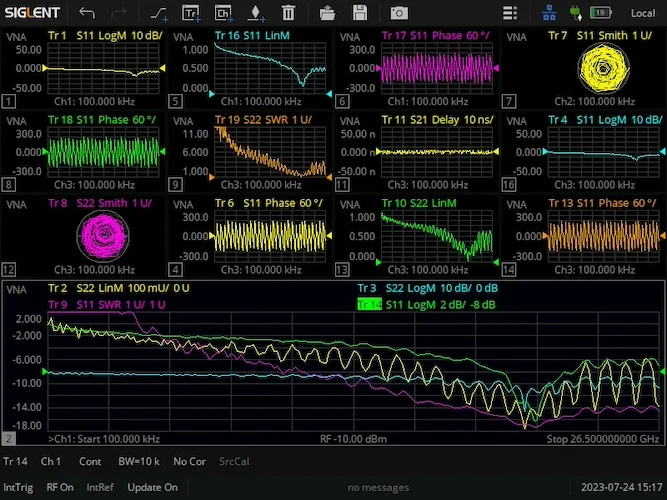
Waveforms and analysis on the SHN900A. Image used courtesy of Siglent
The SHN900A series (datasheet linked) also supports a wide array of measurements, including scattering parameter, differential parameter, and time-domain parameter analyses. It can perform limit tests, ripple tests, impedance conversion, fixture simulation, and adapter removal/insertion adjustments. Additionally, it includes a spectrum analysis mode and can measure parameters like channel power, adjacent channel power ratio (ACPR), and occupied bandwidth.
The VNA’s built-in time domain analysis (TDA) and enhanced time domain refractometry (TDR) modes provide comprehensive tools for characterizing signal integrity and identifying transmission issues. These features, combined with the ability to display data in multiple formats such as Smith chart, polar chart, SWR, phase, and log magnitude, make the SHN900A a versatile tool.
Calibration for VNAs
Calibrating an RF vector network analyzer is an important process that guarantees the accuracy and reliability of the device’s measurements
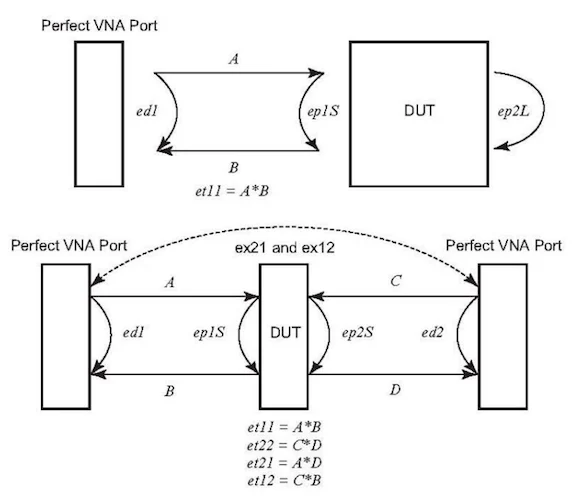
One port and two port VNA error models. Image used courtesy of the University of Maryland
Calibration involves adjusting the VNA to correct systematic errors that can arise from various sources, such as signal path imperfections, connector mismatches, and environmental factors. This is achieved by performing a series of standard measurements using known reference standards, such as open, short, load, and through (SOLT) standards. These reference measurements allow the VNA to determine the error coefficients that describe the discrepancies between the actual and measured responses. Applying these coefficients allows the VNA to correct subsequent measurements, leading to more accurate and reliable results.
Calibration typically starts with connecting calibration standards to the VNA’s ports. The VNA measures each standard’s response, which provides the data needed to calculate the error coefficients. Advanced calibration methods like TRL and enhanced response calibration extend this process by using additional standards and techniques to improve accuracy over a wider frequency range. Some VNAs also support automated electronic calibration (E-calibration) modules, which simplify the process and reduce the risk of user errors.
Accurate Testing Anywhere
Developing RF electronics requires accurate, reliable, and high-resolution testing and measurement equipment. With its new handheld VNA, Siglent hopes to bring all of these features to a portable form factor so engineers can trust their testing equipment anywhere, whether in the field or the lab.
