
The Imperative for Next-Generation Semiconductor Performance
GaN and SiC Semiconductors are revolutionizing power electronics design. Your 65W laptop charger used to be the size of a brick—now it fits in your palm thanks to these advanced wide-bandgap materials. But here’s what most engineers discover the hard way: drop GaN and SiC Semiconductors into a traditional silicon design and you’ll fry prototypes, fail EMC tests, and watch gate voltages spike into the danger zone.
GaN and SiC semiconductors are leading the charge. Power electronics has hit a ceiling. For decades, silicon MOSFETs carried the load—literally. They’ve powered everything from laptop chargers to electric vehicles. But the demands of modern systems have outgrown them. Today’s EVs are chasing 800V battery platforms. Server power supplies must hit 96%+ efficiency. USB-C fast chargers need to cram 100W into something smaller than a matchbox.
And that’s where GaN and SiC semiconductors come in.
These wide-bandgap (WBG) materials aren’t future tech—they’re already shipping in phones, cars, and data centers. They switch faster, handle higher voltages, and dissipate heat more efficiently. But they also break the rules you’re used to with silicon. Design them like a typical MOSFET and you’ll fry prototypes, fail EMC tests, or watch gate voltages spike into the danger zone.
This complete guide shows you exactly how GaN and SiC semiconductors work, where each excels, and how to design with them without getting burned—whether you’re building power converters, EV traction inverters, or USB-C chargers.

II. Why GaN Semiconductors Are Crushing Silicon: 5x Faster Switching + Zero Reverse Recovery
Fundamentals for the Design Engineer
GaN and SiC semiconductors represent the next generation of power devices, with GaN leading
What Makes GaN Different
Gallium Nitride is fast. Really fast. Electrons move through it roughly five times faster than through silicon. That allows GaN transistors to switch at frequencies in the megahertz range, enabling dramatic reductions in inductor and transformer size. A 65W charger using GaN can be less than half the size of a silicon equivalent.
GaN also eliminates reverse recovery charge—something every power engineer fights in silicon body diodes. That’s a game-changer in bridge topologies where diode switching losses dominate.
The gate threshold voltage of GaN is typically around 1.2V to 1.8V, with a tight safe range between 0V and +6V. Exceeding this range—even briefly—can damage the part permanently.
Compare the key specs:
| Parameter | Silicon MOSFET | GaN FET | Why It Matters |
| Switching Frequency | 100-200 kHz | 500 kHz – 5 MHz | Smaller transformers and inductors |
| Reverse Recovery (Qrr) | 50-200 nC | 0 nC | Huge win in bridge circuits |
| Gate Voltage | 10-12V | 4-6V | Less complex gate drives |
Prime Applications & Design Wins for GaN and SiC semiconductors
USB-C Chargers and Consumer Electronics
Look at a modern 65W or 100W charger. Most use GaN to push switching frequency high enough to shrink the transformer and caps, slashing volume by 40–50%. Anker, Apple, and Baseus all ship GaN-based power adapters in production.
Server Power Supplies
In hyperscale data centers, power supply efficiency translates directly into lower cooling costs and power bills. GaN helps PSU designs hit 96%+ efficiency and achieve 80 PLUS Titanium certification. Higher switching frequencies also mean smaller filter components, reducing the physical footprint of 1U supplies.
LiDAR and RF Applications
These systems need fast, clean switching edges for timing precision. GaN’s low gate charge and lack of reverse recovery makes it ideal for pulsed systems. In LiDAR, this allows tighter beam timing and better resolution.

GaN Design Pitfalls That Destroy Prototypes (And How to Avoid Them)
Gate Drive Design Challenges
Here’s where many engineers get burned. GaN devices are not forgiving when it comes to gate drive voltages. Overshoot or ripple beyond +6V can destroy the device silently.
Use gate drivers specifically designed for GaN. Choose ones that offer:
-
Precise voltage clamping
-
Separate turn-on and turn-off resistors
-
Optional Miller clamps for high dV/dt environments
A good rule of thumb: keep R<sub>gon</sub> lower than R<sub>goff</sub> to minimize overshoot on turn-off.
Layout and Loop Inductance
GaN’s fast edge rates (sub-1ns) mean parasitics are deadly. The gate loop and power loop should be as tight as physically possible.
-
Minimize trace length and maximize width
-
Place input capacitors within 2–3mm of drain-source pins
-
Use Kelvin source returns if available
Even 3–4nH of loop inductance can cause spikes of 10V or more—easily enough to breach safe limits.
Thermal Management
GaN-on-silicon devices typically spread heat laterally into the PCB rather than through the top. That means your board layout becomes the heatsink.
Use:
-
Thick copper pours
-
Thermal vias under the pad
-
Multilayer stitching for better heat dissipation

III. GaN and SiC Semiconductors: Complete Performance Comparison
Why GaN and SiC Semiconductors Outperform Silicon
While GaN and SiC semiconductors both offer advantages over silicon, SiC dominates when you need serious voltage and power handling. Silicon Carbide supports electric fields up to 3 MV/cm—10 times what silicon can handle. This allows thinner die structures for the same voltage rating, lowering on-resistance and conduction losses.
It also has far superior thermal conductivity (nearly 5 W/cm·K), which enables better heat flow away from the die. This matters in systems running hundreds of amps.
Some SiC devices operate at 200°C junction temperature. That extra thermal headroom is critical in EVs, industrial drives, and high-reliability installations.
Here’s what the numbers look like:
| Parameter | Silicon MOSFET | SiC MOSFET | What This Gets You |
| Breakdown Field | 0.3 MV/cm | 3.0 MV/cm | Higher voltage capability |
| Thermal Conductivity | 1.5 W/cm·K | 4.9 W/cm·K | Better heat dissipation |
| Max Junction Temp | 150°C | 200°C+ | Reliable high-temp operation |
| Voltage Sweet Spot | <650V | 900V-1700V+ | High-voltage applications |
Prime Applications & Design Wins
Electric Vehicle Powertrains
The EV push toward 800V+ systems? That’s SiC territory. Tesla’s Model S Plaid runs SiC in its main traction inverter. Most other manufacturers are copying this approach for their performance vehicles.
Efficiency numbers are impressive. Well-designed SiC inverters hit 97-98% efficiency across their operating range. More range from the same battery pack. Smaller cooling systems since you’re not dumping heat everywhere.
On-board chargers benefit too. SiC enables 22kW AC chargers that actually fit in a vehicle. The voltage handling plus efficiency makes the size and weight practical.
Industrial Motor Drives
Industrial VFDs have used IGBTs forever, but SiC is taking over high-performance applications. Better efficiency means less cooling. Higher switching frequencies allow smaller output filters.
Maintenance improves as well. Lower junction temperatures extend device life, especially in harsh industrial environments where ambient temps run high.
Solar and Wind Power Inverters
Renewable energy inverters need efficient high-voltage DC conversion while meeting grid requirements. SiC enables string inverters that work directly with higher-voltage solar configurations without intermediate conversion stages.
Wind turbine converters get SiC’s temperature reliability and power handling for multi-megawatt installations.

Practical SiC Design Considerations
GaN and SiC Semiconductors Gate Drive Requirements
SiC MOSFETs need higher gate voltages than silicon or GaN devices. Typical parts want +15V to +20V for full turn-on, compared to +6V for GaN.
Many designs use negative gate voltages (-3V to -5V) for turn-off. Not strictly required, but it improves noise immunity and dV/dt tolerance when the other device in a half-bridge switches.
Gate charge runs higher than GaN but comparable to similar-rated silicon MOSFETs. You need gate drivers that can source and sink higher peak currents for fast switching.
Advanced GaN and SiC Semiconductors Thermal Management
SiC’s thermal conductivity makes heat management easier than with silicon. You can rely on the device conducting heat to your heatsink instead of fighting thermal limitations.
Power modules leverage this with aggressive thermal interface materials and designs. Some SiC modules handle twice the power density of equivalent silicon parts due to better heat extraction.
Body Diode Behavior
SiC MOSFETs have body diode reverse recovery, but much less than silicon. Numbers: 10-50 nC versus 100-500 nC for comparable silicon parts.
For most applications, this works fine without external diodes. But for something like a PFC boost converter where the body diode sees hard commutation, you might add external SiC Schottky diodes for best performance.

IV. Choosing Between GaN and SiC Semiconductors: Selection Matrix
Head-to-Head Technical Comparison
Choosing between GaN and SiC semiconductors requires understanding their distinct characteristics.
Voltage and power requirements usually drive the choice, but other factors matter:
| Parameter | GaN | SiC | How to Decide |
| Voltage Range | 40V-700V (900V+ emerging) | 650V-1700V+ | Application voltage drives choice |
| Max Switching Frequency | MHz range | 100s of kHz for high power | GaN for highest frequency/smallest magnetics |
| Power Handling | Watts to few kW | kW to MW | SiC for highest power levels |
| Thermal Conductivity | Moderate | High | SiC better for raw heat dissipation |
| RDS(on) vs. Voltage | Best at <650V | Best at >900V | Match to your voltage class |
| Reverse Recovery (Qrr) | Zero | Low but non-zero | GaN advantage in bridge topologies |
| Gate Drive Voltage | +6V / 0V (or -3V) | +18V / -3V | Different driver complexity |
| Device Cost Trend | Lower (GaN-on-Si) | Higher (SiC substrate) | System cost matters most |
Application Sweet Spots – Quick Decision Guide
Choose GaN when:
- Operating frequency >500kHz
- Need maximum power density at <900V
- Zero reverse recovery is critical (totem-pole PFC, synchronous converters)
- Size and weight are primary concerns
- Think: USB-PD chargers, laptop adapters, 1U server PSUs, LiDAR pulsers
Choose SiC when:
- Voltage >900V
- Power levels in multi-kW range
- Extreme temperature/ruggedness required
- Efficiency at high power more important than size
- Think: EV traction inverters, industrial motor drives, solar inverters, charging infrastructure
Engineering Trade-offs
No technology wins everywhere. GaN gives you speed and density but requires careful PCB layout and gate drive design. SiC handles power and voltage better but costs more and typically needs more complex gate drivers.
The real decision often comes down to system-level optimization. A GaN design might cost more per watt in components but save money on magnetics and cooling. A SiC design might have higher device costs but eliminate the need for complex multilevel topologies.

V. GaN and SiC Semiconductors: Future Trends and Applications
Core Design Workflow for WBG Semiconductors
“Implementing GaN and SiC semiconductors successfully requires a systematic approach that differs from…”
Getting from concept to working prototype requires a systematic approach:
Define Your Requirements First
- Nail down voltage, current, and power specs before touching a datasheet
- Set efficiency targets and thermal constraints early
- Know your switching frequency requirements and EMI limits
Device Selection Strategy
- Pick your WBG devices based on the comparison matrix from Section IV
- Select compatible gate drivers designed for your chosen technology
- Don’t forget about protection circuits – these parts are less forgiving than silicon
Gate Drive Circuit Design
- Simulate before building – gate drive timing matters more than you think
- Plan for separate Rgon/Rgoff resistors from day one
- Include gate voltage monitoring if you’re pushing performance
PCB Layout Optimization
- Minimize power loop and gate loop inductance as your top priorities
- Place decoupling caps within 2-3mm of device pins
- Design thermal vias and copper pours during layout, not as an afterthought
Thermal and EMI Strategy
- Calculate junction temperatures under worst-case conditions
- Plan EMI filtering early – fast edges create noise you’ve never seen
- Test thermal performance with realistic airflow conditions
Sourcing Advanced Components: Finding the Right Partner
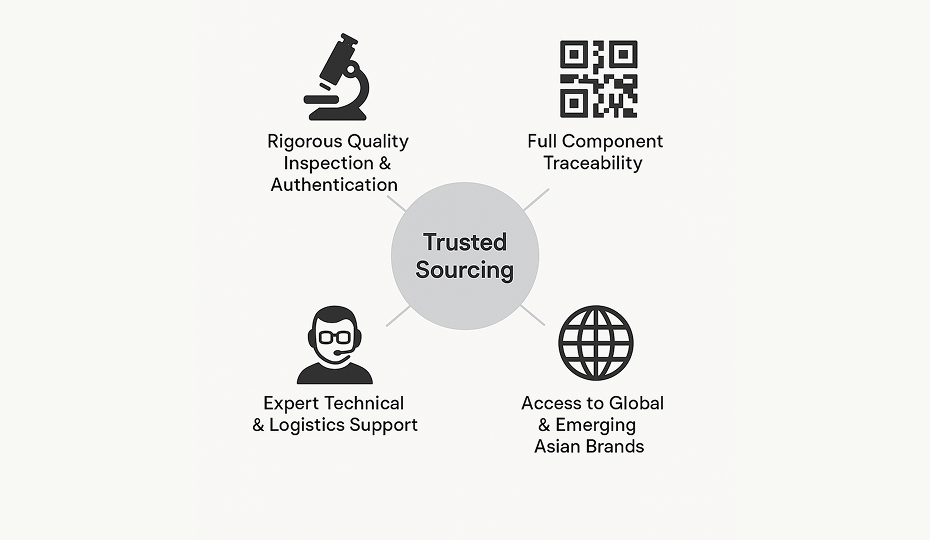
Sourcing GaN and SiC components is Not like buying resistors from Digi-Key. Supply chains are still maturing. Quality varies wildly between suppliers.
GaN and SiC Semiconductors Market Growth
An experienced distributor saves months of frustration. Find suppliers who actually understand the technology. They should provide genuine parts with proper traceability. Technical support matters when your first prototype fails.
Asian suppliers often access emerging manufacturers and offer competitive pricing. Just make sure they grasp quality requirements. Component authentication and proper handling matter more with these advanced devices.
VI. The Future is Wide-Bandgap: Trends and Outlook
The GaN and SiC semiconductors market keeps accelerating as manufacturing scales up. The WBG semiconductor market keeps accelerating. Costs are dropping as manufacturing scales up, especially for GaN-on-silicon devices. We’re seeing better integration too – GaN ICs with built-in drivers and protection are becoming common, making designs simpler.
SiC modules are getting more sophisticated with advanced packaging that leverages the material’s thermal properties. Expect to see higher power densities and better reliability as the technology matures.
Wide-Bandgap GaN and SiC Semiconductors Cost Analysis
New applications keep emerging. AI hardware needs efficient power delivery at scale. Electric aircraft development is pushing power-to-weight ratios. Even consumer electronics are adopting WBG devices as costs come down.

VII. Conclusion: Your Path to Next-Generation Power Systems
GaN and SiC Semiconductors aren’t just incremental improvements—they’re the foundation of next-generation power systems. Engineers who master GaN and SiC Semiconductors design techniques will lead the industry transformation. Start implementing GaN and SiC Semiconductors in your designs today. The future belongs to wide-bandgap technology, and GaN and SiC Semiconductors are leading the charge
Start with your application requirements, choose the right technology, and pay attention to the design details that matter. Partner with suppliers who understand both the technology and your quality needs.
The future of power electronics is wide-bandgap. The question isn’t whether to adopt these technologies, but how quickly you can master them to stay competitive.
Frequently Asked Questions
Design and Implementation
Q: Can I drop GaN or SiC devices into an existing silicon MOSFET design?
A: Not recommended. While pin-compatible parts exist, you won’t get the performance benefits without redesigning the gate drive and layout. Specifically, GaN especially needs different PCB design rules.
Q: Which technology should I choose for a 400V application?
A: Either could work, but GaN typically offers better performance at 400V. However, SiC’s advantages really show up above 900V. Consider your frequency requirements and power levels too.
Q: What’s the learning curve for switching to GaN and SiC semiconductors?
A: GaN and SiC semiconductors require understanding new design principles, but the performance gains justify the investment in learning proper implementation techniques. Most engineers need 2-3 months to become proficient.
Reliability and Cost
Q: Are WBG devices reliable enough for automotive applications?
A: Yes, when properly designed. Furthermore, SiC is already in production EVs from Tesla, BMW, and others. Qualification standards exist (AEC-Q101 for discrete devices), and reliability data keeps improving.
Q: How much do GaN and SiC devices cost compared to silicon?
A: Still more expensive per device, but often cost-neutral or cheaper at the system level due to smaller magnetics and simpler cooling. Additionally, GaN costs are dropping faster than SiC due to silicon substrate manufacturing.
Common Mistakes and Solutions
Q: What’s the biggest mistake engineers make when switching to WBG devices?
A: Treating them like silicon MOSFETs. The gate drive requirements, layout rules, and thermal management are different. Therefore, invest time in understanding the design guidelines before building your first prototype.
Q: Can I use standard MOSFET gate drivers with these devices?
A: Sometimes, but dedicated WBG drivers usually work better. Furthermore, GaN needs lower voltage drivers with fast edge rates. Meanwhile, SiC needs higher voltage capability and often negative turn-off voltages.
EMI and Safety
Q: How do I handle the faster switching edges and EMI issues?
A: Layout is critical – minimize loop inductances and use proper grounding techniques. Additionally, plan your EMI filtering from the beginning rather than trying to fix it after the fact. Gate resistor values help control edge rates.
Q: Are there any safety considerations unique to WBG devices?
A: Gate voltage limits are less forgiving – exceed them and you’ll damage the device permanently. Moreover, SiC devices can fail short-circuit, so proper protection is essential. Follow manufacturer guidelines for safe operating areas.
References:
-
- Coil Technology Corporation. (2024, February 7). “Selection Guide for SiC MOSFET Gate Drive Voltage.”
- EDN Asia. (2021, December 8). “What makes SiC and GaN suitable for high-power designs.”
- Engineering.com. (2021, July 30). “Si, SiC, and GaN for Power Devices, Part One: Electron Energy and the Semiconductors.”
- Power Electronics News. (2020, May 7). “Using GaN FETs in a 3.3kW bridgeless totem-pole PFC design.”
- Power Systems Design. (2020). “SiC MOSFET Gate-Driver Design for Efficiency and Reliability.”
- ROHM Semiconductor. (2020, July 22). “Demystifying SiC MOSFETs challenges.” Power Electronics News.
