
Solid-state beam steering in 3D LiDAR eliminates mechanical parts, enhancing durability, precision, and adaptability. This innovation, exemplified by Lumotive’s LM10 chip and Hokuyo’s YLM-10LX sensor, offers software-defined scanning, compact design, and cost-effective manufacturing, revolutionizing applications in industrial automation and robotics.
How Does Solid-State Beam Steering Enhance 3D LiDAR Performance?
Solid-state beam steering replaces mechanical components with semiconductor-based metasurfaces, enabling precise light direction without moving parts. This advancement leads to improved reliability, faster response times, and reduced size and cost, making 3D LiDAR systems more efficient and versatile.
What Are the Key Features of Lumotive’s LM10 Chip?
Lumotive’s LM10 chip utilizes Light Control Metasurface (LCM™) technology to achieve true solid-state beam steering. Key features include:
-
Zero moving parts for enhanced durability
-
Software-defined scanning patterns
-
Compact size (11 mm × 9 mm aperture)
-
Wide field of view up to 180° with appropriate optics
-
Compatibility with standard semiconductor manufacturing processes
These attributes contribute to high-performance, cost-effective 3D sensing solutions suitable for various applications.
Which Applications Benefit Most from Solid-State 3D LiDAR?
Solid-state 3D LiDAR systems are particularly advantageous in:
-
Industrial automation: Enhancing precision in manufacturing and logistics
-
Robotics: Improving navigation and obstacle detection in AGVs and AMRs
-
Automotive: Supporting advanced driver-assistance systems (ADAS)
-
Consumer electronics: Enabling features like gesture recognition and augmented reality
The robustness and adaptability of solid-state LiDAR make it ideal for environments where traditional mechanical systems may falter.
Why Is the YLM-10LX Sensor a Milestone in LiDAR Technology?
The YLM-10LX sensor, developed by Hokuyo and powered by Lumotive’s LM10 chip, represents a significant advancement in LiDAR technology. It offers:
-
True solid-state beam steering
-
Adjustable field of view (110° Horizontal × 90° Vertical)
-
Detection range from 0.3 to 10 meters
-
IP67-rated enclosure for outdoor use
-
Compatibility with ROS 2 for integration into robotic systems
This sensor sets a new standard for performance and reliability in 3D sensing applications.
How Does Software-Defined Scanning Improve LiDAR Systems?
Software-defined scanning allows dynamic adjustment of LiDAR parameters such as resolution, frame rate, and field of view. This flexibility enables:
-
Real-time adaptation to changing environments
-
Focused scanning on areas of interest
-
Improved data quality and efficiency
Such capabilities are essential for applications requiring responsive and customizable sensing solutions.
Are There Cost Advantages to Using Solid-State LiDAR?
Yes, solid-state LiDAR systems offer significant cost benefits:
-
Reduced manufacturing costs due to standard semiconductor fabrication
-
Lower maintenance expenses owing to the absence of mechanical parts
-
Scalability for mass production
These factors contribute to more affordable and accessible 3D sensing technologies across various industries.
Buying Tips
When considering the purchase of solid-state 3D LiDAR components:
-
Evaluate the specific requirements of your application, including range, field of view, and environmental conditions.
-
Ensure compatibility with existing systems, such as ROS or other software platforms.
-
Consider suppliers with a proven track record in providing reliable and original components.
Fly-wing Technology (HK) Co., Limited has been a trusted source for electronic components since 2012, offering competitive prices and a vast inventory. Their expertise in sourcing hard-to-find parts and commitment to quality make them a valuable partner in procuring solid-state LiDAR components.
Electronic Components Expert Views
“Solid-state beam steering is transforming the landscape of 3D sensing. By eliminating mechanical parts, we’re seeing unprecedented improvements in reliability and performance,” says Dr. Axel Fuchs, Vice President of Business Development at Lumotive.
“Integrating Lumotive’s LCM technology into our sensors has allowed us to meet the evolving demands of industrial automation with greater precision and adaptability,” adds Ms. Chiai Tabata, Product and Marketing Lead at Hokuyo.
FAQ
Q: What is solid-state beam steering in 3D LiDAR?
A: It’s a technology that uses semiconductor-based metasurfaces to direct laser beams without mechanical parts, enhancing durability and precision.
Q: How does the LM10 chip improve LiDAR systems?
A: The LM10 chip offers true solid-state beam steering, software-defined scanning, and compact design, leading to more efficient and adaptable 3D sensing.
Q: What makes the YLM-10LX sensor significant?
A: It’s the first commercial 3D LiDAR sensor with true solid-state beam steering, offering adjustable field of view, robust design, and compatibility with robotic systems.
Q: Are solid-state LiDAR systems more cost-effective?
A: Yes, they reduce manufacturing and maintenance costs and are scalable for mass production, making them more affordable than traditional mechanical systems.
Q: Where can I purchase reliable solid-state LiDAR components?
A: Fly-wing Technology (HK) Co., Limited is a reputable supplier offering competitive prices and a wide range of electronic components, including solid-state LiDAR parts.
Lumotive and Hokuyo Automatic have teamed up to bring the world’s first true beam-steering sensor to 3D LiDAR.
Lumotive and Hokuyo Automatic have announced a combined effort to release the world’s first solid-state beam steering LiDAR sensor module. The LM10 Light Control Metasurface (LCM) chip by Lumotive is the heart of the Hokuyo Automatic YLM-10LX 3D LiDAR sensor.
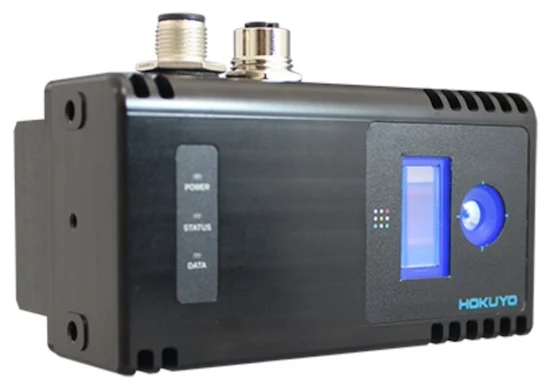
Solid-state 3D LiDAR YLM-10LX. Image used courtesy of Hokuyo Automatic
Lumotive is a 2021 startup built around the technology used in the LM10 chip, its first commercial product. Hokuyo Automatic has been in the automation industry since its founding in 1946 and has an extensive portfolio of optical sensing and ranging products.
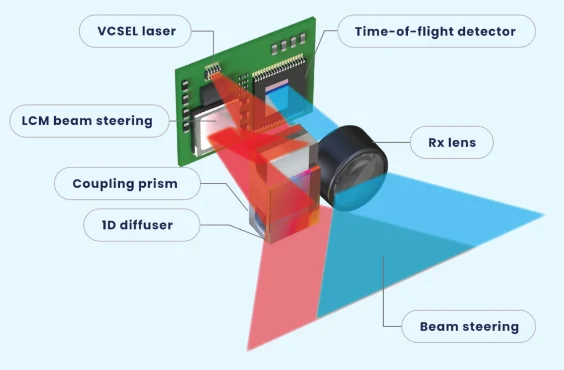
LM10 solid-state beam steering. Image used courtesy of Lumotive
Lumotive’s LCM manipulates and directs the laser light with the metasurface instead of the traditional mechanical componentry.
Solid-State Beam Steering
The aim of solid-state beam steering is to significantly reduce the size, weight, and cost of reliable LiDAR. Vision LiDAR typically uses moving mirrors or prisms to traverse a laser beam horizontally and vertically in a raster scan pattern similar to that of an old cathode ray tube (CRT). Building these systems robust enough to survive in an automotive environment is expensive from both a financial and structural perspective. It makes for a bulky and expensive system.
The LM10 is a solid-state chip manufactured on conventional semiconductor wafer fab equipment. Each chip replaces a significant set of electro-optical moving mechanical parts.
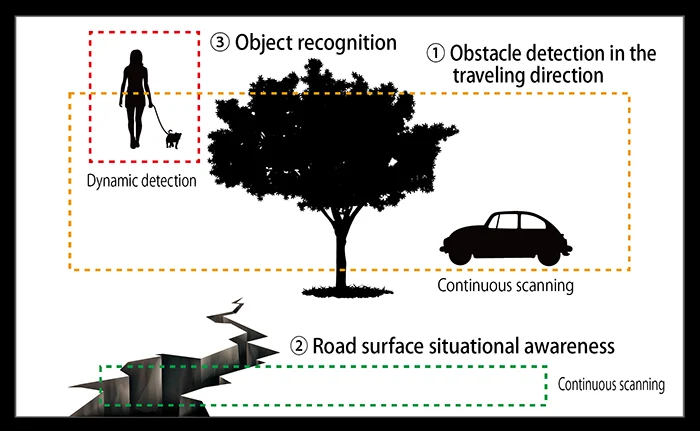
Software adjustable scanning with solid-state beam steering. Image used courtesy of Hokuyo Automatic
An additional advantage of the Lumotive LM10 sensor’s solid-state beam steering is its sensing flexibility. Range, angle of view, and other parameters with conventional beam steering are limited based on the mechanical and optical configuration as built at the factory. Solid-state beam steering can be used to adjust many of these parameters in real-time. For example, the system can keep a generalized scan ongoing but then focus on an anomalous object for greater detail.
LCM Technology and YLM-LM10LX Module
The Lumotive sensor can scan up to 180 degrees with appropriate optics. Resolution can be changed dynamically via software. It offers true zero-inertia solid-state beam steering. Scan patterns are software-defined and random access. The chip aperture is 11 mm × 9 mm, enabling compact end designs. As implemented in the YLM-LM10LX, it delivers a maximum field of view of 120 degrees (H) x 90 degrees (V) at distances from 0.5 to 10 meters.
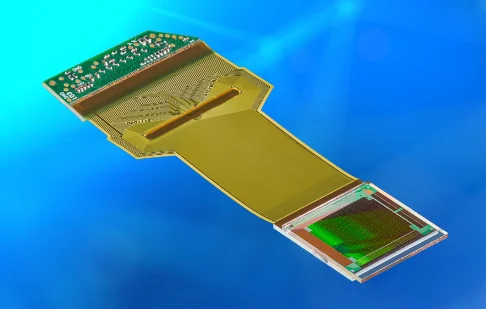
World’s first solid-state beam steering LiDAR sensor. Image used courtesy of Lumotive
Lumotive also offers a complete reference design built around the sensor that is about half the size of a credit card. The design comes with a complete set of manufacturing and support files. Lumotive has shared libraries in C/C++ and sample code written in Python to drive the sensor and display the results. Hokuyo provides instructions, sample code (in Python, C#, and Java), and libraries for using the YLM-LM10LX with robot operating system (ROS) and ROS2.
LiDAR in Action
LiDAR, or Light Detection and Ranging, is one of the three primary vision technologies used in automated driver assistance systems (ADAS) and robot vision systems, along with radar and binocular image processing. LiDAR emits a laser beam pulse and measures time-of-flight with the formula d = (c × t)/2, with d being the distance, c the speed of light, and t the time. A simple ranging system may look at whatever point is directly in front of the sensor. For practical 3D vision systems, either the sensor has to move or the laser beam does.
Lumotive and Hokuyo’s partnership presents the first LiDAR sensor of its kind to apply programmable, solid-state optics to 3D sensing for service robotics and industrial automation. According to the partners, the sensor offers a higher range field of view (FOV) and range than other solid-state products on the market, thanks to the LM10 chip.
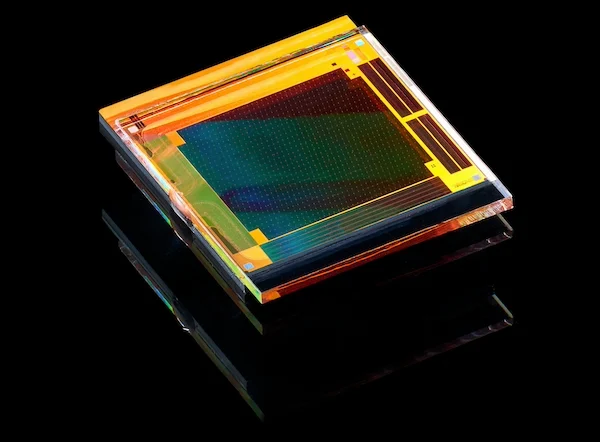
The LM10 chip. Image used courtesy of Lumotive
This solid-state beam steering component provides accuracy and stability in 3D object detection and distance measurement while also effectively managing multi-path interference. With its digital, software-defined scanning, users can modify the sensor’s detection range, resolution, and frame rate. It can also support multiple FOVs at once and adapt to an application’s changing requirements both indoors and outdoors.
