
If you have ever pulled a blown fuse out of a USB port protector, a battery pack, or a control board and wondered whether there is a better way, there is. A resettable fuse does the same overcurrent protection job as a traditional fuse.
However, it does not need to be dug out and replaced every time it trips. It heats up, limits the current, then cools back down and goes back to work on its own.
That self-healing behavior is why resettable fuses, most often built as PPTC (polymeric positive temperature coefficient) devices, show up everywhere from phone chargers to automotive wiring to industrial control panels.
This guide walks through how they actually work, the different types you will run into, the ratings that matter when you are selecting one, and where they tend to trip people up in real designs.
What Is a Resettable Fuse?
A resettable fuse is a reusable overcurrent protection device. Under normal current, it sits in a low-resistance state and barely affects the circuit.

When current climbs past a certain point, usually because of a short, a wiring fault, or a downstream failure, the device heats up and its resistance jumps sharply, which chokes the current down to a safe trickle.
Once the fault clears and the device cools off, it returns to its low-resistance state and the circuit works normally again, no replacement required.
You will see this component called a few different names depending on the manufacturer or the datasheet: PPTC fuse, PTC resettable fuse, polyfuse, PolySwitch (a Littelfuse trademark), or multifuse. They all refer to the same underlying technology.
Physically, a PPTC device is built from a polymer loaded with conductive carbon black particles.
At normal temperatures, the polymer sits in a crystalline structure that traps the carbon particles into millions of tiny conductive chains, so current flows freely.
When the current gets high enough to heat the polymer past a threshold, the material expands and shifts to an amorphous state, which breaks apart those conductive chains and sends resistance climbing fast.
That is the whole trick: it is a mechanical and thermal phase change, not a melting wire like a traditional fuse.
Fly-Wing stocks a full range ofPTC resettable fuses from major manufacturers, along with relatedcircuit breakers and fuses, if you want to jump straight to parts once you know what you need.
How Does a Resettable Fuse Work?
A resettable fuse works through three main states. Understanding each state helps you choose the right device, avoid nuisance trips, and make sure the circuit gets proper overcurrent protection.

Normal operation
Current flows through the device at or below its rated hold current.
Resistance stays low (often well under an ohm for small SMD parts), and the fuse is essentially invisible to the circuit aside from a small, predictable voltage drop.
Fault condition
When current exceeds the trip threshold, self-heating from I²R losses inside the polymer pushes the material past its phase-change temperature within milliseconds to a few seconds, depending on the severity of the overcurrent and the device’s thermal mass.
Resistance rises by several orders of magnitude, and current drops to a low leakage level, typically a small fraction of the original fault current, that continues to flow as long as the fault and power remain.
Reset
This is the part people misunderstand most often. A PPTC fuse does not “reset” the way a circuit breaker resets when you flip a switch.
It resets thermally: once the fault is cleared and, in most cases, power is removed or significantly reduced, the device cools, the polymer recrystallizes, and the conductive chains reform.
This typically takes anywhere from a few seconds to a couple of minutes depending on size and ambient conditions.
If the load current is still above the hold current when you try to reapply power, the device will simply trip again immediately, because it never had the thermal headroom to fully reset.
That last point answers a question that comes up constantly: why won’t my resettable fuse reset? Usually it is one of three things.
The fault is still present. The device hasn’t cooled enough yet. Or the normal operating current of your circuit is actually higher than the fuse’s hold current, meaning it was undersized from the start.
Resettable Fuse vs. Traditional Fuse
Both devices exist to protect a circuit from overcurrent, but they get there in very different ways, and that difference drives when you’d pick one over the other.
A traditional fuse contains a metal element that physically melts and opens the circuit permanently once it exceeds its rated current.
That gives you a hard, complete break, current effectively drops to zero, which matters in high-energy fault scenarios or wherever a residual leakage path is unacceptable.
The tradeoff is that someone has to replace it, which is a real problem in sealed enclosures, remote installations, or anything where downtime is expensive.
A resettable fuse never fully opens the circuit. Even in its tripped, high-resistance state, a small leakage current continues to flow.
That is by design, and it is actually part of how the device eventually resets, but it means a PPTC fuse is not a substitute for a traditional fuse everywhere.
For sensitive semiconductor protection, high-energy short circuits, or safety-critical isolation, a traditional fuse (or a resettable fuse working alongside one) is often still the right call.
For the much larger category of everyday overcurrent events, like a shorted USB cable, a jammed motor, or a battery pack fault, the resettable fuse’s ability to recover on its own without a truck roll or a service call is the whole reason it exists.
Important note: Thermistor-type current limiters are not always direct replacements for current-interrupting devices such as traditional fuses. In safety-critical designs, always check the end-equipment requirements and relevant standards.
Main Types of Resettable Fuses
PPTC Resettable Fuses

This is the umbrella term for the polymer-based devices described above, and it covers the vast majority of what people mean when they search for “resettable fuse.”
Within this category, the meaningful differences come down to package and voltage/current range rather than the underlying operating principle.
SMD Resettable Fuses
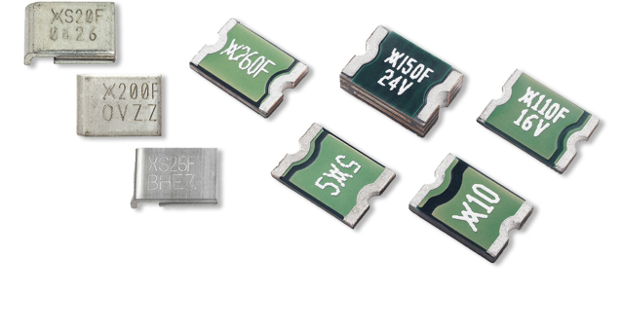
Surface-mount PPTC devices are the default choice on modern PCBs. Common sizes run from compact 0402/0603-style chip packages up through larger SMD footprints rated for a few amps.
They show up constantly in phones, tablets, USB ports, IoT boards, and battery protection circuits, largely because they reflow-solder alongside everything else on the board with no extra assembly step.
Fly-Wing carries a range of these, including parts like the Littelfuse SMD100F/33-2 and the compact nanoSMD series, if you want to see actual part specs.
Radial Leaded (Through-Hole) Resettable Fuses
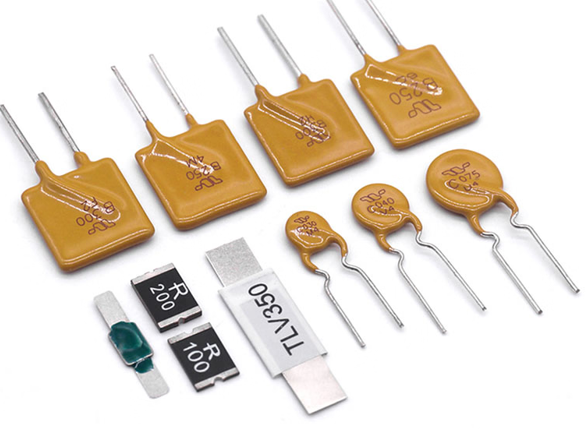
These are the older, larger-format devices, still very much in production, that solder into through-holes rather than reflowing onto pads.
They generally handle higher current and voltage than their SMD counterparts and dissipate heat more easily because of their larger physical size and lead-frame construction.
You will find them in power supplies, appliance control boards, and industrial equipment where board space is less constrained than in consumer electronics.
Automotive Resettable Fuses
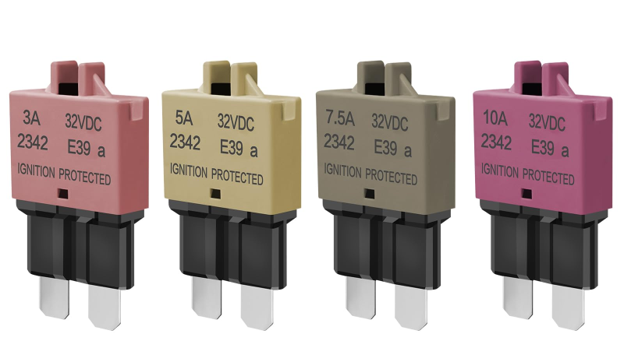
Automotive applications add a wrinkle: the term gets used for two genuinely different things.
One is a PPTC device rated for automotive temperature ranges and vibration, used the same way as anywhere else, in series with a low-voltage DC circuit.
The other is a resettable circuit breaker, often a blade-style part that physically resembles a standard automotive blade fuse but uses a bimetallic or magnetic trip mechanism instead of a polymer.
Blade-style resettable breakers are common for accessory circuits and lighting where a temporary overload (like an inrush current) shouldn’t require popping the hood, while PPTC devices tend to show up embedded on control boards inside the vehicle rather than in the fuse box itself.
PTC Resettable Fuses vs. Thermal Cutoffs (Thermal Fuses)
Here is a distinction worth getting right, because the names are close enough to cause real confusion.
A PTC resettable fuse responds primarily to current-induced self-heating, and it resets on its own once the fault clears and it cools.
A thermal cutoff, sometimes called a thermal fuse, is a completely different, non-resettable device: it is designed to permanently open when ambient or component temperature exceeds a fixed threshold, regardless of current, and once it trips, it has to be replaced.
Fly-Wing’s own Thermal Cutoffs (Thermal Fuses) category and PTC Resettable Fuses category are kept as separate product lines for exactly this reason: they solve related but distinct problems, and swapping one for the other in a design is a mistake, not a style choice.
If your application needs a hard, one-time thermal shutdown for safety reasons (many appliance motor windings, for instance), a thermal cutoff is the correct part, not a PPTC fuse.
It is also worth noting that PTC thermistors, a related but separate product family used mainly for temperature sensing rather than circuit protection, sometimes get lumped into the same conversation because they share the same positive-temperature-coefficient physics.
Fly-Wing’s PTC Thermistors category and the site’s Thermistor vs. RTD comparison are useful if you’re trying to sort out sensing components from protection components.
Key Ratings and Terms You Need to Know
Selecting a resettable fuse is not just about choosing an amp rating. You need to understand how its main parameters work together.
If you choose the wrong part, the fuse may trip during normal operation. Or worse, it may not trip when the circuit actually needs protection.
Hold Current IH
Hold current is the maximum current the fuse can carry without tripping at a specified ambient temperature, usually 23°C or 25°C.
Choose a hold current that is higher than your circuit’s maximum normal operating current. Also leave enough margin for startup current, load changes, and temperature effects.
Trip Current IT
Trip current is the current level at which the fuse is expected to trip.
It is higher than the hold current. In many resettable fuses, trip current is around 1.5 to 2 times the hold current, but this depends on the part family.
Do not design your circuit to operate between the hold current and trip current. In this range, the fuse may or may not trip reliably.
Maximum Voltage
Maximum voltage is the highest voltage the fuse can safely handle while limiting current during a fault.
This rating must be equal to or higher than your circuit’s maximum operating voltage. Treat it as a strict limit, not a target. A resettable fuse with the wrong voltage rating may fail during a fault.
Maximum Fault Current
Maximum fault current is the highest short-circuit current the fuse can survive without physical damage.
This is different from trip current. Trip current tells you when the fuse should react. Maximum fault current tells you how much fault current the device can safely withstand.
Always compare this rating with the worst-case short-circuit current your power source can deliver.
Resistance
A resettable fuse has resistance even during normal operation. This resistance causes voltage drop and power loss.
It is especially important in low-voltage circuits, where even a small voltage drop can affect performance.
Also check the datasheet for initial resistance and post-trip resistance. After a trip, the fuse resistance may stay higher for some time before fully recovering.
Time to Trip
A resettable fuse does not trip instantly. Trip time depends on the fault current, device size, thermal mass, and ambient temperature.
A hard short can trip the fuse quickly. However, a mild overload may take much longer. If you are protecting sensitive components, check the time-current curve in the datasheet instead of assuming the fuse will react fast enough.
Temperature Derating
Ambient temperature changes how a resettable fuse behaves.
As temperature rises, the fuse is already closer to its trip point. This means its usable hold current becomes lower. A fuse that works fine at room temperature may trip too early inside a hot enclosure.
Always check the manufacturer’s derating curve before final selection. Skipping this step is one of the most common resettable fuse selection mistakes.
How to Select the Right Resettable Fuse
Use this process when choosing a resettable fuse for a real circuit.
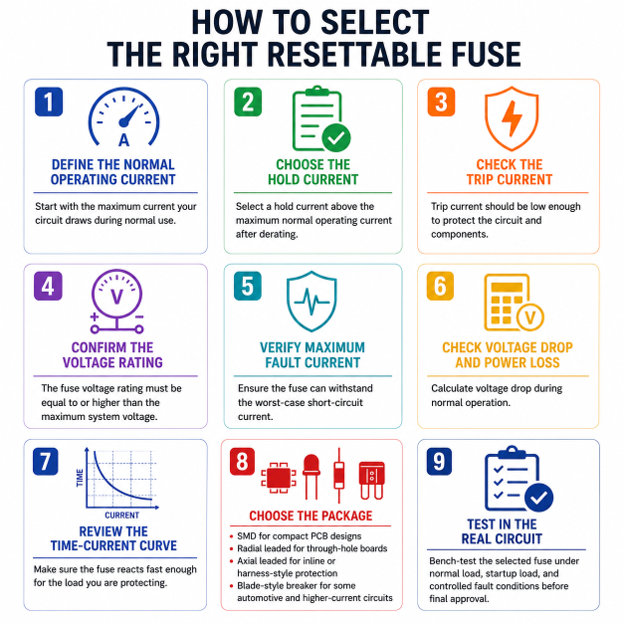
Step 1: Define the Normal Operating Current
Start with the maximum current your circuit draws during normal use. Include startup current, inrush current, motor start current, charging current, and peak load conditions.
Do not select the fuse based only on average current.
Step 2: Choose the Hold Current
Select a hold current above the maximum normal operating current after derating.
For example, if your circuit normally draws 750mA and may operate in a warm enclosure, a 750mA hold-current fuse may be too small. You may need a higher-rated device after checking the datasheet curve.
Step 3: Check the Trip Current
Trip current should be low enough to protect the circuit, PCB traces, connectors, wiring, and downstream components.
If the trip current is too high, the fuse may allow damaging current for too long.
Step 4: Confirm the Voltage Rating
The fuse voltage rating must be equal to or higher than the maximum system voltage.
For automotive or industrial DC circuits, include voltage spikes and operating margin when reviewing the design.
Step 5: Verify Maximum Fault Current
Check how much current the power source can deliver during a short circuit.
A USB port, lithium battery pack, bench supply, or automotive battery can all deliver very different fault currents. The resettable fuse must survive the worst-case fault.
Step 6: Check Voltage Drop and Power Loss
Calculate voltage drop during normal operation.
If the circuit is sensitive to supply voltage, choose a lower-resistance device or a larger package.
Step 7: Review the Time-Current Curve
Look at the trip-time curve in the datasheet. Make sure the fuse reacts fast enough for the load you are protecting.
For motors, allow normal startup current. For semiconductors, make sure the fuse does not react too slowly.
Step 8: Choose the Package
Select the package based on the application:
- SMD for compact PCB designs
- Radial leaded for through-hole boards and higher dissipation
- Axial leaded for inline or harness-style protection
- Blade-style breaker for some automotive and higher-current circuits
Step 9: Test in the Real Circuit
Datasheet ratings are based on defined test conditions. Real PCBs have different airflow, copper area, enclosure temperature, and nearby heat sources.
Bench-test the selected fuse under normal load, startup load, and controlled fault conditions before final approval.

Where Resettable Fuses Show Up
Resettable fuses are used in many circuits where temporary faults can happen and automatic recovery is useful.
USB and Charging Ports
USB-A and USB-C ports often use small resettable fuses to protect against shorted cables or connected devices that draw too much current.
Battery Packs and Portable Electronics
Rechargeable battery systems often use resettable fuses with protection ICs. Together, they help protect the battery during charging, discharging, or short-circuit events.
Power Supplies
Power supply outputs often use resettable fuses to protect downstream loads. If one load develops a short, the fuse can limit current without permanently shutting down the whole supply.
Automotive Electronics
Low-voltage vehicle circuits, control modules, and wiring harnesses may use resettable fuses for board-level protection. For higher-current accessory circuits, blade-style resettable breakers are often used instead.
HVAC and Appliance Control Boards
Control boards in HVAC systems and appliances are not always easy to access. A resettable fuse helps the board recover from temporary faults without requiring fuse replacement.
Development Boards and DIY Electronics
Many Arduino-compatible boards and prototyping boards use a small resettable fuse on the USB or power input. This helps protect the board from accidental shorts during testing.
Telecom and Industrial Equipment
Telecom and industrial systems often operate in hard-to-access locations. Resettable fuses help reduce downtime and service calls when repeated fault events are possible.
Advantages and Limitations
The case for resettable fuses is straightforward: they recover automatically without service intervention, they’re compact, especially in SMD form, and they hold up well against repeated temporary faults that would otherwise mean replacing a traditional fuse over and over.
The tradeoffs are just as real, though, and worth weighing honestly before you commit to one in a design:
- They’re slower than fast-blow fuses, which matters for protecting fragile semiconductors from very fast fault events.
- Resistance, both initial and post-trip, adds a voltage drop that can matter in low-voltage or high-precision circuits.
- Trip behavior is temperature-dependent, so a device that performs fine on the bench can behave differently in a hot enclosure.
- The device doesn’t fully isolate the circuit; leakage current persists in the tripped state, which rules it out for applications that need a hard, guaranteed disconnect.
- Repeated trip cycles can gradually shift resistance and, over enough cycles, degrade performance, so a PPTC fuse that’s tripped hundreds of times isn’t necessarily performing exactly like a new one.
How to Test a Resettable Fuse
To reset a PPTC resettable fuse, remove the overload or short circuit first. Then remove or reduce power and allow the device to cool.
A resettable fuse may take a few seconds to several minutes to recover. Larger parts and hotter environments usually need more time.
If the fuse trips again immediately, check for:
- A remaining short circuit
- A load current above the hold current
- Poor derating at high temperature
- Incorrect fuse selection
- A damaged fuse
- A circuit that needs a different protection method
A quick safety note: never short a live, unlimited power supply just to see whether a fuse trips.
Use a current-limited bench supply and follow the datasheet’s test conditions, both to protect the device and to get a result that actually reflects real-world behavior.
Sizing by Current and Voltage: What Actually Changes
Rather than walking through five near-identical “1A fuse” and “3A fuse” examples that would just repeat the same selection logic with a different number, here’s what genuinely changes as you move across the current and voltage range, and why it matters for your part choice.
| Range | Typical use case | What to watch for |
| Sub-1A (SMD, low voltage) | Sensor circuits, low-power boards, signal lines | Resistance and voltage drop matter more here since currents are small; check that trip current doesn’t sit too close to your working signal levels |
| 1-3A | USB ports, small DC accessories, control boards | Standard SMD territory; hold/trip margin and ambient temperature derating are the main design levers |
| 3-5A | Moderate loads, power rail protection, accessory circuits | Package size and heat dissipation start to matter more; through-hole or larger SMD packages often make more sense here |
| 12V automotive/DC | Vehicle accessory circuits, low-voltage DC systems | Confirm you actually need a PPTC device rather than a blade-style resettable breaker; automotive temperature range and vibration tolerance become real selection criteria |
| 20A+ | Higher-current automotive or industrial circuits | At this range, many “resettable fuse” searches are actually looking for resettable circuit breakers, not PPTC devices; verify which technology your application genuinely needs before shopping by amperage alone |
Resettable Fuse vs. Circuit Breaker
A resettable fuse and a circuit breaker both protect against overcurrent, but they are not the same.
A PPTC resettable fuse resets automatically after cooling. It has no switch, lever, or button. It is usually used at PCB level.
A circuit breaker uses a mechanical, magnetic, thermal, or bimetallic mechanism. Some breakers reset manually, while some automotive-style breakers reset automatically after cooling.
Use a resettable fuse for compact, board-level protection. Use a circuit breaker when you need higher current handling, a visible reset action, or serviceable panel-level protection.
Fly-Wing’s dedicated Fuse vs. Circuit Breaker guide covers this comparison in more depth, including where a layered approach using both makes sense.
Common Mistakes to Avoid
Avoid these mistakes when selecting a resettable fuse:
- Choosing only by current rating
- Ignoring ambient temperature
- Confusing hold current with trip current
- Ignoring voltage rating
- Ignoring available short-circuit current
- Forgetting voltage drop
- Assuming the fuse fully opens the circuit
- Skipping the time-current curve
- Using a PPTC fuse where a fast fuse is needed
- Testing with an unlimited short
- Using a thermal cutoff as a substitute for a resettable fuse
Final Thoughts
A resettable fuse is a practical choice when a circuit needs reusable overcurrent protection.
It is especially useful in USB ports, battery systems, power supplies, development boards, appliances, automotive electronics, and industrial control circuits.
The right part depends on more than amperage. You need to check hold current, trip current, voltage rating, maximum fault current, resistance, trip time, temperature derating, and package style.
If you’re sourcing parts for a design, Fly-Wing carries a wide range of PTC resettable fuses, along with related circuit breakers, thermal cutoffs, and fuseholders to round out your circuit protection strategy.
FAQs About Resettable Fuses
How do resettable fuses work?
A resettable fuse works by increasing its resistance when too much current flows through it. This limits current during a fault. After the fault clears and the device cools, it returns to a low-resistance state.
How does a resettable fuse reset?
It resets thermally. Remove the fault, turn off or reduce power, and let the device cool. It does not reset like a mechanical switch.
What is the difference between hold current and trip current?
Hold current is the current the fuse can carry without tripping. Trip current is the current level where the fuse is expected to trip. The area between these two values is not a guaranteed operating region.
Can I use a resettable fuse instead of a normal fuse?
Sometimes, yes. A resettable fuse is useful for temporary and repeated faults. However, it is not a universal replacement for a traditional fuse. Use a traditional fuse when the circuit needs a hard disconnect, very low leakage, or safety-certified one-time protection.
Do resettable fuses wear out?
They can handle many trip cycles, but repeated trips may increase resistance or change performance over time. If a fuse trips often, fix the root cause instead of relying on repeated resets.
Why will my resettable fuse not reset?
The fault may still be present, the device may still be hot, or the normal load current may be higher than the hold current. The fuse may also be damaged or incorrectly selected.
Are resettable fuses good for automotive circuits?
Yes, for many low-voltage automotive control and accessory circuits. However, high-current vehicle circuits often need a standard automotive fuse or resettable blade-style circuit breaker.
Is a resettable thermal fuse the same as a PPTC fuse?
No. A PPTC resettable fuse responds mainly to current-induced heating and resets after cooling. A thermal cutoff opens permanently at a fixed temperature and must be replaced.
Can I make a resettable fuse?
For real circuit protection, use a tested commercial resettable fuse. Making one yourself is not practical or safe because trip behavior, resistance, voltage rating, and fault-current survival must be controlled and verified.


COMMENTS