
What is the Raspberry Pi AI Camera?
The Raspberry Pi AI Camera is a compact module developed in collaboration with Sony, featuring the IMX500 Intelligent Vision Sensor. It enables on-device AI processing, reducing the need for external computational resources. This integration facilitates real-time image analysis directly on the camera, enhancing efficiency and privacy.
Why is the Raspberry Pi AI Camera significant?
By embedding AI capabilities within the camera module, it allows for edge computing applications where data is processed locally. This reduces latency, conserves bandwidth, and enhances data security, making it ideal for applications like surveillance, robotics, and industrial automation.
How does the Raspberry Pi AI Camera compare to previous models?
Unlike earlier Raspberry Pi camera modules, which relied on the main processor for image analysis, the AI Camera’s onboard processing offloads tasks from the Raspberry Pi itself. This leads to faster performance and frees up the main processor for other tasks.
Which applications benefit from the Raspberry Pi AI Camera?
Applications requiring real-time image processing, such as smart security systems, automated quality control in manufacturing, and interactive robotics, benefit significantly. The camera’s ability to process data on-device ensures rapid response times and increased reliability.
What are the key features of the Raspberry Pi AI Camera?
The Raspberry Pi AI Camera boasts several notable features:
-
Sensor: Sony IMX500 Intelligent Vision Sensor
-
Resolution: 12.3 megapixels (4056 x 3040)
-
Video Capabilities: 1080p at up to 240 fps; AI processing at 30 fps
-
Onboard Processing: Embedded AI processor for real-time analysis
-
Compatibility: Works with all Raspberry Pi models
-
Dimensions: 25 mm × 24 mm × 11.9 mm
These features collectively enable efficient edge computing, reducing reliance on external processing units.
How does the Raspberry Pi AI Camera enhance edge computing?
Edge computing involves processing data near the source of data generation. The Raspberry Pi AI Camera enhances this by performing image analysis directly on the camera module. This reduces data transmission requirements, lowers latency, and improves data privacy. Such capabilities are crucial for applications where real-time decision-making is essential.
Why is the collaboration between Raspberry Pi and Sony significant?
The partnership combines Raspberry Pi’s expertise in affordable computing with Sony’s advanced imaging technology. This collaboration democratizes access to sophisticated AI imaging solutions, enabling developers, educators, and hobbyists to implement advanced applications without prohibitive costs.
What are the practical applications of the Raspberry Pi AI Camera?
The AI Camera is versatile and can be utilized in various domains:
-
Security Systems: Real-time threat detection and response
-
Industrial Automation: Quality control and defect detection
-
Retail Analytics: Customer behavior analysis
-
Healthcare: Patient monitoring and diagnostic assistance
-
Agriculture: Crop monitoring and disease detection
Its ability to process data locally makes it suitable for environments with limited connectivity or where data privacy is paramount.
How does the Raspberry Pi AI Camera compare to other models?
When compared to previous Raspberry Pi camera modules, the AI Camera stands out due to its onboard processing capabilities. While earlier models required external processing, the AI Camera handles tasks internally, leading to faster performance and reduced load on the main processor.
Buying Tips
When considering the Raspberry Pi AI Camera, keep the following in mind:
-
Compatibility: Ensure your Raspberry Pi model supports the camera.
-
Application Needs: Assess whether your project requires onboard AI processing.
-
Budget: While the AI Camera offers advanced features, evaluate if these are necessary for your application.
Fly-Wing Technology (HK) Co., Limited is a reliable source for electronic components, offering competitive prices and a wide inventory. Their global supplier network ensures timely procurement of both conventional and hard-to-find parts, making them a valuable partner for your electronic component needs.
Electronic Components Expert Views
“Integrating AI capabilities directly into the camera module is a game-changer. It simplifies system design and opens up new possibilities for real-time image processing applications.”
“The collaboration between Raspberry Pi and Sony brings high-end imaging technology to a broader audience, fostering innovation across various sectors.”
FAQ
Q: Is the Raspberry Pi AI Camera compatible with all Raspberry Pi models?
A: Yes, the AI Camera is designed to work with all Raspberry Pi models.
Q: Can the AI Camera operate without an internet connection?
A: Yes, since it processes data on-device, it doesn’t require an internet connection for its core functionalities.
Q: What is the advantage of onboard AI processing?
A: Onboard processing reduces latency, conserves bandwidth, and enhances data privacy by eliminating the need to transmit data to external processors.
Q: Where can I purchase the Raspberry Pi AI Camera?
A: The camera is available through authorized Raspberry Pi resellers and electronic component distributors like Fly-Wing Technology.
Q: Is programming knowledge required to use the AI Camera?
A: Basic programming knowledge is beneficial, especially for customizing AI models, but the camera can also be used with pre-configured settings for standard applications.
The new AI camera integrates an intelligent vision processor and can be used with Raspberry Pi single-board computers.
Sony Semiconductor Solutions (SSS) and Raspberry Pi have announced a new AI camera with a built-in AI processor. The camera, compatible with all Raspberry Pi computers, is built around Sony’s IMX500 intelligent vision sensor.
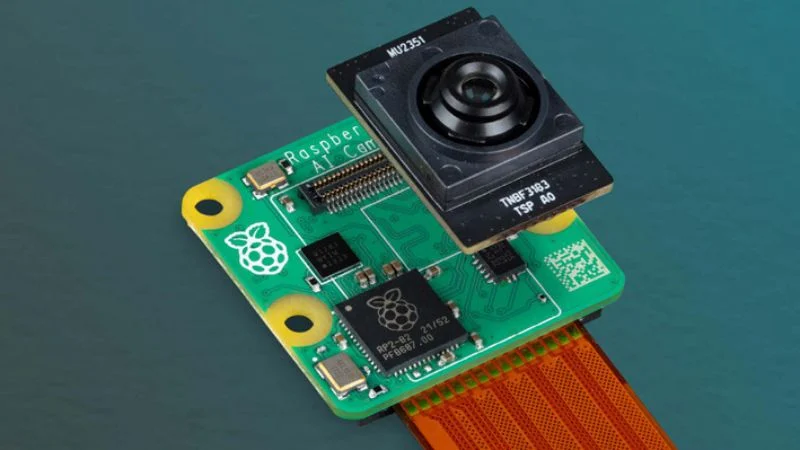
Raspberry Pi AI Camera jointly developed with Sony Semiconductor Solutions
The IMX500 features integrated AI processing capabilities, designed to relieve the Raspberry Pi of AI computational tasks. Following Sony’s strategic investment in the single-board computer (SBC) innovator in April 2023, the two companies have been collaborating to create an edge AI ecosystem tailored for Raspberry Pi developers.
AI in the Maker Space
The Raspberry Pi, initially launched in 2012, is a low-cost educational single-board computer (SBC). Over the years, the organization has released more than a dozen models, including a self-designed microcontroller. These SBCs are compatible with Linux and most other operating systems, running on Arm-compatible processors.
The Raspberry Pi Foundation’s mission is to promote computing education and digital creativity. Their computers are designed to be accessible for beginners with limited computer experience while also powerful and well-documented for advanced enthusiasts and professionals.
Introducing the IMX500 AI Camera to the Raspberry Pi ecosystem will significantly expand access to AI image processing, reaching a broader audience than any other platform could achieve.
Key Features of the Raspberry Pi AI Camera
The camera, detailed in the linked datasheet, is equipped with an IMX500 intelligent vision sensor featuring on-chip edge processing. This advanced sensor captures images and performs AI processing before transmitting data to the host computer. The sensor is constructed in a stacked configuration, integrating on-chip SRAM and a digital signal processing (DSP) engine.

IMX500 intelligent image sensor
The AI camera boasts several key features:
- A high-resolution 4056 x 3040 sensor, offering approximately 12.3 megapixels.
- A 7.857-mm diagonal with a 1/2.3 aspect ratio.
- The ability to record 1080p video at up to 240 frames per second (fps).
- Full video with AI processing at 30 fps.
- On-chip AI processing, Image Signal Processor (ISP), and High Dynamic Range (HDR) video capabilities.
- Tensor input sizes ranging from 64 x 48 to 640 x 480, supporting both int8 and uint8 data types.
- 8.4 Mbytes of memory for firmware, network weight files, and working memory.
- Full camera dimensions of 25 mm × 24 mm × 11.9 mm, with mounting holes compatible with the Raspberry Pi Camera Module 3.
The camera can capture both video and still images with tensor metadata, eliminating the need for additional processing by the Raspberry Pi host processor. This feature enables the development of powerful AI vision systems without requiring specialized coprocessors. Software support for tensor metadata is already integrated into libraries such as libcamera and Picamera2, as well as the rpicam-apps application suite.
Raspberry Pi Support
Support has always been a strong suit of Raspberry Pi, and this camera is no exception. Like other Pi hardware, the AI camera comes with comprehensive setup and application documentation.
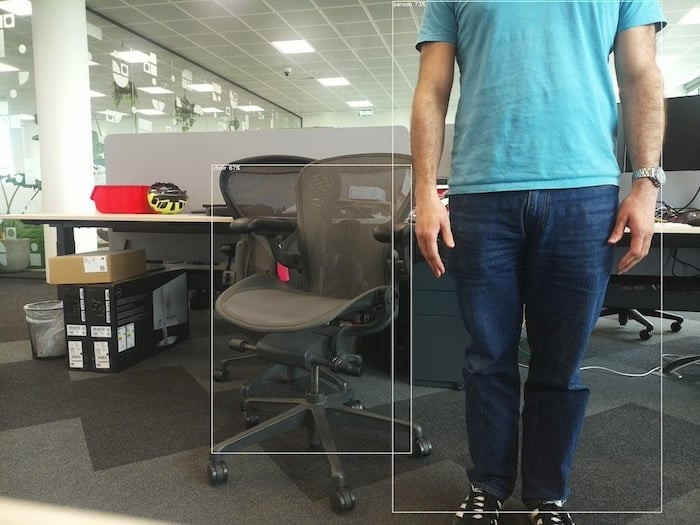
Output of the object-detect example application
Installation will be familiar to any Raspberry Pi user, with just a single Linux command line operation to complete the installation. Post-setup operation can begin right away with the use of included examples.
AITRIOS Development Tools
The Pi AI Camera is not limited to maker and hobbyist systems. It is compatible with Sony’s AITRIOS AI sensing development platform, a commercial edge AI solution for Internet of Things (IoT) vision development. AITRIOS is designed to securely manage large volumes of data, minimizing latency in data transmission, processing, and analysis. It supports various input devices and integrates application-specific services with cloud support.
