
A potentiometer, often called a pot by engineers, is one of the simplest and most reliable ways to adjust voltage in a circuit. Turn the knob or slide the lever and you instantly change how much signal passes through.
So engineers and designers use potentiometers everywhere like in audio volume controls, LED dimmers, sensor calibration circuits, motor controllers, and industrial equipment that requires precise manual adjustment.
If you have worked with electronics in any form, such as Arduino projects, audio repair, robotics, or embedded hardware design, you have likely used a potentiometer already.
These components are affordable, dependable, and very versatile, which makes them popular in both hobby projects and professional designs.
In this guide, you will learn how a potentiometer works, what its symbol and pinout look like, the different types available, and how to wire one correctly.
You will also see real-world applications and a clear selection guide so you can choose the right potentiometer for your next project with confidence.
Potentiometer Symbol and Pinout Explained
In circuit diagrams, the potentiometer symbol looks like a resistor with an arrow touching the middle of it.

The resistor part represents the fixed resistive track. The arrow represents the wiper, which moves along the track and picks off a variable voltage.
You may see two common symbol styles:
- A zigzag resistor with an arrow pointing to the middle
- A rectangular block resistor with an arrow pointing to the middle
Both symbols mean the exact same thing. They both represent a three terminal variable resistor used as a voltage divider or current control device.
Potentiometer Pinout
A standard potentiometer has three pins which you can see below:

| Pin | Common Label | Description |
| Pin 1 | A or VCC | One end of the resistive track. Often connected to the positive supply. |
| Pin 2 | Wiper or OUT | The movable contact. This pin outputs a variable voltage based on knob or slider position. |
| Pin 3 | B or GND | The other end of the resistive track. Often connected to ground. |
When you rotate the shaft or slide the lever:
- Moving the wiper closer to Pin 1 increases the output voltage
- Moving the wiper closer to Pin 3 decreases the output voltage
If you look at a typical rotary potentiometer from the front with the shaft facing toward you and the pins pointing downward:
- The left pin is Pin 1
- The middle pin is the wiper
- The right pin is Pin 3
How a Potentiometer Works
A potentiometer works on the voltage divider principle. Inside the device, a resistive track connects between the supply voltage and ground.
A movable contact, called the wiper, slides along this track. The wiper picks off a voltage that lies somewhere between the two ends of the resistor.
When you rotate the shaft or move the slider, the wiper changes position on the resistive element. The closer it is to the supply terminal, the higher the output voltage. The closer it is to ground, the lower the output voltage.
This simple action makes the potentiometer a smooth and reliable way to adjust brightness, volume, gain, speed or sensor sensitivity.
Potentiometers Internal Structure
The diagram below shows the key components inside a typical potentiometer.
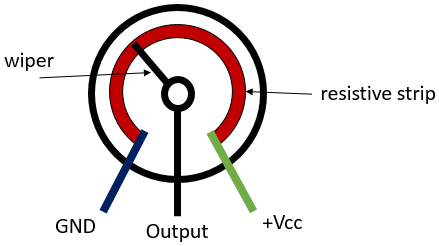
| Component | Description |
| Resistive Strip | A curved or straight track made from carbon, cermet or conductive plastic. |
| Wiper (Slider or Brush) | A movable contact that slides along the resistive element and produces the output voltage. |
| Housing | The outer body that supports and protects the internal parts. |
| Shaft or Slider | The part you turn or slide to move the wiper along the track. |
| Terminals (3) | The two end terminals connect to the ends of the resistive track. The center terminal is the wiper output. |
Voltage Divider Concept
To understand how a potentiometer creates a variable voltage, consider the following terminal arrangement:

- Terminal 1: Connected to VCC
- Terminal 3: Connected to ground
- Terminal 2: Wiper output
As the wiper moves: Closer to Terminal 1, the output voltage increases toward the supply voltage.
Then closer to Terminal 3, the output voltage decreases toward ground
This core principle allows the potentiometer to function as an adjustable control. Check more information on the voltage divider concept.
Modes of Use
We can also wire a potentiometer in two main ways, depending on the application.
| Mode | Terminals Used | Function |
| Voltage Divider | All 3 terminals | Produces a variable output voltage. Common in analog controls and sensor inputs. |
| Variable Resistor (Rheostat) | One end terminal and the wiper | Controls current or resistance in a circuit. Useful for dimming LEDs or adjusting sensitivity. |
Potentiometer Specifications and Key Parameters
When choosing a potentiometer, it is important to understand how it behaves in a circuit.
These parameters directly determine the accuracy, durability, and smoothness of control your application will get.
Below is a clear overview of the most important potentiometer specifications and what they mean.
| Parameter | Description | Typical Range or Options |
| Resistance Value | Total resistance between the end terminals. | 1 kΩ to 1 MΩ |
| Taper Type | How resistance changes with rotation. | Linear (B), Log (A), Reverse Log |
| Power Rating | Maximum power it can handle safely. | 0.1 W to 2 W |
| Tolerance | Accuracy of the stated resistance value. | ±10%, ±20%, ±5% (precision) |
| Mechanical Rotation Angle | Total physical rotation of the shaft. | 270° to 360° |
| Electrical Angle | Usable rotation where resistance changes. | 240° to 300° |
| Life Expectancy | Number of rotations or slider cycles. | 10,000 to 1,000,000 cycles |
| Temperature Coefficient | How resistance changes with temperature. | ±100 ppm/°C to ±500 ppm/°C |
| Contact Resistance Variation | Small resistance changes caused by wiper movement. | Less than 5 mV preferred |
| Mounting Style | How the pot is installed. | Through-hole, SMD, panel mount |
| Shaft Type | Shape and style for knob compatibility. | Knurled, flat, slotted, round |
| Linearity | Accuracy of resistance change across rotation. | ±5% to ±20% |
| Ingress Protection | Dust or water protection rating. | IP40, IP65, IP67 |
Each parameter affects accuracy, durability, smoothness of control and overall compatibility with your circuit. Knowing these values also helps you choose the right potentiometer for your design.
Types of Potentiometers
Potentiometers are available in several forms, each designed to suit a particular style of adjustment, level of precision or operating environment.
Although the basic working principle remains the same, the construction and user interaction vary from type to type.
Rotary Potentiometers
A rotary potentiometer has a circular resistive track and a shaft that rotates the wiper across it.
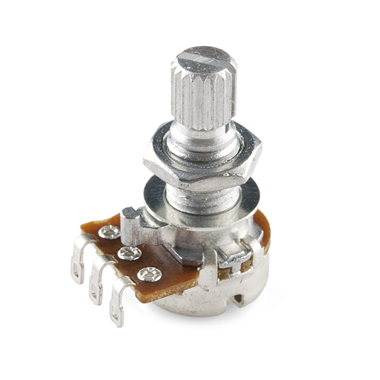
When you turn the knob, you change the voltage smoothly, and you get a familiar, intuitive feel.
Rotary pots are found in audio equipment, home appliances, control panels and countless hobby circuits because they are durable, easy to operate and available in many resistance values and taper types.
Moreover, rotary potentiometers come in many configurations depending on power rating, rotation angle, and resistive material.
For example, industrial models such as the TT Electronics P270-DS21R5K or the Panasonic EVL-HFKA05A24 thumbwheel-style rotary pot offer high durability and smooth rotational control.
This makes them suitable for appliances, audio systems, and general-purpose adjustment circuits.

Linear (Slide) Potentiometers
Linear potentiometers use a straight resistive track instead of a curved one. A sliding handle moves the wiper from one end to the other in a linear motion.

Because the slider position directly reflects the resistance value, users prefer linear pots when they need clear visual feedback.
You will also find them in audio mixing consoles, equalizers, lighting controllers, and laboratory instruments where fine, continuous adjustment matters.
In these setups, slide potentiometers give users an immediate visual indication of the control position, which makes them ideal for mixers and lighting consoles.
Components like the TT Electronics PS30-10PB10BR10K or the Bourns PTB6043-2010BPA103 offer smooth travel and long mechanical life
This makes them ideal for user interfaces where tactile accuracy matters.
Trimmer Potentiometers (Trimpots)
Trimmer potentiometers are small, screw-adjustable devices meant for occasional or one-time calibration. Instead of a knob or slider, they use a tiny screw mechanism that moves the wiper.
They can mount onto PCBs and adjust during manufacturing or servicing.
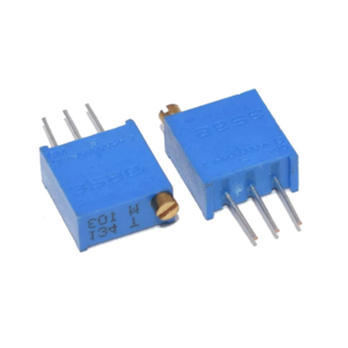
You will often see these in sensor circuits, voltage references, timing circuits and calibration points in embedded hardware.
We use Trimmer potentiometers for PCB tuning and one-time calibration. They are compact, stable, and adjustable with a screwdriver.
Popular examples include the BI Technologies67WR1K (vertical cermet trimmer) and the Bourns 3262P-1-254LF, commonly used for sensor calibration, reference-voltage tuning, and analog circuit trimming.
Digital Potentiometers (Digipots)
A digital potentiometer performs the same function as an analog pot but without any mechanical movement.
Digital signals such as SPI or I²C control the wiper position electronically.
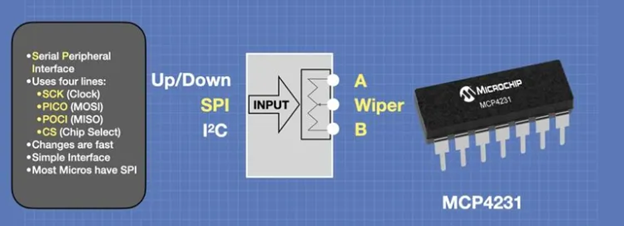
This allows microcontrollers to adjust resistance automatically with high repeatability.
Digipots are used in programmable gain amplifiers, remote calibration systems, volume controls, and modern embedded devices that require precise and stable adjustments over long periods.
Precision Potentiometers
Precision potentiometers are engineered for applications where accuracy, stability and repeatability are critical.
They often use high-quality resistive materials, very low contact resistance variation and tightly controlled linearity.
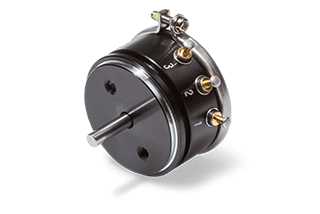
Because of this, they maintain stable performance even after many adjustment cycles. These types are used in medical equipment, aerospace controls, scientific instruments and other high-reliability systems.
Hybrid Potentiometers
Hybrid potentiometers combine different resistive technologies, such as a wirewound section for power handling and a conductive plastic section for smooth control.
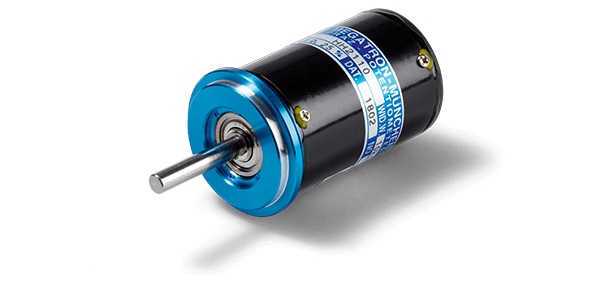
This hybrid approach offers the benefits of both worlds: the durability and high wattage capability of wirewound elements and the quiet, low-noise operation of plastic tracks.
We use hybrid ones for industrial machinery, servo controls and other demanding environments where both precision and strength are important.
Ceramic and Cermet Potentiometers
Ceramic or cermet potentiometers use a ceramic-based resistive element that provides excellent temperature stability and low noise.

They maintain accuracy even under changing environmental conditions, which makes them ideal for harsh or high-temperature settings. These potentiometers are commonly found in automotive electronics, communication equipment, instrumentation and applications that require long-term stability.
Potentiometer Circuit Examples for Beginners
Case Study 1: LED Dimmer Using a Potentiometer
This circuit is the simplest way to see how a potentiometer controls current. The potentiometer acts as a variable resistor.
When you rotate the knob, the resistance changes, which increases or decreases the current flowing through the LED.
Lower resistance makes the LED brighter, and higher resistance makes it dimmer. A 1 kΩ resistor is added in series to protect the LED from excessive current.

To build it, connect one outer terminal of the potentiometer to the positive supply. Connect the wiper to the LED through the 1 kΩ resistor, and connect the LED back to ground. Turning the potentiometer gives smooth brightness control with only a few components.
Case Study 2: Arduino Potentiometer with LED Control
This example introduces a microcontroller but keeps the circuit simple.
The potentiometer is wired as a voltage divider, and the wiper connects to one of the Arduino’s analog input pins, such as A0.
As the knob moves, the voltage on the wiper changes between 0 and 5 volts, which the Arduino reads as values from 0 to 1023.
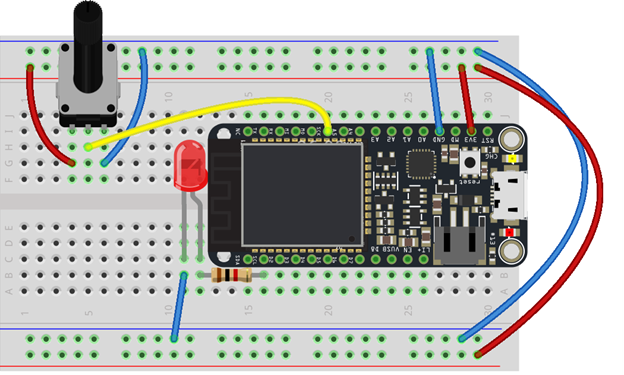
In the code, this reading is mapped to a range of 0 to 255 and used to adjust the LED brightness through PWM on a digital pin.
The circuit shows how a potentiometer can act as a smooth, real-time input device for microcontroller projects.
Case Study 3: LED Strip Dimmer Using a MOSFET and Potentiometer

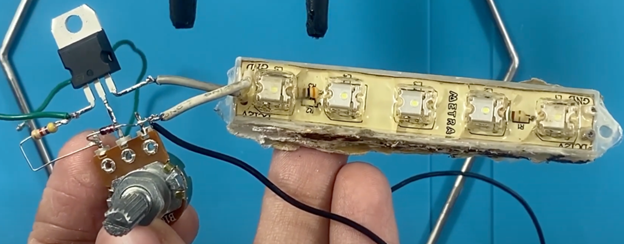
This circuit extends the idea to higher power loads, such as LED strips that operate on 12 volts.
The potentiometer controls the voltage applied to the gate of an N-channel MOSFET like the IRFZ44N.
The MOSFET regulates how much current flows through the LED strip. A low gate voltage keeps the strip dim, and a higher gate voltage increases the brightness.
A small resistor limits current into the MOSFET gate, and a diode provides protection from reverse voltage.
Developers commonly use this setup in lighting control projects where a simple potentiometer needs to adjust the brightness of a larger, more powerful LED strip.
Applications of Potentiometers
Potentiometers appear in a wide range of electronics because they offer simple, reliable and precise manual control.
Whether the goal is to adjust a signal level, tune a sensor or measure mechanical movement, the same basic principle makes them useful across many industries.
Audio and Volume Control
One of the most familiar uses of a potentiometer is controlling audio volume. A rotary pot acts as a voltage divider that changes the audio signal level before it reaches the amplifier.
Turning the knob reduces or increases the amplitude of the signal.
This is why radios, speakers, headphones and home audio systems have used rotary pots for decades.
Sensor Calibration and Tuning
In embedded systems, many sensors require small adjustments to operate accurately. A trimmer potentiometer can fine-tune the output of temperature sensors, light sensors, gas detectors and similar analog circuits.
For example, in a gas leak detector, a trimmer pot adjusts the reference voltage so the sensor responds correctly to concentration changes.
User Interface and Control Panels
Potentiometers provide intuitive control in appliances, laboratory instruments and industrial dashboards. A simple rotation of a knob can set fan speed, oven temperature, motor speed or light intensity.
Linear slide potentiometers are often used when a visual indication of position is helpful, such as in photometers or lighting consoles.
Position and Angle Sensing
A potentiometer can operate as a basic position sensor by converting mechanical movement into a proportional voltage.
Robotic arms, throttle assemblies, joystick modules and flight control systems use potentiometers to monitor angle or displacement.
For example, a linear pot in a robotic gripper gives continuous feedback about how far the gripper is open or closed.
Voltage Division in Analog Circuits
Potentiometers frequently serve as adjustable voltage dividers to set thresholds or reference points.
They are used to tune op-amp gain, adjust comparator levels or scale signals before sending them to a microcontroller’s ADC input.
In an LM358 comparator circuit, a potentiometer can define the switching threshold with precision.
Simulation and Gaming Hardware
High-resolution rotary potentiometers are built into steering wheels, pedal sets and flight simulator controls.
As the user moves the controls, the potentiometer converts that motion into an analog signal that represents angle or pressure.
A multi-turn pot, for example, can map pedal movement to a smooth throttle input in a racing simulator.
Medical and Laboratory Equipment
Medical and scientific devices often rely on precision potentiometers for stable and repeatable adjustments.
Technicians also use them to set pulse intensity in TENS units, tune thresholds in ECG amplifiers and calibrate imaging or diagnostic systems.
A precision potentiometer in an ECG circuit, for example, ensures consistent signal conditioning across repeated measurements.
How to Choose the Right Potentiometer for Your Project
Selecting a potentiometer mostly comes down to where it will be used and how precise the adjustment needs to be.
Each type has strengths, so matching the component to the application prevents noise, drift, and unstable readings.
Audio and Volume Control
Audio devices almost always use rotary potentiometers. A logarithmic (audio-taper) pot works best for volume because it follows the way our ears respond to loudness. Linear pots can still be used for tone or balance settings.
These typically fall in the 10k–100k range and are chosen for smooth rotation and predictable response.
Precision Tuning in Instrumentation
Laboratory and measurement tools rely on multi-turn or cermet trimmer potentiometers. They allow very small adjustments and remain stable over temperature changes.
Because they mount directly on the PCB, they’re ideal for calibrating oscillators, reference voltages, and other sensitive analog stages.
User Interface Controls
Appliances, control panels, and dashboards need components that are easy to operate and durable. Panel-mount rotary potentiometers work well here because the shaft, threading, and mechanical feel are built for frequent use.
They’re used anywhere a user adjusts speed, brightness, or temperature.
Position Sensing in Mechanical Systems
Potentiometers also act as position sensors. Conductive plastic rotary pots and slide potentiometers provide a clean voltage output that reflects movement.
Their long life and linear response make them suitable for joysticks, robotic joints, throttle control, and steering feedback. They handle vibration better than basic carbon types.
Embedded System Calibration
Small trimmer potentiometers (SMD or through-hole) are common in embedded boards where occasional adjustment is needed.
These fit into compact layouts and are adjusted with a screwdriver. They’re often used for sensor thresholds, backlight control, and analog tuning during manufacturing or servicing.
Harsh Environment and Automotive Use
Industrial environments require components that tolerate dust, vibration, and heat. Sealed rotary potentiometers and Hall-effect versions are a better fit here.
Sealed pots keep out moisture and particles, while Hall-effect pots avoid wear because the wiper never physically touches the resistive element.
That’s why they show up in throttle assemblies, actuator feedback systems, and steering sensors.
Educational and Prototyping
For simple circuits and microcontroller projects, a basic linear rotary potentiometer is usually enough.
They’re inexpensive, easy to wire on a breadboard, and widely available in standard values like 10k.
Students and hobbyists use them for analog inputs, dimming LEDs, or controlling small motors.
General Selection Tips
Before you choose a potentiometer, check the resistance value, power rating, taper type, mounting style, and expected lifetime. Before you choose a potentiometer, check the resistance value
Also confirm whether the environment requires dust or moisture protection.
A quick review of the datasheet usually prevents most compatibility issues.
Final Thoughts
A potentiometer is a small part with a big impact. From simple LED dimmers and Arduino experiments to audio mixers, robots, and industrial controls, the same basic device gives you precise, repeatable control over voltage and signal levels.
Once you understand how a potentiometer works, how its pins are arranged, and which type suits each job, it becomes much easier to design, debug, and upgrade your circuits with confidence.
If you are ready to choose a potentiometer for your next build, Flywing Tech offers a wide range of rotary, slide, thumbwheel, value-display, and trimmer potentiometers, along with matching knobs, connectors, sensors, and other PCB-friendly components.
Whether you are prototyping on a breadboard or specifying parts for an industrial design, you can source reliable, brand-name parts from a single catalog and get help matching the right potentiometer to your requirements.
Visit Flywing Tech to explore potentiometers and related components for audio control, sensor calibration, motion feedback, and embedded systems, and use this guide as a reference while you shortlist parts and compare datasheets.
Frequently Asked Questions (FAQ)
1. What does a potentiometer actually do in a circuit?
A potentiometer adjusts voltage by dividing it across a resistive track. Moving the wiper changes the output voltage, which lets you control brightness, volume, speed, and sensitivity.
2. What’s the difference between a potentiometer and a rheostat?
A potentiometer uses all three terminals as a voltage divider. A rheostat uses only two terminals and works mainly as a variable resistor to control current.
3. Can I use a potentiometer with Arduino or ESP32?
Yes. A 10k linear potentiometer is ideal for microcontroller analog inputs. It’s commonly used in LED dimmers, servo controls, and interactive projects.
4. Why do some potentiometers feel smoother than others?
The smoothness depends on the resistive material, shaft quality, and taper type. Conductive plastic and cermet pots feel smoother than low-cost carbon types.
5. What taper type should I choose?
Use logarithmic (A) for audio volume and linear (B) for general control, sensors, and analog tuning.
6. Why does my potentiometer produce noisy or jumpy readings?
This could be caused by dust, oxidation, a worn-out wiper, poor-quality construction, or using a pot not rated for your operating environment.
7. Can a potentiometer burn out?
Yes—if too much power is applied. Always choose a pot with a suitable wattage rating and avoid running high current directly through it.
8. Are digital potentiometers better than analog ones?
Digital pots are more stable and allow microcontroller control, but they are limited in voltage range and cost more. Analog pots are still better for manual adjustment and simple circuits.
9. Which potentiometer should I use for audio volume?
An audio-taper (log) rotary potentiometer between 10k–100k ohms is the standard choice for audio level control.
10. Where can I buy reliable potentiometers for electronics projects?
You can find quality potentiometers, trimmers, knobs, connectors, sensors, and PCB-friendly components at Flywing Tech, with options suited for hobby and industrial designs.

