
New position sensing ICs simplify design and enhance precision by integrating advanced technologies like Hall-effect and inductive sensing, reducing system complexity, and improving accuracy. These innovations lead to more efficient, reliable, and cost-effective solutions across various industries, including automotive, industrial automation, and consumer electronics.
What Are Position Sensing ICs and How Do They Function?
Position sensing ICs are integrated circuits designed to detect the position of an object, either linearly or rotationally. They function by converting physical position into electrical signals using various sensing technologies, such as Hall-effect, inductive, or magnetoresistive sensing. These signals are then processed to determine precise positional information, enabling accurate control in applications like motor control, robotics, and user interfaces.
How Do New Position Sensing ICs Simplify Design?
Modern position sensing ICs simplify design by integrating multiple functions into a single package, reducing the need for external components. Features like built-in signal processing, digital interfaces (e.g., I2C, SPI), and self-calibration minimize design complexity and development time. This integration leads to smaller PCB footprints and lower overall system costs.
Why Do These ICs Enhance Precision?
Enhanced precision in new position sensing ICs is achieved through advanced sensing technologies and improved signal processing algorithms. For instance, differential sensing techniques reduce noise and improve accuracy, while higher-resolution analog-to-digital converters enable finer position measurements. These advancements result in more reliable and precise position detection, critical for applications requiring high accuracy.
Which Technologies Are Employed in Modern Position Sensing ICs?
Modern position sensing ICs utilize various technologies to achieve accurate position detection:
-
Hall-Effect Sensing: Uses magnetic fields to detect position changes, offering contactless operation and durability.
-
Inductive Sensing: Employs electromagnetic fields to detect metallic targets, providing high accuracy and immunity to environmental factors.
-
Magnetoresistive Sensing: Utilizes changes in resistance due to magnetic fields, offering high sensitivity and precision.
These technologies enable ICs to cater to diverse application requirements, balancing factors like cost, precision, and environmental robustness.
What Are the Advantages of Integrating Position Sensing ICs?
Integrating position sensing ICs into systems offers several benefits:
-
Reduced Component Count: Combining sensing and processing functions minimizes the number of external components needed.
-
Simplified PCB Design: Smaller IC packages and fewer components lead to more straightforward and compact PCB layouts.
-
Lower Power Consumption: Integrated solutions often consume less power, beneficial for battery-powered applications.
-
Enhanced Reliability: Fewer components and connections reduce potential points of failure, improving overall system reliability.
Where Are These ICs Commonly Applied?
New position sensing ICs find applications across various industries:
-
Automotive: Used in throttle position sensors, steering angle sensors, and pedal position detection.
-
Industrial Automation: Employed in robotic arms, conveyor systems, and CNC machines for precise position control.
-
Consumer Electronics: Integrated into smartphones, gaming controllers, and wearable devices for user interface and motion detection.
-
Medical Devices: Applied in equipment like infusion pumps and imaging systems for accurate positioning.
Buying Tips
When selecting position sensing ICs, consider the following factors:
-
Sensing Technology: Choose between Hall-effect, inductive, or magnetoresistive based on application requirements.
-
Resolution and Accuracy: Ensure the IC meets the precision needs of your application.
-
Interface Compatibility: Verify that the IC’s communication interfaces align with your system’s architecture.
-
Environmental Robustness: Assess the IC’s ability to operate under your application’s environmental conditions.
Fly-Wing Technology (HK) Co., Limited offers a wide range of position sensing ICs, providing competitive prices and reliable sourcing for both common and hard-to-find components. Their extensive inventory and global supplier network help reduce procurement cycles and transaction costs, ensuring quality electronic components for your projects.
Electronic Components Expert Views
“The integration of advanced sensing technologies into compact ICs is revolutionizing the way we approach position detection in various applications. These innovations not only simplify design but also enhance precision, enabling more efficient and reliable systems across industries.”
A new crop of magnetic switches, sensors, and PCB-based position encoders aims to redefine position sensing in automotive, industrial, and robotic designs.
Recent advancements in electric vehicles (EVs) and robotics have heightened the need for more sophisticated motion system designs. In this roundup, we delve into how Allegro Microsystems, Melexis, and CambridgeIC are tackling this challenge with their latest sensor ICs, offering precise position-sensing solutions while simplifying design and integration.
Allegro Microsystems Unveils Position-Sensing ICs
At Electronica 2024, Allegro Microsystems unveiled new inductive position sensors along with micropower magnetic switches and latches. Allegro asserts that these innovative ICs can reduce costs, extend battery life, and enhance performance in motion systems for automotive, industrial, and consumer applications.
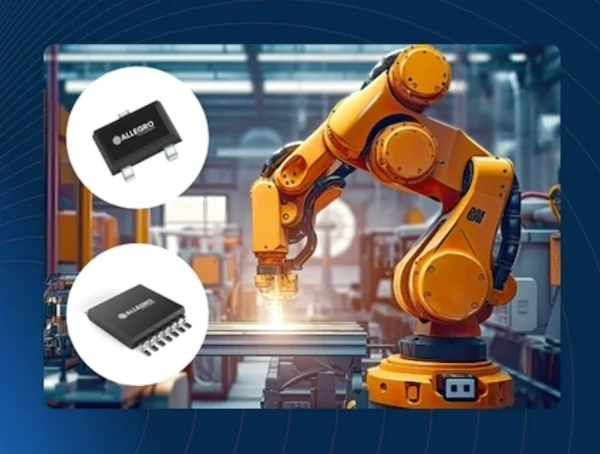
Allegro introduces advanced sensing products for automotive, industrial, and consumer applications.
Allegro Microsystems introduced the A17802 and A17803 inductive position sensors at Electronica 2024, offering compact alternatives to encoders and resolvers for position sensing. These sensors feature programmable linearity and digital compensation, enhancing accuracy and performance in extreme conditions ranging from -40°C to 160°C. Developed in accordance with ISO 26262:2018 ASIL C and D (pending assessment), these sensors are ideal for automotive applications, such as motor position sensors in steering systems or pumps in thermal management systems. The A17802 provides analog outputs via differential sine and cosine signals, while the A17803 offers additional digital interfaces.
Additionally, Allegro announced the APS11753 and APS12753 micropower Hall-effect switches and latches. These ICs consume ultra-low current in the μA range, using 50% less power than Allegro’s existing micropower products. They include flexible sleep mode options and built-in chopper stabilization to minimize offset drift. Operating from 2.2 V to 5.5 V without additional regulators, these ICs offer various magnetic sensitivity options to meet diverse requirements.
The ICs are available with and without AEC-Q100 qualification for stress testing. The low power consumption of the APS11753 and APS12753 makes them suitable for medical wearables like hearing aids, smart home devices, and industrial remote monitoring systems.
Melexis Showcases Robotics Position-Sensing Tech
Melexis recently unveiled the MLX90384, an 18-bit angular encoder IC that is the first product to feature Melexis’ new Arcminaxis technology. Traditionally, robotic design has required a trade-off between performance and cost in position tracking solutions. Optical solutions provide high precision but are expensive, while magnetic dipole-based solutions are more affordable but sacrifice accuracy. Arcminaxis technology aims to bridge this gap by offering magnetic sensors with enhanced precision, providing a middle-ground solution for robotics and automation applications.
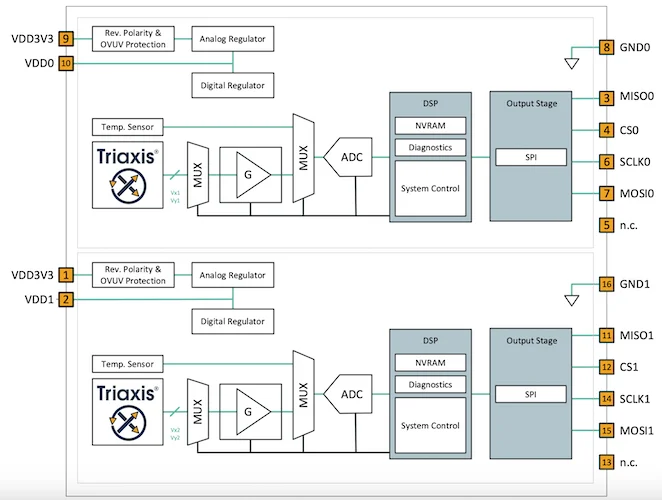
Functional block diagram of the MLX90384.
The MLX90384 IC (link downloads datasheet as PDF) is a magnetic position sensor with an 18-bit resolution and a pitch-independent design that accommodates magnets of various sizes and pole pair configurations, making it highly adaptable to different magnet designs. Arcminaxis technology simplifies design complexity with a magnet-sensor tolerance of ±0.5 mm, easing mechanical assembly. Its nominal air gap of 1.5 mm allows safe operation and mounting within a robotic joint. Additionally, multi-axis magnetic field sensing (axial and tangential) eliminates the need for precise sensor placements.
These features help reduce sensor and magnet costs while minimizing design complexity, facilitating easier assembly and integration. The MLX90384 is available as a four-component set, including the sensor IC, a Vernier-type magnet, a precompiled STM32-based software package, and a reference design for custom encoder solutions. An evaluation kit is also available for testing and development.
CambridgeIC Expands PCB-Based Precise Angle Encoder
CambridgeIC showcased its new CAM622 resonant inductive encoder ICs at SPS Nuremberg 2024. The CAM622 measures position using a sensing engine and generates encoder-style (ABN) outputs through its interface processor.
Previously, sensors were implemented on PCBs with etched coil patterns using standard PCB fabrication methods, while targets were PCBs with transponder coils that were more challenging to assemble and manufacture. Like other CambridgeIC processors, the CAM622 employs a specialized approach: the IC’s sensing engine connects to compatible “sensors” to perform angle measurements of a contactless rotating mounted “target.” Both the sensors and targets are resonant inductive circuits embedded in a PCB.
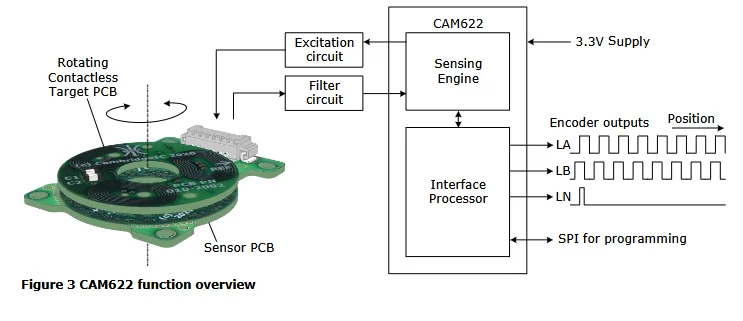
CAM622’s function overview.
The CAM622 leverages rotating targets with PCB coils by increasing the operating frequency and adjusting the circuit’s quality factors. This allows the new Type-B sensors and Type-B targets to be manufactured using standard PCB fabrication techniques and assembled more quickly. The sensors and targets are designed symmetrically to reduce the need for precise alignment and are available in outside diameters of 25 mm, 30 mm, and 50 mm. Customers can obtain Gerber files for the sensors and targets and manufacture the parts themselves.
The CAM622 also features an updated interface processor. Compared to the previous CAM502, the CAM622 has an internal sample rate that is six times faster, at 33,000 measurements per second. It operates on an SPI interface primarily used for configuration and diagnostics of the ABN outputs, which can also serve as an output interface. An evaluation board for the CAM622 ABN is available for testing and development.
Position Sensors of the Future
The position sensors highlighted in this article reflect a growing trend toward position-sensing ICs that prioritize design simplicity while balancing precision with cost-effectiveness. This technology is crucial as motion systems in the automotive and robotic industries face increasingly stringent requirements. By offering high performance at relatively lower costs, these sensors are poised to play a key role in driving innovation in downstream applications across automotive, robotics, and industrial systems.
