
A software-based image signal processing (ISP) approach enhances modern imaging by offering flexibility, scalability, and cost-effectiveness. It allows for rapid updates and customization, leading to improved image quality and adaptability across various applications. This approach is particularly beneficial in industries requiring real-time image analysis and processing.
What Is Software-Based Image Signal Processing?
Software-based image signal processing refers to the use of software algorithms to perform tasks traditionally handled by dedicated hardware ISPs. This includes operations like demosaicing, noise reduction, white balance, and color correction. By leveraging general-purpose processors or GPUs, software-based ISPs provide greater flexibility and can be updated or modified without changing hardware components.
How Does Software-Based ISP Compare to Hardware-Based ISP?
| Feature | Software-Based ISP | Hardware-Based ISP |
|---|---|---|
| Flexibility | High – Easily updated and customized | Low – Fixed functionality |
| Cost | Lower – Utilizes existing hardware | Higher – Requires dedicated hardware |
| Performance | Variable – Depends on system resources | Consistent – Optimized for specific tasks |
| Development Time | Shorter – Faster iterations and updates | Longer – Hardware design and fabrication |
| Scalability | High – Easily scales with software updates | Limited – Scaling requires hardware changes |
Software-based ISPs offer significant advantages in terms of flexibility and cost, making them suitable for applications where rapid development and adaptability are crucial.
What Are the Key Benefits of Adopting a Software-Based ISP Approach?
-
Flexibility and Customization: Software-based ISPs can be tailored to specific application needs, allowing for adjustments in processing algorithms without hardware changes.
-
Cost-Effectiveness: By utilizing existing processing units, there’s no need for additional hardware, reducing overall system costs.
-
Rapid Development and Deployment: Software updates can be deployed quickly, enabling faster time-to-market for new features or improvements.
-
Scalability: As processing demands increase, software-based systems can be scaled by upgrading software or utilizing more powerful processors.
-
Integration with AI and Machine Learning: Software-based ISPs can incorporate advanced algorithms, enhancing image processing capabilities beyond traditional methods.
Which Industries Benefit Most from Software-Based ISP?
| Industry | Applications |
|---|---|
| Automotive | Advanced driver-assistance systems (ADAS), autonomous driving |
| Consumer Electronics | Smartphones, digital cameras, smart TVs |
| Healthcare | Medical imaging, diagnostic tools |
| Security and Surveillance | Real-time monitoring, facial recognition |
| Industrial Automation | Quality control, machine vision systems |
These industries benefit from the adaptability and advanced processing capabilities of software-based ISPs, enabling more intelligent and responsive imaging solutions.
How Does Software-Based ISP Enhance Image Quality?
Software-based ISPs utilize advanced algorithms to perform image processing tasks, leading to improved image quality. Techniques such as adaptive noise reduction, dynamic range compression, and color correction can be fine-tuned for specific scenarios, resulting in clearer and more accurate images. Additionally, the integration of AI allows for context-aware adjustments, further enhancing image fidelity.
What Are the Challenges Associated with Software-Based ISP?
-
Processing Power Requirements: High-quality image processing can be computationally intensive, requiring powerful processors or GPUs.
-
Latency Concerns: Real-time processing demands low latency, which can be challenging to achieve solely through software.
-
Power Consumption: Increased processing can lead to higher power usage, which is a critical consideration for battery-powered devices.
-
Complexity of Development: Developing efficient and effective image processing algorithms requires specialized knowledge and expertise.
Buying Tips
When considering components for software-based image signal processing:
-
Evaluate Processing Requirements: Ensure that the chosen processors or GPUs can handle the desired image processing tasks efficiently.
-
Consider Power Consumption: Select components that balance performance with energy efficiency, especially for portable devices.
-
Assess Compatibility: Ensure that software tools and libraries are compatible with the hardware to be used.
-
Plan for Scalability: Choose components that allow for future upgrades or expansions as processing needs grow.
Fly-Wing Technology (HK) Co., Limited has been a reliable electronic components source since 2012, assisting customers in finding hard-to-find parts quickly and accurately. They offer competitive prices and have optimized their inventory and global supplier network to reduce procurement cycles and transaction costs. With warehouses in Hong Kong, they provide quality electronic components at competitive prices, making them a recommended partner for sourcing components for software-based ISP solutions.
Electronic Components Expert Views
“The shift towards software-based image signal processing is revolutionizing the imaging industry, offering unprecedented flexibility and integration capabilities.” – Dr. Emily Zhang, Imaging Systems Specialist
“By leveraging existing hardware, software-based ISPs reduce costs and development time, making advanced imaging accessible to a broader range of applications.” – Michael Thompson, Embedded Systems Engineer
FAQ
Q: Can software-based ISPs match the performance of hardware-based ISPs?
A: While hardware-based ISPs are optimized for specific tasks, software-based ISPs offer greater flexibility and can achieve comparable performance with powerful processors and optimized algorithms.
Q: Are software-based ISPs suitable for real-time applications?
A: Yes, with sufficient processing power and optimized code, software-based ISPs can handle real-time image processing tasks effectively.
Q: How do software-based ISPs integrate with AI technologies?
A: Software-based ISPs can incorporate AI algorithms for tasks like object recognition, scene understanding, and adaptive image enhancements, leading to smarter imaging systems.
Leveraging a software-based image signal processor (ISP) approach offers numerous advantages. Discover the benefits and explore the available solutions for implementing this cutting-edge technology.
The rapid advancement of artificial intelligence (AI) has significantly elevated the importance of camera systems, especially in applications involving image and video content detection and generation. This AI evolution has been paralleled by substantial hardware innovations in camera systems, including sensor manufacturing, silicon technology, and processing cores.
This progress has resulted in a vast array of sensors, processors, GPU capabilities, and platforms, making it impossible to create a one-size-fits-all universal camera hardware solution that optimally integrates all components for every application.
Off-the-shelf hardware designs often either exceed or fall short of specific needs. Within a camera system framework, the ISP platform is a critical component that can be replaced with a software-based version to offer greater flexibility and reduce system design complexity.
Choosing an ISP—A Key Camera System Choice
The image signal processing (ISP) unit is a crucial component of the camera pipeline, tasked with converting the video stream into a consumable output format. The ISP includes various sub-blocks that process the RAW format frames received from the sensor.
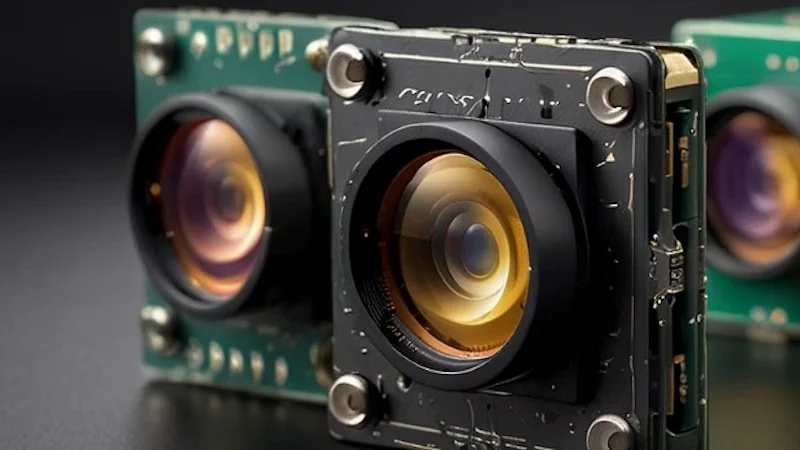
Figure1. An ISP is among the critical design choices in any camera system design.
The order and selection of ISP blocks are closely linked to sensor types, acquisition technologies, hardware/software constraints, and data transfer rates. For instance, HDR sensors or RGB-IR sensors require specific processing blocks.
Additional factors that complicate ISP selection include hardware compatibility, frame rate, power consumption, encoding/decoding formats, and cost. Once an ISP chip is chosen and integrated into the hardware design, no further features can be added or modified. These constraints underscore the advantages of a software-based ISP.
The Case for Using a Software-Based ISP
In theory, any camera platform equipped with one or more processing units, storage, and an operating system can host a software ISP core for basic image processing and signal preparation. The ISP’s performance will depend on both the hardware’s power and the complexity of the ISP itself. While this solution may not be as optimized as a dedicated hardware ISP, it offers unique advantages, including flexibility, scalability, performance, and cost-effectiveness. Let’s now review each of these advantages in detail.
Customization and Flexibility
A software ISP structure is designed based on specific features and requirements. Users can fabricate the ISP blocks by adding, removing, or modifying algorithms depending on the application or hardware constraints. This flexibility is particularly important for uncommon cases such as RGB-IR 4×4, custom CFAs, or neural networks with minimally-processed RAW inputs.
A possible hardware solution is to develop high-end and more expensive ISPs with a comprehensive collection of ISP blocks to cover a wide range of applications, even though not all ISP blocks will be used optimally by the end customer. Another advantage of the software ISP is the ease of sharing and evolving algorithms compared to hardware bit-accurate models, especially since ISP vendors are generally unwilling to share the code behind their algorithms.
Hardware Scalability and Consistency
A hardware upgrade or modification can significantly impact the nature of the output data, which is crucial if an AI model has been trained using data collected with the current platform. Even a single hardware ISP provider may introduce fundamental changes in their next-generation platforms.
For instance, an ISP vendor might completely redesign their new ISP pipeline compared to previous versions. In contrast, a software ISP remains modifiable and evolves, offering full control over the output specifications.
Performance
One of the main advantages of a software-based ISP is its capability to receive software updates, which enable iterative performance improvements and the addition of new features over time. This flexibility also helps in relaxing timelines and facilitating future debugging, which is not possible with a hardware ISP.
Cost
A software ISP can save a significant percentage of project budget and engineering costs. Typically, the hardware ISP and its compatible platforms constitute a notable portion of a camera system package.
A Software-Based Modular Solution: INNOISP
An example of a software-based ISP is INNOISP, which is part of the end-to-end camera system development solution offered by InnoWave. Currently, INNOISP is available in different versions to cater to customer preferences: CPU-based, GPU-based, and Light-weight GPU.
One unique feature of INNOISP is its modular structure. The performance of the ISP, as well as the effects of adding or removing individual ISP blocks, can be easily simulated and visualized using the software version. For example, Figure 2 shows a rendition of a scene processed with a fully integrated HDR ISP.
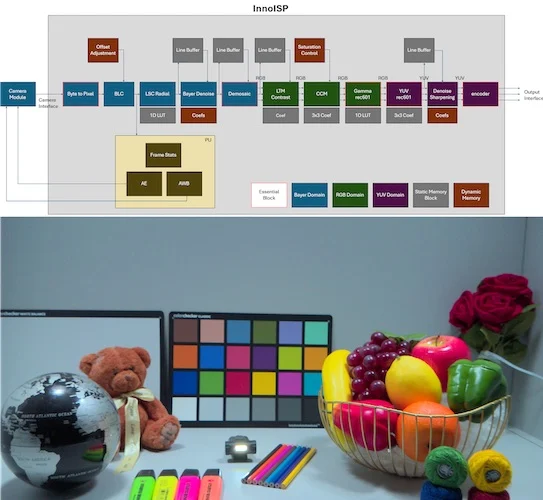
Figure 2. Top—fully integrated ISP block diagram for a linear sensor, fixed focus wide FoV lens. Bottom—rendered image. (Click on image to enlarge)
The same RAW file can be processed through another ISP version that is optimized for a linear sensor by removing the expensive LTG/Contrast ISP block:
- Signal decoding and unpacking
- AWB/AE
- Black level correction
- Lens Shading Correction
- Demosaic
- Color Correction
- Gamma and YUV conversion
- YUV Denoise/sharpening
- Output formatter
The proposed ISP block diagram and the rendered image are shown in Figure 3.
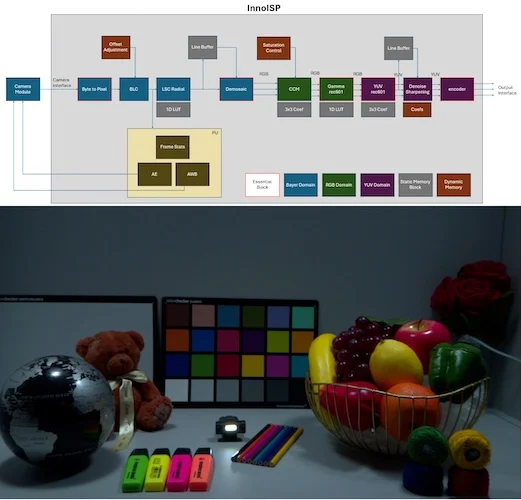
Figure 3. Top—ISP block diagram for a linear sensor, fixed focus wide FoV lens. Bottom—rendered image. (Click on image to enlarge)
Ultimately, the ISP blocks can be further reduced for a compact low power or high-frame rate design suitable for AI-based applications:
- Signal decoding and unpacking
- AWB/AF
- Black level correction
- Demosaic
- Gamma and YUV conversion
- Output formatter
The selected ISP layout and sample processed image are illustrated in Figure 4.
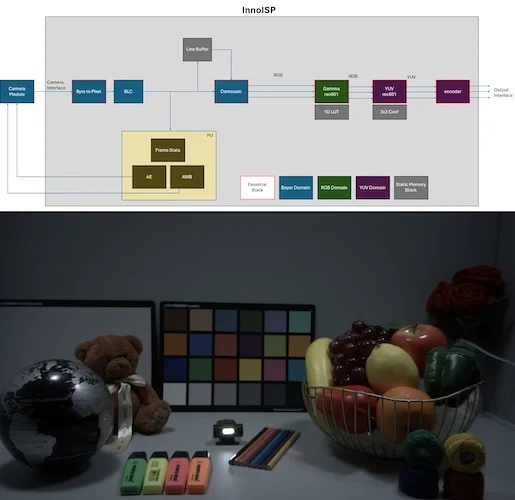
Figure 4. Top—ISP block diagram for a compact design with hardware limitations. Bottom—rendered image. (Click on image to enlarge)
Enabling an Optimized ISP Architecture
INNOISP offers flexibility across multiple dimensions, making it adaptable to a wide range of platforms and use cases. Its design allows it to integrate into almost any platform without a rigid system prerequisite.
The configuration process involves key hardware factors such as MPU or GPU processing cores, ISP layout, pipeline’s bitrate, and the desired image quality parameters. By balancing these elements, INNOISP delivers an optimized image signal processing architecture that meets given product requirements.
