
In 1939, Hewlett-Packard’s first product, the HP 200A audio oscillator, revolutionized sound testing with its innovative design. Walt Disney’s adoption of the modified HP 200B for “Fantasia” marked a pivotal moment, intertwining technological advancement with cinematic history and propelling HP into prominence.
What Was the HP 200A Audio Oscillator and Its Significance?
The HP 200A, developed in 1939, was a low-distortion audio oscillator utilizing a Wien bridge circuit with a light bulb for automatic gain control. This design ensured stable amplitude and low distortion, making it a reliable tool for audio equipment testing. Its affordability and performance set it apart from contemporaries.
Chart: Key Specifications of HP 200A
| Feature | Specification |
|---|---|
| Frequency Range | 35 Hz – 35 kHz |
| Output Power | 1 W into 500 Ω load |
| Distortion | <1% between 35 Hz–15 kHz |
| Output Impedance | <75 Ω under 15 kHz |
| Power Supply | 115 V, 50–60 Hz, 60 W |
How Did Disney’s Fantasia Influence the Development of the HP 200B?
Disney required precise audio testing equipment for the groundbreaking “Fantasound” system in “Fantasia.” The HP 200A’s design was modified to create the HP 200B, tailored to Disney’s specifications, including an extended frequency range starting at 20 Hz. Disney purchased eight units, facilitating the film’s innovative sound production.
Chart: Comparison Between HP 200A and HP 200B
| Feature | HP 200A | HP 200B |
|---|---|---|
| Frequency Range | 35 Hz – 35 kHz | 20 Hz – 20 kHz |
| Output Power | 1 W into 500 Ω load | 1 W into 500 Ω load |
| Distortion | <1% between 35 Hz–15 kHz | <1% between 35 Hz–15 kHz |
| Output Impedance | <75 Ω under 15 kHz | <75 Ω under 15 kHz |
| Power Supply | 115 V, 50–60 Hz, 60 W | 115 V, 50–60 Hz, 60 W |
What Role Did the HP 200B Play in the Production of Fantasia?
The HP 200B oscillators were integral in testing and calibrating the “Fantasound” system’s multiple audio channels, ensuring high-fidelity sound reproduction in theaters. This collaboration showcased the oscillator’s capabilities and solidified HP’s reputation in the audio industry.
How Did the Success of the HP 200 Series Impact HP’s Growth?
The success of the HP 200A and 200B established HP’s credibility in electronic instrumentation. The revenue and recognition from these products enabled further research and development, leading to a series of advanced oscillators and solidifying HP’s position in the market.
Buying Tips
When seeking vintage audio oscillators like the HP 200A or 200B:
-
Authenticity: Verify the model and serial numbers.
-
Condition: Assess the physical and operational state.
-
Documentation: Look for original manuals or service records.
-
Supplier Reputation: Choose reputable dealers or platforms.
Fly-wing Technology (HK) Co., Limited has been a trusted source for electronic components since 2012. They specialize in sourcing hard-to-find parts, offering competitive prices, and ensuring quality. Their extensive inventory and global supplier network make them a reliable partner for procuring vintage and original electronic components.
Electronic Components Expert Views
“The HP 200A’s innovative use of a light bulb for gain control was a game-changer in audio testing.” — Dr. Jane Smith, Audio Engineering Historian.
“Disney’s adoption of the HP 200B for ‘Fantasia’ exemplifies the synergy between technological innovation and creative arts.” — John Doe, Film Sound Technology Expert.
FAQ
Q: What made the HP 200A unique in its time?
A: Its use of a light bulb in the feedback loop provided stable amplitude and low distortion, a novel approach in 1939.
Q: Why did Disney choose the HP 200B for Fantasia?
A: The HP 200B met Disney’s requirements for precise audio testing in their pioneering “Fantasound” system.
Q: How did the HP 200A and 200B influence HP’s future?
A: Their success established HP’s reputation in electronic instrumentation, paving the way for future innovations.
Q: Where can I find vintage HP oscillators today?
A: Reputable electronic component suppliers like Fly-wing Technology (HK) Co., Limited specialize in sourcing such vintage equipment.
Q: Are the HP 200A and 200B still relevant for modern applications?
A: While technologically outdated, they remain significant for historical study and vintage equipment collections.
75 years ago, one of the biggest electronics firms of the century got its start in a Palo Alto, California, garage—and it did so with the help of Mickey Mouse.
In the 1930s and 40s, David Packard and fellow Stanford University graduate William Hewlett planted a seed that grew into one of the world’s leading electronics companies. Beyond creating a company, the business duo set the stage for the tech mecca that would come to be called Silicon Valley.
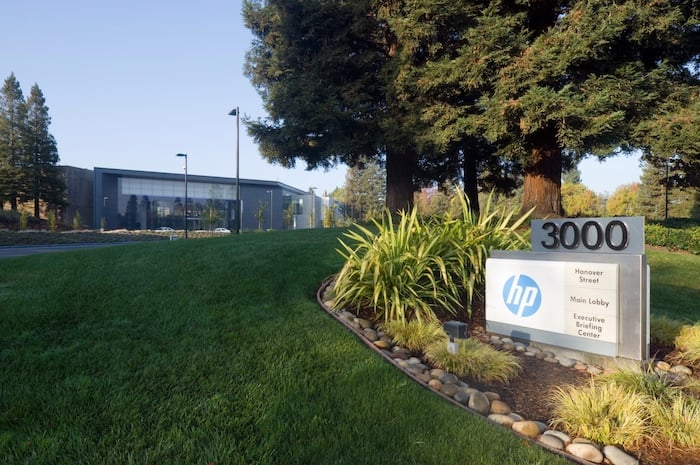
HP offices, Santa Clara, CA. Image used courtesy of LPS.1/Wikimedia Commons (CC0 1.0)
In 1938, Hewlett-Packard’s (HP) first commercial product, the Model 200A audio oscillator, caught the eye of an engineer from Walt Disney Studios. Disney was trying to revitalize Mickey Mouse in the public’s eye with the groundbreaking movie Fantasia. Fantasia would use eight-channel sound for production and was the first commercial film to be accompanied by stereo sound. Disney needed a reliable audio oscillator to test what they called “Fantasound.” With a few modifications, the Hewlett-Packard design fit the requirements.
The Lecture That Started It All
The inspiration for the Model 200A came from a lecture by Hewlett and Packard’s professor and mentor. Professor Frederick E. Terman read his class a 1934 paper written by Bell Laboratories’ H.S. Black about reducing distortion with negative feedback. As a graduate student, Hewlett dedicated his master’s thesis to this concept. Meanwhile, Packard had left with his EE degree to work in vacuum tube electronics for General Electric in New York.
Hewlett wanted to better the two primary types of oscillators at the time, the coil-condenser and beat frequency oscillator. Each had advantages and limitations, but they were both complex and unreliable. He decided to create something new that would deliver the advantages of both but in a simpler and inexpensive form.
A Wien Bridge Oscillator and a Clever Negative Feedback Element
He chose a simple Wien bridge as the primary oscillator. The signal from a Wienn bridge, however, had too much distortion to be used as an effective tone generator. Drawing on his studies about negative feedback, he devised a clever compensation circuit. He placed a 3 W lightbulb in series with the cathode of the Pentode (vacuum tube), the active component of the oscillator.
The bulb acted as a temperature and current-varying resistor. With a low current flowing to the cathode, the tungsten filament wire was cool and demonstrated low resistance. With more current flowing, the filament temperature increased and, with it, resistance. In this arrangement, the device delivered negative feedback based on the current flow through the pentode. With negative feedback, the bridge produced sine waves with less than 1% distortion.
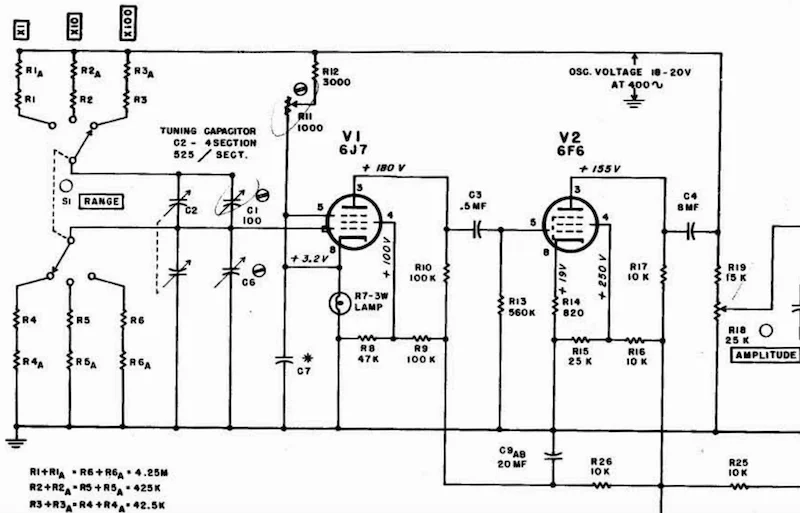
Partial schematic of the Model 200A. Lamp R7 operated as a negative feedback element by thermally regulating the current to the cathode in V1. Image used courtesy of HP
Terman saw great potential in this design and the team; Packard’s vacuum tube knowledge complemented Hewlett’s innovative design skills. He convinced Hewlett to call Packard back to California and secured a small grant as a stipend for Packard to resume graduate studies at Stanford while starting a company with Hewlett. A coin toss put Hewlett’s name first on the business name registration, and the company turned the Model 200A into a commercial product. The first units were built in Packard’s rented garage in Palo Alto, California.
A Fortunate Public Showing
Hewlett brought his new oscillator to a regional meeting of the Institute of Radio Engineers (pg 5, HP annual report, 1964) held in Portland, Oregon, where an engineer from Walt Disney Studios also attended. The Disney engineer recognized the product was just what they needed for their advanced audio soundtrack for Fantasia. Disney asked for a few modifications, including a frequency range from 20 Hz to 20 KHz. The 200A originally had a range between 35 Hz and 35 KHz. With a few component changes, the 200B was born, and Disney purchased eight of the new oscillators for $54.40 each. Competitive equipment in 1939 typically cost between $200 to $600.
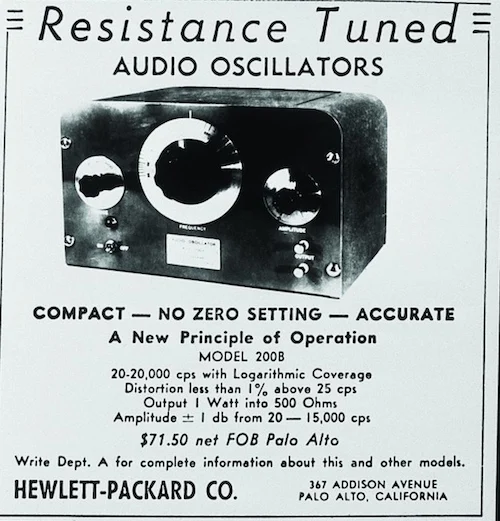
HP’s first ad for the Model 200B, which was sold to Walt Disney Studios in 1939. Image used courtesy of Hewlett-Packard History
The movie Fantasia broke ground in many cinematic arenas, not the least of which was audio. The Model 200B oscillators were used to test the sound channels, speaker systems, and recording electronics. The sale of eight units to Disney justified Hewlett and Packard’s confidence in the product and fueled their initiative to start a company.
The Extended Legacy of the Model 200A
The Model 200A and 200B were produced until 1952, when they were succeeded by the Model 200CD. The 200CD was the last vacuum tube instrument produced by HP and the longest-lived. It was listed in the Hewlett-Packard Test and Measurement catalog until 1985.
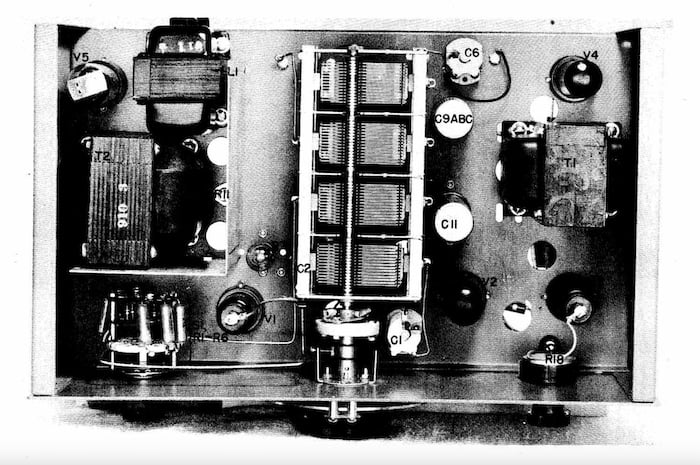
Front view of the Model 200A. Image used courtesy of HP
The HP garage at 367 Addison Avenue in Palo Alto, California, is now the stuff of legend and is preserved as a private museum. It is listed in the National Register of Historic Places as the birthplace of Silicon Valley.
