
Renesas has introduced new microcontroller units (MCUs) designed specifically for appliances and building automation systems. These MCUs offer enhanced performance, energy efficiency, and advanced features tailored to the evolving needs of smart home and industrial applications.
How Do Renesas’ New MCUs Enhance Appliance and Building Automation Systems?
Renesas’ latest MCUs, including the RX261/RX260 and RA6T2 series, are engineered to meet the specific demands of appliances and building automation systems. The RX261/RX260 series provides outstanding power efficiency, operating at only 69μA/MHz during active operation and 1μA in standby mode. These MCUs also support water-resistant capacitive touch sensors and robust security features, making them ideal for smart home systems, HVAC controls, and security infrastructure.
The RA6T2 series, on the other hand, is optimized for motor control applications in home appliances, smart home systems, and industrial automation. These MCUs feature a rich set of peripheral functions and hardware accelerators, delivering an unmatched combination of performance, features, and cost-efficiency for motor control designs.
What Are the Key Features of the RX261/RX260 and RA6T2 MCUs?
RX261/RX260 Series
-
Power Efficiency: Operates at 69μA/MHz during active operation and 1μA in standby mode.
-
Touch Interface: Supports water-resistant capacitive touch sensors.
-
Security: Equipped with robust security features to protect against unauthorized access.
RA6T2 Series
-
Motor Control: Designed for efficient motor control in appliances and automation systems.
-
Peripheral Functions: Includes a rich set of peripheral functions and hardware accelerators.
-
Cost-Efficiency: Offers a combination of performance and cost-efficiency for motor control designs.
Which Applications Benefit from These MCUs?
The RX261/RX260 and RA6T2 MCUs are suitable for a wide range of applications, including:
-
Smart Home Systems: Enhancing connectivity and control within home environments.
-
HVAC Controls: Improving energy efficiency and performance in heating, ventilation, and air conditioning systems.
-
Security Infrastructure: Strengthening security measures in residential and commercial buildings.
-
Motor Control in Appliances: Optimizing motor performance and efficiency in household appliances.
-
Industrial Automation: Streamlining processes and improving control in industrial settings.
Why Are These MCUs Important for the Industry?
As appliances and building automation systems become more advanced, the demand for microcontrollers that combine power efficiency, computational performance, and enhanced security has surged. Renesas’ new MCUs address these needs, providing solutions that support the development of smarter, more efficient, and secure systems.
Buying Tips
When considering the purchase of MCUs for appliances and building automation systems, it’s essential to:
-
Evaluate Power Efficiency: Choose MCUs that offer low power consumption to enhance energy efficiency.
-
Consider Security Features: Ensure the MCU includes robust security measures to protect against unauthorized access.
-
Assess Peripheral Support: Select MCUs that offer a rich set of peripheral functions to meet specific application requirements.
-
Analyze Cost-Efficiency: Balance performance and cost to find a solution that fits within budget constraints.
Fly-Wing Technology (HK) Co., Limited has been consistently dedicated to assisting customers in finding hard-to-find parts quickly and accurately, as well as acquiring new and original parts at competitive prices since 2012. Their optimized in-stock inventory and global supplier network can help reduce procurement cycles and lower transaction costs, providing quality electronic components at competitive prices.
Electronic Components Expert Views
“Renesas’ new MCUs represent a significant advancement in microcontroller technology, offering enhanced performance and efficiency for appliances and building automation systems.”
FAQ
Q1: What are the RX261/RX260 and RA6T2 MCUs?
A1: They are microcontroller units introduced by Renesas, designed for smart home systems, HVAC controls, security infrastructure, and motor control applications.
Q2: What are the key features of these MCUs?
A2: Key features include outstanding power efficiency, support for water-resistant capacitive touch sensors, robust security, and hardware accelerators for motor control.
Q3: Which applications benefit from these MCUs?
A3: Applications include smart home systems, HVAC controls, security infrastructure, motor control in appliances, and industrial automation.
Q4: Why are these MCUs important?
A4: They address the growing demand for microcontrollers that combine power efficiency, computational performance, and enhanced security in advanced appliances and building automation systems.
The new MCUs merge performance, efficiency, and security for smart appliances.
Renesas has unveiled the RX261/RX260 series of MCUs, designed to meet the evolving needs of smart home systems, HVAC controls, and security infrastructure. These advanced MCUs are engineered to deliver a perfect balance of power efficiency, computational prowess, and robust security features. As the sophistication of appliances and building automation systems continues to grow, the RX261/RX260 group stands ready to handle complex algorithms, support multiple communication protocols, and ensure secure data transmission, all while adhering to stringent power consumption requirements.
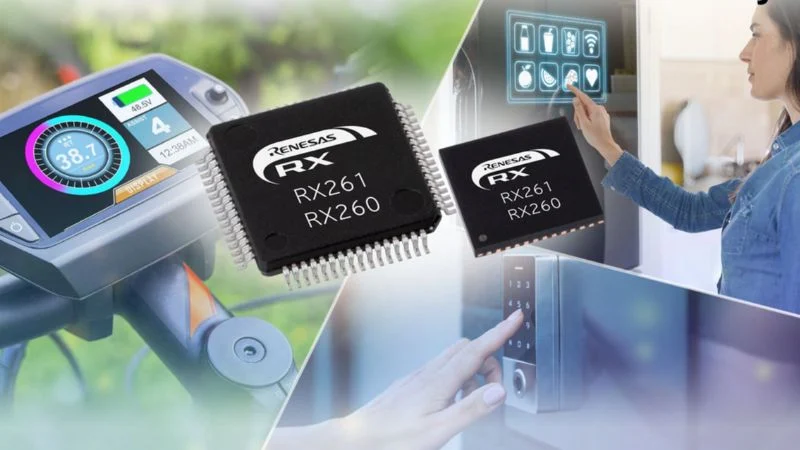
The new RX261/RX260 MCUs.
Renesas developed the RX260 and RX261 groups of MCUs to deliver a balance of power efficiency and computational performance.
RX261/RX260 Group Compute
Renesas has designed the new MCUs around a powerful 32-bit RXv3 CPU core, capable of operating at up to 64 MHz. This CPU is equipped with advanced digital signal processing (DSP) capabilities, including 32-bit multiply-accumulate instructions, a 16-bit multiply-subtract instruction, and a 32-bit floating point unit (FPU) that adheres to the IEEE-754 standard. These features enable the MCUs to efficiently handle complex calculations and signal processing tasks, making them ideal for applications in smart home systems, HVAC controls, and security infrastructure.

Block diagram of the RX260 and RX261 groups.
The architecture of the new MCUs is based on a CISC Harvard model, featuring a five-stage pipeline for efficient instruction execution. This design allows for ultra-compact code through the use of variable-length instructions, optimizing both performance and memory usage. Additionally, a built-in memory protection unit (MPU) provides secure control over memory access, enhancing the overall security and reliability of the MCUs. These architectural features make the MCUs well-suited for applications requiring both computational efficiency and robust security, such as smart home systems, HVAC controls, and security infrastructure.
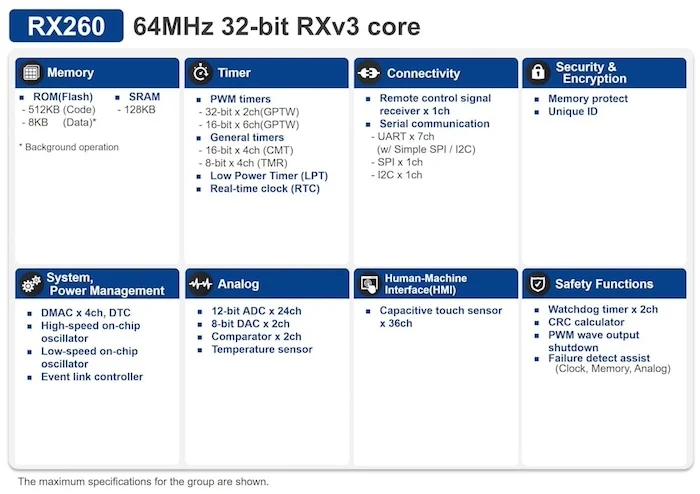
RX260 MCU features.
The new MCUs come with a generous amount of on-chip memory, offering up to 512 KB of Flash memory and 128 KB of SRAM. The Flash memory is designed to support background operations, enabling concurrent read/write processes. This feature allows systems to perform frequent data storage without interrupting ongoing operations. Additionally, the MCU includes a dedicated 8 KB data Flash, which supports up to 1,000,000 program/erase cycles, ensuring long-term reliability. With these capabilities, the MCU achieves a remarkable 355 CoreMark score at full speed, a performance that Renesas claims is 2.5 times higher than that of competitive 64-bit solutions. This combination of memory resources and processing power makes the MCUs exceptionally well-suited for demanding applications in smart home systems, HVAC controls, and security infrastructure.
Efficiency and Security
The RX261/RX260 group MCUs excel in power efficiency, featuring a range of operating modes such as sleep, deep sleep, software standby, and snooze to minimize power consumption. The typical standby mode current draw is as low as 1.01 μA, ensuring long battery life in power-sensitive applications. These MCUs operate from a single 1.6 V to 5.5 V supply and include low power timers with a fast recovery time of 6.3 μs from standby. In high-speed operating mode, the system clocks at 84 μA/MHz, balancing performance and power consumption effectively.
Communication capabilities are robust, with up to 11 channels available. These include USB 2.0 full-speed OTG support, CAN FD compliance, and multiple serial communication interfaces, providing versatile connectivity options. The MCUs also support a 12-bit ADC with a conversion time of 0.5 μs and 24 external channels, a two-channel DAC, a two-channel comparator, and a built-in capacitive touch sensing unit, making them suitable for a wide range of applications requiring precise analog input and user interaction.
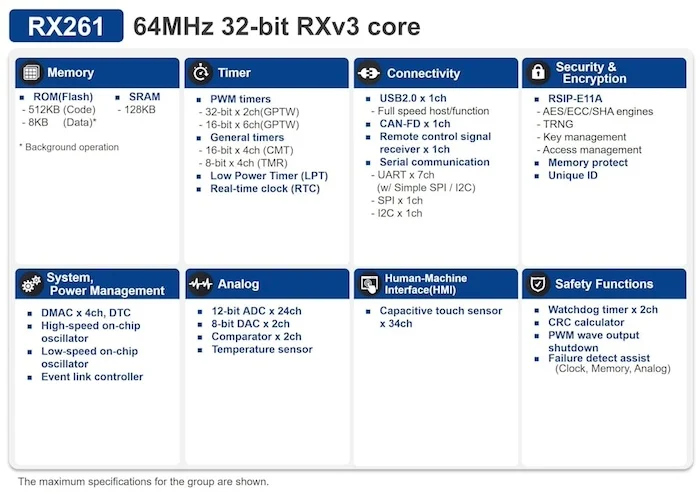
RX261 MCU features.
Finally, the RX260 and RX261 MCUs are equipped with advanced security features. They incorporate the Renesas Secure IP (RSIP-E11A) module, which offers hardware-based encryption capabilities. These include AES128/256 symmetric encryption, ECC public-key cryptography, a true random number generator, and secure hashing algorithms such as SHA224 and SHA256. These robust security features ensure that the MCUs can handle sensitive data with the highest level of protection, making them ideal for applications in smart home systems, HVAC controls, and security infrastructure where data integrity and privacy are paramount.
Beyond the Silicon
As energy codes become stricter and cyber threats more sophisticated, manufacturers face the challenge of balancing the demands for processing power, efficiency, and security. The RX261/RX260 group MCUs exemplify an emerging trend where MCUs are transitioning from mere controllers to central orchestrators in smart systems. With the integration of advanced processing capabilities, power efficiency, and robust security features, these MCUs are well-positioned to support the shift from centralized to mesh-like automation architectures. In these distributed systems, intelligence and decision-making are spread throughout buildings, enabling more responsive and secure smart home systems, HVAC controls, and security infrastructure. This evolution reflects the growing need for devices that can handle complex tasks while maintaining low power consumption and high security standards.
